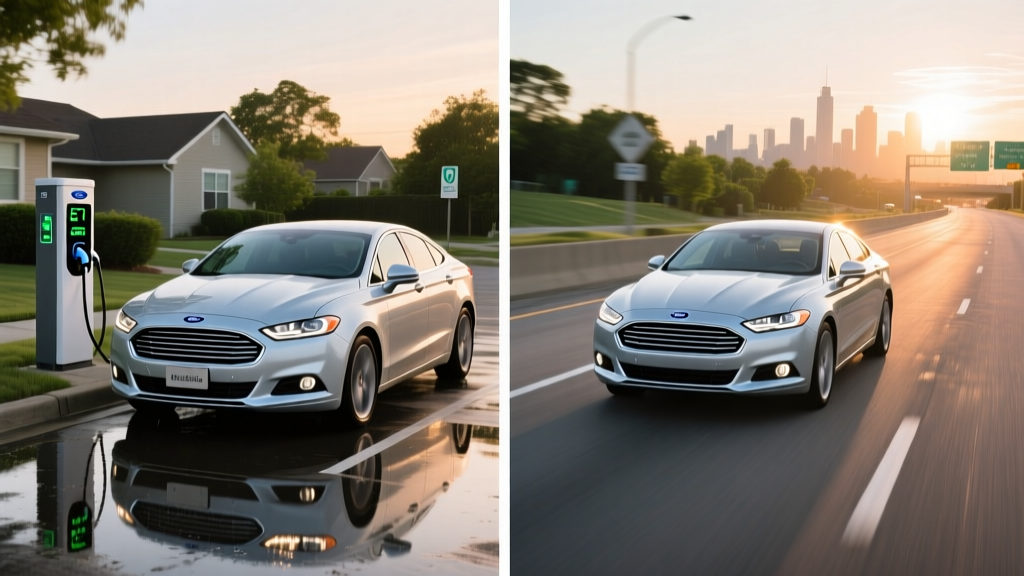
The Ford Fusion Hybrid built a reputation as one of the most fuel-efficient midsize sedans ever sold in the United States. Even though Ford discontinued the Fusion after the 2020 model year, thousands remain on the road and in the used-car market, and its mileage figures still compete with current hybrid offerings. If you're researching the mileage for Ford Fusion Hybrid models — whether you own one, are shopping the used market, or are benchmarking against newer hybrids — this guide covers every number that matters.
Below we break down EPA-rated MPG for both the conventional Fusion Hybrid (HEV) and the Fusion Energi plug-in hybrid (PHEV), compare real-world fuel economy against the sticker, examine battery longevity and warranty coverage, and help you decide whether a Fusion Hybrid, a modern PHEV, or a full battery-electric vehicle (BEV) fits your driving needs in 2026.
Ford Fusion Hybrid MPG: EPA Ratings by Model Year
The Fusion Hybrid went through two distinct generations with meaningfully different fuel economy. Ford also offered the Fusion Energi, a plug-in hybrid variant with electric-only range. Here is the EPA data as published on fueleconomy.gov:
| Model Years | Variant | City MPG | Highway MPG | Combined MPG | MPGe (PHEV) |
|---|---|---|---|---|---|
| 2013–2014 | Hybrid (HEV) | 44 | 41 | 42 | — |
| 2015–2017 | Hybrid (HEV) | 44 | 41 | 42 | — |
| 2017–2020 | Hybrid (HEV) | 43 | 41 | 42 | — |
| 2013–2014 | Energi (PHEV) | — | — | — | 100 MPGe |
| 2015–2016 | Energi (PHEV) | — | — | — | 107 MPGe |
| 2017–2020 | Energi (PHEV) | — | — | — | 103 MPGe |
The conventional Fusion Hybrid's 42 MPG combined is impressive by any standard. The 2017 refresh slightly reduced the city figure from 44 to 43 MPG due to revised EPA testing procedures, not a mechanical change. For context, the 2026 Toyota Camry Hybrid achieves up to 51 MPG combined — showing how far the segment has advanced in six years.
Real-World MPG vs. EPA: What Owners Actually Report
EPA figures are measured under controlled laboratory conditions. Real-world mileage for the Ford Fusion Hybrid depends heavily on driving style, climate, and route profile.
- City / stop-and-go: 40–45 MPG (hybrids often meet or beat EPA city ratings in traffic because regenerative braking recovers energy)
- Highway (70+ mph): 35–39 MPG (aerodynamic drag and sustained engine operation reduce the hybrid advantage)
- Mixed commute: 38–42 MPG
- Cold weather (below 32°F): Expect a 5–10% reduction, roughly 36–39 MPG combined, as the engine runs more often for cabin heat
Data from owner-reported sources like Fuelly consistently show Fusion Hybrid drivers averaging between 38 and 42 MPG over tens of thousands of miles. Drivers who accelerate gently and allow regenerative braking to do most of the deceleration work regularly report mid-40s figures in urban driving. Lead-footed highway driving at 80 mph, however, can drop the number into the low-to-mid 30s.
The hybrid system's Atkinson-cycle 2.0-liter four-cylinder engine prioritizes efficiency over power. When you demand full acceleration, fuel consumption spikes noticeably. The real efficiency payoff comes from anticipating stops and coasting — the Fusion's regenerative braking system can recover significant energy that a conventional sedan would waste as brake heat.
Fusion Hybrid vs. Fusion Energi: HEV and PHEV Compared
Ford sold the Fusion in two electrified flavors, and confusing them is a common buyer mistake. Here's the distinction:
| Attribute | Fusion Hybrid (HEV) | Fusion Energi (PHEV) |
|---|---|---|
| Plug-in charging required? | No — self-charging via engine and regen | Yes — plug in to use electric-only range |
| Battery capacity (usable) | ~1.4 kWh (Li-ion) | 7.6 kWh (2017+); ~6.5 kWh (pre-2017) |
| Electric-only range | N/A (motor assists engine) | 21 miles (2017+ EPA); ~19 miles (pre-2017) |
| Combined range (full tank + charge) | ~620 miles | ~610 miles (21 electric + ~590 gas) |
| Combined MPG / MPGe | 42 MPG | 103 MPGe (electric) / 42 MPG (gas-only) |
| Level 2 charge time (240V) | N/A | ~2.5 hours (3.3 kW onboard charger) |
| DC fast charging | N/A | Not supported |
| Combined horsepower | 188 hp | 188 hp |
| 0–60 mph | ~8.4 seconds | ~8.7 seconds (heavier battery) |
| Cargo volume | 12.0 cu ft | 8.2 cu ft (battery intrudes into trunk) |
The Fusion Energi's 7.6 kWh battery (2017 and later) delivers 21 miles of electric-only driving — enough for short commutes without burning a drop of gasoline. On a Level 2 home charger at 240 volts, the battery replenishes in about 2.5 hours via the 3.3 kW onboard charger. The Energi does not support DC fast charging, which is typical for PHEVs of this era.
The trade-off is trunk space: the Energi's larger battery reduces cargo volume from 12.0 cubic feet to just 8.2 cubic feet — a significant compromise for a midsize sedan. If you regularly carry luggage or groceries, the conventional Hybrid's full trunk is a practical advantage.
Powertrain and Performance Specifications
| Engine | 2.0L Atkinson-cycle I-4 |
| Engine horsepower | 141 hp @ 6,000 rpm |
| Electric motor output | 88 kW (118 hp) |
| Combined net horsepower | 188 hp |
| Combined net torque | 129 lb-ft (engine) + electric motor torque |
| Transmission | eCVT (planetary gearset, not a belt CVT) |
| Drivetrain | Front-wheel drive |
| Fuel tank capacity | 13.5 gallons |
| Battery chemistry | Lithium-ion (NMC) |
| Battery capacity (HEV) | 1.4 kWh usable |
| Battery capacity (Energi PHEV) | 7.6 kWh usable (2017+) |
| Curb weight (Hybrid) | ~3,472 lbs |
| Curb weight (Energi) | ~3,918 lbs |
Ford's hybrid powertrain uses an electronically controlled continuously variable transmission (eCVT). Unlike the rubber-belt CVTs found in some competitors, Ford's eCVT is a planetary gearset that mechanically blends engine and motor power. This design is inherently robust — there is no belt to wear or slip, which contributes to the powertrain's long-term reliability.
The 188 combined horsepower is adequate for commuting and highway merging, but the Fusion Hybrid is not a performance sedan. Expect 0–60 mph times in the mid-8-second range. The electric motor's instant torque provides responsive launches from stops, which makes the car feel quicker in city driving than the 0–60 number suggests.
Battery Longevity, Warranty, and Replacement Cost
- Hybrid battery warranty (original): 8 years / 100,000 miles (10 years / 150,000 miles in CARB states including CA, CT, ME, MA, NJ, NY, OR, RI, VT, WA)
- Warranty capacity threshold: Battery must fall below approximately 60–70% of original capacity for a warranty claim
- Powertrain warranty: 5 years / 60,000 miles
Battery degradation is the top concern for used-hybrid buyers, and it's worth addressing with data. The Fusion Hybrid's 1.4 kWh lithium-ion battery is small and operates within a narrow state-of-charge window — the hybrid control system never fully charges or fully depletes it. This shallow-cycling strategy dramatically extends cell life.
Real-world evidence supports this engineering approach. Taxi fleets running Ford Fusion Hybrids have logged 200,000+ miles on original batteries with minimal capacity loss. For the Fusion Energi PHEV, the larger 7.6 kWh battery sees deeper cycling, so some degradation is expected — owners at 100,000+ miles report a modest reduction in electric-only range (perhaps 17–18 miles instead of the original 21), but catastrophic failures are uncommon.
If the battery does need replacement out of warranty, here is what to budget:
- Fusion Hybrid (HEV) battery replacement: $2,000–$4,000 (remanufactured unit installed)
- Fusion Energi (PHEV) battery replacement: $4,000–$7,000 (larger pack, higher parts cost)
- Dealer OEM new battery: Can exceed $6,000–$8,000 for the Energi
Independent hybrid specialists and remanufactured battery suppliers have driven aftermarket replacement costs down significantly. In most cases, a remanufactured battery restores the vehicle to near-original performance at a fraction of the OEM dealer price.
Tax Credits and Incentives (2026 Update)
The Fusion Hybrid and Fusion Energi were discontinued after the 2020 model year, which means they are only available as used vehicles in 2026. Here is the current incentive landscape:
- Federal §30D New Vehicle Credit: Not applicable — these are no longer sold new.
- Federal §25E Used Clean Vehicle Credit: The used Fusion Energi (PHEV) may qualify for up to $4,000 (30% of sale price, capped at $4,000) under the IRS used-EV credit, provided the vehicle sells for $25,000 or less, the buyer meets income caps ($75,000 single / $150,000 joint), and the sale is processed through a registered dealer. The conventional Fusion Hybrid (HEV) does not qualify for §25E — it is not a plug-in vehicle. Verify current rules at IRS.gov.
- State incentives: Some states offer rebates for used PHEVs or HOV-lane access stickers. California's CVRP program and New York's Drive Clean Rebate have varying eligibility — check your state's energy office for current programs.
The key takeaway: only the Fusion Energi PHEV is potentially eligible for a federal tax credit on the used market, and only under specific income and pricing conditions. The conventional Hybrid offers no federal incentive, which is worth factoring into your purchase math.
Fusion Hybrid vs. Modern Alternatives: HEV, PHEV, or BEV?
If you're weighing a used Fusion Hybrid against newer options, here is a decision framework:
- You want a proven, low-cost entry into hybrid ownership ($10,000–$16,000 used)
- You lack access to home or workplace charging
- Your commute is mixed city/highway and under 50 miles daily
- You want a full-size trunk without battery intrusion
- You prefer no plug-in routine or range planning
- You have home Level 2 charging and a short commute (25–45 miles)
- You want to drive mostly electric daily with gas backup for road trips
- You want current-model safety tech, warranty, and available §30D credits
- You're willing to pay $30,000–$42,000 new
- You have reliable home charging and rarely drive 300+ miles in a single day
- You want zero tailpipe emissions and minimal maintenance (no oil changes, no engine)
- You want to maximize fuel cost savings ($0.04–$0.06/mile on home electricity vs. $0.12–$0.15/mile on gas)
- You qualify for the full $7,500 §30D credit on eligible new models
- You drive very low annual miles (<5,000/year) where fuel savings don't offset a hybrid premium
- You live in an area with no hybrid service infrastructure
- Upfront budget is extremely constrained (sub-$8,000)
The Fusion Hybrid's 42 MPG combined still delivers meaningful savings over a comparable gas-only midsize sedan (typically 28–32 MPG combined). At 15,000 miles per year and $3.40/gallon, the Fusion Hybrid saves roughly $600–$800 annually in fuel compared to a 30 MPG gas sedan. Over five years of ownership, that's $3,000–$4,000 in fuel savings — often enough to cover the used-car price premium over a non-hybrid Fusion.
Frequently Asked Questions
How many MPG does the Ford Fusion Hybrid get?
The EPA rates the 2017–2020 Ford Fusion Hybrid at 43 city / 41 highway / 42 combined MPG. Earlier 2013–2016 models are rated at 44 city / 41 highway / 42 combined. Real-world mixed driving typically yields 38–42 MPG, with city-heavy routes sometimes exceeding the EPA figure thanks to regenerative braking.
How far can the Fusion Energi go on electric only?
The 2017–2020 Fusion Energi provides 21 miles of EPA-rated electric-only range. Pre-2017 Energi models deliver about 19 miles. After the battery depletes, the car operates as a conventional hybrid at approximately 42 MPG combined. Total range with a full tank and full charge is roughly 610 miles.
Does the Ford Fusion Hybrid need to be plugged in?
No. The conventional Fusion Hybrid (HEV) charges its small 1.4 kWh battery entirely through regenerative braking and the gasoline engine. You never plug it in. Only the Fusion Energi (PHEV) requires plug-in charging to access its electric-only range — and even the Energi can be driven without plugging in, though you'd forfeit the electric miles that make it worthwhile.
Is the Fusion Hybrid reliable, and what does a battery replacement cost?
The Fusion Hybrid has a strong reliability track record. Ford's eCVT planetary gearset is mechanically simple and durable, and the hybrid battery's shallow-cycling design promotes longevity. Many examples have exceeded 150,000 miles on the original battery. Out-of-warranty replacement costs range from $2,000–$4,000 for the HEV and $4,000–$7,000 for the Energi PHEV using remanufactured units.
Does the Ford Fusion Hybrid qualify for a tax credit?
As a discontinued model, the Fusion Hybrid is only available used. The conventional HEV does not qualify for any federal tax credit. The Fusion Energi PHEV may qualify for the federal §25E Used Clean Vehicle Credit of up to $4,000, subject to a $25,000 sale-price cap, buyer income limits, and dealer registration requirements. Consult the IRS used vehicle credit page and a tax professional for your specific situation.
How does the Fusion Hybrid's mileage compare to a 2026 hybrid?
The Fusion Hybrid's 42 MPG combined is still competitive, but newer hybrids have surpassed it. The 2026 Toyota Camry Hybrid achieves up to 51 MPG combined, and the 2026 Hyundai Sonata Hybrid reaches 52 MPG combined. If maximum fuel economy is your priority, a newer model will save an additional 9–10 MPG — roughly $200–$300 more per year at 15,000 miles. However, the Fusion Hybrid's lower used-car price often offsets the efficiency gap in total cost of ownership.
The Ford Fusion Hybrid's mileage remains a strong reason to consider one on the used market. With EPA ratings of 42 MPG combined, real-world fuel economy that can exceed expectations in city driving, and a proven powertrain with manageable battery replacement costs, it stands as one of the most practical used hybrid sedans available. Whether you choose the conventional HEV for its simplicity and trunk space or the Energi PHEV for its 21-mile electric commute capability, the numbers support the Fusion Hybrid as a smart, cost-conscious electrified choice.