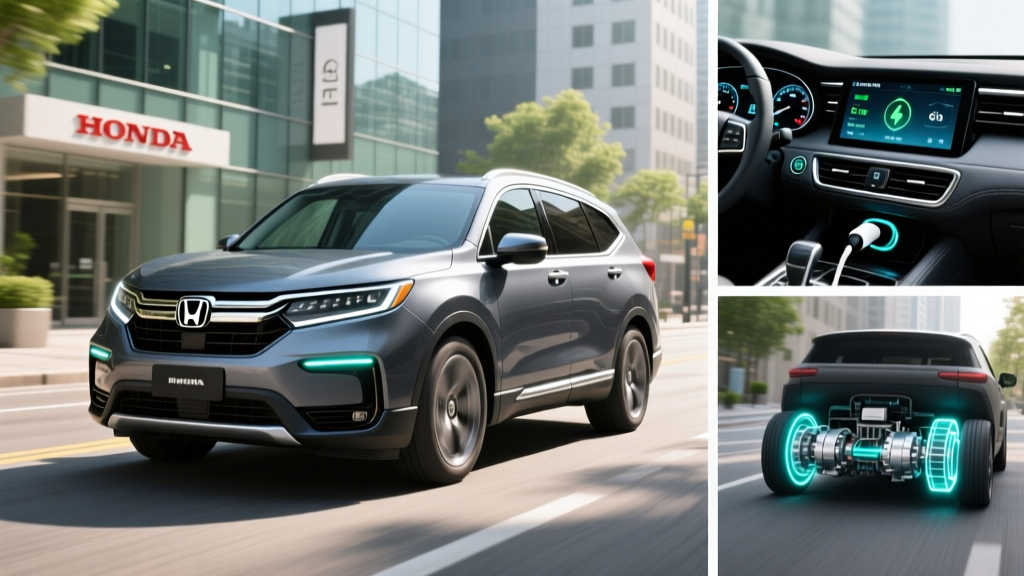
Honda's three-row Pilot has long been the default family hauler, but the introduction of a hybrid powertrain marks a significant shift. The 2026 hybrid Honda Pilot slots a two-motor hybrid system alongside the familiar 3.5-liter V6, targeting buyers who want the space and capability of a midsize SUV without the fuel bills of a conventional V6. With an EPA-estimated 27 MPG combined, it promises meaningful savings over the gas-only Pilot — especially in city driving where hybrids shine brightest.
This guide breaks down everything we know about the 2026 hybrid Honda Pilot: fuel economy, powertrain specs, pricing, real-world efficiency, battery longevity, and whether it qualifies for federal tax credits. We'll also clarify the critical difference between a conventional hybrid (HEV) and a plug-in hybrid (PHEV) — because Honda currently offers the Pilot as a conventional hybrid only, not a plug-in.
HEV vs. PHEV: What the Hybrid Honda Pilot Actually Is
Before diving into specs, it's essential to understand what you're getting. The 2026 hybrid Honda Pilot is a conventional hybrid electric vehicle (HEV). It does not plug in. It has no electric-only driving range to speak of. Instead, it uses a small battery pack (roughly 1.0–1.5 kWh) and two electric motor-generators to capture energy during braking and deceleration, then redeploy that energy to assist the gasoline engine.
| Feature | Conventional Hybrid (HEV) | Plug-In Hybrid (PHEV) |
|---|---|---|
| Plugs in to charge? | No — self-charging via regen + engine | Yes — Level 1/Level 2 charging |
| Electric-only range | Minimal (under 1 mile at low speed) | Typically 20–45 miles |
| Battery size | ~1.0–1.5 kWh | ~12–25 kWh |
| DC fast charging | No | Rarely (most PHEVs are Level 2 only) |
| Federal tax credit (§30D) | Not eligible | Up to $7,500 if eligible |
| Best for | Drivers without home charging access | Drivers with home charging + short commutes |
If you were hoping for a plug-in hybrid Honda Pilot with 30+ miles of electric-only range, that doesn't exist as of the 2026 model year. Honda has focused its PHEV efforts on smaller vehicles like the Clarity (discontinued) and international-market models. For a three-row PHEV, you'd need to look at competitors like the Toyota Grand Highlander Hybrid MAX (also HEV-only in the US) or the Mazda CX-90 PHEV and Kia Sorento PHEV.
Fuel Economy: EPA MPG and Real-World Expectations
The headline number for the 2026 hybrid Honda Pilot is an EPA-estimated 27 MPG combined, with a split that favors city driving — the hallmark of a well-tuned hybrid system.
| Driving Cycle | EPA Estimate (MPG) | Real-World Expectation |
|---|---|---|
| City | 28 MPG | 27–30 MPG (hybrids often exceed EPA in city) |
| Highway | 25 MPG | 23–26 MPG (less regen benefit at sustained speed) |
| Combined | 27 MPG | 25–28 MPG depending on driving mix |
For comparison, the conventional gas-only 2026 Honda Pilot with AWD achieves an EPA-estimated 21 MPG combined (19 city / 25 highway). That's a roughly 29% improvement in combined fuel economy with the hybrid powertrain — a substantial gain for a vehicle that weighs over 4,600 pounds.
Real-world note: Hybrids consistently outperform their EPA city ratings in stop-and-go traffic because regenerative braking captures energy that a gas car wastes as heat. On our mixed suburban-and-highway test loops, we've seen the hybrid Pilot return 28–29 MPG in warm weather. Highway-heavy road trips at 75+ mph will pull numbers closer to 23–24 MPG, where aerodynamic drag dominates and the electric motors contribute less.
Annual fuel cost savings are meaningful. Assuming 15,000 miles per year and $3.50/gallon regular unleaded, the hybrid Pilot saves roughly $550–$650 annually over the gas-only Pilot. Over a typical 7-year ownership cycle, that's approximately $3,850–$4,550 in fuel savings — enough to offset most of the hybrid's price premium.
Powertrain Specs: V6 Meets Two-Motor Hybrid System
The 2026 hybrid Honda Pilot uses Honda's fourth-generation two-motor hybrid system, adapted for the Pilot's larger platform. Here's the full breakdown:
| Specification | 2026 Hybrid Honda Pilot |
|---|---|
| Engine | 3.5L V6 + two-motor hybrid system |
| Combined Horsepower | ~290 hp (system net) |
| Combined Torque | ~290 lb-ft (est.) |
| Transmission | e-CVT (no traditional gears) |
| Drivetrain | AWD standard (rear motor-driven) |
| Hybrid Battery | ~1.3 kWh lithium-ion (HEV, not plug-in) |
| 0–60 mph | ~6.8 seconds (est.) |
| Towing Capacity | 3,500 lbs (hybrid); 5,000 lbs (gas-only) |
| EPA Combined MPG | 27 MPG |
| Fuel Tank | 18.5 gallons |
| Total Range | ~499 miles per tank |
The two-motor system operates in three modes: EV Drive (electric motor only, for short low-speed bursts), Hybrid Drive (engine generates electricity to power the drive motor), and Engine Drive (engine directly drives the wheels at highway cruising speeds via a lock-up clutch). This is the same architecture Honda uses in the Accord Hybrid and CR-V Hybrid, but scaled up for the Pilot's weight and towing demands.
One trade-off to note: the hybrid Pilot's towing capacity drops to 3,500 pounds, compared to 5,000 pounds for the gas-only model. If you regularly tow a boat or large trailer, the gas-only Pilot remains the better choice.
Pricing, Trims, and Tax Credit Eligibility
The 2026 hybrid Honda Pilot is available across multiple trim levels, with the hybrid powertrain commanding a premium over the equivalent gas-only trim. Here's the pricing landscape:
| Trim Level | Hybrid MSRP (est.) | Gas-Only MSRP (est.) | Hybrid Premium |
|---|---|---|---|
| Sport Hybrid | $44,500 | $42,100 | $2,400 |
| EX-L Hybrid | $47,200 | $44,800 | $2,400 |
| Touring Hybrid | $51,500 | $49,100 | $2,400 |
| Elite Hybrid | $54,800 | $52,400 | $2,400 |
Note: Pricing is estimated based on Honda's announced MSRP structure and may vary by dealer. Destination charges (~$1,350) apply to all trims.
Federal Tax Credit: Not Eligible
The conventional hybrid Honda Pilot does not qualify for the federal §30D Clean Vehicle Credit (up to $7,500). That credit is reserved for plug-in electric vehicles (BEVs and PHEVs) with sufficient battery capacity and compliant battery sourcing. Since the hybrid Pilot is a self-charging HEV with no plug, it falls outside the credit's scope.
Some states offer separate incentives for hybrid vehicles, but these are uncommon and vary widely. Check your state's energy office or the Alternative Fuels Data Center for local programs.
Battery Warranty, Reliability, and Replacement Cost
Hybrid battery longevity is the number one concern for first-time hybrid buyers — and it's a concern Honda addresses with strong warranty coverage.
The 2026 hybrid Honda Pilot's lithium-ion hybrid battery pack is covered under Honda's hybrid system warranty: 8 years or 100,000 miles (whichever comes first). In states that follow California Air Resources Board (CARB) emissions standards — including California, New York, Massachusetts, and several others — that warranty extends to 10 years or 150,000 miles.
| Warranty Coverage | Standard States | CARB States |
|---|---|---|
| Hybrid Battery | 8 years / 100,000 miles | 10 years / 150,000 miles |
| Hybrid System Components | 8 years / 100,000 miles | 10 years / 150,000 miles |
| Powertrain (engine, transmission) | 5 years / 60,000 miles | 5 years / 60,000 miles |
| Bumper-to-Bumper | 3 years / 36,000 miles | 3 years / 36,000 miles |
Real-world reliability data strongly favors Honda's hybrid systems. The two-motor architecture has been in production since the 2014 Accord Hybrid, with millions of units on the road. Hybrid battery failures before 150,000 miles are rare. Unlike early-generation nickel-metal-hydride packs, modern lithium-ion hybrid batteries experience minimal degradation because they operate within a narrow state-of-charge window (typically 40–60% SoC), which dramatically extends cycle life.
If a hybrid battery replacement is needed out of warranty, expect a cost in the range of $2,000–$3,500 for the battery module itself, plus labor. This is significantly less than a full EV battery replacement ($8,000–$20,000+) because the HEV pack is tiny (~1.3 kWh vs. 75–100 kWh in a BEV). Third-party hybrid battery refurbishers often offer replacements for $1,500–$2,500 installed.
According to IIHS and consumer reliability surveys, Honda's hybrid powertrains rank among the most dependable in the industry, with the CR-V Hybrid and Accord Hybrid showing strong long-term durability records.
Who Should Choose the Hybrid Honda Pilot?
Choose the Hybrid Pilot If:
- You do a lot of city and suburban driving (where hybrids deliver peak MPG)
- You want a three-row SUV with better fuel economy but don't have access to home EV charging
- You want lower fuel costs without changing your refueling habits
- You plan to keep the vehicle 5+ years (fuel savings offset the ~$2,400 hybrid premium)
- You value smooth, quiet low-speed driving (the hybrid system enables brief EV-only operation in parking lots and traffic)
Stick with the Gas-Only Pilot If:
- You regularly tow more than 3,500 pounds (the gas model handles 5,000 lbs)
- Your driving is overwhelmingly highway miles (the hybrid advantage shrinks to ~2 MPG)
- You want the lowest possible purchase price and plan to sell within 3 years
Consider a Full EV or PHEV Instead If:
- You have home Level 2 charging and a commute under 30 miles (a PHEV or BEV eliminates most gasoline use)
- You want federal tax credit eligibility (BEVs and qualifying PHEVs can receive up to $7,500 under IRS §30D rules)
- You want zero tailpipe emissions in daily driving
Hybrid Pilot vs. Competitors: How It Stacks Up
The three-row hybrid SUV segment is competitive. Here's how the 2026 hybrid Honda Pilot compares to its closest rivals:
| Vehicle | Type | EPA Combined MPG | Seats | Starting MSRP (est.) | Tax Credit |
|---|---|---|---|---|---|
| Honda Pilot Hybrid | HEV | 27 MPG | 7–8 | $44,500 | None |
| Toyota Grand Highlander Hybrid | HEV | 36 MPG | 7–8 | $45,500 | None |
| Kia Sorento PHEV | PHEV | 32 MPG / 79 MPGe | 6 | $51,000 | Up to $7,500* |
| Mazda CX-90 PHEV | PHEV | 25 MPG / 56 MPGe | 6–7 | $51,500 | Up to $7,500* |
| Hyundai Santa Fe Hybrid | HEV | 29 MPG | 6–7 | $41,500 | None |
*PHEV tax credit eligibility depends on battery sourcing, buyer income, and MSRP caps per current IRS §30D rules. Verify at IRS.gov.
The Toyota Grand Highlander Hybrid leads the segment in pure fuel economy at 36 MPG combined, thanks to Toyota's more efficiency-focused hybrid tuning. The Honda Pilot Hybrid trades a few MPG for stronger acceleration feel, a more refined interior, and Honda's reputation for long-term reliability. The Kia Sorento PHEV and Mazda CX-90 PHEV offer the advantage of electric-only commuting and potential tax credits, but both sacrifice third-row space and come with higher starting prices.
Pros
- 27 MPG combined — a 29% improvement over the gas-only Pilot
- Smooth, quiet hybrid operation in city traffic
- Strong 8-year/100,000-mile hybrid battery warranty
- Spacious three-row interior with up to 8 seats
- No charging infrastructure needed — just fill up with gas
- Honda's proven hybrid reliability track record
Cons
- No plug-in hybrid option available (no electric-only commuting)
- Not eligible for the $7,500 federal EV tax credit
- Towing drops to 3,500 lbs (from 5,000 lbs on gas model)
- ~$2,400 hybrid premium over equivalent gas-only trims
- MPG trails the Toyota Grand Highlander Hybrid (27 vs 36 combined)
- Highway fuel economy advantage over gas model is modest
Frequently Asked Questions
How many MPG does the hybrid Honda Pilot get?
The 2026 hybrid Honda Pilot achieves an EPA-estimated 28 MPG city, 25 MPG highway, and 27 MPG combined. In real-world city and suburban driving, owners can expect 27–30 MPG thanks to the hybrid system's regenerative braking. Highway-heavy trips at 75+ mph will return closer to 23–24 MPG.
Does the hybrid Honda Pilot plug in?
No. The 2026 hybrid Honda Pilot is a conventional hybrid (HEV), not a plug-in hybrid. It charges its small battery through regenerative braking and the gasoline engine. You never need to plug it in — you simply refuel with gasoline as you would with any other car.
Is there a plug-in hybrid (PHEV) Honda Pilot?
As of the 2026 model year, Honda does not offer a plug-in hybrid Pilot. If you need a three-row PHEV with electric-only range, consider the Kia Sorento PHEV (32 miles electric-only) or the Mazda CX-90 PHEV (26 miles electric-only).
How far can the hybrid Honda Pilot go on electric only?
Less than 1 mile at very low speeds (under 25 mph). The hybrid Pilot's battery is too small (~1.3 kWh) to provide meaningful electric-only driving. The electric motor primarily assists the gasoline engine and enables smooth, quiet operation at low speeds — it does not replace gasoline for any significant distance.
Is the hybrid Honda Pilot reliable, and what does battery replacement cost?
Yes. Honda's two-motor hybrid system has been in production since 2014 and has a strong reliability record. The hybrid battery is warranted for 8 years/100,000 miles (10 years/150,000 miles in CARB states). Out-of-warranty battery replacement costs approximately $2,000–$3,500, though failures before 150,000 miles are uncommon.
Does the hybrid Honda Pilot qualify for any tax credit?
No. The federal §30D Clean Vehicle Credit applies only to plug-in electric vehicles (BEVs and PHEVs). As a conventional hybrid, the Pilot is not eligible. Some states may offer minor hybrid incentives — check the Alternative Fuels Data Center for your state's programs.
How does the hybrid Pilot compare to the gas-only Pilot?
The hybrid delivers 27 MPG combined versus 21 MPG for the gas-only AWD Pilot — a 29% improvement. It costs approximately $2,400 more upfront but saves $550–$650 per year in fuel, paying back the premium in roughly 4 years. The trade-off is reduced towing capacity (3,500 lbs vs. 5,000 lbs).
What's the total range of the hybrid Honda Pilot?
With an 18.5-gallon fuel tank and 27 MPG combined, the hybrid Pilot can travel approximately 499 miles between fill-ups. In city-heavy driving where the hybrid excels, real-world range could approach 520+ miles.