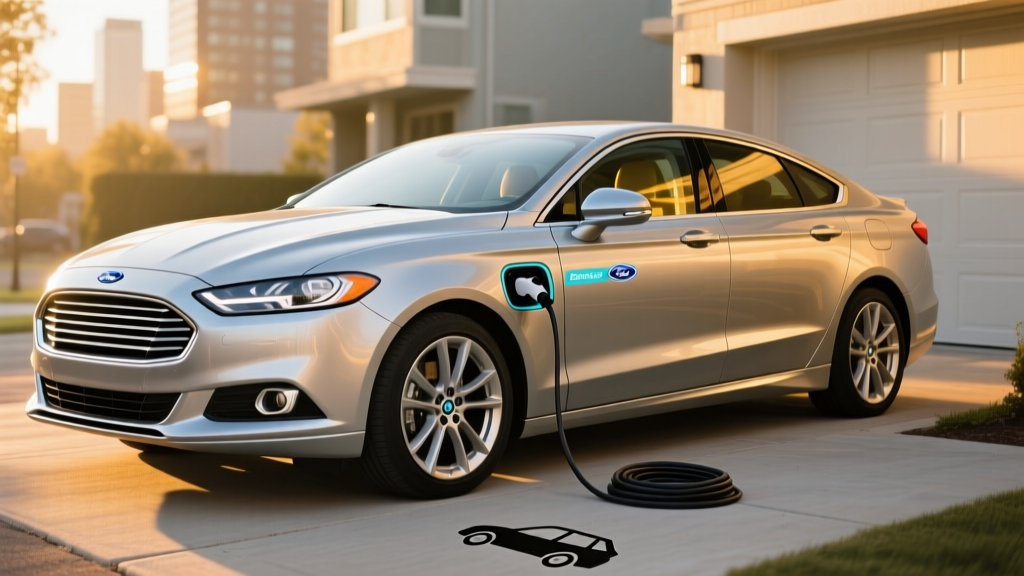
The Ford Fusion Energi — Ford's plug-in hybrid (PHEV) sedan — was discontinued after the 2020 model year, but it remains one of the most practical used PHEVs on the market in 2026. For buyers searching for a Ford Fusion plug-in hybrid, the Energi offers a compelling blend of electric-only commuting and gas-engine flexibility, all in a midsize sedan package that undercuts newer PHEVs on price. This guide covers everything you need to know before buying one today: real-world MPG, electric range, battery longevity, charging logistics, and whether it still makes financial sense versus a newer hybrid or full EV.
Ford Fusion Energi: PHEV vs. Standard Hybrid Explained
Ford sold two electrified Fusion variants, and confusing them is the most common buyer mistake. Here's the critical distinction:
| Feature | Fusion Hybrid (HEV) | Fusion Energi (PHEV) |
|---|---|---|
| Plug-in charging | No — charges via regenerative braking and engine | Yes — plug in to charge the larger battery |
| Battery capacity | 1.4 kWh (small buffer) | 7.6 kWh usable (2019–2020); 6.5 kWh (2013–2018) |
| Electric-only range | None (EV mode limited to ~1 mile at low speed) | EPA 26 miles (2019–2020) |
| Charge port | None | J1772 Level 1/Level 2 (no DC fast charge) |
| EPA combined MPG (gas) | 42 MPG | 42 MPG (after battery depleted) |
| MPGe (electric + gas) | N/A | 103 MPGe |
| Trunk space | 16.0 cu ft | 8.2 cu ft (battery intrudes) |
The Fusion Hybrid (HEV) never plugs in. It uses a small battery and electric motor to assist the gas engine, achieving excellent MPG without any lifestyle change. The Fusion Energi (PHEV) adds a much larger battery and a charge port, letting you drive 26 miles on electricity alone before the gas engine kicks in. If your commute is under 25 miles round-trip and you can charge at home, you might go weeks without visiting a gas station.
Fuel Economy: EPA Numbers vs. Real-World MPG
The Fusion Energi's efficiency depends entirely on how often you charge. Here's the EPA breakdown for the final-generation 2019–2020 models, which represent the best version of this car:
| Mode | City | Highway | Combined |
|---|---|---|---|
| Electric + Gas (MPGe) | 113 MPGe | 95 MPGe | 103 MPGe |
| Gas Only (MPG) | 43 MPG | 41 MPG | 42 MPG |
Source: EPA fueleconomy.gov
- With daily charging: Owners with short commutes (under 20 miles) routinely report 70–100+ MPG because most driving happens on electricity. The gas engine may only fire for longer weekend trips.
- Without charging (gas-only): Expect 38–42 MPG combined. The Energi carries ~300 lbs of extra battery weight versus the standard Hybrid, so its gas-only MPG is slightly lower in real-world highway driving.
- Cold weather: Electric-only range drops 20–30% in freezing temperatures (to roughly 18–21 miles). The engine also runs more often to provide cabin heat, since the Energi lacks a dedicated heat pump.
The key insight: if you never plug in, you're carrying dead weight. The Energi only makes economic sense if you charge regularly. If you can't charge at home or work, the standard Fusion Hybrid (HEV) is the smarter buy — same 42 MPG combined, no plug required, and significantly more trunk space.
Electric-Only Range, Battery, and Charging Specs
| Specification | 2019–2020 Energi | 2013–2018 Energi |
|---|---|---|
| Usable battery capacity | 7.6 kWh | 6.5 kWh |
| Battery chemistry | Lithium-ion (NMC) | Lithium-ion (NMC) |
| EPA electric-only range | 26 miles | 20–21 miles |
| Total range (electric + gas) | ~520 miles | ~500 miles |
| Top speed in EV mode | 85 mph | 85 mph |
| Level 1 charging (120V) | ~7 hours (0–100%) | ~7 hours (0–100%) |
| Level 2 charging (240V, 3.3 kW) | ~2.5 hours (0–100%) | ~2.5 hours (0–100%) |
| DC fast charging | Not supported | Not supported |
| Charge port | J1772 | J1772 |
| Combined horsepower | 195 hp (net) | 195 hp (net) |
| Engine | 2.0L Atkinson-cycle I4 (141 hp) | 2.0L Atkinson-cycle I4 (141 hp) |
| Electric motor | 118 hp (88 kW) | 118 hp (88 kW) |
| Transmission | eCVT (planetary gearset) | eCVT (planetary gearset) |
| 0–60 mph | ~7.6 seconds | ~7.6 seconds |
| Fuel tank | 14.0 gallons | 14.0 gallons |
A few practical notes on charging:
- Level 1 is viable for daily use. The battery is small enough that a standard 120V household outlet adds roughly 4–5 miles of range per hour. If you drive 25 miles a day and plug in overnight (8–10 hours), Level 1 will fully replenish the battery. No electrician required.
- Level 2 is a luxury, not a necessity. A 240V Level 2 charger cuts charge time to ~2.5 hours, which matters if you need to top up midday. But unlike a full EV with a 75+ kWh battery, the Energi's tiny pack doesn't demand Level 2.
- No DC fast charging. The Energi cannot use public DC fast chargers (CCS, CHAdeMO, or NACS). This is standard for PHEVs of this era — the battery is too small to benefit from high-power DC input.
Battery Longevity, Warranty, and Replacement Cost
Since the earliest Energi models date to 2013, some examples are now outside the 8-year federal warranty window. The 2017–2020 models should still have remaining factory battery coverage through 2025–2028, depending on mileage.
Real-world degradation data: The Fusion Energi's NMC lithium-ion battery has proven durable in owner surveys. Most high-mileage Energi owners report 10–15% capacity loss after 80,000–100,000 miles, meaning the 26-mile electric range may shrink to 22–24 miles. This is moderate degradation and well within acceptable PHEV territory. The smaller battery (relative to a full EV) cycles more frequently, but Ford's thermal management system and conservative state-of-charge buffer (the car never uses the full gross capacity) protect long-term health.
Battery replacement cost (2026 estimate): If the battery fails out of warranty, expect to pay $4,000–$7,000 for a replacement pack plus labor at a Ford dealer. Independent hybrid specialists may offer refurbished packs for $3,000–$4,500. Given the vehicle's used-market value ($12,000–$20,000 depending on year and mileage), a full dealer replacement may not be economical — which makes verifying battery health before purchase essential.
Pre-purchase battery check: Ask the seller to fully charge the battery and drive in EV mode until the engine kicks in. Measure the miles driven. If a 2019–2020 Energi delivers fewer than 20 miles of electric range at moderate temperatures (60–80°F), significant degradation has occurred. Some OBD-II scanners can also read the battery's state of health (SoH) directly.
Used Pricing and Tax Credit Eligibility in 2026
The Fusion Energi is no longer sold new. On the used market in early 2026, typical pricing breaks down as follows:
- 2013–2016 models: $9,000–$13,000 (higher mileage, older battery, 20–21 mile EV range)
- 2017–2018 models: $12,000–$16,000 (updated styling, still 21 mile range on '17; 22 miles on '18)
- 2019–2020 models: $15,000–$21,000 (best battery, 26-mile range, most recommended)
Federal tax credits: The Fusion Energi originally qualified for a $4,007 federal tax credit when new (not the full $7,500, due to battery size). That credit is long expired for new purchases. However, under current IRS §30D rules, the used clean vehicle credit (IRC §25E) may apply when buying from a dealer:
- Credit amount: 30% of the sale price, up to a maximum of $4,000
- Vehicle price cap: Sale price must be $25,000 or less (all Energi models qualify)
- Vehicle age: Must be at least 2 model years old (all Energi models qualify)
- Buyer income cap: AGI must not exceed $75,000 (single), $112,500 (head of household), or $150,000 (joint)
- Dealer requirement: Must purchase from a licensed dealer (not a private party) and the dealer must report the sale to the IRS
- One-time use: The specific VIN can only claim the used-vehicle credit once every 3 years
A $17,000 used 2019 Energi could yield a $4,000 credit (30% of $17,000 = $5,100, capped at $4,000), effectively bringing the net cost to $13,000 — exceptional value for a plug-in hybrid. Verify eligibility with a tax professional and consult the IRS used clean vehicle credit page for current rules.
Reliability and Common Issues
The Fusion Energi's powertrain is one of Ford's most reliable modern setups. The eCVT transmission (a planetary gearset with no traditional clutch packs or bands) is virtually bulletproof — it has fewer moving parts than a conventional automatic. The 2.0L Atkinson-cycle engine is under-stressed and proven. NHTSA gave the Fusion strong safety ratings across model years.
Common issues to watch for on used examples:
- 12V battery drain: Like all electrified vehicles, the Energi has a conventional 12V battery that powers accessories. If the car sits unplugged for extended periods, the 12V battery can die, preventing the car from starting even if the high-voltage battery is charged.
- Regenerative braking feel: Some owners note the brake pedal feel is inconsistent as the car blends regen and friction braking. This is normal for PHEVs, not a defect.
- Infotainment (SYNC 3): The 2017+ models use SYNC 3, which is responsive and supports Apple CarPlay/Android Auto. Pre-2017 models with SYNC 2 (MyFord Touch) are noticeably slower and less reliable — another reason to target 2017+ models.
- Cargo space: The high-voltage battery sits behind the rear seats, reducing trunk volume to just 8.2 cubic feet (versus 16.0 in the gas Fusion). This is a real limitation for families or anyone who regularly carries luggage.
Fusion Energi vs. Alternatives: Which Fits You?
Choose the Ford Fusion Energi (used PHEV) if:
- Your daily commute is 15–25 miles and you can charge at home (even a 120V outlet works)
- You want to drive electric most days but need gas flexibility for road trips
- Your budget is $13,000–$20,000 and you want maximum electrification per dollar
- You prefer a sedan over a crossover and don't need large cargo space
Choose the standard Fusion Hybrid (HEV) if:
- You cannot charge at home or at work
- You want the same 42 MPG without plugging in
- You need the full 16 cu ft trunk
- You want a simpler ownership experience with no charging logistics
Choose a full EV (e.g., used Chevrolet Bolt EV, Nissan Leaf, Tesla Model 3) if:
- Your daily driving is under 150 miles and you want zero gas expenses
- You have reliable home Level 2 charging
- You want lower maintenance costs (no oil changes, no engine)
- You don't take frequent road trips over 250 miles
Choose a newer PHEV (e.g., Toyota RAV4 Prime, Hyundai Tucson PHEV) if:
- You want current-model warranty coverage and the latest safety tech
- You need SUV cargo space and ground clearance
- Your budget is $35,000+
- 26-mile EV range covers most commutes gas-free
- 42 MPG even when battery is depleted
- Charges fully on a standard 120V outlet overnight
- Comfortable, quiet midsize sedan ride
- Strong used-market value, especially with $4,000 tax credit
- Proven, reliable eCVT powertrain
- Trunk is tiny (8.2 cu ft) due to battery placement
- No DC fast charging
- Discontinued — no new models, limited dealer support long-term
- Pre-2019 models have only 20–21 miles of EV range
- Battery replacement cost could exceed vehicle value on older models
- Infotainment feels dated versus 2026 vehicles
Frequently Asked Questions
How many MPG does the Ford Fusion plug-in hybrid get?
The 2019–2020 Fusion Energi achieves an EPA-rated 42 MPG combined (43 city / 41 highway) when operating as a conventional hybrid after the battery is depleted. When factoring in electric-only driving, the combined rating is 103 MPGe. Real-world results vary widely: owners who charge daily and commute under 25 miles often see effective fuel economy well over 70 MPG, while those who never charge will see 38–42 MPG.
How far can the Ford Fusion Energi go on electric only?
The 2019–2020 model is EPA-rated for 26 miles of electric-only range. The 2013–2018 models are rated for 20–21 miles. In real-world conditions, expect 22–26 miles in moderate weather and 18–21 miles in freezing temperatures, as battery efficiency drops and the engine may engage to provide cabin heat.
Does the Ford Fusion Energi qualify for a tax credit in 2026?
Not as a new vehicle — it's discontinued. However, when purchased from a licensed dealer as a used vehicle, it may qualify for the IRS §25E used clean vehicle credit: up to $4,000 (30% of sale price) if the buyer meets income limits ($75K single / $150K joint) and the sale price is under $25,000. Consult a tax professional and review IRS guidelines.
Is the Fusion Energi reliable and what does battery replacement cost?
The powertrain is among Ford's most reliable — the eCVT has no wearable clutch components and the 2.0L engine is under-stressed. Battery degradation is typically 10–15% after 100,000 miles. Out-of-warranty battery replacement costs $4,000–$7,000 at a dealer, or $3,000–$4,500 through independent hybrid specialists. The original warranty was 8 years/100,000 miles (10 years/150,000 miles in CARB states).
Can I charge the Fusion Energi at home with a regular outlet?
Yes. The battery is small enough that a standard 120V household outlet (Level 1) will fully charge it in about 7 hours — easily enough for overnight charging. A 240V Level 2 charger reduces this to approximately 2.5 hours. The car uses a standard J1772 connector. It does not support DC fast charging.
Should I buy the Fusion Energi or the regular Fusion Hybrid?
If you can charge at home and your commute is under 26 miles, the Energi lets you drive on electricity most days, saving significantly on fuel. If you can't charge, or you need the full trunk space (16 cu ft vs. 8.2 cu ft), the standard Hybrid delivers the same 42 MPG with no plug-in hassle and a lower purchase price.