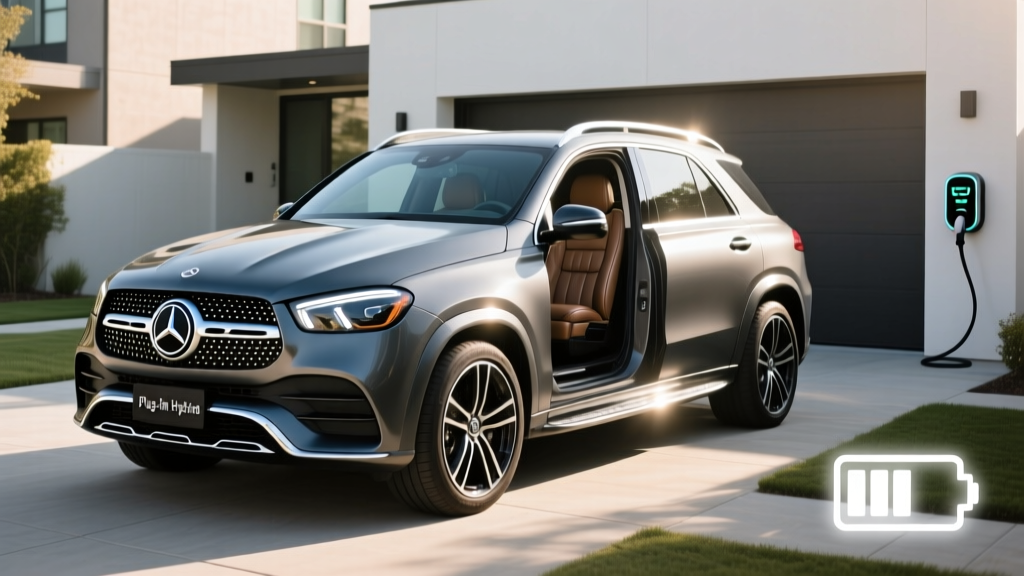
The Mercedes-Benz GLE has long been a benchmark in the midsize luxury SUV segment, and its plug-in hybrid variant—the GLE 350e 4MATIC—represents a bridge between old-world comfort and electrified efficiency. For 2026, the GLE plug-in hybrid continues to offer a compelling proposition: genuine electric-only commuting wrapped in a three-row luxury package. But does the math actually work for real buyers navigating school runs, road trips, and the occasional DC fast-charging stop?
After analyzing EPA data, owner reports, and Mercedes-Benz specifications, we've put together a spec-driven guide to the 2026 GLE PHEV—covering everything from its electric-only range and combined MPGe to battery warranty nuances and §30D tax credit eligibility.
GLE Plug-In Hybrid at a Glance: Key Specifications
| Specification | Value |
|---|---|
| Powertrain | 2.0L turbocharged I4 + permanent-magnet synchronous electric motor |
| Combined System Output | 375 hp / 480 lb-ft torque |
| Battery (usable) | 23.3 kWh (lithium-ion NMC chemistry) |
| EPA Electric-Only Range | 48 miles |
| EPA Combined MPGe (electric + gas) | 56 MPGe |
| EPA MPG (gas-only, charge-sustaining) | 23 city / 27 highway / 25 combined |
| Total Combined Range (electric + gas) | ~460 miles |
| Level 2 AC Charging (max) | 7.4 kW |
| DC Fast Charging | Not available (no DC port) |
| Level 2 Charge Time (0–100%) | ~3.5 hours at 7.4 kW |
| 0–60 mph | 6.5 seconds |
| Base MSRP | $66,250 (before destination) |
| Federal §30D Tax Credit | Not eligible (battery sourcing requirements) |
| Powertrain Warranty | 4 years / 50,000 miles |
| Hybrid Battery Warranty | 6 years / 62,000 miles |
HEV vs PHEV: Where the GLE Plug-In Hybrid Fits
Buyers evaluating the GLE lineup will encounter two distinct electrified options. Understanding the difference is critical before signing a purchase order:
Conventional Hybrid (HEV) — GLE 350h (if offered in your market): Uses a small battery (~1–2 kWh) charged solely through regenerative braking and the engine. No plug. Delivers modest efficiency gains (~28–30 MPG combined) but zero electric-only range. Think of it as a more efficient gas car.
Plug-In Hybrid (PHEV) — GLE 350e 4MATIC: Carries a substantially larger 23.3 kWh battery that charges via a plug (Level 1 or Level 2). Delivers 48 miles of EPA-rated electric-only driving—enough for most daily commutes—before the gasoline engine seamlessly takes over. This is a dual-powertrain vehicle that can function as a short-range EV on weekdays and a long-range hybrid on weekends.
The GLE plug-in hybrid is strictly a PHEV. There is no non-plug HEV version of the GLE currently sold in the United States for the 2026 model year. If you cannot install a home charger or lack regular plug-in access, a PHEV's advantage diminishes—you'll be carrying a heavy battery without utilizing its electric range, effectively driving a less efficient gas car.
Electric-Only Range and Real-World Efficiency
The EPA rates the 2026 GLE 350e at 48 miles of electric-only range. In practice, this figure holds up reasonably well under moderate conditions—city driving at speeds under 45 mph with mild weather can yield 44–50 miles. However, real-world variables compress that number:
- Highway driving (70+ mph): Expect 35–40 miles electric-only due to aerodynamic drag and higher energy consumption.
- Cold weather (below 35°F): Battery chemistry slows and cabin heating draws significant energy—expect 30–38 miles.
- Hilly terrain or heavy cargo: Regenerative braking helps on descents, but loaded climbs reduce range by 10–15%.
Once the battery depletes to its charge-sustaining threshold (roughly 10–12% state of charge, which the system reserves to protect battery health), the GLE operates as a conventional hybrid, returning the EPA-rated 25 MPG combined. In city-heavy driving, owners frequently report 27–29 MPG in charge-sustaining mode, as regenerative braking recaptures energy that a pure gas car would waste. Highway-only driving in hybrid mode tends to settle closer to 24–26 MPG.
EPA electric-only: 48 miles | Real-world daily commute (mixed): 42–48 miles | Highway (70 mph): 35–40 miles | Cold weather: 30–38 miles
EPA gas-only (combined): 25 MPG | Real-world city hybrid mode: 27–29 MPG | Real-world highway hybrid mode: 24–26 MPG
Charging the GLE PHEV: What You Need to Know
The GLE 350e uses a Level 2 AC charging port (J1772 connector) rated at a maximum of 7.4 kW. This is a critical specification: it means the vehicle cannot accept DC fast charging. There is no CCS or NACS DC port on this vehicle. For a 23.3 kWh battery, this is not a major limitation—a full 0–100% charge takes approximately 3.5 hours on a 7.4 kW Level 2 home charger, which means overnight charging is more than sufficient.
| Charging Level | Power (kW) | Estimated Time (0–100%) | Miles of Range Added per Hour |
|---|---|---|---|
| Level 1 (120V household outlet) | 1.4 kW | ~17 hours | ~8–9 miles |
| Level 2 (240V, 32A home charger) | 7.4 kW | ~3.5 hours | ~38–42 miles |
| DC Fast Charging | Not supported — no DC charging port | ||
Home charging setup: Most GLE PHEV owners install a Level 2 wallbox (such as a ChargePoint Home Flex or Emporia Vue) on a 240V / 40A circuit. Expect installation costs of $500–$1,500 depending on panel proximity and local permitting, on top of $400–$700 for the charger unit itself. A licensed electrician should evaluate your panel capacity—a 200A service panel typically handles a Level 2 charger without an upgrade.
Charging tip: The GLE's onboard charger caps at 7.4 kW even if your Level 2 station delivers 11.5 kW or more. You won't damage the vehicle (the car draws only what it can accept), but you won't charge any faster than the 7.4 kW ceiling.
Powertrain Performance and Driving Dynamics
The GLE 350e pairs a 2.0-liter turbocharged inline-four (producing roughly 255 hp on its own) with a 100 kW (134 hp) electric motor integrated into the transmission housing. Combined system output is 375 horsepower and 480 lb-ft of torque, routed through a 9-speed automatic to all four wheels via 4MATIC.
The electric motor delivers instant torque from standstill, making the GLE PHEV feel genuinely quick in city driving. The 0–60 mph sprint lands at 6.5 seconds—respectable for a 5,000+ lb luxury SUV. In EV mode, acceleration is smooth and silent up to about 50 mph, after which the gasoline engine blends in seamlessly if you demand more power.
Driving modes include Electric, Hybrid, and a Battery Hold mode (which preserves charge for later use—useful if you're highway-commuting and want electric range for city driving at your destination). The transition between electric and gas power is among the smoothest in the PHEV segment, thanks to Mercedes' integrated starter-generator architecture.
Pricing, Trims, and Tax Credit Eligibility
The 2026 Mercedes-Benz GLE 350e 4MATIC starts at $66,250 (plus $1,150 destination), placing it in the upper tier of midsize luxury SUVs. A well-equipped example with the AMG Line exterior, Premium package, and driver-assistance features will land in the $72,000–$78,000 range.
Federal tax credit (§30D): Unfortunately, the GLE 350e does not qualify for the $7,500 federal EV tax credit under current IRS rules. The §30D credit requires that battery components and critical minerals meet North American sourcing thresholds that the GLE PHEV's supply chain does not satisfy as of the 2026 model year. Additionally, the vehicle must meet an MSRP cap of $80,000 for SUVs—a threshold some higher-trim GLE configurations approach or exceed. Always verify current eligibility at IRS.gov before purchasing, as sourcing rules and qualified vehicle lists update periodically.
State incentives: Some states offer their own PHEV rebates or HOV lane access. California's Clean Fuel Reward program, for example, has historically offered up to $1,000 for qualifying PHEVs (though program availability changes—check your state's energy office). Several states also grant solo-occupant carpool lane stickers to PHEVs meeting minimum electric-range thresholds, which the GLE's 48-mile rating typically satisfies.
Hybrid battery warranty: 6 years / 62,000 miles (capacity retention guaranteed above 70%)
Powertrain warranty: 4 years / 50,000 miles
General vehicle warranty: 4 years / 50,000 miles
Estimated out-of-warranty battery replacement: $8,000–$12,000 (based on comparable Mercedes PHEV battery packs)
Note: Mercedes-Benz's PHEV battery warranty is shorter than Toyota/Lexus's 10-year hybrid battery coverage. Factor this into long-term ownership planning.
Reliability and Long-Term Battery Outlook
Mercedes-Benz PHEV systems have proven generally reliable, though they carry more complexity than a conventional hybrid like the Toyota Highlander Hybrid. The GLE 350e's battery uses NMC (nickel-manganese-cobalt) chemistry, which offers high energy density but is more sensitive to extreme temperatures and high state-of-charge storage than LFP (lithium iron phosphate) cells.
Based on data from earlier-generation Mercedes PHEVs (such as the GLE 350e predecessor and the S 580e), battery degradation in the 5–8% range over 5 years / 60,000 miles is typical. The system's thermal management and conservative buffer (reserving ~10% at the bottom and ~5% at the top) help preserve long-term health. Most owners will not see meaningful range loss within the warranty period.
However, the 6-year / 62,000-mile battery warranty is notably shorter than competitors. Toyota and Lexus cover hybrid batteries for 10 years / 150,000 miles, and BMW covers PHEV batteries for 8 years / 80,000 miles. If you plan to own the GLE PHEV beyond year six, budgeting for potential battery-related service is prudent.
For the latest safety and reliability data, consult NHTSA.gov and IIHS.org for crash-test ratings and technical service bulletins.
Who Should Buy the GLE Plug-In Hybrid?
- 48-mile electric range covers most daily commutes without gasoline
- Smooth, near-silent EV driving in city traffic
- 375 hp combined output delivers confident acceleration
- Premium interior with MBUX infotainment and available air suspension
- No range anxiety—gas engine provides 460+ total miles
- Qualifies for HOV lane access in several states
- No DC fast charging—road-trip recharging limited to Level 2
- Does not qualify for $7,500 federal §30D tax credit
- 6-year battery warranty is shorter than key competitors
- Starts at $66,250—premium pricing even among luxury PHEVs
- Cargo space reduced vs. gas GLE due to battery placement
- Real-world highway electric range drops to ~35 miles
- You can charge at home every night (Level 2 strongly recommended)
- Your daily commute is under 45 miles round-trip
- You want a luxury SUV that can run emission-free on weekdays and handle 400-mile road trips on weekends
- You value carpool lane access and reduced fuel costs for local driving
- You want zero gasoline dependency and DC fast-charging capability for road trips
- Your state offers strong EV purchase incentives that offset higher upfront cost
- You have reliable home and workplace charging access
- You cannot install a Level 2 charger at home or work
- Your daily driving exceeds 60+ miles (PHEV advantage diminishes)
- Budget is a primary concern and luxury badges are not a priority
Ownership Cost Snapshot: 5-Year Estimate
| Category | Estimated Cost |
|---|---|
| Purchase price (base + destination) | $67,400 |
| Federal tax credit | $0 (not eligible) |
| Home Level 2 charger + installation | $1,000–$1,800 |
| Electricity (charging ~70% of miles) | $2,400–$3,200 |
| Gasoline (~30% of miles on engine) | $2,800–$3,500 |
| Insurance (5-year total) | $9,500–$12,000 |
| Maintenance (fewer oil changes vs. gas, but complex systems) | $3,000–$4,500 |
| Estimated 5-year depreciation | $28,000–$34,000 |
For a detailed, personalized cost comparison, the EPA's fueleconomy.gov side-by-side tool lets you compare the GLE 350e against gas competitors with your local electricity and fuel prices.
Frequently Asked Questions
How many MPG does the GLE plug-in hybrid get?
The EPA rates the 2026 GLE 350e at 56 MPGe when operating in combined electric-and-gas mode. Once the battery is depleted and the vehicle runs on gasoline alone (charge-sustaining mode), it delivers 23 MPG city, 27 MPG highway, and 25 MPG combined. In real-world city driving with frequent regenerative braking, owners commonly see 27–29 MPG in hybrid mode.
How far can the GLE plug-in hybrid go on electric only?
The EPA rates the GLE 350e at 48 miles of electric-only range. Real-world results vary: expect 42–48 miles in mixed city driving, 35–40 miles at sustained highway speeds, and 30–38 miles in cold weather (below 35°F). The total combined range (electric + full gas tank) is approximately 460 miles.
Does the GLE plug-in hybrid qualify for a federal tax credit?
No. As of the 2026 model year, the GLE 350e does not qualify for the §30D federal clean vehicle tax credit (up to $7,500). The vehicle's battery does not meet the critical minerals and battery component sourcing requirements established by the Inflation Reduction Act. Some state-level incentives or HOV lane perks may still apply. Always verify at IRS.gov before purchasing.
Is the GLE plug-in hybrid reliable, and what does battery replacement cost?
Mercedes-Benz PHEV powertrains have shown average reliability for the luxury segment. The hybrid battery is warranted for 6 years / 62,000 miles—shorter than Toyota's 10-year coverage. Out-of-warranty battery replacement is estimated at $8,000–$12,000 based on comparable Mercedes PHEV packs. Degradation data from previous-generation models suggests 5–8% capacity loss over 5 years / 60,000 miles under normal use.
Hybrid vs PHEV vs EV — which is right for me?
A conventional hybrid (HEV) is best if you cannot plug in and simply want better fuel economy with zero behavior change. A plug-in hybrid (PHEV) like the GLE 350e is ideal if you have home charging and a short commute—you'll drive on electricity most days and use gas only for longer trips. A full EV (BEV) makes sense if you want zero gasoline costs, have reliable charging access, and are comfortable planning road-trip charging stops. The PHEV is the "best of both worlds" compromise, but only if you actually plug it in regularly.
Can the GLE 350e DC fast charge?
No. The GLE 350e supports only AC charging up to 7.4 kW via a J1772 Level 2 port. There is no CCS or NACS DC fast-charging capability. A full charge from empty takes approximately 3.5 hours on a 240V Level 2 home charger. For a PHEV with a 23.3 kWh battery and 48-mile electric range, overnight home charging is the intended use case, and the lack of DC charging is rarely a practical limitation.