If you've ever popped the hood of a Toyota Prius, Ford Maverick Hybrid, or Honda CR-V Hybrid, you might have noticed something missing: the familiar belt-driven alternator bolted to the front of the engine. That observation leads to one of the most common questions from first-time hybrid buyers — do hybrids have alternators?
The short answer is that most modern hybrids do not use a traditional standalone alternator. Instead, they rely on a much larger motor-generator unit integrated into the transmission or powertrain to handle every job an alternator would normally do — and far more. But the engineering reality is more nuanced, and understanding it will make you a smarter hybrid shopper.
Below, we break down exactly how hybrid electrical systems work, how conventional hybrids (HEVs) differ from plug-in hybrids (PHEVs) in this regard, and what this means for long-term reliability and ownership costs.
The Alternator's Job in a Conventional Gas Car
In a standard internal-combustion vehicle, the alternator serves two critical functions:
- Charging the 12-volt battery that powers lights, infotainment, ECU computers, and accessories
- Supplying real-time electrical power to the vehicle's electrical system while the engine runs
A typical gas-car alternator produces between 100 and 200 amps at 12 volts — roughly 1.2 to 2.4 kilowatts (kW) of electrical output. It's driven by a serpentine belt connected to the engine's crankshaft, meaning it only generates power when the engine is spinning. When the engine is off at a stoplight, the car runs entirely off the 12V battery.
This system works, but it's inherently wasteful. The alternator creates parasitic drag on the engine, consuming fuel to produce electricity. And during braking, all that kinetic energy is lost as heat through the brake pads.
How Hybrids Replace the Alternator
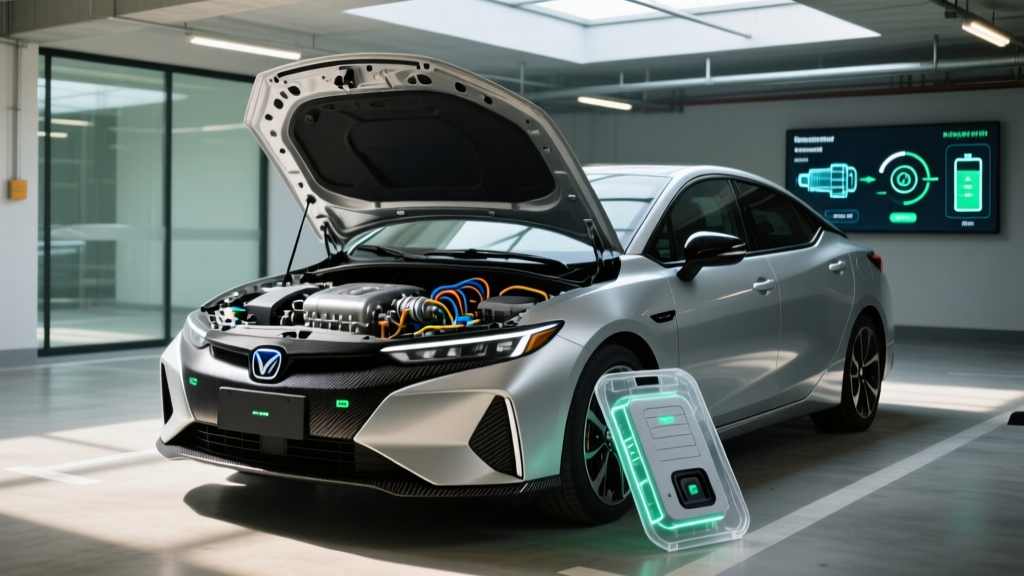
Hybrids eliminate the standalone alternator because they already carry something far more capable: a motor-generator (MG) connected to the high-voltage traction battery. In most hybrid systems — including Toyota's Hybrid Synergy Drive, Honda's two-motor system, and Hyundai-Kia's TMED architecture — the motor-generator performs three roles simultaneously:
- Propulsion: Driving the wheels using electricity from the high-voltage battery
- Regeneration: Converting kinetic energy back into electricity during deceleration and braking
- 12V charging: Stepping down high-voltage DC current to keep the 12-volt auxiliary battery topped up via a DC-DC converter
That third function is the key. Instead of a belt-driven alternator generating 12V power, hybrids use a DC-DC converter — a solid-state electronic device that transforms the high-voltage battery's output (typically 200V to 650V depending on the model) down to the 14V needed to charge the 12V battery and run accessories. The DC-DC converter is smaller, lighter, more efficient, and has no moving parts to wear out.
HEV vs. PHEV: Does the Powertrain Type Matter?
The alternator-free architecture applies to both conventional hybrids (HEVs) and plug-in hybrids (PHEVs), but the two differ in how they manage energy flow.
| Feature | Conventional Hybrid (HEV) | Plug-in Hybrid (PHEV) |
|---|---|---|
| Traditional alternator | No — uses DC-DC converter + motor-generator | No — uses DC-DC converter + motor-generator |
| High-voltage battery size | 0.5–2.0 kWh (small buffer) | 10–30+ kWh (usable) |
| 12V battery charging method | DC-DC converter from HV battery | DC-DC converter from HV battery |
| External plug-in charging | No — engine + regen only | Yes — Level 1/Level 2 AC |
| Regenerative braking | Yes (smaller energy recapture) | Yes (larger energy recapture) |
| Electric-only driving | Brief, low-speed only (~1 mi) | 20–50+ miles at highway speed |
In a conventional HEV like the 2026 Toyota Prius, the 1.0 kWh (gross) nickel-metal-hydride or lithium-ion battery is recharged exclusively through regenerative braking and the gasoline engine spinning the motor-generator. You never plug it in. The engine acts as a range extender and battery charger combined.
In a PHEV like the 2026 Toyota RAV4 Prime (18.1 kWh usable battery) or the 2026 Jeep Wrangler 4xe (17.3 kWh usable), you plug into a Level 1 (120V) or Level 2 (240V) AC charger to fill the much larger battery. But the DC-DC converter still handles 12V charging duties — no alternator required. When the battery depletes, the gasoline engine kicks in, and the motor-generator switches to generating electricity from engine power and regenerative braking, just like a conventional hybrid.
Real-World Fuel Economy: HEV and PHEV MPG Breakdown
One reason hybrids can shed the alternator's weight and parasitic loss is that every component is optimized for efficiency. Here's how popular 2026 hybrids stack up per EPA estimates at fueleconomy.gov:
| Model | Type | City MPG | Hwy MPG | Combined | EV Range (mi) |
|---|---|---|---|---|---|
| Toyota Prius (LE) | HEV | 57 | 56 | 57 | — |
| Toyota Prius Prime (SE) | PHEV | — | — | 52 (hybrid) / 127 MPGe | 44 |
| Honda CR-V Hybrid (Sport) | HEV | 43 | 36 | 40 | — |
| Ford Maverick Hybrid | HEV | 42 | 33 | 37 | — |
| Toyota RAV4 Prime | PHEV | — | — | 38 (hybrid) / 94 MPGe | 42 |
| Hyundai Tucson PHEV | PHEV | — | — | 35 (hybrid) / 80 MPGe | 33 |
What About the 12V Battery? Do Hybrids Still Have One?
Yes. Every hybrid and PHEV still carries a conventional 12-volt auxiliary battery — typically an AGM (absorbed glass mat) or lithium-iron-phosphate (LiFePO4) unit — to power the vehicle's computers, lights, door locks, infotainment, and safety systems. This battery is essential because the high-voltage traction system is completely disconnected when the car is off for safety reasons.
The DC-DC converter charges this 12V battery whenever the vehicle is in "Ready" mode, performing the exact same function a traditional alternator would. Some newer models, including certain Tesla vehicles and the latest Hyundai-Kia platforms, have even eliminated the standalone 12V battery entirely, using a section of the high-voltage pack to supply low-voltage power through an integrated DC-DC converter. Most hybrids, however, retain a separate 12V battery as a safety redundancy.
If your hybrid's 12V battery dies (just like in a gas car), the vehicle won't start — even if the high-voltage battery is fully charged. You can jump-start the 12V system using standard jumper cables or a portable lithium jump-starter, following the procedure in your owner's manual.
Hybrid Powertrain Specs: What Replaces the Alternator in Practice
To understand the scale difference between an alternator and a hybrid motor-generator, consider the 2026 Toyota Prius:
| Specification | Value |
|---|---|
| Engine | 2.0L inline-4 (150 hp, 139 lb-ft) |
| Motor-generator output | 83 kW (111 hp) peak |
| Combined system horsepower | 194 hp (FWD) / 196 hp (AWD) |
| High-voltage battery | ~1.0 kWh gross, lithium-ion |
| 0–60 mph | 7.2 seconds |
| Traditional alternator | None — DC-DC converter handles 12V |
| Base MSRP (LE FWD) | ~$29,445 |
The motor-generator's 83 kW output is roughly 40 to 70 times more powerful than a conventional alternator. That's the fundamental reason hybrids don't need a separate alternator — the MG unit is already generating vastly more electricity than the vehicle's 12V systems could ever consume.
Battery Warranty and Reliability: What Hybrid Buyers Need to Know
Hybrid battery reliability has proven exceptional over two decades of real-world data. The Toyota Prius, now in its fifth generation, has documented cases of original battery packs lasting well beyond 200,000 miles. The smaller battery in a conventional HEV undergoes shallower charge-discharge cycles than a PHEV or full EV, which contributes to its longevity.
If a hybrid battery does need replacement out of warranty, costs typically range from:
- $2,000–$4,000 for conventional HEV batteries (smaller capacity)
- $4,000–$8,000+ for PHEV batteries (larger capacity)
Refurbished and aftermarket replacement cells have brought costs down significantly. Many independent hybrid-specialty shops now offer reconditioned battery packs for $1,500–$2,500 installed for popular models like the Prius and Camry Hybrid.
Because hybrids lack a traditional alternator, there's one fewer wear item to replace. Alternator failures in gas cars typically occur between 80,000 and 150,000 miles and cost $400–$900 to replace. The DC-DC converter in a hybrid has no moving parts and rarely fails — and when it does, it's typically covered under the hybrid system warranty.
Does Any Hybrid or PHEV Qualify for a Tax Credit?
This is where HEVs and PHEVs diverge sharply:
- Conventional hybrids (HEVs): Do not qualify for the federal §30D Clean Vehicle Credit. They are not plug-in vehicles. No federal purchase incentive applies.
- Plug-in hybrids (PHEVs): May qualify for up to $7,500 under IRS §30D rules, but eligibility depends on multiple factors including MSRP caps ($55,000 for SUVs/pickups/vans, $55,000 for sedans), buyer income limits ($300,000 joint / $150,000 single modified AGI), battery critical-mineral sourcing, and North American final assembly.
As of 2026, qualifying PHEVs include models like the Jeep Wrangler 4xe (partial credit depending on sourcing compliance), the Chrysler Pacifica PHEV, and certain Toyota RAV4 Prime configurations — but the list shifts as battery supply chains evolve. Always verify current eligibility at fueleconomy.gov's tax credit page before purchasing, and consult a tax professional for your specific situation. The credit can now be transferred to the dealer at point of sale as an instant discount.
Some states offer additional rebates for PHEVs (typically $1,000–$2,500). Conventional hybrids receive no state EV incentives but may qualify for HOV lane access in certain jurisdictions.
Hybrid vs. PHEV vs. Full EV: Which Is Right for You?
Choose a Conventional Hybrid (HEV) If:
- You can't charge at home or work (no garage, apartment living)
- You want maximum simplicity — no plugs, no charging apps, no range planning
- Your priority is city MPG and you drive 15,000+ miles/year
- You want the lowest upfront cost among electrified options
- You're in a region with extreme cold where EV range loss is a concern
Choose a Plug-in Hybrid (PHEV) If:
- You can charge at home (Level 1 or Level 2)
- Your daily commute is under 30–45 miles (within EV range)
- You want electric daily driving but gas flexibility for road trips
- You want to qualify for the federal tax credit (up to $7,500)
- You have a two-car household and want one vehicle to do both jobs
Choose a Full EV (BEV) If:
- You have reliable home Level 2 charging
- You want the lowest cost per mile (electricity vs. gasoline)
- You want minimal maintenance (no oil changes, no engine, no transmission)
- Your daily driving is within the vehicle's real-world range
- You want the full $7,500 federal credit on qualifying models
Frequently Asked Questions
Can a hybrid run without its 12V battery?
No. Even though the high-voltage traction battery powers the drivetrain, the 12V battery is required to boot the vehicle's computers, close the high-voltage contactors, and power safety systems. A dead 12V battery will leave a hybrid completely inoperable until it's jump-started or replaced — just like a gas car.
Do any hybrids still use a traditional alternator?
A small number of older or mild-hybrid systems (often called "belt-starter generators" or BSG systems) retain a belt-driven unit that functions as both a starter motor and an alternator. These are common in 48-volt mild-hybrid systems from manufacturers like Stellantis, Mercedes-Benz, and Volvo. However, these are not full hybrids — they cannot drive the wheels on electric power alone. In true full hybrids (HEVs) and PHEVs, the traditional alternator has been eliminated.
Does regenerative braking fully replace the alternator's function?
Regenerative braking recharges the high-voltage traction battery — not the 12V battery directly. The DC-DC converter then steps down high-voltage power to maintain the 12V system. So regenerative braking is part of the energy chain, but the DC-DC converter is the direct functional replacement for what an alternator does for the 12V system.
How long do hybrid DC-DC converters last?
DC-DC converters are solid-state electronics with no moving parts, and they typically last the life of the vehicle. Failures are rare and are generally covered under the hybrid-system warranty (8 years / 100,000 miles minimum). Replacement cost, if needed out of warranty, typically ranges from $500 to $1,500 including labor.
Are hybrids more reliable than gas-only cars?
Data from Consumer Reports and J.D. Power consistently ranks conventional hybrids among the most reliable vehicle types. The absence of a traditional alternator, starter motor (the motor-generator handles engine starting), and conventional transmission (most use a planetary e-CVT with no clutches or bands) actually reduces the number of wear-prone components. Toyota's hybrid system in particular has an exceptional long-term track record spanning over 25 years of production.