The 2010 Hybrid Prius in 2026: Still Worth Buying?
The third-generation Toyota Prius (model years 2010–2015) was a watershed moment for mainstream hybrids. With an EPA-estimated 50 MPG combined, it set a fuel-economy benchmark that stood for years. In 2026, the 2010 Hybrid Prius remains one of the most searched used hybrids on the market — and for good reason. With used examples trading between $4,500 and $9,000 depending on mileage and condition, it represents an ultra-low-cost entry into electrified driving. But a 16-year-old hybrid battery is the elephant in the garage. This guide breaks down everything you need to know before buying one today.
HEV vs PHEV: Where the 2010 Prius Fits
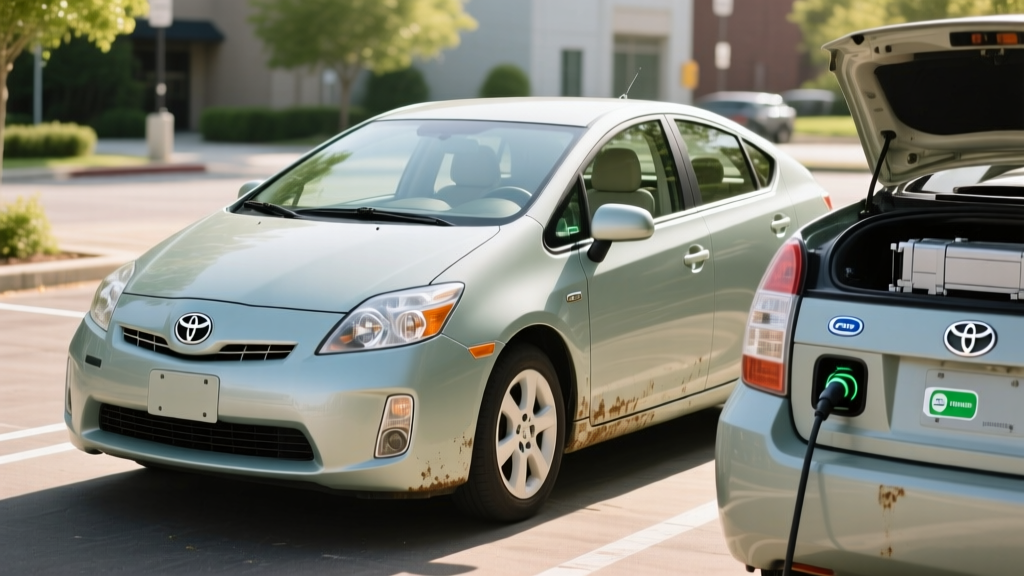
The 2010 Prius is a conventional hybrid (HEV) — it does not plug in. It captures energy through regenerative braking and its gasoline engine to charge a small nickel-metal hydride (NiMH) battery. Toyota did not introduce a plug-in Prius (the Prius Plug-in, later renamed Prius Prime) until the 2012 model year. If you're looking for electric-only driving with a plug, the 2010 model is not it. This guide focuses on the standard HEV.
2010 Prius Fuel Economy: EPA vs Real-World MPG
| Driving Cycle | EPA Estimate | Real-World Expectation |
|---|---|---|
| City | 51 MPG | 48–55 MPG (hybrids often exceed EPA in stop-and-go) |
| Highway | 48 MPG | 43–48 MPG (high speed reduces regen advantage) |
| Combined | 50 MPG | 45–52 MPG depending on driving mix |
The 2010 Prius's city MPG advantage comes from its ability to run on electric power at low speeds and shut off the engine at stops. In real-world commuting with frequent stops, many owners report exceeding the EPA city figure. Highway driving at 75+ MPH reduces that advantage — expect closer to 43–45 MPG on extended interstate trips. According to fueleconomy.gov, the 2010 Prius delivers an estimated 50 MPG combined, which translates to roughly $900–$1,100 in annual fuel cost at 15,000 miles per year and current gas prices.
Cold-weather note: In sub-freezing temperatures, expect a 5–10% MPG reduction. The engine runs more frequently to maintain cabin heat and keep the catalytic converter warm, reducing electric-only operation.
Powertrain Specs: What Moves the 2010 Prius
| Specification | Value |
|---|---|
| Engine | 1.8L 4-cylinder Atkinson-cycle (98 hp) |
| Electric Motor | Permanent-magnet synchronous (80 hp / 60 kW) |
| Combined System Output | 134 hp |
| Transmission | Planetary eCVT (no traditional gears) |
| Hybrid Battery | 1.3 kWh NiMH (nickel-metal hydride), 201.6V nominal |
| 0–60 MPH | ~9.8 seconds |
| Drivetrain | Front-wheel drive |
| Curb Weight | ~3,042 lbs |
| Fuel Tank | 11.9 gallons |
| Total Range (est.) | ~550–600 miles per tank |
The third-generation Prius upgraded from the prior 1.5L engine to a 1.8L, gaining 24 additional horsepower. The eCVT is not a belt-and-pulley CVT — it's a planetary gearset that blends engine and motor power with no fixed gear ratios, which is a key reason for its legendary reliability. There are no traditional transmission components to fail.
Hybrid Battery: Lifespan, Warranty, and Replacement Cost
Original Battery Warranty
Toyota originally covered the 2010 Prius hybrid battery for 8 years / 100,000 miles (10 years / 150,000 miles in California and states that adopted CARB emissions standards). That factory warranty has expired for all 2010 examples as of 2020 at the latest.
The 1.3 kWh NiMH battery in the 2010 Prius is far smaller than any modern EV or PHEV battery, but it also has a less demanding job — it buffers energy for short electric assists and regenerative captures, not sustained electric driving. Many original batteries have lasted 150,000–200,000+ miles. However, at 16 years old, most surviving 2010 Priuses are on their second battery or will need one soon.
Battery Replacement Options and Costs (2026)
- New OEM Toyota battery: $2,000–$2,500 installed at a dealership. Toyota still supplies new NiMH packs for the third-gen Prius.
- Refurbished/reconditioned battery: $800–$1,400 installed at independent hybrid specialists. These replace failed cells within the existing pack casing.
- Used/salvage battery: $400–$800 from a wrecking yard — viable but carries unknown remaining life.
- Aftermarket new battery: Companies like Green Bean Battery offer new-cell replacements with 2–5 year warranties in the $1,200–$1,800 range.
A failed hybrid battery triggers a check-engine light (commonly P0A80 or individual weak-block codes). The car can still drive in a degraded limp mode, but fuel economy drops sharply and further driving risks damage to the inverter. Address it promptly.
Reliability and Common Issues Beyond the Battery
The 2010 Prius scores well in long-term reliability surveys. The eCVT has no wear-prone belts or clutches, and the Atkinson-cycle engine runs under less stress than a conventional powerplant. That said, third-gen Prius models (2010–2015) have known issues worth checking:
- Head gasket failure: The most significant mechanical concern for this generation. EGR (exhaust gas recirculation) clogging can cause localized overheating. A clean EGR system and regular coolant maintenance reduce risk. Repair cost: $1,500–$3,000.
- Inverter coolant pump: Can fail silently. Check for turbulence in the inverter coolant reservoir with the car in READY mode. OEM replacement: ~$300–$500.
- Brake actuator: The regenerative braking system uses an electronic brake actuator that can fail on higher-mileage examples. A firm or unresponsive brake pedal is the tell. Replacement: $1,200–$1,800.
- Oil consumption: Some 2010–2014 1.8L engines consume oil between changes. Check the dipstick regularly and top off with 0W-20 synthetic.
For safety data, the 2010 Prius received a Top Safety Pick designation from IIHS and a 4-star overall rating from NHTSA — solid for its era but not comparable to 2026 crash-test standards.
2010 Prius vs Modern Hybrids and EVs: What Fits You?
Pros of Buying a 2010 Prius in 2026
- Ultra-low purchase price ($4,500–$9,000)
- 50 MPG real-world combined — still competitive with 2026 hybrids
- Proven reliability; parts and hybrid specialists are everywhere
- No charging infrastructure needed — just gas up and go
- Low annual fuel cost (~$900–$1,100/yr at 15k miles)
- Extremely low cost per mile when maintained properly
Cons of Buying a 2010 Prius in 2026
- Hybrid battery likely needs replacement if original
- Outdated infotainment — no Apple CarPlay, Android Auto, or Bluetooth audio streaming
- No modern ADAS (no automatic emergency braking, lane-keep, or adaptive cruise)
- Modest 134 hp; slow acceleration by 2026 standards
- Head gasket risk if EGR system hasn't been maintained
- No federal or state EV/PHEV tax credits apply
Decision Framework: Should You Buy the 2010 Prius, a Modern Hybrid, or an EV?
| Choose the 2010 Prius If… | Choose a Modern Hybrid (e.g., 2026 Prius) If… | Choose a Full EV If… |
|---|---|---|
| Your budget is under $10,000 and you need maximum MPG per dollar | You want 50+ MPG with modern safety tech, CarPlay, and a full warranty | You have home charging access and want to eliminate gas entirely |
| You're comfortable budgeting $1,500–$2,500 for a potential battery replacement | You can spend $28,000–$38,000 and want lower long-term maintenance risk | Your daily commute is under 250 miles and you want $0.04–$0.12/mile "fuel" cost |
| You lack home charging access and public charging isn't practical | You want AWD availability and 0–60 in the 6-second range (2026 Prius AWD) | You qualify for the §30D federal tax credit (up to $7,500) and want the lowest operating cost |
Tax Credits and Incentives: What Applies to the 2010 Prius?
The short answer: none at the federal level. The 2010 Prius is a conventional hybrid (HEV), not a plug-in vehicle. The IRS §30D Clean Vehicle Credit applies only to new plug-in EVs and PHEVs meeting battery-sourcing, MSRP, and buyer income requirements. The original Prius hybrid tax credit (up to $3,150) expired for Toyota in 2010 after the company hit the 250,000-unit manufacturer cap.
Some states and municipalities offer used-EV rebates, but these typically apply only to battery-electric or plug-in hybrid vehicles — not conventional HEVs. Check your state's energy office for any applicable programs, but do not count on incentives for this purchase.
Pre-Purchase Checklist for a Used 2010 Prius
- Hybrid battery health check: Use an OBD-II scanner with hybrid-specific software (Techstream or Dr. Prius app) to read individual battery block voltages. A spread greater than 0.3V between blocks indicates imbalance and impending failure.
- EGR system inspection: Ask if the EGR cooler and intake manifold have been cleaned. Clogged EGR is the leading cause of head gasket failure on this generation.
- Inverter coolant flow: With the car ON (READY mode), open the inverter coolant reservoir and look for visible turbulence. No movement = failing pump.
- Brake actuator test: Press the brake pedal before starting — it should feel firm. After starting, it should drop slightly as the brake booster pressurizes. A rock-hard pedal that doesn't soften is a red flag.
- 12V auxiliary battery age: The 12V battery in the rear hatch area powers the computers. If it's over 4 years old, budget $180–$250 for an AGM replacement.
- Service records: Prioritize examples with documented oil changes (every 10,000 miles with 0W-20 synthetic) and inverter coolant changes (every 100,000 miles).
Frequently Asked Questions
How many MPG does the 2010 Hybrid Prius get?
The EPA rates the 2010 Prius at 51 city / 48 highway / 50 combined MPG. In real-world driving, expect 45–52 MPG combined depending on your driving mix. City-heavy commutes often exceed the EPA figure thanks to regenerative braking, while sustained highway driving at 75+ MPH may drop to the low-to-mid 40s.
Does the 2010 Prius plug in or have electric-only range?
No. The 2010 Prius is a conventional hybrid (HEV). It cannot plug in and has no meaningful electric-only range — it uses the battery for brief low-speed assists and regenerative energy capture. Toyota's first plug-in Prius (Prius Plug-in) debuted for the 2012 model year with an 11-mile EV range.
How much does it cost to replace the hybrid battery in a 2010 Prius?
A new OEM Toyota NiMH battery costs $2,000–$2,500 installed at a dealer. Refurbished or aftermarket options range from $800–$1,800 installed. Many hybrid specialists offer reconditioned packs with 1–3 year warranties. Budget for this expense when purchasing any 2010 Prius still on its original battery.
Is the 2010 Prius reliable in 2026?
Yes, with caveats. The powertrain (engine + eCVT + hybrid system) is among the most reliable Toyota has ever built. The primary risk is head gasket failure due to EGR clogging — a known issue for the 2010–2014 model years. A preemptive EGR cleaning ($200–$400) significantly reduces this risk. Brake actuator and inverter pump failures are less common but expensive when they occur.
Does the 2010 Prius qualify for any tax credit?
No. The original federal hybrid tax credit for the Prius expired in 2010 after Toyota reached the 250,000-unit cap. The current §30D Clean Vehicle Credit applies only to new plug-in EVs and PHEVs. No federal tax incentive is available for purchasing a used 2010 Prius. Check your state energy office for any local programs, but HEVs rarely qualify.
How does the 2010 Prius compare to the 2026 Prius?
The 2026 Toyota Prius offers 57 MPG combined (LE FWD), 196 hp, standard Toyota Safety Sense 3.0 (automatic emergency braking, lane-keep, adaptive cruise), Apple CarPlay/Android Auto, and a modern interior — starting around $29,000. The 2010 model trades all of that for a $4,500–$9,000 entry price. If your budget allows, the 2026 Prius is a dramatically better vehicle. If you need the cheapest possible MPG, the 2010 still delivers.
Bottom Line: The 2010 Prius in 2026
Sixteen years after its debut, the 2010 Hybrid Prius remains a rational purchase for budget-conscious drivers who prioritize fuel economy above all else. At 50 MPG combined, it still matches or beats many 2026 hybrids. The key is going in with eyes open: budget $1,500–$2,500 for a hybrid battery if the original is still in place, verify EGR maintenance to mitigate head gasket risk, and accept that you're driving a car with 2010-era safety tech and infotainment. For those constraints, it's one of the best cost-per-mile vehicles ever built.