The Core Difference: Where Does the Energy Come From?
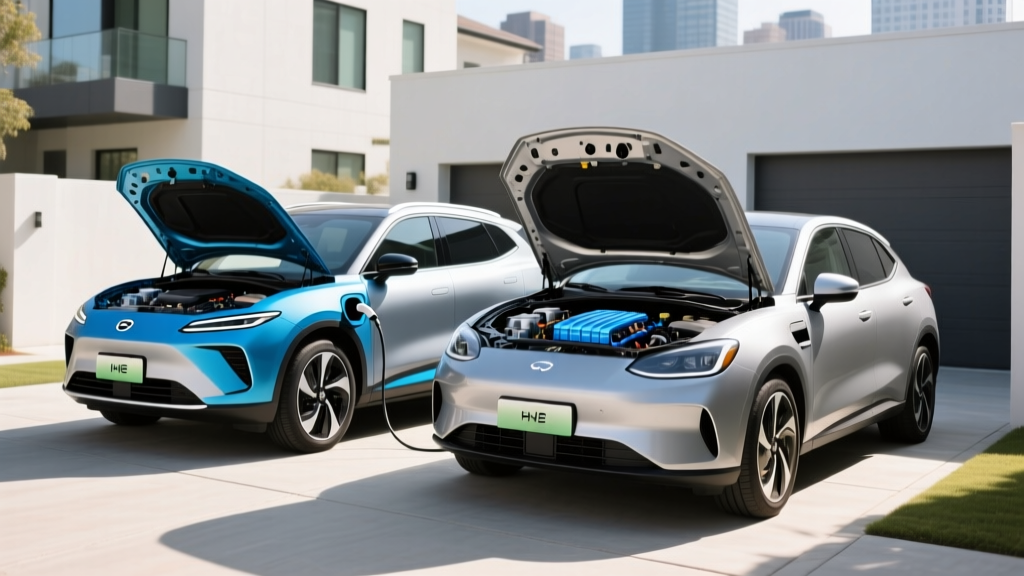
If you've narrowed your next car down to an electrified powertrain but aren't ready for a full battery-electric vehicle (BEV), you're likely weighing two options: a conventional hybrid (HEV) or a plug-in hybrid (PHEV). The difference between a hybrid and a plug-in hybrid comes down to one fundamental question — can you plug it in to drive on electricity alone?
A conventional hybrid like the Toyota Prius or Honda Accord Hybrid generates all its electricity internally. A small battery (typically 1–2 kWh) is charged exclusively through regenerative braking and the gasoline engine. You never plug it in. A plug-in hybrid like the Toyota RAV4 Prime or Jeep Wrangler 4xe carries a much larger battery (12–25+ kWh) that you charge from a wall outlet or charging station, enabling 20–50 miles of pure electric driving before the gas engine takes over.
HEV vs. PHEV at a Glance
| Feature | Conventional Hybrid (HEV) | Plug-In Hybrid (PHEV) |
|---|---|---|
| Plugs in? | No | Yes (Level 1 or Level 2) |
| Battery size | 1–2 kWh | 12–25+ kWh |
| Electric-only range | 0–1 mi at low speed | 20–50+ miles |
| EPA combined MPG (gas) | 40–57 MPG | 25–40 MPG (after battery depletes) |
| Federal tax credit | None (§30D is BEV/PHEV only) | Up to $7,500 (eligibility varies) |
| Price premium over gas model | $1,000–$3,000 | $5,000–$12,000 |
| Home charging needed? | No | Strongly recommended for value |
Neither is universally "better." The right choice depends on your daily mileage, charging access, and budget. Let's break down every factor that matters.
Fuel Economy: Real-World MPG for Hybrids and PHEVs
Hybrids shine in stop-and-go city driving, where regenerative braking recovers energy that a gas car wastes as heat. This is why the EPA city MPG for a hybrid is often higher than its highway number — the opposite of a conventional car.
| Model (Type) | City MPG | Hwy MPG | Combined | PHEV Elec. Range |
|---|---|---|---|---|
| Toyota Prius (HEV) | 57 | 56 | 57 | — |
| Toyota Prius Prime (PHEV) | 53* | 51* | 52* | 44 mi |
| Honda Accord Hybrid (HEV) | 51 | 44 | 48 | — |
| Toyota RAV4 Hybrid (HEV) | 41 | 38 | 40 | — |
| Toyota RAV4 Prime (PHEV) | 40* | 36* | 38* | 42 mi |
| Ford Escape PHEV | 42* | 38* | 40* | 37 mi |
| Jeep Wrangler 4xe (PHEV) | 20* | 20* | 20* | 22 mi |
* PHEV MPG figures reflect charge-sustaining (gas-only) mode after the battery is depleted. While the battery has charge, MPGe figures are higher. Source: fueleconomy.gov.
PHEV Electric-Only Range and Total Range
The electric-only range of a PHEV is its most important spec if you want to minimize gas use. For 2026 models, PHEV electric ranges span from roughly 20 miles (heavy body-on-frame SUVs like the Wrangler 4xe) to 44 miles (the Prius Prime). When the battery depletes, the vehicle seamlessly switches to hybrid mode and runs on gasoline — giving you a combined total range of 400–550+ miles.
| PHEV Model | Battery (kWh) | Electric Range (mi) | Total Range (mi) | DC Fast Charge? |
|---|---|---|---|---|
| Toyota Prius Prime | 13.6 | 44 | ~510 | No |
| Toyota RAV4 Prime | 18.1 | 42 | ~520 | No |
| Ford Escape PHEV | 14.4 | 37 | ~460 | No |
| Chrysler Pacifica PHEV | 16.0 | 32 | ~460 | No |
| Jeep Wrangler 4xe | 17.3 | 22 | ~370 | No |
| Jeep Grand Cherokee 4xe | 17.3 | 26 | ~440 | No |
An important detail many buyers overlook: virtually no mainstream PHEV supports DC fast charging. You're limited to Level 1 (120V household outlet, ~5–8 hours for a full charge) or Level 2 (240V, ~2–3.5 hours). For most PHEV owners, overnight Level 1 charging from a standard outlet is sufficient — the batteries are small enough that even 1.4 kW replenishes 25–35 miles of range in 6–8 hours.
Powertrain, Battery, and Performance Specs
Both HEVs and PHEVs pair a gasoline engine with one or more electric motors, but the scale differs significantly.
Conventional Hybrids (HEV): The electric motor is relatively small (30–80 kW) and assists the engine during acceleration and low-speed driving. Combined output typically ranges from 138 hp (base Prius) to 240 hp (RAV4 Hybrid). The tiny 1–2 kWh nickel-metal-hydride or lithium-ion battery acts as a buffer — it never stores more than a minute or two of driving energy.
Plug-In Hybrids (PHEV): The electric motor is substantially more powerful (80–150+ kW), capable of propelling the vehicle at highway speeds on electricity alone. Combined system output ranges from 220 hp (Prius Prime) to 375 hp (Wrangler 4xe). The 12–25 kWh lithium-ion battery is large enough for meaningful electric-only trips but small enough to keep weight and cost below a full BEV.
| Model | Combined HP | Engine | 0–60 mph | Drivetrain |
|---|---|---|---|---|
| Toyota Prius (HEV) | 194 | 2.0L 4-cyl | 7.2 sec | FWD / AWD |
| Toyota Prius Prime (PHEV) | 220 | 2.0L 4-cyl | 6.6 sec | FWD |
| Toyota RAV4 Prime (PHEV) | 302 | 2.5L 4-cyl | 5.7 sec | AWD |
| Ford Escape PHEV | 210 | 2.5L 4-cyl | 7.5 sec | FWD |
| Jeep Wrangler 4xe (PHEV) | 375 | 2.0L turbo 4-cyl | 6.0 sec | 4WD |
The RAV4 Prime's 302 hp and 5.7-second 0–60 make it one of the quickest compact SUVs on the market — gas, hybrid, or electric — a fact that surprises many first-time PHEV buyers.
Pricing and Federal Tax Credit Eligibility
Conventional hybrids carry a modest price premium over their gas-only siblings — typically $1,000 to $3,000 — and do not qualify for the federal §30D clean vehicle tax credit. That credit applies only to BEVs and PHEVs that meet strict requirements.
PHEVs command a larger upfront premium ($5,000–$12,000 over a gas equivalent) but can qualify for up to $7,500 in federal tax credits — though eligibility is far from guaranteed. Under current IRS §30D rules, a PHEV must satisfy all of the following:
- MSRP cap: Vans, SUVs, and pickups ≤ $80,000; sedans ≤ $55,000
- Buyer income cap: Modified AGI ≤ $150,000 (single), $225,000 (head of household), $300,000 (joint)
- Battery sourcing: Critical minerals and battery components must meet escalating domestic-sourcing thresholds — many PHEVs with overseas battery supply chains have lost eligibility
- Battery capacity: Minimum 7 kWh (all current mainstream PHEVs exceed this)
- Point-of-sale transfer: As of 2024, you can transfer the credit to the dealer for an immediate price reduction rather than waiting to claim it on your tax return
Here's how pricing breaks down for popular 2026 models:
| Model | Base MSRP | Est. Fed. Credit | Effective Price |
|---|---|---|---|
| Toyota Prius LE (HEV) | $29,445 | $0 | $29,445 |
| Toyota Prius Prime SE (PHEV) | $34,445 | $3,750* | ~$30,695 |
| Toyota RAV4 Hybrid XLE (HEV) | $33,425 | $0 | $33,425 |
| Toyota RAV4 Prime SE (PHEV) | $44,900 | $3,750* | ~$41,150 |
| Ford Escape PHEV | $40,400 | $3,750* | ~$36,650 |
* Credit amounts reflect partial eligibility based on current critical-mineral sourcing requirements. Confirm at purchase — rules change frequently.
Battery Warranty, Reliability, and Replacement Costs
Battery longevity is the number-one concern for hybrid buyers, and the data is reassuring. Federal law mandates that hybrid and PHEV batteries carry a minimum warranty of 8 years / 100,000 miles (10 years / 150,000 miles in California Air Resources Board states). Many manufacturers exceed these minimums.
Hybrid Battery Warranty Snapshot (2026 Models)
- Toyota (HEV & PHEV): 10 years / 150,000 miles (all states)
- Honda (HEV): 8 years / 100,000 miles (10/150k in CARB states)
- Ford (PHEV): 8 years / 100,000 miles
- Hyundai/Kia (HEV & PHEV): 10 years / 100,000 miles
- Stellantis/Jeep (PHEV): 8 years / 100,000 miles
Warranty covers battery capacity falling below a defined threshold (typically 60–70% of original capacity). Source: Manufacturer warranty documents.
In practice, modern hybrid batteries rarely need replacement within the warranty period. Toyota's hybrid synergy drive system has accumulated over two decades of real-world data, and Prius batteries commonly last 150,000–200,000+ miles before significant degradation. The smaller batteries in HEVs undergo shallow charge/discharge cycles (never fully draining or fully charging), which dramatically extends their lifespan compared to a BEV battery that cycles through deeper ranges.
If replacement is needed out of warranty, costs vary:
- HEV battery (1–2 kWh): $2,000–$4,000 installed
- PHEV battery (12–25 kWh): $6,000–$12,000 installed
- Refurbished/remanufactured options: 30–50% less than new OEM
For context, a HEV battery replacement at $3,000 after 150,000 miles is roughly equivalent to what a gas-car owner would have spent on additional maintenance (timing belts, transmission fluid changes, starter replacements) over the same period.
Hybrid vs. PHEV vs. Full EV: Which Should You Choose?
The decision framework comes down to three variables: daily mileage, charging access, and trip flexibility.
Choose a Conventional Hybrid (HEV) If:
- You have no access to home or workplace charging (apartment, street parking)
- You want maximum MPG with zero behavior change — just fill up with gas
- Your budget is tighter and you want a $1,000–$3,000 premium, not $5,000+
- You frequently take long road trips and don't want to plan around charging
Choose a Plug-In Hybrid (PHEV) If:
- You can charge at home (even a standard 120V outlet works overnight)
- Your daily round-trip commute is under 40 miles — you'll rarely burn gas
- You want electric commuting but need gas-engine flexibility for weekend trips
- You qualify for a federal or state tax credit that narrows the price gap
Choose a Full EV (BEV) If:
- You can install a Level 2 home charger and want zero gasoline costs
- Your daily driving is under 250 miles and you're comfortable with DC fast charging on road trips
- You want the lowest operating cost (electricity at $0.12/kWh ≈ $0.04/mile vs. gas at $3.50/gal ≈ $0.14/mile)
- You want to eliminate oil changes, transmission fluid, and exhaust system maintenance entirely
✓ Hybrid (HEV) Pros
- No charging infrastructure needed
- 50+ MPG in city driving
- Lowest upfront premium
- Proven 20+ year reliability track record
- Excellent resale value
✗ Hybrid (HEV) Cons
- No electric-only driving
- No federal tax credit
- Still 100% dependent on gasoline
- Higher emissions than PHEV or BEV
✓ PHEV Pros
- 20–50 mi electric-only commuting
- Gas engine eliminates range anxiety
- May qualify for $3,750–$7,500 tax credit
- Strong acceleration from combined power
- Charges on standard 120V outlet
✗ PHEV Cons
- $5,000–$12,000 premium over gas model
- Must plug in to realize value — unplug = expensive hybrid
- No DC fast charging (most models)
- Heavier than HEV = lower gas MPG when depleted
- Two systems to maintain (engine + electric)
Frequently Asked Questions
Do I need to plug in a conventional hybrid?
No. A conventional hybrid (HEV) charges its small battery entirely through regenerative braking and the gasoline engine. You fuel it exactly like a normal gas car — the hybrid system simply uses that fuel more efficiently.
How many MPG does a hybrid get compared to a gas car?
Most 2026 hybrids achieve 40–57 MPG combined, compared to 25–35 MPG for comparable gas-only models. In city driving, the gap widens further: a Prius delivers 57 MPG city versus roughly 28 MPG for a similarly sized gas sedan. That's roughly 500–700 fewer gallons per year for a 15,000-mile driver.
How far can a PHEV go on electric only?
Current PHEVs offer 20–50 miles of electric-only range. The Toyota Prius Prime leads at 44 EPA-rated miles; the RAV4 Prime delivers 42 miles. Real-world range drops 15–30% in freezing weather or sustained highway speeds above 70 mph.
What happens when a PHEV battery runs out of charge?
The vehicle seamlessly transitions to hybrid mode and operates like a conventional HEV, using the gasoline engine and regenerative braking. You'll get 25–40 MPG depending on the model. The car never "strands" you — it simply becomes a (slightly heavier) hybrid.
Is a hybrid reliable, and what does battery replacement cost?
Hybrids from Toyota, Honda, and Hyundai have excellent reliability records spanning 20+ years of production. Hybrid batteries are warranted for 8–10 years / 100,000–150,000 miles. Out-of-warranty replacement costs $2,000–$4,000 for HEVs and $6,000–$12,000 for PHEVs. In practice, most hybrid batteries outlast 150,000 miles without issue.
Does a hybrid or PHEV qualify for a tax credit?
Conventional hybrids do not qualify for the federal §30D clean vehicle tax credit. PHEVs may qualify for up to $7,500, but eligibility depends on MSRP caps, buyer income limits, and battery component/critical mineral sourcing rules. Check the IRS clean vehicle credits page and fueleconomy.gov for the latest qualified vehicle list. State incentives may also apply.
Can a PHEV use DC fast chargers?
Almost no mainstream PHEV supports DC fast charging. You're limited to Level 1 (120V, ~1.4 kW) or Level 2 (240V, ~3.3–7.2 kW). Because PHEV batteries are small (12–25 kWh), a Level 2 charge typically completes in 2–3.5 hours, and even a standard household outlet can replenish a full battery overnight.
Is a PHEV worth it if I can't charge at home?
Generally, no. Without regular plug-in charging, a PHEV operates as a heavy, expensive conventional hybrid — you'll pay a $5,000–$12,000 premium for battery capacity you never use. If you lack home or workplace charging, a conventional HEV delivers similar gas MPG at a much lower purchase price.