If you have searched for the definition of a hybrid vehicle and found only vague answers about "using both gas and electricity," you are not alone. The term covers two mechanically distinct powertrains — the conventional hybrid electric vehicle (HEV) and the plug-in hybrid electric vehicle (PHEV) — and conflating them leads to costly purchase mistakes. One never plugs in and sips fuel in stop-and-go traffic. The other can commute 30–45 miles on electricity alone before its gas engine ever starts.
This guide defines both types with exact numbers, explains where each excels, and helps you decide whether a hybrid, a PHEV, or a full battery-electric vehicle (BEV) fits your driving life in 2026.
What Is a Hybrid Vehicle? The Core Definition
By engineering definition, a hybrid vehicle is any automobile that combines an internal combustion engine (ICE) with at least one electric motor and a battery pack, using both power sources to move the wheels. The electric motor recovers energy during braking (regenerative braking) and assists the engine during acceleration, reducing fuel consumption versus a gas-only equivalent.
Where the definition splits is in how the battery gets charged:
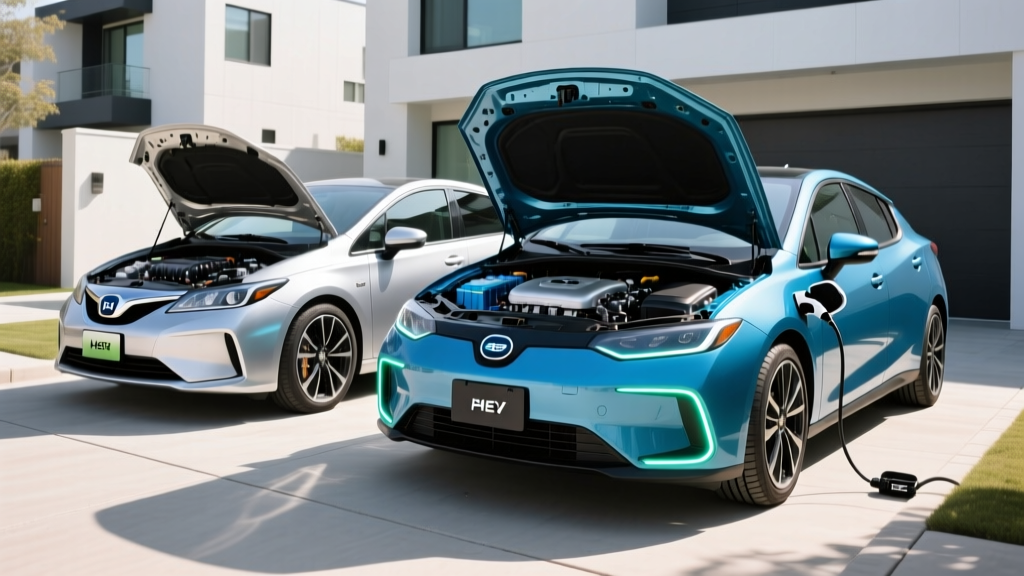
- Conventional Hybrid (HEV): The battery charges only from the engine and regenerative braking. There is no plug. The battery is small (typically 1–2 kWh), and the electric motor assists but cannot propel the car alone for meaningful distances.
- Plug-in Hybrid (PHEV): The battery is much larger (typically 13–25 kWh usable) and charges via a plug — either a standard 120V outlet (Level 1) or a 240V home charger (Level 2). A PHEV can drive 25–50 miles on electricity alone before the gas engine engages.
Both are hybrids. Only one plugs in. This distinction matters for your fuel bill, your charging setup, and your tax-credit eligibility.
HEV vs PHEV: Side-by-Side Powertrain Comparison
| Attribute | Conventional Hybrid (HEV) | Plug-in Hybrid (PHEV) |
|---|---|---|
| Battery capacity | 1–2 kWh | 13–25 kWh usable |
| Plugs in? | No — charges via engine + regen | Yes — Level 1 (120V) or Level 2 (240V) |
| Electric-only range | <1 mile at low speed | 25–50 miles (EPA) |
| DC fast charging | Not applicable | Some models (e.g., RAV4 Prime: no; Tucson PHEV: no; most 2026 PHEVs lack DCFC) |
| Typical EPA combined MPG (gas mode) | 40–58 MPG | 25–35 MPG (after battery depletes) |
| Typical MPGe (electric + gas combined) | Not rated in MPGe | 80–105 MPGe |
| Federal tax credit (§30D) | Not eligible | Up to $7,500 if battery ≥7 kWh + sourcing/income/MSRP rules met |
| Home charging install needed? | No | Recommended for daily EV-mode use |
The critical takeaway: a conventional hybrid is a gas car made more efficient. A PHEV is a short-range EV with a gas-engine backup. Your daily mileage and charging access determine which one saves you more money.
How Many MPG Does a Hybrid Get? Real Numbers by Model
Fuel economy is the primary reason buyers choose hybrids. Below are EPA figures for popular 2026 models, with real-world notes from owner data and independent testing.
| Model (2026) | Type | City MPG | Highway MPG | Combined MPG | Real-World Note |
|---|---|---|---|---|---|
| Toyota Prius | HEV | 57 | 56 | 57 | Often exceeds EPA in city; ~52–55 highway at 75 mph |
| Toyota Prius Prime | PHEV | 52 (gas) | 48 (gas) | 50 (gas) / 127 MPGe | 44 mi EV range; 480+ mi total |
| Honda Accord Hybrid | HEV | 51 | 44 | 48 | Strong city regen; highway drops to ~40 at 80 mph |
| Toyota RAV4 Hybrid | HEV | 41 | 38 | 40 | Consistent across seasons; ~37 real-world highway |
| Toyota RAV4 Prime | PHEV | 40 (gas) | 36 (gas) | 38 (gas) / 94 MPGe | 42 mi EV range; 302 combined HP; no DC fast charge |
| Hyundai Tucson PHEV | PHEV | N/A (gas: 33) | N/A (gas: 33) | 33 (gas) / 80 MPGe | 33 mi EV range; 261 combined HP |
| Ford Maverick Hybrid | HEV | 42 | 33 | 38 | Excellent city; highway towing drops MPG sharply |
Source: fueleconomy.gov — EPA estimates. Real-world figures based on aggregated owner reports and independent testing.
Why hybrids beat their EPA numbers in the city: Regenerative braking recovers kinetic energy every time you slow down, feeding it back into the battery. In stop-and-go traffic, the engine shuts off frequently and the electric motor handles low-speed propulsion. On the highway, the engine runs continuously, and aerodynamic drag dominates — so highway MPG is often lower than city MPG, the opposite of a gas car.
PHEV Electric-Only Range and Total Range
For PHEV buyers, the electric-only range is the number that determines whether you can commute without burning gas. Here are 2026 benchmarks:
| Model | Battery (usable kWh) | EPA EV Range | Total Range (EV + Gas) | Level 2 Charge Time (0–100%) | DC Fast Charge |
|---|---|---|---|---|---|
| Toyota Prius Prime | 13.6 kWh | 44 miles | ~490 miles | ~4 hours (240V, 3.3 kW) | No |
| Toyota RAV4 Prime | 18.1 kWh | 42 miles | ~600 miles | ~2.5 hours (240V, 6.6 kW) | No |
| Hyundai Tucson PHEV | 13.8 kWh | 33 miles | ~420 miles | ~3.5 hours (240V, 7.2 kW) | No |
| Jeep Wrangler 4xe | 17.3 kWh | 22 miles | ~370 miles | ~4 hours (240V) | No |
| BMW X5 xDrive50e | 25.7 kWh | 38 miles | ~440 miles | ~5 hours (240V, 7.4 kW) | No |
DC fast charging is rare on PHEVs. Most 2026 plug-in hybrids max out at Level 2 AC charging (3.3–7.4 kW). The battery is too small to justify the cost and weight of DC fast-charge hardware, and a Level 2 home charger fully replenishes the pack in 2–5 hours — usually overnight. If DC fast charging is essential to your routine, you likely need a full BEV.
Real-world EV range caveat: EPA PHEV range assumes moderate temperatures and mixed driving. Expect 15–25% less EV range in winter (below 40°F) due to cabin heating demands and reduced battery efficiency. Highway-only driving at 70+ mph also reduces EV range by roughly 20% versus the EPA sticker.
Powertrain Specs: Engine + Motor Combined Output
Hybrids are not just about efficiency — many deliver substantially more power than their gas-only siblings because the electric motor fills in torque at low RPMs where the engine is weakest.
- Toyota Prius (HEV): 2.0L 4-cylinder + 2 motors → 194 combined HP (AWD-e: 196 HP). 0–60 mph in ~7.0 seconds.
- Toyota RAV4 Prime (PHEV): 2.5L 4-cylinder + 2 motors → 302 combined HP. 0–60 mph in ~5.7 seconds — the quickest RAV4 ever sold.
- Honda Accord Hybrid: 2.0L 4-cylinder + 2 motors → 204 combined HP. 0–60 mph in ~7.5 seconds.
- Ford Maverick Hybrid: 2.5L 4-cylinder + 1 motor → 191 combined HP. 0–60 mph in ~7.8 seconds.
- Hyundai Tucson PHEV: 1.6L turbo 4-cylinder + 1 motor → 261 combined HP. 0–60 mph in ~6.8 seconds.
The RAV4 Prime is the standout: its PHEV powertrain makes it both the most efficient and the most powerful RAV4 variant, a rare case where going hybrid costs nothing in performance.
Hybrid Battery Warranty, Reliability, and Replacement Cost
Federal mandate: Hybrid and PHEV battery packs must be warranted for a minimum of 8 years / 100,000 miles (10 years / 150,000 miles in California and states adopting CARB emissions standards). This covers defects and excessive capacity loss.
Real-world lifespan: Toyota's nickel-metal hydride (NiMH) and lithium-ion hybrid batteries routinely exceed 150,000–200,000 miles with minimal degradation. Prius taxi fleets have logged 300,000+ miles on original packs. PHEV batteries, which cycle more deeply, show slightly more degradation but remain well within warranty thresholds.
Replacement cost (out of warranty): HEV battery: $2,000–$4,000. PHEV battery: $4,000–$8,000 depending on capacity. Refurbished packs from independent shops cost 40–60% less.
Hybrid reliability is among the highest in the industry. According to Consumer Reports annual surveys, Toyota and Lexus hybrids consistently rank at or near the top for predicted reliability. The planetary-gear eCVT transmissions used in Toyota hybrids have no clutch packs or bands to wear out, making them mechanically simpler than conventional automatics.
For PHEVs, the added complexity of a charge port, onboard charger, and larger battery introduces more potential failure points, but warranty coverage is robust. The IIHS and NHTSA safety ratings for mainstream hybrids and PHEVs are typically Good/Acceptable across all crash-test categories.
Hybrid vs PHEV vs Full EV: Which Fits Your Life?
Choose a Conventional Hybrid (HEV) If:
- You cannot install a home charger (apartment, street parking, no garage)
- Your daily driving is 30–80 miles with frequent stop-and-go traffic
- You want maximum MPG with zero behavior change — just fill up with gas
- You want the lowest upfront cost among electrified options
- You take frequent long road trips and don't want to plan charging stops
Choose a Plug-in Hybrid (PHEV) If:
- You can charge at home (Level 2, 240V) and your commute is under 40 miles round-trip
- You want to drive on electricity most days but need gas flexibility for weekend trips
- You want to qualify for the federal §30D tax credit (up to $7,500)
- You want EV-like daily driving without range anxiety
- Your household has one car that must do everything — commute and road trip
Choose a full BEV if: Your daily driving is under 250 miles, you have reliable home charging, and you want the lowest per-mile energy cost (~$0.04–$0.06/mile vs. $0.10–$0.14/mile for a hybrid on gas). BEVs also eliminate oil changes, spark plugs, and transmission fluid. But if you regularly drive 400+ miles in a day or live in a charging-desert region, a PHEV or HEV removes the stress.
Pricing and 2026 Federal Tax Credit Eligibility
Conventional hybrids receive no federal tax credit. The IRS §30D Clean Vehicle Credit applies only to plug-in vehicles (PHEVs and BEVs) with battery capacity ≥7 kWh. However, many PHEVs qualify for partial or full credits depending on battery sourcing, buyer income, and MSRP caps.
§30D Credit Requirements (2026):
- Vehicle must be a PHEV or BEV with ≥7 kWh battery capacity
- MSRP cap: $80,000 for SUVs/pickups/vans; $55,000 for sedans
- Buyer income cap (AGI): $150,000 single / $225,000 head of household / $300,000 joint
- Battery critical minerals and components must meet phased-in domestic-sourcing thresholds (increasing annually through 2030)
- Credit can be transferred to the dealer at point of sale as an immediate price reduction
- Credit amount: up to $7,500 ($3,750 for critical minerals + $3,750 for battery components)
Source: IRS §30D Clean Vehicle Credit. Rules are subject to change; verify eligibility with a tax professional before purchase.
Representative 2026 pricing (base MSRP):
- Toyota Prius (HEV): $28,350 — no federal credit
- Toyota Prius Prime (PHEV): $33,375 — may qualify for up to $3,750 (critical-minerals portion; battery-component sourcing varies by build date)
- Toyota RAV4 Hybrid (HEV): $31,925 — no federal credit
- Toyota RAV4 Prime (PHEV): $44,515 — may qualify for up to $7,500 if sourcing thresholds met; limited dealer allocation inflates real transaction prices
- Hyundai Tucson PHEV: $38,400 — credit eligibility depends on battery sourcing; check fueleconomy.gov for current status
- Ford Maverick Hybrid (HEV): $26,995 — no federal credit
Frequently Asked Questions
How many MPG does a hybrid get?
Conventional hybrids range from 38 MPG combined (Ford Maverick Hybrid, RAV4 Hybrid) to 57 MPG combined (Toyota Prius). PHEVs are rated in MPGe during electric-assisted operation — the Prius Prime achieves 127 MPGe — and 48–52 MPG in gas-only mode after the battery depletes. Real-world city driving often exceeds EPA estimates thanks to regenerative braking; highway driving at 75+ mph typically falls 5–10% below the sticker.
How far can a PHEV go on electric only?
Current 2026 PHEVs deliver 22–44 miles of EPA-rated electric-only range. The Toyota Prius Prime leads at 44 miles; the RAV4 Prime achieves 42 miles. In cold weather (below 40°F) or sustained highway speeds, expect 15–25% less. After the battery depletes, the gas engine takes over and the vehicle operates as a conventional hybrid with 33–52 MPG.
Do conventional hybrids need to be plugged in?
No. A conventional hybrid (HEV) charges its battery exclusively through the gasoline engine and regenerative braking. There is no charge port. You fuel it like any gas car and never think about charging infrastructure.
Is a hybrid reliable and what does battery replacement cost?
Hybrids are among the most reliable vehicles on the road. Toyota's hybrid systems in particular have proven durable past 200,000 miles. The hybrid battery is federally warranted for 8 years/100,000 miles (10/150,000 in CARB states). Out-of-warranty replacement runs $2,000–$4,000 for an HEV and $4,000–$8,000 for a PHEV, though refurbished options are widely available at lower cost.
Does a hybrid qualify for a tax credit?
Conventional hybrids (HEVs) do not qualify for the federal §30D Clean Vehicle Credit. Plug-in hybrids (PHEVs) with ≥7 kWh batteries may qualify for up to $7,500, subject to MSRP caps ($80,000 for SUVs, $55,000 for sedans), buyer income limits, and battery-sourcing requirements. The credit can be applied as a point-of-sale price reduction at participating dealers. Always verify current eligibility on fueleconomy.gov before purchasing.
Hybrid vs PHEV vs EV — which should I buy?
If you lack home charging or regularly drive 300+ miles between fuel stops, choose an HEV. If you can charge at home and your commute is under 40 miles, a PHEV lets you drive electric daily while keeping gas flexibility for road trips — and may net you a $3,750–$7,500 tax credit. If your daily driving stays under 250 miles and you have reliable home charging, a full BEV offers the lowest running costs and least maintenance, but requires accepting charging-infrastructure limitations on long trips.