The Definition of a Hybrid Car: What Actually Qualifies
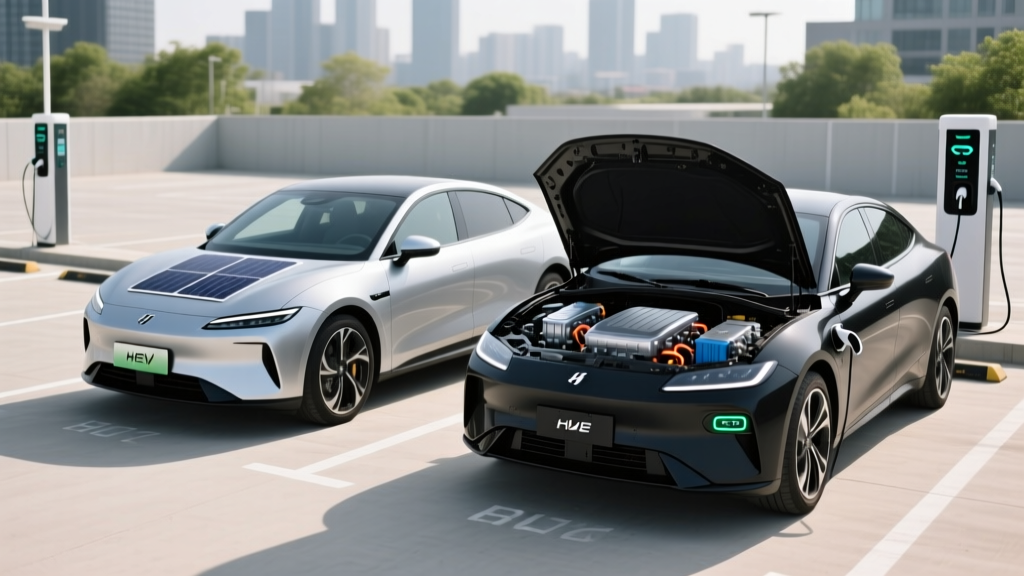
At its simplest, the definition of a hybrid car is any vehicle that combines an internal combustion engine with at least one electric motor and a battery pack to propel the vehicle. Unlike a pure battery-electric vehicle (BEV), a hybrid carries gasoline (or diesel) as its primary energy source and uses the electric drivetrain to improve efficiency, smooth out acceleration, or—in the case of plug-in hybrids—provide a limited electric-only driving range.
That broad definition covers two very different architectures that buyers frequently confuse. Getting the distinction right determines whether you'll ever plug in, how much you'll spend on fuel, and whether you qualify for federal tax credits.
HEV vs PHEV: The Critical Difference
| Feature | Conventional Hybrid (HEV) | Plug-In Hybrid (PHEV) |
|---|---|---|
| Plugs in to charge? | No — charges via regenerative braking and engine | Yes — Level 1 (120V) or Level 2 (240V) |
| Battery size | 0.5–2.0 kWh | 10–25 kWh (usable) |
| Electric-only range | 0 miles (motor assists only) | 20–50 miles typical |
| Federal tax credit (§30D) | Not eligible | Up to $7,500 if requirements met |
| Best for | Drivers without home charging access | Drivers with home charging and short commutes |
Conventional hybrids (HEVs) like the Toyota Prius or Honda Accord Hybrid never need a plug. Their small battery is recharged entirely through regenerative braking and the gasoline engine. Plug-in hybrids (PHEVs) like the Toyota RAV4 Prime or Jeep Wrangler 4xe carry a much larger battery that you charge from a wall outlet or public charger, enabling genuine zero-tailpipe-emission driving for daily commutes before the engine takes over.
How Hybrid Powertrains Work: Engine Meets Electric Motor
Every hybrid pairs a gasoline engine with one or more electric motors. The specific layout varies by manufacturer, but the core operating principle is consistent: the electric motor handles low-speed driving and acceleration assist (where engines are least efficient), while the gasoline engine provides sustained highway cruising and recharges the battery.
There are three primary architectures:
- Parallel hybrid: Both the engine and motor can drive the wheels directly. The Toyota Prius uses a power-split device (planetary gearset) that blends both sources seamlessly. This is the most common design.
- Series hybrid: The engine never drives the wheels—it acts solely as a generator to charge the battery or power the electric motor. The Nissan e-Power system (available in some markets) uses this approach.
- Series-parallel (power-split):strong> The system can operate in either mode depending on conditions. Most modern Toyota, Ford, and Hyundai hybrids use this architecture.
In a PHEV, the same architectures apply, but the larger battery (typically 13–25 kWh usable) and more powerful electric motor (often 100–200 hp on its own) allow the vehicle to operate as a pure EV for a meaningful distance before the engine fires up.
Fuel Economy: Real-World MPG for Today's Top Hybrids
Hybrid fuel economy is where EPA estimates and real-world results often diverge—in a good way. Unlike gasoline cars that get their worst mileage in stop-and-go traffic, hybrids are most efficient in the city, where regenerative braking recovers energy and the electric motor handles low-speed driving. Many drivers consistently exceed EPA city estimates in an HEV.
| Vehicle (2025–2026 MY) | Type | City MPG | Hwy MPG | Combined MPG | Real-World Note |
|---|---|---|---|---|---|
| Toyota Prius (LE AWD) | HEV | 53 | 54 | 54 | 55–60 city common |
| Honda Accord Hybrid | HEV | 51 | 44 | 48 | City exceeds EPA |
| Toyota RAV4 Prime | PHEV | 94 MPGe | 84 MPGe | 94 MPGe | 42 mi EV, then 38 MPG |
| Hyundai Tucson PHEV | PHEV | 80 MPGe | 79 MPGe | 80 MPGe | 33 mi EV, then 35 MPG |
| Ford Maverick Hybrid | HEV | 42 | 33 | 38 | 40+ city achievable |
Source: EPA estimates via fueleconomy.gov. MPGe (miles per gallon equivalent) measures efficiency during electric-only operation for PHEVs. Once the battery is depleted, PHEVs operate as conventional hybrids with standard MPG ratings.
For PHEVs, the real-world advantage is enormous if your daily driving falls within the electric-only range. A RAV4 Prime owner with a 30-mile round-trip commute and nightly Level 2 charging may use gasoline only on weekend road trips—achieving an effective annual fuel consumption measured in gallons, not gallons-per-week.
PHEV Electric Range, Battery, and Charging Explained
The plug-in hybrid's defining feature is its ability to drive on electricity alone. Here's what the numbers look like for current-market PHEVs:
| PHEV Model | Battery (usable kWh) | EV Range (mi) | Total Range (mi) | Level 2 Charge Time | DC Fast Charge? |
|---|---|---|---|---|---|
| Toyota RAV4 Prime | 14.9 kWh | 42 | ~600 | ~2.5 hr (3.3 kW) | No |
| Toyota Prius Prime | 13.6 kWh | 44 | ~610 | ~4 hr (3.3 kW) | No |
| Jeep Wrangler 4xe | 17.3 kWh | 22 | ~370 | ~2 hr (7.2 kW) | No |
| Hyundai Tucson PHEV | 13.8 kWh | 33 | ~430 | ~2 hr (7.2 kW) | No |
| Chrysler Pacifica PHEV | 16.0 kWh | 32 | ~520 | ~2 hr (7.2 kW) | No |
A critical point most buyers overlook: virtually no current PHEVs support DC fast charging. You're limited to Level 1 (standard 120V household outlet, adding roughly 3–5 miles of range per hour) or Level 2 (240V, requiring a dedicated circuit or wallbox, fully charging most PHEVs in 2–4 hours). For overnight home charging, this is perfectly adequate—a PHEV battery is small enough that even a slow charge fills it while you sleep.
When the battery depletes, the vehicle seamlessly transitions to hybrid mode. You never strand yourself—the gasoline engine provides the same total range as any conventional vehicle, often exceeding 500 miles combined.
Powertrain Output: Where Hybrids Punch Above Their Weight
Hybrids don't just save fuel—they often deliver stronger acceleration than their gasoline-only counterparts, thanks to the instant torque from electric motors. Here's what the combined output looks like across popular models:
- Toyota Prius (HEV): 196 hp combined (2.0L 4-cyl + two motor-generators). 0–60 mph in approximately 7.0 seconds—a dramatic improvement over the previous generation's leisurely 10-second sprints.
- Toyota RAV4 Prime (PHEV): 302 hp combined (2.5L 4-cyl + front and rear electric motors). 0–60 mph in 5.7 seconds, making it the quickest RAV4 Toyota sells and one of the quickest compact SUVs in its class.
- Honda Accord Hybrid: 204 hp combined (2.0L 4-cyl + two-motor system). 0–60 mph in roughly 7.4 seconds, with seamless torque delivery that makes it feel quicker than the number suggests.
- Ford Maverick Hybrid: 191 hp combined (2.5L 4-cyl + electric motor). 0–60 mph in approximately 7.8 seconds—competitive with the turbocharged gas Maverick.
- Jeep Wrangler 4xe (PHEV): 375 hp / 470 lb-ft combined (2.0L turbo + two electric motors). 0–60 mph in 6.0 seconds, with the electric motors providing precise low-speed torque for off-road crawling.
The electric motor's contribution is most noticeable in everyday driving: merging onto highways, accelerating from stoplights, and passing on two-lane roads. The motor fills in the torque gaps where a gasoline engine would need to downshift and build RPM.
Pricing, Tax Credits, and Total Cost of Ownership
Hybrid vehicles typically carry a price premium of $1,000–$5,000 over their gasoline-only equivalents, while PHEVs command a larger premium of $4,000–$10,000 due to the bigger battery and more complex powertrain. However, federal tax credits can substantially narrow the gap for PHEVs.
§30D Federal Tax Credit for PHEVs (2026 Rules)
Conventional hybrids (HEVs) do not qualify for the §30D Clean Vehicle Credit. PHEVs may qualify for up to $7,500, but eligibility depends on all of the following:
- Battery capacity: Must be at least 7 kWh (most PHEVs meet this)
- MSRP caps: Vans/SUVs/pickups ≤ $80,000; sedans/other ≤ $55,000
- Buyer income limits: AGI ≤ $150K (single), $225K (head of household), $300K (joint)
- Battery sourcing: Critical minerals and battery components must meet phased-in domestic/free-trade sourcing requirements (thresholds increase annually through 2029)
- Final assembly: Vehicle must be assembled in North America
- Point-of-sale transfer: Credit can be applied at purchase or claimed on your tax return
Rules change annually. Verify current eligibility at irs.gov before purchasing. Consult a tax professional for your specific situation.
Here's how pricing breaks down for representative models (base MSRP, before destination and before any credits):
- Toyota Prius LE (HEV): ~$29,000 — no federal credit
- Toyota Prius Prime SE (PHEV): ~$34,000 — may qualify for up to $3,750–$7,500 depending on sourcing compliance
- Toyota RAV4 Hybrid (HEV): ~$32,000 — no federal credit
- Toyota RAV4 Prime (PHEV): ~$44,500 — may qualify for $7,500 if all sourcing and income requirements are met
- Ford Maverick Hybrid: ~$28,000 — no federal credit
- Jeep Wrangler 4xe (PHEV): ~$51,000 — may qualify for $7,500 (SUV MSRP cap is $80K)
On a total-cost-of-ownership basis, hybrids typically break even with their gas counterparts within 3–5 years through fuel savings alone, depending on local gas prices and annual mileage. PHEVs can break even faster if you charge at home on cheap residential electricity and your commute fits within the EV range.
Battery Longevity, Warranty, and Replacement Costs
Hybrid battery longevity is one of the most common concerns among first-time hybrid buyers. The data, now spanning two decades of real-world use, is reassuring.
Hybrid Battery Warranty Standards
Federal law mandates that hybrid and EV battery packs carry a minimum warranty of 8 years / 100,000 miles. In California Air Resources Board (CARB) states, that extends to 10 years / 150,000 miles. Most manufacturers match or exceed these minimums:
- Toyota: 10 years / 150,000 miles (all states, from 2020 MY forward)
- Hyundai/Kia: 10 years / 100,000 miles
- Honda: 8 years / 100,000 miles (10/150K in CARB states)
- Ford: 8 years / 100,000 miles
The warranty covers battery capacity loss below a specified threshold (typically 60–70% of original capacity) and any cell or module failure.
In practice, hybrid batteries routinely last 150,000–200,000+ miles before needing replacement. The Toyota Prius, now in its fifth generation with over two decades on the road, has demonstrated battery lifespans exceeding 200,000 miles in taxi and fleet service. HEV batteries undergo shallow charge/discharge cycles (typically operating between 40–80% state of charge), which dramatically reduces degradation compared to the deeper cycles in a BEV.
If replacement is needed out of warranty, costs vary significantly:
- HEV battery (Prius, Accord Hybrid): $2,000–$4,000 for a new OEM pack; $1,000–$2,000 for a refurbished unit from a reputable supplier
- PHEV battery (RAV4 Prime, Wrangler 4xe): $6,000–$12,000 for a new OEM pack, reflecting the larger capacity
These costs are declining as the supply of refurbished hybrid batteries grows and third-party repair shops gain expertise. Individual cell or module replacement (rather than the full pack) is increasingly available for $500–$1,500, depending on the model.
Hybrid vs PHEV vs EV: Which Powertrain Fits Your Life?
The decision between HEV, PHEV, and BEV comes down to three variables: your access to charging, your daily driving distance, and your willingness to plan around range.
The Decision Framework
Choose a conventional hybrid (HEV) if:
- You rent or live in an apartment without charging access
- You want maximum fuel efficiency with zero behavior change
- Your budget is tighter and you want the lowest upfront cost
- You frequently take long road trips and don't want to plan charging stops
Choose a plug-in hybrid (PHEV) if:
- You can install a Level 2 charger at home (or have access to workplace charging)
- Your daily round-trip commute is under 40 miles (within EV range)
- You want electric daily driving but gasoline flexibility for road trips
- You want to qualify for the federal tax credit but aren't ready for a full EV
Choose a battery-electric vehicle (BEV) if:
- You have reliable home or workplace charging
- You want to eliminate gasoline entirely and minimize maintenance
- Your budget accommodates the higher upfront cost (offset by tax credits and fuel savings)
- You're comfortable with public DC fast charging for road trips
For many households, a PHEV represents the lowest-risk entry into electrification. You get the daily fuel savings of an EV for commuting, with the security blanket of a gasoline engine for the 5% of driving that exceeds the battery's range. The EPA's PHEV comparison tool lets you model your specific commute to see how a PHEV would perform in your hands.
Pros and Cons: The Honest Hybrid Scorecard
Advantages
- Significantly better city MPG than gas equivalents (often 40–57 MPG combined)
- No range anxiety — gasoline infrastructure everywhere
- Lower maintenance than gas cars (regenerative braking reduces brake wear; no traditional starter or alternator)
- Proven long-term reliability with 20+ years of real-world data
- PHEVs offer electric commuting without charging-station dependence
- Strong resale value — hybrids consistently rank among top-retained-value vehicles
- Smoother acceleration from electric motor torque assist
Limitations
- Higher upfront cost vs gas equivalent ($1,000–$10,000 premium)
- HEVs do not qualify for federal §30D tax credit
- Highway MPG advantage over gas cars is smaller than city advantage
- PHEVs require home charging access to realize full benefit
- PHEV electric range (20–50 mi) is insufficient for some commutes
- Battery replacement cost is a real (though infrequent) long-term expense
- Most PHEVs lack DC fast charging — long road trips run entirely on gas
- Two powertrains mean two systems that could theoretically require service
Frequently Asked Questions
How many MPG does a hybrid car get?
It varies by model, but today's top hybrids achieve 48–57 MPG combined. The Toyota Prius LE leads at 54 MPG combined (53 city/54 highway). Real-world city driving often exceeds EPA estimates because regenerative braking captures energy in stop-and-go traffic where gas cars are least efficient. Highway driving yields slightly lower numbers than the EPA combined figure for most hybrids.
How far can a plug-in hybrid go on electric only?
Current PHEVs offer 22–48 miles of EPA-estimated electric-only range. The Toyota Prius Prime leads at 44 miles, while the RAV4 Prime provides 42 miles. In cold weather (below 40°F), expect 10–20% less due to battery chemistry and heating demand. Once depleted, the vehicle operates as a conventional hybrid with 30–40+ MPG.
Do conventional hybrids need to be plugged in?
No. A conventional hybrid (HEV) charges its battery entirely through regenerative braking and the gasoline engine. You fuel it exactly like a normal car—just fill up with gas. Only plug-in hybrids (PHEVs) benefit from being connected to an external power source.
Is a hybrid car reliable? What about battery replacement cost?
Hybrids have demonstrated strong reliability over 20+ years of production. Toyota's hybrid system in particular has proven exceptionally durable, with many Prius taxis exceeding 300,000 miles on the original battery. All hybrid batteries carry a minimum 8-year/100,000-mile federal warranty. Out-of-warranty replacement runs $2,000–$4,000 for HEVs and $6,000–$12,000 for PHEVs, though refurbished options cost significantly less.
Does a hybrid qualify for any tax credit?
Conventional hybrids (HEVs) do not qualify for the federal §30D Clean Vehicle Credit. Plug-in hybrids (PHEVs) may qualify for up to $7,500, subject to MSRP caps ($55K sedans, $80K SUVs/trucks), buyer income limits, battery sourcing requirements, and North American final assembly rules. Some states offer additional rebates for PHEVs. Check current rules at irs.gov and consult a tax professional.
Hybrid vs PHEV vs EV — which should I buy?
Choose an HEV if you lack home charging and want maximum simplicity. Choose a PHEV if you have home charging, a commute under 40 miles, and want electric daily driving with gas-trip flexibility. Choose a BEV if you have reliable charging access, want zero gasoline costs, and are comfortable with public fast charging for longer trips. For most one-car households without guaranteed charging access, a PHEV is the lowest-risk electrified choice.
How long do hybrid batteries last?
Most hybrid batteries last 150,000–200,000+ miles under normal use. HEV batteries experience shallow charge cycles (typically 40–80% state of charge), which significantly reduces degradation. Toyota's 10-year/150,000-mile battery warranty (in all states for 2020+ models) reflects the company's confidence in longevity. Many first-generation Prius batteries are still in service beyond 200,000 miles.