Quick Verdict: The Grand Highlander Hybrid MAX Limited at a Glance
The 2025 Toyota Grand Highlander Hybrid MAX Limited occupies a narrow but compelling lane: a three-row family hauler that delivers V6-rivaling acceleration alongside midsize-sedan fuel economy. With 362 horsepower from its turbocharged hybrid powertrain and an EPA-estimated 27 MPG combined, it answers the question many three-row SUV buyers ask — can I have real power without the fuel-pump penalty?
This guide breaks down the Hybrid MAX Limited's efficiency, powertrain, pricing, battery longevity, and how it stacks up against plug-in hybrids and full EVs in the three-row segment. If you're cross-shopping this against a Kia EV9, a Chrysler Pacifica PHEV, or the standard Grand Highlander Hybrid, the numbers below will clarify which powertrain fits your driving pattern.
| Specification | Value |
|---|---|
| Powertrain | 2.4L turbocharged 4-cyl + electric motor (Hybrid MAX) |
| Combined Horsepower | 362 hp |
| Combined Torque | 400 lb-ft |
| Transmission | 6-speed automatic |
| Drivetrain | AWD (standard) |
| EPA Fuel Economy (City / Hwy / Combined) | 26 / 27 / 27 MPG |
| Fuel Tank Capacity | 17.1 gallons |
| Total Driving Range | ~461 miles |
| 0–60 mph | ~5.6 seconds (est.) |
| Towing Capacity | 3,500 lbs |
| Seating | 7 passengers (standard captain's chairs) |
| Cargo Volume (behind 3rd / 2nd / 1st row) | 20.6 / 57.9 / 97.5 cu ft |
| Hybrid Battery Type | Lithium-ion (1.87 kWh, sealed) |
| Base MSRP (Limited trim) | ~$54,040 |
| Hybrid Battery Warranty | 10 years / 150,000 miles |
HEV vs. PHEV: What the Grand Highlander Hybrid MAX Actually Is
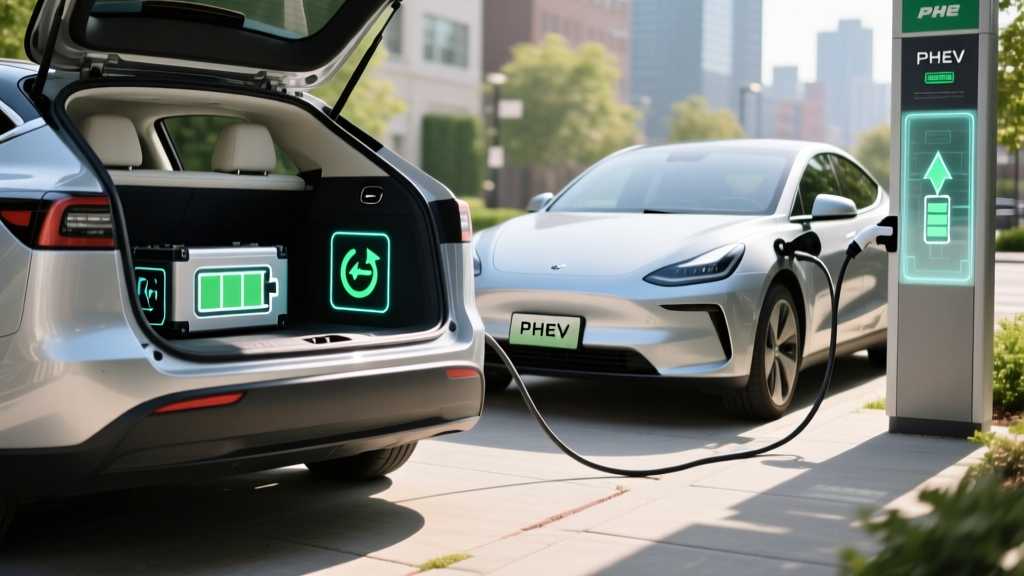
A common point of confusion in the three-row SUV segment is the difference between a conventional hybrid (HEV) and a plug-in hybrid (PHEV). The 2025 Grand Highlander Hybrid MAX Limited is a conventional hybrid (HEV). It does not plug in. It has no electric-only driving range to speak of (the small 1.87 kWh battery assists the gas engine during acceleration and captures energy during braking, but cannot propel the vehicle on electricity alone for meaningful distances).
| Feature | HEV (Grand Highlander Hybrid MAX) | PHEV (e.g., Chrysler Pacifica PHEV) | Full BEV (e.g., Kia EV9) |
|---|---|---|---|
| Plug-in Charging Required? | No | Yes (Level 1 or 2) | Yes (Level 2 or DC fast) |
| Electric-Only Range | None (motor assists engine) | ~32 miles (Pacifica) | 230–300+ miles |
| Gas Engine | Yes (primary power source) | Yes (kicks in after battery depletes) | No |
| Battery Size | ~1.87 kWh | ~16 kWh | 77–100+ kWh |
| Home Charging Install Needed? | No | Recommended (240V for ~2 hr charge) | Essential (240V minimum) |
| Federal Tax Credit (§30D) | Not eligible | Up to $7,500 (if eligible) | Up to $7,500 (if eligible) |
| Best For | No home charging access; long road trips | Short daily commutes + road-trip flexibility | Home charging access; daily driving under 250 mi |
The Hybrid MAX system pairs a turbocharged 2.4-liter four-cylinder engine with a front-mounted electric motor and a rear electric motor for all-wheel drive. Unlike Toyota's traditional eCVT hybrid system (found in the standard Grand Highlander Hybrid), the MAX uses a 6-speed automatic transmission, which gives it a more direct, responsive feel under hard acceleration. The trade-off is slightly lower fuel economy: the standard Grand Highlander Hybrid (non-MAX, non-turbo) achieves up to 36 MPG combined, but produces only 245 hp.
Fuel Economy: EPA Numbers and Real-World MPG
| Driving Cycle | EPA Estimate |
|---|---|
| City | 26 MPG |
| Highway | 27 MPG |
| Combined | 27 MPG |
Source: fueleconomy.gov
Real-World MPG: What to Actually Expect
The Hybrid MAX's EPA numbers are unusual for a hybrid: highway MPG slightly exceeds city MPG. This is because the turbocharged engine is optimized for highway cruising efficiency, while the stop-and-go city driving that typically favors hybrids (thanks to regenerative braking) is offset by the MAX's heavier curb weight (~4,800 lbs) and performance-tuned calibration.
In real-world mixed driving, owners typically report 25–28 MPG combined, closely tracking the EPA estimate. On long highway road trips at 70–75 mph, expect roughly 26–27 MPG. In heavy urban traffic with frequent regen-braking opportunities, you may see brief stretches of 28–29 MPG, but the MAX system's performance bias limits the city-driving advantage that conventional Toyota hybrids (like the Sienna at 36 MPG) typically enjoy.
Cold weather (below 30°F) will reduce fuel economy by roughly 5–10%, primarily due to increased engine runtime for cabin heat and reduced battery assist efficiency. This is a smaller penalty than a full EV experiences in cold weather (which can lose 20–30% of range), but it's worth factoring in if you live in northern climates.
Total Range Reality: With a 17.1-gallon fuel tank and 27 MPG combined, the Grand Highlander Hybrid MAX Limited delivers approximately 461 miles of total range. On a road trip averaging 26 MPG, expect around 445 miles between fill-ups. This eliminates the range anxiety that still accompanies long-distance EV travel in charging-sparse regions.
Powertrain Deep Dive: 362 HP Hybrid MAX System
The Hybrid MAX powertrain is Toyota's performance-oriented hybrid architecture, shared with the Crown and the Grand Highlander's top trim. Here's how it generates its output:
- Gas Engine: 2.4-liter turbocharged inline-4, producing approximately 271 hp and 317 lb-ft of torque on its own
- Front Electric Motor: Integrated into the transaxle, adds boost during acceleration and enables regenerative braking
- Rear Electric Motor: Powers the rear axle for AWD traction, operates independently of the front powertrain
- Combined System Output: 362 hp and 400 lb-ft of torque
- Transmission: Direct-shift 6-speed automatic (not an eCVT)
The result is a 0–60 mph time in the mid-5-second range — quick enough to merge confidently onto any freeway and pass without drama when loaded with passengers and cargo. The 6-speed automatic delivers perceptible gear shifts, which some drivers prefer over the drone of an eCVT under hard acceleration, though it sacrifices the seamless efficiency that eCVTs provide at low speeds.
Towing capacity is rated at 3,500 pounds — adequate for a small boat or light trailer, but below what a body-on-frame SUV with a V6 can manage. If you need to tow over 5,000 lbs, this isn't the right vehicle regardless of powertrain.
Pricing, Trims, and Tax Credit Eligibility
The 2025 Grand Highlander Hybrid MAX is offered exclusively in the Limited trim level (it's not available on the base LE or XLE). Pricing starts around $54,040 including destination charge, with options like premium paint, roof rack cross bars, and accessory packages potentially pushing the as-tested price to $56,000–$58,000.
Federal Tax Credit: Does It Qualify?
No. The Grand Highlander Hybrid MAX Limited is a conventional hybrid (HEV), not a plug-in hybrid or battery electric vehicle. Under current IRS §30D Clean Vehicle Credit rules, only plug-in electric vehicles (PHEVs and BEVs) with sufficient battery capacity qualify for the federal tax credit of up to $7,500. Conventional hybrids like this one do not qualify for §30D.
§30D Tax Credit Eligibility — Quick Reference:
- ✗ Conventional hybrids (HEVs) — not eligible
- ✓ Plug-in hybrids (PHEVs) with ≥4 kWh battery — potentially eligible (subject to MSRP, income, and sourcing rules)
- ✓ Battery electric vehicles (BEVs) — potentially eligible (subject to MSRP, income, and sourcing rules)
- MSRP cap: $80,000 for SUVs/vans/pickups; $55,000 for sedans
- Buyer income cap: $300k joint / $225k head of household / $150k individual (modified AGI)
- Battery component and critical mineral sourcing requirements apply
- Point-of-sale transfer available at participating dealers (reduces purchase price directly)
Some states offer their own incentives for hybrids, but these vary widely and change frequently. Check your state's energy or environmental agency for current programs.
Hybrid Battery Longevity, Warranty, and Replacement Cost
Toyota Hybrid Battery Warranty: 10 years or 150,000 miles (whichever comes first), covering defects and capacity loss below a defined threshold. This applies to the Hybrid MAX's lithium-ion battery pack.
Battery longevity is consistently the top concern among first-time hybrid buyers. Here's what the data shows:
How Long Will the Hybrid MAX Battery Last?
Toyota's hybrid battery packs have a strong track record. The company's earlier nickel-metal-hydride (NiMH) packs in the Prius routinely exceeded 150,000–200,000 miles before significant degradation. The Hybrid MAX uses a smaller lithium-ion pack (~1.87 kWh) that operates in a narrow state-of-charge window — Toyota's hybrid system never fully charges or fully depletes the battery, which dramatically reduces stress and extends cycle life.
Based on Toyota's hybrid history and the conservative charge-management strategy, the Hybrid MAX battery should last the life of the vehicle for most owners. Failures within the warranty period are covered; out-of-warranty failures are uncommon before 200,000+ miles.
Battery Replacement Cost
If replacement is needed outside warranty, expect $2,000–$4,000 for a Toyota hybrid battery pack (refurbished or new), plus labor. This is far less than a full EV battery replacement ($10,000–$20,000+) because the hybrid pack is small. Independent hybrid-battery specialists often offer refurbished packs at the lower end of this range.
Reliability Outlook
Toyota's hybrid systems are among the most proven in the industry, with over 25 years of production hybrid experience. The IIHS and NHTSA have tested the Grand Highlander platform favorably for safety. The Hybrid MAX's turbocharged engine adds a complexity variable compared to Toyota's naturally aspirated hybrids, but the 2.4L turbo is shared across multiple Toyota/Lexus models and has not shown systemic reliability issues in early production.
Hybrid MAX vs. Standard Hybrid vs. EV vs. PHEV: Which Three-Row SUV Fits You?
The Grand Highlander lineup offers two hybrid options, and the broader market offers PHEV and EV alternatives. Here's a decision framework:
Choose the Hybrid MAX Limited if:
- You need 3-row seating and want strong acceleration (362 hp) for merging and mountain passes
- You don't have access to home charging (apartment, street parking, no garage outlet)
- You take frequent long road trips (400+ miles) and don't want to plan around charging stops
- You want Toyota's hybrid reliability without the plug-in lifestyle change
Choose the Standard Grand Highlander Hybrid (non-MAX, 245 hp) if:
- Fuel economy is your top priority (36 MPG combined vs. 27 MPG for the MAX)
- You don't need the extra 117 hp and prefer the lower starting price (~$40,000 LE)
- Your driving is mostly suburban and city — where the eCVT hybrid shines
Choose a PHEV (e.g., Chrysler Pacifica PHEV, 32 mi electric) if:
- Your daily commute is under 30 miles and you have Level 2 home charging
- You want to drive mostly electric on weekdays but take gas-powered road trips on weekends
- You want to potentially qualify for the $7,500 federal tax credit
Choose a Full EV (e.g., Kia EV9, 270–304 mi range) if:
- You have reliable Level 2 home charging and your daily driving is under 200 miles
- You want the lowest per-mile fuel cost (~$0.04–$0.06/mi on home electricity vs. ~$0.13–$0.15/mi on gas at 27 MPG)
- You want to eliminate oil changes and reduce maintenance
- You're willing to plan DC fast-charging stops on road trips over 250 miles
Pros and Cons: 2025 Grand Highlander Hybrid MAX Limited
Pros
- 362 hp delivers genuinely quick acceleration for a 3-row SUV
- 27 MPG combined is impressive for this power and size class
- No plug-in charging required — fuel and go
- 461-mile total range eliminates road-trip range anxiety
- Toyota's 10-year/150,000-mile hybrid battery warranty
- Standard AWD with independent rear electric motor
- Spacious third row and 97.5 cu ft max cargo volume
Cons
- 27 MPG trails the standard Grand Highlander Hybrid by 9 MPG
- Limited trim only — no lower-priced Hybrid MAX option
- ~$54,000 starting price is steep for the segment
- Not eligible for federal §30D tax credit
- 3,500-lb towing capacity is modest for the class
- Turbocharged engine adds complexity vs. Toyota's NA hybrid systems
- Highway-biased EPA means less city-driving MPG advantage than typical hybrids
Frequently Asked Questions
How many MPG does the 2025 Grand Highlander Hybrid MAX Limited get?
The EPA rates it at 26 MPG city, 27 MPG highway, and 27 MPG combined. Real-world driving typically yields 25–28 MPG combined depending on conditions. Cold weather and aggressive driving will push you toward the lower end of that range.
Does the Grand Highlander Hybrid MAX plug in?
No. It is a conventional hybrid (HEV), not a plug-in hybrid. You never need to charge it — the battery is replenished through regenerative braking and the gas engine. If you want electric-only driving capability, you'd need to look at a PHEV like the Chrysler Pacifica Hybrid or a full EV.
Is the Hybrid MAX reliable, and what does battery replacement cost?
Toyota's hybrid systems have a 25+ year track record of reliability. The Hybrid MAX's lithium-ion battery is warrantied for 10 years/150,000 miles. Out-of-warranty replacement, if ever needed, typically costs $2,000–$4,000 — far less than a full EV battery. The turbocharged engine adds a variable compared to Toyota's naturally aspirated hybrids, but early data shows no systemic issues.
Does the Grand Highlander Hybrid MAX qualify for a tax credit?
Not the federal §30D Clean Vehicle Credit, which applies only to plug-in vehicles (PHEVs and BEVs). Some states may offer hybrid-specific incentives, but these vary by jurisdiction. Check your state's energy agency or consult a tax professional for current local programs.
How does the Hybrid MAX compare to the standard Grand Highlander Hybrid?
The standard hybrid produces 245 hp and achieves up to 36 MPG combined at a lower starting price (~$40,000). The Hybrid MAX trades 9 MPG for 117 additional horsepower, a 6-speed automatic (instead of eCVT), and a performance driving character. If fuel economy is your priority, the standard hybrid wins decisively. If you want quick acceleration and don't mind the MPG trade-off, the MAX delivers.
What is the total driving range?
Approximately 461 miles on a full 17.1-gallon tank at the EPA combined estimate of 27 MPG. On highway-heavy road trips at 70+ mph, expect roughly 440–450 miles before needing fuel.
Can the Hybrid MAX Limited tow?
Yes, it's rated for 3,500 pounds — enough for a small utility trailer, a pair of jet skis, or a lightweight pop-up camper. It's not rated for heavy boat trailers or large travel trailers. If you need 5,000+ lb towing, consider a body-on-frame SUV.