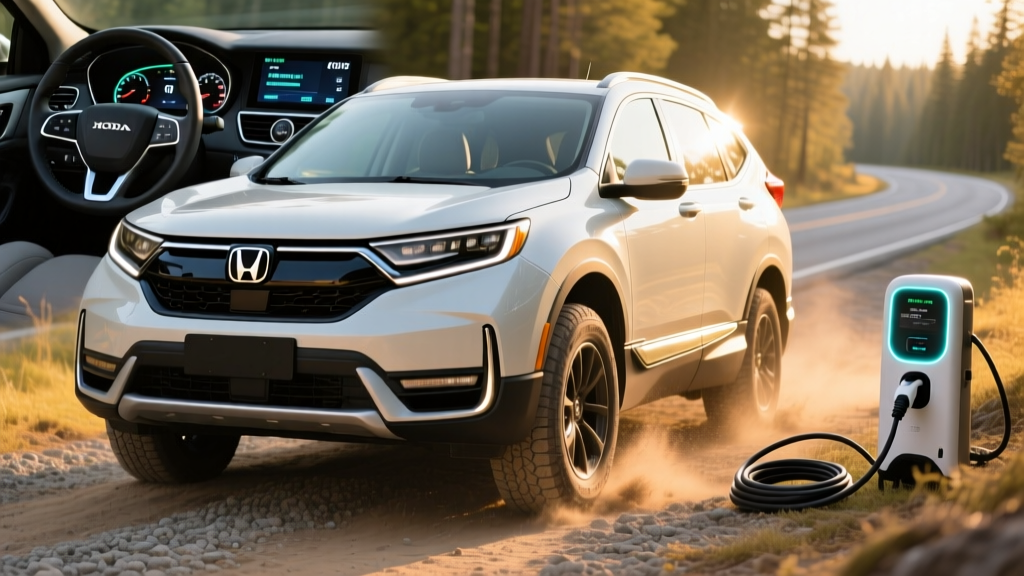
The Honda CR-V TrailSport Hybrid occupies a specific niche: buyers who want the rugged styling and light off-road capability of an adventure trim without the fuel-economy penalty that typically comes with it. For 2026, Honda continues to offer the TrailSport exclusively with its two-motor hybrid powertrain, making it one of the most efficient compact SUVs in the adventure-oriented segment. This guide covers everything you need to know — from EPA-rated MPG to real-world fuel economy, powertrain behavior, pricing, and whether this hybrid makes more sense for your lifestyle than a PHEV or full EV.
HEV vs PHEV: What the CR-V TrailSport Hybrid Actually Is
Before evaluating the CR-V TrailSport Hybrid's efficiency, it's essential to understand what type of electrified vehicle it is — and what it isn't.
Conventional Hybrid (HEV) — The CR-V TrailSport Hybrid
- How it charges: Regenerative braking and the gasoline engine recharge the battery automatically. No plug-in required.
- Battery size: ~1.06 kWh lithium-ion (small, assists the engine)
- Electric-only driving: Very short distances at low speeds (under ~1 mile). The electric motor primarily assists the engine rather than replacing it.
- Refueling: Gasoline only, just like a conventional car.
Plug-In Hybrid (PHEV) — Not Offered for CR-V TrailSport
- How it charges: Plugs into a wall outlet or Level 2 charger for meaningful electric-only range (typically 25–45 miles).
- Battery size: 12–20 kWh range, substantially larger.
- Electric-only driving: Can handle daily commutes entirely on electricity before the gas engine engages.
- Refueling: Electricity + gasoline.
The CR-V TrailSport Hybrid is a conventional HEV. You never plug it in. You simply fill it with gas and drive. The hybrid system recovers energy during braking and deceleration that would otherwise be wasted, storing it in a small battery that powers an electric motor to assist the gasoline engine. The result is significantly better fuel economy — especially in city driving — without any change to your fueling routine.
Fuel Economy: EPA Ratings vs Real-World MPG
The headline number for the 2026 CR-V TrailSport Hybrid is strong for an AWD SUV with off-road pretensions. Here's the EPA breakdown:
| Metric | EPA Rating |
|---|---|
| City MPG | 40 MPG |
| Highway MPG | 34 MPG |
| Combined MPG | 37 MPG |
| Fuel Tank Capacity | 14.0 gallons |
| Total Estimated Range | ~518 miles |
Source: EPA Fuel Economy
Real-World MPG: What Owners Actually See
The CR-V hybrid's two-motor system excels in stop-and-go city driving, where regenerative braking constantly recaptures energy. In real-world testing and owner reports, city MPG often meets or even exceeds the 40 MPG EPA rating — sometimes touching 42–44 MPG on flat urban routes with moderate traffic.
Highway driving tells a different story. At sustained 70–80 mph speeds, the gasoline engine does most of the work, and the aerodynamic drag of the TrailSport's taller ride height and all-terrain tires reduce efficiency. Expect 31–34 MPG on the highway in real-world conditions. On a 300-mile road trip at 75 mph, plan for roughly 33 MPG — right at or slightly below the EPA highway estimate.
Cold weather impact: In freezing temperatures (below 32°F), hybrid fuel economy typically drops 10–15% because the engine runs more frequently to generate cabin heat and because battery efficiency decreases in cold conditions. Winter city driving may yield 34–36 MPG rather than 40.
TrailSport-specific considerations: The TrailSport trim rides on 17-inch wheels with all-terrain tires and has slightly increased ground clearance. Compared to the Sport Touring Hybrid (which wears street-oriented tires), expect a 1–2 MPG penalty across the board. The trade-off is improved traction on gravel, dirt, and light snow.
Powertrain Specs: Two-Motor Hybrid System
Honda's fourth-generation two-motor hybrid system powers the 2026 CR-V TrailSport. Unlike some competitors that use a traditional transmission, Honda's system operates primarily in series-hybrid mode at lower speeds — the gasoline engine acts as a generator to produce electricity, and the electric drive motor turns the wheels. At higher highway speeds, a lock-up clutch connects the engine directly to the wheels for maximum efficiency.
| Specification | Detail |
|---|---|
| Engine | 2.0L DOHC 4-cylinder (Atkinson cycle) |
| Engine Output | 145 hp / 134 lb-ft torque |
| Drive Motor Output | 184 hp / 247 lb-ft torque |
| Combined System Output | 204 hp / 247 lb-ft torque |
| Drivetrain | Real Time AWD™ (standard on TrailSport) |
| Transmission | Electronic Continuously Variable (eCVT) |
| Hybrid Battery | ~1.06 kWh lithium-ion |
| 0–60 mph (est.) | ~7.8 seconds |
| Towing Capacity | 1,000 lbs |
The 204 combined horsepower is competitive with the Toyota RAV4 Hybrid (219 hp) and exceeds the non-hybrid CR-V's 190 hp turbocharged output. More importantly, the electric motor's instant 247 lb-ft of torque gives the TrailSport Hybrid responsive acceleration from a stop — no turbo lag, no transmission hunting. It feels quicker than the 7.8-second 0–60 time suggests in everyday driving.
The Real Time AWD system is torque-vectoring and can send up to 50% of power to the rear wheels when slip is detected. It's not a dedicated off-road system like a Jeep Wrangler's 4WD, but it handles gravel roads, snowy driveways, and mild trail use competently. The TrailSport adds specific off-road drive modes (Snow, Trail) and revised damper tuning for rougher surfaces.
Pricing, Trims, and Tax Credit Eligibility
The 2026 CR-V TrailSport Hybrid starts at a competitive price point for the compact SUV segment:
| Trim | MSRP (incl. destination) |
|---|---|
| CR-V TrailSport Hybrid (AWD) | $39,845 |
Standard equipment on the TrailSport Hybrid includes:
- Real Time AWD with off-road drive modes
- 17-inch alloy wheels with all-terrain tires
- Heated front seats and heated steering wheel
- 9-inch touchscreen with wireless Apple CarPlay and Android Auto
- Honda Sensing suite (adaptive cruise, lane keeping, collision mitigation)
- Wireless phone charger
- Power moonroof
- Orange-accented interior stitching and TrailSport badging
Does the CR-V TrailSport Hybrid Qualify for a Federal Tax Credit?
No. The CR-V TrailSport Hybrid is a conventional hybrid (HEV), not a plug-in hybrid or battery-electric vehicle. Under current IRS §30D Clean Vehicle Credit rules, only plug-in electric vehicles (PHEVs and BEVs) with sufficient battery capacity qualify for the federal tax credit of up to $7,500. Conventional hybrids are excluded.
Some states offer modest incentives for conventional hybrids, but these are increasingly rare as state programs shift focus to PHEVs and BEVs. Check your state's energy or environmental agency website for current programs.
Battery Warranty, Reliability, and Replacement Cost
Honda Hybrid Battery Warranty
- Coverage: 8 years / 100,000 miles (10 years / 150,000 miles in CARB states including CA, NY, MA, and others)
- What's covered: Hybrid battery pack and hybrid system components (power control unit, electric motor)
- Threshold: Honda warrants against defects and abnormal capacity loss
How Long Will the Hybrid Battery Last?
Honda's hybrid battery packs in the CR-V have demonstrated strong longevity. The ~1.06 kWh battery is small and operates within a conservative state-of-charge window — it never fully charges or fully depletes, which dramatically reduces stress on the cells. Based on data from Honda's hybrid fleet (Accord Hybrid, CR-V Hybrid), most hybrid batteries outlast the 8-year/100,000-mile warranty period without significant degradation.
Real-world reports from high-mileage Honda hybrid owners (150,000+ miles) generally show minimal battery capacity loss. Unlike full EVs where battery degradation directly reduces range, a modest loss in hybrid battery capacity primarily reduces the frequency and duration of electric assist — the car remains fully drivable, just slightly less efficient.
Battery Replacement Cost
If replacement is needed outside warranty coverage, a CR-V hybrid battery pack typically costs $2,000–$4,000 including parts and labor at a Honda dealer. Independent hybrid specialists may offer refurbished packs for $1,500–$2,500. This is substantially less than full EV battery replacement ($8,000–$20,000+) because the hybrid battery is far smaller.
Honda's hybrid system reliability is well-established. IIHS has historically rated the CR-V highly for safety, and the hybrid powertrain adds few failure-prone components — there is no traditional transmission, no starter motor, and no alternator to replace.
TrailSport vs Other CR-V Hybrids: What You Gain and Lose
The TrailSport isn't the only hybrid in the CR-V lineup. Here's how it compares to the Sport Touring Hybrid, the other top-tier CR-V hybrid trim:
| Feature | TrailSport Hybrid | Sport Touring Hybrid |
|---|---|---|
| MSRP | $39,845 | $41,845 |
| Wheels | 17-inch w/ all-terrain tires | 19-inch w/ all-season tires |
| EPA Combined MPG | 37 MPG | 39 MPG |
| Ground Clearance | 8.2 inches (slightly raised) | 7.9 inches |
| Off-Road Modes | Snow, Trail | Snow only |
| Roof Rails | Standard | Standard |
| Premium Audio | — | Bose 12-speaker |
| Navigation | — | Standard |
| Hands-Free Liftgate | — | Standard |
The trade-off is clear: the TrailSport gives you genuine light off-road capability and rugged aesthetics at a lower price, while the Sport Touring Hybrid offers more luxury features and marginally better fuel economy with its street tires. For buyers who actually drive on unpaved roads, campgrounds, or snowy mountain passes, the TrailSport's all-terrain tires and Trail mode justify the 2 MPG penalty.
CR-V TrailSport Hybrid vs the Competition
The compact adventure-hybrid segment has several strong competitors. Here's how the CR-V TrailSport Hybrid stacks up:
| Vehicle | Combined MPG | Combined HP | AWD Standard? | Starting MSRP |
|---|---|---|---|---|
| Honda CR-V TrailSport Hybrid | 37 MPG | 204 hp | Yes | $39,845 |
| Toyota RAV4 TRD Off-Road (non-hybrid) | 28 MPG | 203 hp | Yes | $39,395 |
| Toyota RAV4 Woodland Edition Hybrid | 39 MPG | 219 hp | Yes | $37,495 |
| Subaru Forester Hybrid (2026) | 35 MPG | 194 hp | Yes | $38,495 |
| Ford Bronco Sport (non-hybrid) | 26 MPG | 181 hp | Yes | $33,495 |
The RAV4 Woodland Edition Hybrid is the closest direct competitor — it offers slightly better fuel economy and more horsepower at a lower price, but lacks the CR-V TrailSport's interior refinement and Honda Sensing safety suite standard equipment. The Subaru Forester Hybrid provides standard AWD and strong visibility but trails on fuel economy. The Bronco Sport is the most off-road capable but has no hybrid option and significantly worse MPG.
Pros
- 37 MPG combined is excellent for an AWD adventure SUV
- Strong 247 lb-ft electric torque for responsive acceleration
- No plug-in charging required — refuel like any gas car
- Comprehensive Honda Sensing safety suite standard
- 8-year/100,000-mile hybrid battery warranty (10/150k in CARB states)
- Competitive pricing under $40,000
Cons
- 2 MPG penalty vs Sport Touring Hybrid due to all-terrain tires
- No federal tax credit (HEV, not PHEV)
- 1,000-lb towing limit — not for trailers or boats
- Trail mode is light off-road only — not a Jeep Wrangler competitor
- No PHEV version available for electric-only commuting
Who Should Choose the CR-V TrailSport Hybrid?
Choose the CR-V TrailSport Hybrid if:
- You want 35+ MPG without ever plugging in a vehicle
- You drive on gravel roads, forest service roads, or snowy passes regularly
- You prefer the simplicity of gasoline refueling with hybrid efficiency gains
- You want a compact SUV with proven reliability and strong resale value
- You don't have access to home or workplace charging (apartment, street parking)
Consider a PHEV instead if:
- You have home charging and a commute under 30 miles (a PHEV can handle it on electricity alone)
- You want to qualify for the federal §30D tax credit (up to $7,500 for eligible PHEVs)
- You want to minimize gasoline use on daily drives
Consider a full EV if:
- You have reliable home Level 2 charging
- Your daily driving is under 250 miles and you road-trip infrequently
- You want zero tailpipe emissions and the lowest per-mile fuel cost
Frequently Asked Questions
How many MPG does the 2026 CR-V TrailSport Hybrid get?
The EPA rates the CR-V TrailSport Hybrid at 40 MPG city, 34 MPG highway, and 37 MPG combined. Real-world city driving often matches or exceeds 40 MPG, while highway driving at 75 mph typically yields 31–34 MPG. Cold weather reduces city MPG by roughly 10–15%.
Does the CR-V TrailSport Hybrid need to be plugged in?
No. The CR-V TrailSport Hybrid is a conventional hybrid (HEV), not a plug-in hybrid. It charges its small battery through regenerative braking and the gasoline engine. You refuel it at a gas station exactly like a conventional vehicle.
Can the CR-V TrailSport Hybrid drive on electric power only?
Only for very short distances (under a mile) at low speeds, such as creeping through a parking lot. The electric motor primarily assists the gasoline engine rather than replacing it. If you want meaningful electric-only driving (25–40 miles), you need a PHEV — Honda does not currently offer a CR-V PHEV in the US market.
Does the CR-V TrailSport Hybrid qualify for any tax credit?
No. The federal §30D Clean Vehicle Credit applies only to plug-in electric vehicles (PHEVs and BEVs) with qualifying battery sourcing and MSRP/income requirements. Conventional hybrids like the CR-V TrailSport Hybrid are not eligible. Some states may offer minor hybrid incentives — check your state energy office for details.
Is the CR-V hybrid battery reliable, and what does replacement cost?
Honda's hybrid battery systems have demonstrated strong reliability, with most packs lasting well beyond the 8-year/100,000-mile warranty (10 years/150,000 miles in CARB states). If replacement is needed out of warranty, expect $2,000–$4,000 at a dealer, or $1,500–$2,500 from an independent hybrid specialist. The conservative charge/discharge cycles in Honda's hybrid system minimize degradation.
How does the TrailSport Hybrid handle off-road?
The TrailSport Hybrid is designed for light off-road use — gravel roads, dirt fire roads, snowy passes, and grassy campgrounds. Its Real Time AWD, Trail drive mode, all-terrain tires, and 8.2 inches of ground clearance handle these conditions well. It is not designed for rock crawling, deep mud, or extreme terrain. Think forest service roads, not Moab.
What's the difference between the TrailSport Hybrid and the Sport Touring Hybrid?
The TrailSport prioritizes off-road capability with 17-inch all-terrain tires, Trail drive mode, and slightly higher ground clearance at $39,845. The Sport Touring Hybrid ($41,845) prioritizes luxury with 19-inch wheels, Bose premium audio, built-in navigation, and a hands-free liftgate — and gets 39 MPG combined vs the TrailSport's 37 MPG.