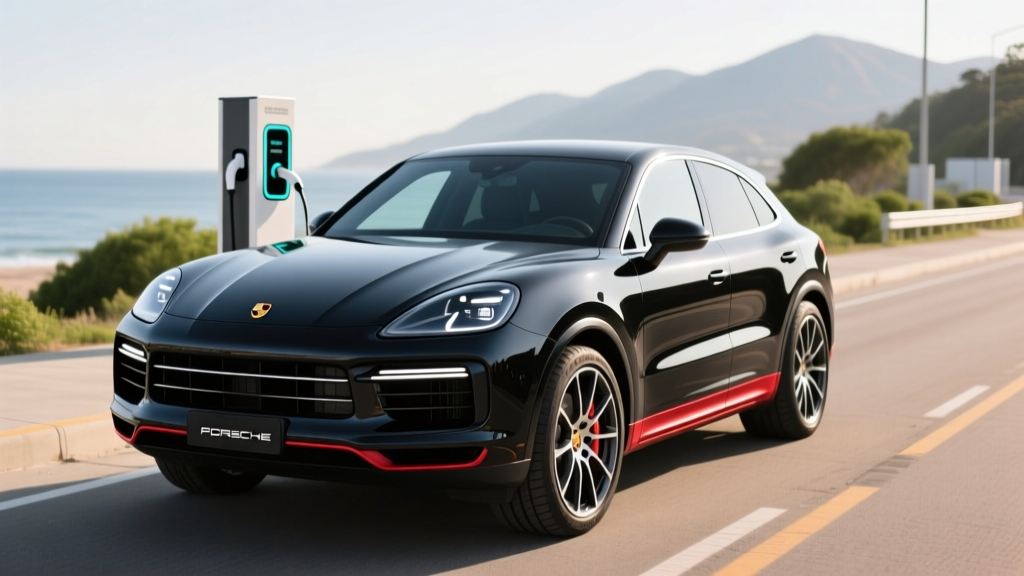
The Porsche Cayenne has offered electrified powertrains for years, but the current-generation Porsche Cayenne plug-in hybrid (officially the Cayenne E-Hybrid) represents a significant leap in electric-only usability. With a 25.9 kWh battery pack, roughly 27 miles of zero-emission driving, and a combined output of 463 horsepower, it threads the needle between daily EV commuting and long-distance capability. But at a starting price north of $91,000, buyers need to know exactly what they're getting — and whether a PHEV makes more sense than going full electric or sticking with the standard Cayenne.
This guide covers every number that matters: EPA fuel economy, real-world range expectations, charging logistics, powertrain specs, tax-credit eligibility, and long-term battery reliability. We'll also frame where the Cayenne E-Hybrid fits against full EVs like the Cayenne Electric (upcoming) and rivals such as the BMW X5 xDrive50e.
HEV vs. PHEV: What the Cayenne E-Hybrid Actually Is
Before diving into specs, it's essential to distinguish the two hybrid architectures Porsche offers in the Cayenne lineup:
Conventional Hybrid (HEV)
A standard hybrid uses a small battery (typically 1–2 kWh) charged solely through regenerative braking and the gas engine. You never plug it in. It improves fuel economy modestly — especially in city driving — but cannot drive on electric power alone for meaningful distances.
Plug-In Hybrid (PHEV) — The Cayenne E-Hybrid
The Cayenne E-Hybrid carries a much larger 25.9 kWh battery that you charge by plugging into a wall outlet, Level 2 home charger, or (on certain trims) a DC fast charger. It can operate as a pure electric vehicle for short trips before the turbocharged V6 engine seamlessly takes over. This dual nature is the PHEV's defining advantage: electric commuting without range anxiety on road trips.
The current Cayenne lineup does not include a conventional HEV variant in the U.S. market. When people search for the "Porsche Cayenne plug-in hybrid," they're looking at the E-Hybrid — and that's what this guide covers.
Powertrain, Horsepower, and Performance Specs
The Cayenne E-Hybrid pairs a 3.0-liter turbocharged V6 with an electric motor integrated into the eight-speed Tiptronic transmission. The result is seamless power delivery and the kind of acceleration you'd expect from Porsche.
| Specification | Cayenne E-Hybrid (SUV) | Cayenne E-Hybrid Coupe |
|---|---|---|
| Engine | 3.0L Turbo V6 + Electric Motor | 3.0L Turbo V6 + Electric Motor |
| Combined Horsepower | 463 hp | 463 hp |
| Combined Torque | 479 lb-ft | 479 lb-ft |
| 0–60 mph | 4.6 seconds | 4.5 seconds |
| Top Speed | 152 mph | 152 mph |
| Battery (Usable) | ~22.0 kWh (25.9 kWh gross) | ~22.0 kWh (25.9 kWh gross) |
| Battery Chemistry | NMC (Nickel Manganese Cobalt) | NMC |
| Transmission | 8-speed Tiptronic Automatic | 8-speed Tiptronic Automatic |
| Drivetrain | All-Wheel Drive (AWD) | All-Wheel Drive (AWD) |
| Max EV-Only Speed | 84 mph | 84 mph |
The electric motor alone produces 174 hp (130 kW), which is substantial enough for highway merging and spirited city driving without ever waking the V6. Porsche's energy management system lets you select from E-Power (electric-first), Hybrid Auto (system-managed), E-Hold (save battery for later), and E-Charge (engine charges battery) modes.
Fuel Economy: EPA MPG and MPGe Breakdown
The Cayenne E-Hybrid's efficiency depends entirely on how you use it. Charge it nightly and keep trips under 27 miles? You'll burn almost no gasoline. Take a 500-mile road trip without charging? You're driving a heavy luxury SUV on its gas engine alone.
| Metric | City | Highway | Combined |
|---|---|---|---|
| MPGe (electric + gas) | — | — | ~46 MPGe |
| Gas-Only MPG (charge-depleted) | ~19 mpg | ~22 mpg | ~20 mpg |
Real-world MPG vs. EPA: PHEVs are notoriously sensitive to driver behavior. If you charge daily and drive 20–25 miles round trip, your effective fuel consumption could approach zero for weeks at a time. On long highway trips with a depleted battery, expect 19–21 mpg — roughly on par with the non-hybrid Cayenne, since the E-Hybrid carries an additional ~300 pounds of battery and powertrain hardware. City driving in gas-only mode may slightly exceed the EPA estimate thanks to regenerative braking recapturing energy in stop-and-go traffic.
Total Range Reality
EPA electric-only range: ~27 miles
Gas tank: ~19.8 gallons
Total combined range (full charge + full tank): ~420 miles
Cold-weather caveat: Expect 15–25% electric-range reduction below freezing. A 27-mile EPA rating may drop to 20–22 miles in winter conditions, as battery chemistry becomes less efficient and cabin heating draws significant energy.
Charging: How Long, How Fast, and What Connector
Charging logistics are where many PHEV buyers are surprised. The Cayenne E-Hybrid's 25.9 kWh battery is large for a PHEV, meaning Level 1 (standard 120V outlet) charging is impractically slow. Here's the full picture:
| Charging Level | Power | 0–100% Time | Notes |
|---|---|---|---|
| Level 1 (120V household) | ~1.4 kW | ~18–20 hours | Emergency/trickle only — impractical for daily use |
| Level 2 (240V home charger) | 7.2 kW (onboard charger max) | ~3.5–4 hours | Ideal for overnight charging; full battery by morning |
| DC Fast Charging (optional) | Up to 40 kW | ~25 min (10–80%) | Available as an option on select trims; CCS connector |
Key takeaway: A Level 2 home charger is essentially mandatory for Cayenne E-Hybrid ownership. The 7.2 kW onboard charger means you'll replenish the full battery in under four hours — easily done overnight. If you opt for the DC fast-charge capability (a cost-add on certain configurations), you can top up at public CCS stations during errands, though 40 kW peak is modest compared to full BEVs that pull 150–350 kW.
Connector: The Cayenne E-Hybrid uses the CCS1 (Combined Charging System) connector for AC and DC charging in North America. Note that Porsche's upcoming all-electric Cayenne will use the NACS (Tesla) standard, but the current PHEV remains CCS1.
Pricing, Trims, and Tax-Credit Eligibility
The Cayenne E-Hybrid sits in the upper tier of Porsche's SUV lineup. Here's the current pricing landscape:
| Trim | Starting MSRP | Typical As-Tested |
|---|---|---|
| Cayenne E-Hybrid (SUV) | ~$91,700 | $100,000–$115,000 |
| Cayenne E-Hybrid Coupe | ~$95,300 | $105,000–$120,000 |
| Cayenne S E-Hybrid (SUV) | ~$102,100 | $115,000–$130,000 |
| Cayenne Turbo E-Hybrid | ~$148,500 | $160,000+ |
Federal tax credit (§30D): This is where the Cayenne E-Hybrid faces a significant hurdle. The IRS §30D clean vehicle credit imposes an MSRP cap of $80,000 for SUVs. Since every Cayenne E-Hybrid trim starts above $91,000, none qualify for the federal $7,500 new-vehicle tax credit. Additionally, the credit requires meeting critical-mineral and battery-component sourcing requirements, and buyer income caps ($300,000 joint / $150,000 single) apply even to eligible vehicles.
State incentives: Some states offer their own rebates or HOV-lane access for PHEVs regardless of price. California's Clean Fuel Rebate, for instance, has historically included PHEVs, though amounts and eligibility change. Check your state's energy office or the Alternative Fuels Data Center for current local programs.
Battery Warranty, Reliability, and Replacement Cost
Porsche High-Voltage Battery Warranty
Coverage: 8 years / 100,000 miles (whichever comes first)
Capacity threshold: Porsche warrants the battery against defects and excessive capacity loss — typically defined as falling below 70% of original usable capacity.
Hybrid system warranty: The electric motor, power electronics, and associated components are also covered under the 8-year/100,000-mile hybrid-component warranty.
Reliability outlook: Porsche's hybrid powertrains have proven generally robust, though the brand's overall reliability ratings from sources like Consumer Reports tend to land in the average-to-below-average range — often due to complex electronics and infotainment issues rather than powertrain failures. The high-voltage battery in the previous-generation Cayenne E-Hybrid (17.9 kWh) has shown modest degradation patterns of roughly 5–8% over 5 years in owner-reported data. The larger 25.9 kWh pack in the current generation should follow similar trajectories, given NMC chemistry's well-documented cycle-life characteristics.
Battery replacement cost: Out-of-warranty high-voltage battery replacement for the Cayenne E-Hybrid is estimated at $12,000–$18,000 including parts and labor at a Porsche dealer. This is a worst-case scenario — individual module replacement or repair may be possible at lower cost. For context, most PHEV batteries last well beyond the warranty period with proper care: avoid frequent deep discharges to 0%, minimize prolonged storage at 100% SoC, and use preconditioning when possible.
Cayenne E-Hybrid vs. Full EV vs. Gas Cayenne: Which Fits You?
Choose the Cayenne E-Hybrid (PHEV) if:
- Your daily commute is under 25–30 miles and you can charge at home nightly
- You take regular road trips exceeding 200 miles and don't want to plan around charging stations
- You want meaningful fuel savings without committing to full-electric infrastructure
- You value Porsche driving dynamics and need a luxury SUV with towing capability (up to 7,700 lbs)
Choose the gas Cayenne if:
- You can't install a Level 2 charger at home (apartment, street parking, no garage)
- Your driving is predominantly long highway trips where the PHEV's weight penalty erodes efficiency
- Upfront cost is a primary concern — the base gas Cayenne starts ~$20,000 lower
Choose a full EV (e.g., Tesla Model X, BMW iX, Rivian R1S) if:
- You want zero tailpipe emissions and the lowest per-mile "fuel" cost
- You have reliable home charging and access to DC fast-charging networks for road trips
- You want to avoid oil changes, spark plugs, and transmission maintenance entirely
- Lower long-term total cost of ownership matters more than initial purchase price
Pros
- ~27 miles electric-only covers most daily commutes emissions-free
- 463 hp with seamless electric torque fill — genuinely quick
- No range anxiety: 420+ total miles on a full tank and charge
- Level 2 charging in ~3.5 hours is fast for a PHEV
- Porsche build quality, interior materials, and driving dynamics
- Optional DC fast charging (rare among PHEVs)
Cons
- MSRP above $91K disqualifies it from the $7,500 federal tax credit
- Gas-only MPG (~20 combined) is unimpressive when battery is depleted
- Heavier than the gas Cayenne, affecting handling and tire wear
- Level 1 charging is impractical — Level 2 install is mandatory
- Options and packages push as-tested prices past $120,000 quickly
- Cargo space slightly reduced vs. gas Cayenne due to battery placement
Ownership Costs: 5-Year Outlook
| Cost Category | Cayenne E-Hybrid | Cayenne (Gas) |
|---|---|---|
| Purchase Price (base) | ~$91,700 | ~$73,200 |
| Fuel (5 yrs / 60K mi)* | ~$5,500–$7,000 | ~$9,500–$11,000 |
| Maintenance (5 yrs) | ~$3,500 | ~$4,000 |
| Insurance (5 yrs) | ~$14,000 | ~$12,500 |
| Depreciation (est.) | ~$38,000 | ~$32,000 |
| Est. 5-Year Total | ~$135,000–$155,000 | ~$131,000–$133,000 |
*Fuel cost assumes regular home charging for the E-Hybrid and $3.50/gallon premium for the gas model. E-Hybrid savings depend heavily on charging frequency — charge daily and fuel costs drop dramatically.
The E-Hybrid's fuel savings partially offset its higher purchase price, but the gap narrows when you factor in steeper depreciation (luxury PHEVs tend to lose value faster) and higher insurance premiums. For most buyers, the E-Hybrid is a lifestyle and environmental choice rather than a pure cost-savings play.
Frequently Asked Questions
How many MPG does the Porsche Cayenne plug-in hybrid get?
The Cayenne E-Hybrid achieves approximately 46 MPGe when operating with a charged battery (combining electric and gas operation). Once the battery is depleted, it returns roughly 20 mpg combined (19 city / 22 highway) on gasoline alone. Your real-world numbers depend entirely on how often you charge: daily charging and short commutes can push effective fuel consumption near zero for local driving.
How far can the Cayenne E-Hybrid go on electric only?
The EPA rates the Cayenne E-Hybrid at approximately 27 miles of electric-only range. In real-world conditions — particularly highway speeds above 65 mph or cold weather below 40°F — expect 20–24 miles. At the max EV-only speed of 84 mph, the battery depletes faster due to aerodynamic drag, so city and suburban driving yields the best electric range.
Does the Porsche Cayenne E-Hybrid qualify for a tax credit?
No. The federal §30D clean vehicle credit caps SUV eligibility at an MSRP of $80,000. Since the cheapest Cayenne E-Hybrid starts around $91,700, it does not qualify for the $7,500 federal credit. Some state-level incentives may still apply — check your local programs. The AFDC state incentive database is a reliable starting point.
Is the Cayenne E-Hybrid reliable, and what does battery replacement cost?
Porsche's hybrid powertrain has been generally reliable, with the high-voltage battery covered by an 8-year/100,000-mile warranty against defects and excessive capacity loss (below 70% SoH). Out-of-warranty battery replacement is estimated at $12,000–$18,000, though most PHEV batteries outlast their warranty periods. Common non-powertrain complaints center on infotainment glitches and complex electronic features rather than the hybrid system itself.
Can the Cayenne E-Hybrid DC fast charge?
Yes, but only if equipped with the optional DC charging package. With this option, the Cayenne E-Hybrid can accept up to 40 kW via a CCS1 connector, achieving a 10–80% charge in roughly 25 minutes. Without the option, the vehicle is limited to AC charging (Level 1 and Level 2 only). We strongly recommend selecting this option if you plan to use public charging infrastructure.
Hybrid vs. PHEV vs. EV — which Cayenne should I buy?
Porsche does not currently sell a conventional hybrid (HEV) Cayenne in the U.S. — your choices are the gas-only Cayenne, the Cayenne E-Hybrid (PHEV), or waiting for the upcoming all-electric Cayenne (announced, expected late 2026/2027). If you can charge at home and want electric commuting without road-trip range planning, the E-Hybrid is the most versatile option today. If you lack home charging access, the gas Cayenne is simpler. If you're ready for full electric and can wait, the upcoming Cayenne Electric will offer 250+ miles of range and NACS Supercharger access.
How much does it cost to charge the Cayenne E-Hybrid at home?
Filling the ~22 kWh usable battery from empty to full on a Level 2 home charger costs approximately $2.60–$4.40 depending on your local electricity rate ($0.12–$0.20/kWh). That works out to roughly $0.10–$0.17 per electric mile — significantly less than the $0.22–$0.28 per mile you'd spend on premium gasoline at current prices.