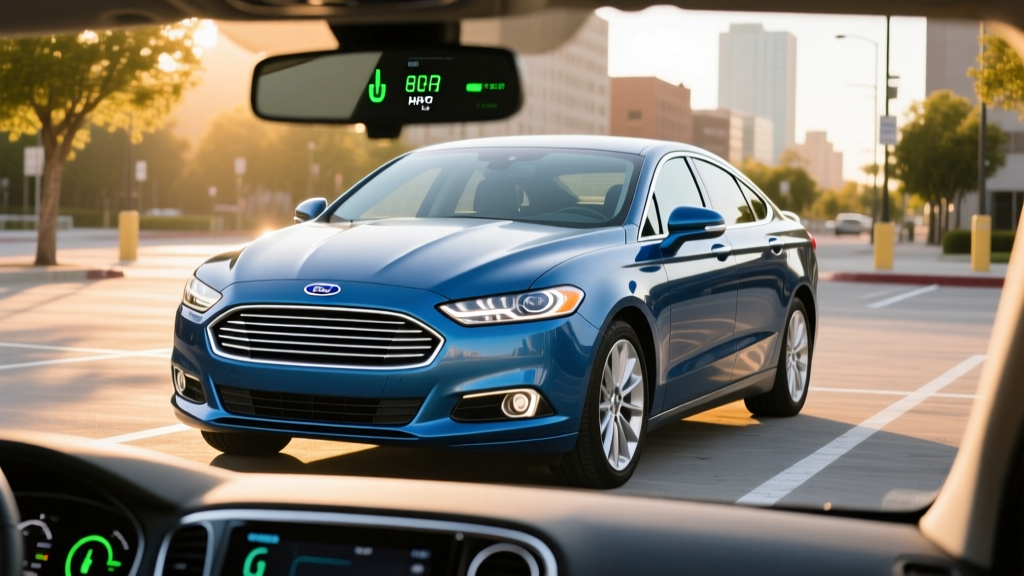
The 2017 Ford Fusion Hybrid remains one of the most popular used midsize sedans for buyers seeking serious fuel savings without plugging in. Nearly a decade after its launch, its EPA-rated 41 MPG combined still holds up against newer competitors. But sticker numbers only tell part of the story — real-world driving habits, battery health, and maintenance costs determine whether this hybrid actually saves you money in 2026.
This guide dissects the 2017 Ford Fusion Hybrid's fuel economy, powertrain, battery longevity, and used-market value so you can decide if it's the right electrified vehicle for your commute — or if a plug-in hybrid (PHEV) or full battery-electric vehicle (BEV) makes more sense today.
2017 Ford Fusion Hybrid Fuel Economy: EPA Ratings vs Real-World MPG
The EPA rates the 2017 Ford Fusion Hybrid at 42 MPG city, 38 MPG highway, and 41 MPG combined. These figures come from fueleconomy.gov, the official U.S. Department of Energy source. For context, the conventional gas-only 2017 Fusion with the 2.5L four-cylinder manages just 21/31/25 MPG — making the hybrid roughly 64% more efficient in combined driving.
| Powertrain | City MPG | Highway MPG | Combined MPG | MPGe (PHEV electric mode) |
|---|---|---|---|---|
| Fusion Hybrid (HEV) | 42 | 38 | 41 | N/A |
| Fusion Energi (PHEV) | 43 (hybrid mode) | 41 (hybrid mode) | 42 (hybrid mode) | 97 MPGe |
| Fusion 2.5L Gas | 21 | 31 | 25 | N/A |
Real-World MPG: What Owners Actually Report
Hybrids typically exceed their EPA city estimates in stop-and-go traffic because regenerative braking recovers energy that gas cars waste as heat. On the flip side, sustained highway driving at 75+ MPH reduces the hybrid advantage since the electric motor assists less at constant speed.
Based on owner-reported data from Fuelly and Edmunds long-term tests, expect:
- City / suburban driving: 40–46 MPG (many owners exceed the 42 EPA city rating)
- Highway (70–75 MPH): 35–39 MPG (slightly below EPA highway due to aerodynamic drag)
- Cold weather (below 32°F): 34–38 MPG combined (engine runs more often for cabin heat)
- Warm-weather mixed driving: 41–44 MPG combined
Hybrid vs Plug-In Hybrid: Fusion HEV and Fusion Energi Explained
Ford sold two electrified Fusions in 2017: the Fusion Hybrid (HEV) and the Fusion Energi (PHEV). Understanding the difference is essential before shopping the used market.
| Feature | Fusion Hybrid (HEV) | Fusion Energi (PHEV) |
|---|---|---|
| Plug-in charging? | No — self-charging via regen & engine | Yes — plug in to access electric-only range |
| Battery capacity | 1.4 kWh (usable ~1.0 kWh) | 7.6 kWh (usable ~5.5 kWh) |
| Electric-only range | N/A (EV assist only at low speed) | 22 miles (EPA) |
| Total range | ~550 miles (13.5-gal tank) | ~610 miles (electric + 14-gal tank) |
| DC fast charging | No | No (Level 1 / Level 2 AC only) |
| Level 2 charge time (0–100%) | N/A | ~2.5 hours at 240V / 3.3 kW |
| Combined HP | 188 hp | 188 hp |
| Trunk space | 12.0 cu ft | 8.2 cu ft (battery intrudes) |
| EPA combined MPG / MPGe | 41 MPG | 42 MPG / 97 MPGe |
How Far Can the Fusion Energi Go on Electric Only?
The 2017 Fusion Energi delivers 22 miles of EPA-rated electric-only range. That covers most short commutes without burning a drop of gas. Once the battery depletes, it operates as a conventional hybrid at 42 MPG combined. Total combined range reaches roughly 610 miles.
The Energi uses a standard J1772 connector for Level 1 (120V, ~7 hours) and Level 2 (240V, ~2.5 hours) charging. It cannot DC fast charge — no CHAdeMO, CCS, or NACS capability. For a 2026 buyer with home Level 2 access, the Energi makes sense if your daily round-trip commute is under 22 miles and you want to minimize gas use without committing to a full BEV.
Powertrain and Performance Specs
| Specification | Detail |
|---|---|
| Engine | 2.0L Atkinson-cycle inline-4 |
| Engine output | 141 hp / 129 lb-ft torque |
| Electric motor | Permanent-magnet AC synchronous, 118 hp / 117 lb-ft |
| Net system horsepower | 188 hp |
| Transmission | eCVT (planetary gearset, no fixed gears) |
| Drivetrain | Front-wheel drive |
| 0–60 MPH | ~7.8 seconds |
| Battery type | Lithium-ion (1.4 kWh gross) |
| Fuel tank | 13.5 gallons |
| Curb weight | ~3,472 lbs |
The 2.0L Atkinson-cycle engine sacrifices some low-RPM torque for thermal efficiency, while the electric motor fills in the gap during acceleration. The eCVT isn't a traditional belt-and-cone CVT — it's a planetary gearset that blends engine and motor power seamlessly. The result is smooth, linear acceleration with no gear-hunt on hills.
At 7.8 seconds to 60 MPH, the Fusion Hybrid is adequate for highway merging but won't win stoplight races. The regenerative braking system is well-calibrated — it offers gradual deceleration that mimics a gas car's engine braking, rather than the aggressive one-pedal feel of many modern BEVs.
Used Pricing and Tax Credit Eligibility in 2026
The 2017 Ford Fusion Hybrid is long discontinued (Ford ended Fusion production after the 2020 model year), so you'll only find it on the used market. As of early 2026, clean-title examples typically list between $10,000 and $16,000 depending on mileage, trim (S, SE, Titanium, Platinum), and condition.
Does It Qualify for a Tax Credit?
Under current IRS §30D Clean Vehicle Credit rules, the used clean vehicle credit (§25E) may apply:
- Credit amount: 30% of the sale price, up to a maximum of $4,000
- Vehicle price cap: Sale price must be $25,000 or less (most used Fusion Hybrids qualify)
- Buyer income limits: AGI ≤ $75,000 (single), $112,500 (head of household), $150,000 (joint)
- Vehicle age: Must be at least 2 model years old (2017 qualifies)
- Dealer requirement: Must purchase from a licensed dealer (private-party sales don't qualify)
- One-time use: Each buyer can claim the used-vehicle credit only once every 3 years
At a $13,000 sale price, the 30% credit yields $3,900 — a meaningful discount. However, always verify eligibility with a tax professional, as IRS rules and dealer participation requirements can change. The original new-vehicle federal tax credit for the Fusion Hybrid expired years ago and is no longer relevant.
Battery Warranty, Longevity, and Replacement Cost
How Long Does the Fusion Hybrid Battery Last?
The 1.4 kWh lithium-ion pack in the Fusion Hybrid is conservatively sized and lightly cycled — it never fully charges or fully discharges, which extends cell life. Owner reports and taxi-fleet data suggest these batteries typically retain 85–92% capacity after 150,000 miles. Failures before 200,000 miles are uncommon but not unheard of.
Key degradation factors:
- Heat exposure: Sustained high ambient temperatures (Arizona, Texas summers) accelerate cell aging
- Mileage: High-mileage examples (150K+) will show more capacity loss
- Storage: Vehicles left sitting at very low or very high state of charge for weeks degrade faster
Is the 2017 Fusion Hybrid Reliable? Battery Replacement Costs
Overall, the 2017 Fusion Hybrid scores well in reliability. IIHS named it a Top Safety Pick+ when equipped with optional front crash prevention. Common complaints center on the infotainment system (SYNC 3 is functional but dated) and occasional coolant leaks in the engine — not the hybrid battery.
If the hybrid battery does need replacement:
- New OEM battery: $2,500–$4,000 (parts and labor at a Ford dealer)
- Refurbished/remanufactured battery: $1,200–$2,200 from independent hybrid specialists
- Individual cell replacement: $500–$1,000 if only a few cells are weak (requires a specialist shop)
Before buying any used Fusion Hybrid, request a hybrid battery health report from the seller or have an independent hybrid-savvy mechanic run a diagnostic scan. The OBD-II port can reveal state of health (SoH) percentage and individual cell voltage variance — key indicators of remaining battery life.
Fusion Hybrid vs PHEV vs Full EV: Which Fits You?
- You can't install a home charger (apartment, street parking, no garage)
- Your commute is mixed city/highway and you want 40+ MPG without behavior changes
- You want the lowest upfront cost ($10K–$16K used) with no charging infrastructure investment
- You regularly drive 400+ miles between fill-ups and don't want to plan charging stops
- You have home Level 2 charging and a commute under 22 miles round-trip
- You want to drive mostly electric on weekdays but need gas flexibility for weekend road trips
- You can sacrifice 3.8 cu ft of trunk space for the larger battery
- You have reliable home charging and want near-zero fuel and maintenance costs
- Your daily driving is under 200 miles and you can plan DC fast-charging stops for road trips
- You want stronger acceleration, one-pedal driving, and the latest ADAS features
Pros and Cons of the 2017 Ford Fusion Hybrid
Pros
- 41 MPG combined — still competitive with 2026 hybrid sedans
- Comfortable, quiet ride with a well-insulated cabin
- Spacious rear seat and 12.0 cu ft trunk (no battery intrusion)
- Strong safety ratings (IIHS Top Safety Pick+)
- Proven, low-risk hybrid powertrain with widely available parts
- Used pricing ($10K–$16K) makes it an accessible entry to electrified driving
Cons
- Discontinued after 2020 — no new models, limited dealer support long-term
- SYNC 3 infotainment feels dated vs modern touchscreens
- No DC fast charging (Energi PHEV) — Level 2 only
- eCVT drone under hard acceleration (common hybrid trait)
- Original battery warranty has expired on all 2017 models
- No advanced driver-assist beyond basic lane-keep and adaptive cruise (no hands-free driving)
Frequently Asked Questions
How many MPG does the 2017 Ford Fusion Hybrid get?
The EPA rates it at 42 MPG city, 38 MPG highway, and 41 MPG combined. In real-world city driving, many owners report 43–46 MPG thanks to regenerative braking. Highway cruising at 75 MPH yields 35–39 MPG. Cold weather reduces combined economy to roughly 34–38 MPG.
Does the 2017 Fusion Hybrid need to be plugged in?
No. The Fusion Hybrid (HEV) is a conventional, self-charging hybrid. It recovers energy through regenerative braking and its gasoline engine — you never plug it in. The separate Fusion Energi (PHEV) model does plug in for 22 miles of electric-only range, but that's a different vehicle.
How far can the Fusion Energi go on electric only?
The 2017 Fusion Energi PHEV delivers 22 miles of EPA-rated electric-only range. After the battery depletes, it switches to hybrid mode at 42 MPG combined. Total range (electric + gas) reaches approximately 610 miles.
Is the 2017 Fusion Hybrid reliable?
Yes. The hybrid powertrain is proven and conservatively engineered. The lithium-ion battery typically retains 85–92% capacity at 150,000 miles. Main reliability concerns are minor — SYNC 3 infotainment glitches and occasional engine coolant system issues. IIHS gave it top safety marks.
What does a replacement hybrid battery cost?
A new OEM replacement runs $2,500–$4,000 installed at a Ford dealer. Refurbished batteries from hybrid specialists cost $1,200–$2,200. Individual cell repairs can be as low as $500–$1,000. Most 2017 Fusion Hybrid batteries haven't needed replacement yet at typical used-car mileages.
Does the 2017 Fusion Hybrid qualify for a tax credit?
The original new-vehicle federal credit is long expired. However, the IRS §25E used clean vehicle credit may provide up to $4,000 (30% of sale price) if you buy from a dealer, the sale price is ≤ $25,000, and your AGI falls within income limits ($75K single / $150K joint). Consult a tax professional to confirm eligibility. Always check current IRS guidance before purchasing.
Should I buy a 2017 Fusion Hybrid or a newer hybrid?
If your budget is under $16,000 and you want a proven, comfortable hybrid sedan, the 2017 Fusion Hybrid is hard to beat on value. However, newer options like the 2022+ Hyundai Sonata Hybrid (52 MPG combined) or Toyota Camry Hybrid (52 MPG combined) offer better efficiency, updated tech, and remaining factory battery warranties — at higher prices ($22K–$30K used). Your choice depends on budget versus longevity assurance.