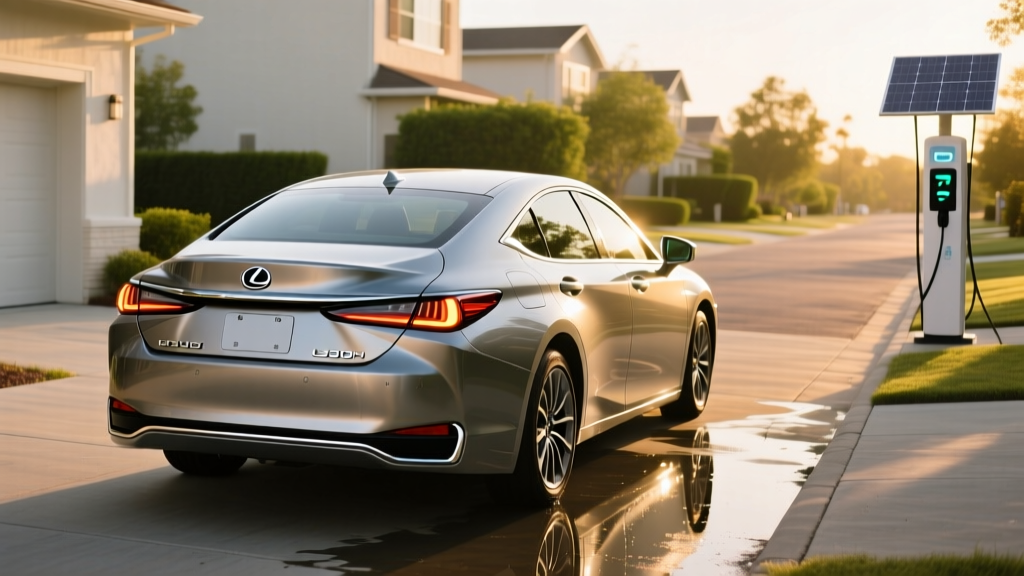
Quick Verdict: The Lexus Hybrid ES 300h in 2026
The 2026 Lexus ES 300h remains one of the most compelling arguments for conventional hybrid ownership. It doesn't plug in. It doesn't require lifestyle changes. It simply delivers an EPA-estimated 44 MPG combined in a midsize luxury sedan that routinely exceeds that figure in real-world city driving. For buyers weighing the Lexus hybrid ES 300h against a full battery-electric vehicle or a traditional gasoline sedan, the math is straightforward: near-EV efficiency with zero charging infrastructure dependence.
This guide covers every number that matters — EPA and real-world fuel economy, powertrain specs, battery longevity, pricing, tax-credit eligibility, and who should (and shouldn't) choose this hybrid over a plug-in or full EV.
EPA Fuel Economy and Real-World MPG
| Metric | EPA Estimate | Real-World Expectation |
|---|---|---|
| City MPG | 43 MPG | 44–48 MPG (hybrids excel in stop-and-go) |
| Highway MPG | 44 MPG | 38–42 MPG (sustained 70+ mph reduces regen benefit) |
| Combined MPG | 44 MPG | 41–45 MPG (mixed driving) |
| Fuel Tank Capacity | 13.2 gallons | |
| Total Range (est.) | ~580 miles per tank | |
Source: EPA / fueleconomy.gov
Powertrain: Engine, Motor, and Combined Output
| Specification | Detail |
|---|---|
| Engine | 2.5L inline-4 Atkinson-cycle |
| Engine Output | 176 hp / 163 lb-ft torque |
| Electric Motor Output | 134 hp / 199 lb-ft torque |
| Combined Net Horsepower | 215 hp |
| Transmission | Electronically controlled CVT (eCVT) |
| Drivetrain | Front-wheel drive |
| 0–60 mph | ~8.1 seconds |
| Hybrid Battery Type | Lithium-ion (NiMH on earlier gens) |
| Hybrid Battery Capacity | ~1.6 kWh (small, self-charging buffer) |
The ES 300h uses Toyota's fourth-generation hybrid synergy drive. The Atkinson-cycle engine prioritizes thermal efficiency over raw power, while the electric motor fills in torque gaps at low RPM. The eCVT isn't a belt-and-pulley CVT — it's a planetary gearset that seamlessly blends engine and motor output. The result is smooth, linear acceleration without the rubber-band feel of conventional CVTs.
Unlike a PHEV, the 1.6 kWh battery is never plugged in. It charges exclusively through regenerative braking and engine-driven generation. The battery operates in a narrow state-of-charge window (roughly 40–80%) managed by the hybrid control system, which is key to its long lifespan.
HEV vs PHEV vs EV: Which Powertrain Fits You?
| Factor | HEV (ES 300h) | PHEV (e.g., Lexus NX 450h+) | Full EV (e.g., Tesla Model S) |
|---|---|---|---|
| Plug in to charge? | No — self-charging | Yes — for electric range | Yes — always |
| Electric-only range | ~1 mile at low speed | 30–45 miles typical | 250–405 miles |
| Home charging needed? | No | Recommended (Level 2) | Essential |
| Fuel cost per mile | ~$0.08 (at $3.50/gal) | ~$0.04 electric / $0.09 gas | ~$0.04 (at $0.14/kWh) |
| Maintenance complexity | Low (no plug, proven system) | Moderate (two full systems) | Low (fewer moving parts) |
| Federal tax credit | Not eligible (§30D requires plug-in) | Up to $7,500 if eligible | Up to $7,500 if eligible |
| Best for | No home charger, long highway miles | Short commute + home charger | Home charger + daily driving under 300 mi |
The Lexus hybrid ES 300h is a conventional HEV. It cannot be plugged in, and it does not offer meaningful electric-only driving. If you're looking for a plug-in Lexus sedan, the brand doesn't currently offer a PHEV variant of the ES — you'd need to look at the NX 450h+ (SUV) or consider competitors like the BMW 550e. The ES 300h's value proposition is simplicity: gas-station convenience with hybrid efficiency and no charging logistics.
Pricing, Trims, and Tax-Credit Eligibility
| Trim | 2026 MSRP (est.) |
|---|---|
| ES 300h Base | $45,990 |
| ES 300h Luxury | $49,490 |
| ES 300h F SPORT Design | $48,790 |
| ES 300h Ultra Luxury | $53,890 |
Pricing includes destination charge. Final MSRP may vary by dealer. Verify current pricing at Lexus.com.
Battery Warranty, Reliability, and Replacement Cost
- Coverage: 10 years / 150,000 miles (whichever comes first)
- Applies to: Hybrid battery pack, hybrid control module, inverter
- Capacity threshold: Lexus warrants the battery against defects and abnormal degradation — there is no published minimum capacity-retention percentage as with EVs, because the HEV battery operates in a shallow cycle window that minimizes wear
- Transferability: Fully transferable to subsequent owners
Lexus/Toyota hybrid systems are among the most proven in the industry. The ES 300h's hybrid battery operates between roughly 40% and 80% state of charge at all times — this shallow cycling dramatically reduces degradation compared to a full EV battery that regularly cycles from 10% to 90%. It's common for Toyota/Lexus hybrid batteries to last 150,000–200,000+ miles before any capacity concern arises.
Battery replacement cost: If the hybrid battery does fail out of warranty, a replacement from Lexus typically runs $2,500–$4,500 including labor. Third-party refurbished batteries are available for $1,500–$2,500 installed. Individual module replacement (only the failed cells) can bring the cost down to $800–$1,500 at a specialist shop. This is a fraction of EV battery replacement costs, which can exceed $10,000–$20,000.
For reliability data, the ES 300h consistently earns top marks. IIHS has historically rated the ES as a Top Safety Pick, and Lexus as a brand ranks at or near the top of J.D. Power and Consumer Reports reliability surveys year after year.
Driving Experience and Efficiency in Practice
The ES 300h prioritizes comfort over sportiness, and its hybrid system reinforces that character. Off-the-line acceleration is assisted by the electric motor's instant torque, making the sedan feel responsive around town despite its 8.1-second 0–60 time. The transition between electric and gas power is nearly imperceptible — one of the hallmarks of Toyota's mature hybrid system.
In city driving, the engine shuts off frequently at stops and during low-speed coasting, which is where the 43 MPG city rating shines. On a 20-mile urban commute with traffic lights and 35–45 mph zones, real-world consumption often dips below the EPA estimate. Highway cruising at 75 mph sees the engine doing most of the work, and efficiency settles around 38–41 MPG — still strong for a 3,600-pound luxury sedan.
The ES 300h's 13.2-gallon fuel tank yields roughly 540–580 miles of real-world range between fill-ups. For comparison, a gas-only ES 350 (26 MPG combined) delivers around 350 miles per tank. That's nearly 200 extra miles per fill-up — meaningful for road trippers and high-mileage commuters alike.
Who Should Buy the Lexus Hybrid ES 300h?
- You lack access to home or workplace charging (apartment, street parking)
- Your commute is long or highway-heavy where PHEV electric range is irrelevant
- You want luxury-sedan comfort with minimal fuel cost and no behavioral change
- Reliability and low maintenance are top priorities
- You drive 15,000+ miles per year (fuel savings compound quickly)
- You have home Level 2 charging and a short daily commute (PHEV covers it on electricity)
- You want to eliminate gasoline entirely and have reliable charging access
- Federal or state tax credits are a key part of your purchase math
- You want electric-only silent driving for a meaningful portion of your trips
The ES 300h occupies a specific and increasingly rational niche: buyers who want EV-like efficiency without EV-like infrastructure requirements. At 44 MPG combined and current national average gas prices (~$3.50/gallon), the annual fuel cost is approximately $1,270 for 15,000 miles. A comparable gas sedan at 26 MPG would cost ~$2,020 per year. That's roughly $750 in annual fuel savings — not transformative on its own, but meaningful when combined with Lexus's strong resale value and low maintenance costs.
- 44 MPG combined — often exceeded in real city driving
- 580-mile range per tank eliminates fill-up frequency
- No plug-in required — zero infrastructure dependency
- 10-year/150,000-mile hybrid battery warranty
- Proven, mature hybrid system with low failure rates
- Quiet, comfortable ride quality
- Strong Lexus resale value
- No federal tax credit eligibility (HEV, not PHEV)
- Modest 215 hp — not a performance sedan
- 8.1-second 0–60 trails turbocharged rivals
- No AWD option (FWD only)
- Infotainment system still lags German competitors in UX
- No PHEV variant available in the ES lineup
Frequently Asked Questions
How many MPG does the Lexus hybrid ES 300h get?
The 2026 Lexus ES 300h is EPA-rated at 43 city / 44 highway / 44 combined MPG. In real-world city driving with frequent stops, owners commonly see 46–48 MPG thanks to regenerative braking. Highway efficiency at sustained 75 mph drops to approximately 38–41 MPG.
Does the Lexus ES 300h plug in?
No. The ES 300h is a conventional hybrid (HEV), not a plug-in hybrid (PHEV). Its ~1.6 kWh hybrid battery charges exclusively through regenerative braking and the gasoline engine. You never plug it in — you simply refuel at a gas station as normal.
How far can the ES 300h drive on electric only?
Effectively less than one mile at very low speeds (under 25 mph in parking lots or creeping traffic). The hybrid system uses the electric motor to assist the engine and enable engine-off coasting, but it is not designed for meaningful electric-only driving. If electric-only range is a priority, consider a PHEV like the Lexus NX 450h+ (37 miles electric) or a full EV.
Is the Lexus ES 300h hybrid reliable, and what does battery replacement cost?
Yes — Toyota/Lexus hybrid systems have over 25 years of proven reliability. The hybrid battery is warranted for 10 years / 150,000 miles. Out-of-warranty replacement costs $2,500–$4,500 from Lexus, or $1,500–$2,500 with a third-party refurbished unit. Many hybrid batteries last 200,000+ miles without issue due to shallow charge cycling.
Does the Lexus ES 300h qualify for any tax credit?
No. The federal §30D plug-in vehicle tax credit requires a battery of at least 7 kWh and external charging capability. The ES 300h's ~1.6 kWh self-charging battery does not meet these criteria. Most state EV incentives also require plug-in capability. Check IRS.gov for current credit rules.
How does the ES 300h compare to a full EV on cost?
At $45,990 base MSRP and no tax credit, the ES 300h's annual fuel cost is ~$1,270 (15,000 miles at $3.50/gal). A comparable EV at 3.5 miles/kWh and $0.14/kWh would cost ~$600/year to charge — saving ~$670/year. However, the EV likely has a higher purchase price, may require a $1,000–$2,000 home charger installation, and could face insurance premiums 15–25% higher. Over 5 years, the ES 300h's lower purchase price offsets much of the EV's fuel savings.