Quick Verdict: The Civic Hybrid at a Glance
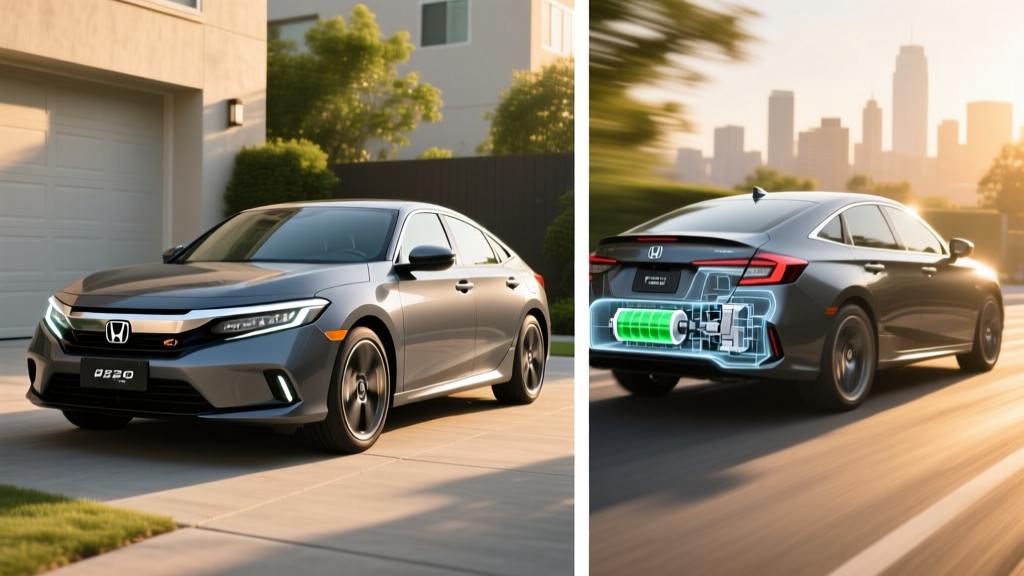
The Honda Civic Hybrid is a conventional hybrid electric vehicle (HEV) — it does not plug in. It pairs a 2.0-liter Atkinson-cycle four-cylinder engine with two electric motors in Honda's fourth-generation two-motor hybrid system. The result is a compact sedan that delivers 49 MPG combined EPA, 200 combined horsepower, and a starting price around $29,845 for the 2026 model year. For buyers who want electrified efficiency without changing their fueling habits, the Civic Hybrid is one of the strongest value propositions in the compact segment.
The Civic Hybrid is a conventional hybrid (HEV). It charges its small battery through regenerative braking and the gas engine. You never plug it in. A plug-in hybrid (PHEV) has a larger battery (typically 10–20 kWh) that you charge from a wall outlet or public charger, enabling 20–50 miles of electric-only driving before the gas engine kicks in. The Civic Hybrid has no electric-only range — it always uses a blend of gas and electric power. Honda does not currently offer a Civic PHEV in the US market.
Fuel Economy: EPA Ratings and Real-World MPG
The headline number for any hybrid buyer is fuel economy. The 2026 Civic Hybrid sedan carries EPA ratings that place it among the most efficient non-plug-in vehicles available.
| Metric | Sedan (Sport Hybrid) | Sedan (Sport Touring Hybrid) |
|---|---|---|
| City MPG | 50 | 49 |
| Highway MPG | 47 | 47 |
| Combined MPG | 49 | 49 |
| Fuel Tank (gallons) | 12.4 | 12.4 |
| Est. Total Range (miles) | ~607 | ~607 |
Source: EPA Fuel Economy Guide
Real-World MPG vs. EPA Sticker
One of the pleasant surprises with Honda's two-motor hybrid system is that real-world city driving often meets or slightly exceeds the EPA city rating. In stop-and-go traffic, the system relies heavily on electric motor propulsion at low speeds, with the gas engine acting primarily as a generator. Owners consistently report 48–52 MPG in mixed suburban driving.
Highway fuel economy tells a different story. At sustained speeds above 70 mph, aerodynamic drag increases and the engine must work harder, often delivering 42–45 MPG on long interstate trips. In cold weather (below 35°F), expect a 3–5 MPG reduction across the board as the engine runs more frequently to maintain cabin heat and battery temperature. This is normal for all hybrids and is far less severe than the 20–30% range loss a full EV experiences in winter.
Powertrain and Performance Specs
Honda's two-motor hybrid system is fundamentally different from the parallel hybrid designs Toyota popularized. In the Civic Hybrid, the gas engine is mechanically disconnected from the wheels at low and moderate speeds. The larger of the two electric motors handles propulsion, while the smaller motor acts as a generator, converting engine output into electricity. At highway cruising speeds, a lock-up clutch connects the engine directly to the wheels for efficiency.
| Specification | Value |
|---|---|
| Engine | 2.0L Atkinson-cycle inline-4 |
| Engine Power | 143 hp @ 6,000 rpm |
| Engine Torque | 134 lb-ft @ 4,500 rpm |
| Drive Motor Power | 181 hp |
| Drive Motor Torque | 232 lb-ft |
| Combined System Output | 200 hp |
| Transmission | e-CVT (no fixed gears) |
| 0–60 mph | ~7.2 seconds |
| Drivetrain | Front-wheel drive |
| Hybrid Battery | ~1.0 kWh lithium-ion |
The 232 lb-ft of electric motor torque is available from near zero RPM, which gives the Civic Hybrid surprisingly strong off-the-line acceleration. The e-CVT means there are no shift shocks — power delivery is linear and smooth. The 0–60 time of approximately 7.2 seconds is competitive with turbocharged gas compact sedans and significantly quicker than most hybrid rivals in this price range.
Pricing, Trims, and Tax Credit Eligibility
The 2026 Civic Hybrid is available in two trims in the US market:
| Trim | MSRP | Key Features |
|---|---|---|
| Sport Hybrid | $29,845 | 18" wheels, wireless CarPlay/Android Auto, Honda Sensing suite, heated front seats |
| Sport Touring Hybrid | $32,845 | Leather seats, Bose 12-speaker audio, wireless charging, navigation, low-speed braking control |
Does the Civic Hybrid Qualify for a Federal Tax Credit?
No. Under current IRS §30D rules, the federal Clean Vehicle Credit (up to $7,500) is available only for new plug-in electric vehicles — battery electric vehicles (BEVs) and plug-in hybrids (PHEVs) with a battery capacity of at least 7 kWh. Because the Civic Hybrid is a conventional HEV with a ~1 kWh battery that cannot be plugged in, it does not qualify for the §30D credit.
Some states offer rebates or incentives for conventional hybrids, but these vary widely by jurisdiction. Check your state's energy or environmental agency website for current programs. Honda occasionally offers manufacturer incentives or low-APR financing on hybrid trims — check with your local dealer.
- ❌ Vehicle must be a BEV or PHEV — HEVs do not qualify
- ❌ Minimum 7 kWh battery capacity — Civic Hybrid has ~1 kWh
- N/A MSRP cap: $55,000 (cars) / $80,000 (SUVs/trucks)
- N/A Buyer income cap: $150K single / $300K joint
- N/A Battery critical minerals & assembly sourcing requirements
Source: IRS Clean Vehicle Tax Credits
Battery Warranty, Lifespan, and Replacement Cost
Hybrid battery longevity is one of the most common concerns among first-time hybrid buyers. Honda addresses this with a comprehensive warranty.
- Hybrid Battery: 8 years / 100,000 miles (10 years / 150,000 miles in CARB states — CA, CT, MA, ME, MD, NJ, NY, OR, RI, VT, WA)
- Hybrid System Components: 8 years / 100,000 miles
- Powertrain Warranty: 5 years / 60,000 miles
- Limited Vehicle Warranty: 3 years / 36,000 miles
How Long Will the Hybrid Battery Last?
Honda's hybrid batteries are designed to last the life of the vehicle. Real-world data from earlier-generation Honda hybrids (Insight, Accord Hybrid) shows batteries routinely lasting 150,000–200,000 miles before significant degradation. The Civic Hybrid's lithium-ion pack is smaller and less stressed than a PHEV or BEV battery because it operates in a narrow state-of-charge window — the system never fully charges or fully depletes it, which dramatically reduces wear.
Battery Replacement Cost
If a replacement is needed out of warranty, a Civic Hybrid battery pack typically costs between $2,000 and $3,500 installed at a Honda dealership. Independent hybrid specialists may offer refurbished packs for $1,200–$2,000. Given the narrow SoC operating window and Honda's track record, the likelihood of needing a replacement within the first 10–15 years is low.
Civic Hybrid vs. PHEV vs. Full EV: Which Fits You?
The Civic Hybrid occupies a specific niche. Here's a practical decision framework:
| Factor | Civic Hybrid (HEV) | Plug-in Hybrid (PHEV) | Battery Electric (BEV) |
|---|---|---|---|
| Plug in required? | No | Yes (recommended) | Yes (mandatory) |
| Electric-only range | None | 20–50 miles | 200–400 miles |
| Combined MPG / MPGe | 49 MPG | 35–50 MPG + 80–100 MPGe | 100–130 MPGe |
| Home charging needed? | No | Recommended (Level 2) | Yes (Level 2 strongly recommended) |
| Federal tax credit | None | Up to $7,500 (if eligible) | Up to $7,500 (if eligible) |
| Upfront cost premium | ~$1,500 over gas | ~$4,000–$8,000 over gas | ~$5,000–$15,000 over gas |
| Best for | No home charging, road trips | Short commutes + road trips | Home charging + daily driving |
- You live in an apartment or lack access to home charging
- You take frequent road trips and don't want to plan around charging stops
- You want lower fuel costs with zero behavior change
- Your budget is under $35,000 and you want maximum value
- You can install a Level 2 charger at home
- Your daily commute is under 40 miles round-trip
- You want some electric driving without range anxiety on longer trips
- You qualify for the §30D tax credit
- You have reliable home Level 2 charging
- You want the lowest per-mile fuel cost and minimal maintenance
- You qualify for federal/state EV incentives
- You're ready to plan road trips around DC fast-charging networks
Reliability, Safety, and Ownership Costs
Honda's hybrid system has matured over four generations. The two-motor design eliminates the conventional transmission entirely — there are no gear shifts, no clutch plates, and no torque converter to fail. The e-CVT is mechanically simpler than a traditional automatic, which historically translates to lower long-term maintenance costs.
The Civic has earned top safety marks. The IIHS has awarded the Civic sedan the Top Safety Pick+ designation in recent model years, and the Honda Sensing suite (adaptive cruise control, lane-keeping assist, collision mitigation braking, traffic sign recognition) comes standard on all hybrid trims.
Five-Year Ownership Cost Estimate
| Category | Estimated Cost |
|---|---|
| Purchase price (MSRP) | $29,845 |
| Fuel (49 MPG, $3.40/gal, 15K mi/yr) | $5,200 |
| Insurance (national avg, good driver) | $7,500 |
| Maintenance (oil changes, tires, brakes) | $2,800 |
| Federal tax credit | $0 |
| Total estimated 5-year cost | ~$45,345 |
For comparison, a similarly equipped gas-only compact sedan averaging 30 MPG combined would spend approximately $8,500 on fuel over the same period — roughly $3,300 more. The hybrid premium pays for itself in fuel savings within approximately 2.5 years at current gas prices.
Pros and Cons
- 49 MPG combined — among the best in the compact segment
- 200 hp and 232 lb-ft electric torque — strong acceleration
- No plug-in required — zero lifestyle change
- 607-mile total range — fewer fill-ups
- Honda Sensing ADAS standard on all trims
- 8-year/100K-mile hybrid battery warranty (10/150K in CARB states)
- Competitive starting price at ~$29,845
- No federal tax credit (HEV ineligible for §30D)
- Highway MPG drops to low-to-mid 40s at sustained 75+ mph
- FWD only — no AWD option (unlike some hybrid rivals)
- Cold weather reduces MPG by 3–5 MPG
- No PHEV variant available in the US
- Road noise is noticeable on coarse pavement
Frequently Asked Questions
How many MPG does the Civic Hybrid get?
The 2026 Civic Hybrid Sport is EPA-rated at 50 city / 47 highway / 49 combined MPG. The Sport Touring Hybrid is rated at 49/47/49. Real-world mixed driving typically yields 46–50 MPG, with highway-heavy trips pulling toward 42–45 MPG.
Does the Civic Hybrid need to be plugged in?
No. The Civic Hybrid is a conventional HEV. Its small lithium-ion battery charges through regenerative braking and the gas engine. You fuel it like any other car — just fill up with regular unleaded gasoline.
How far can the Civic Hybrid go on electric only?
The Civic Hybrid has no meaningful electric-only range. It can creep short distances at very low speeds (parking lots, stop-and-go traffic) on electric power alone, but the gas engine is always available and engages automatically. If you want electric-only driving, you need a PHEV or a full BEV.
Is the Civic Hybrid reliable?
Honda's two-motor hybrid system is in its fourth generation and has a strong reliability track record. The system eliminates the conventional transmission, reducing mechanical complexity. The hybrid battery carries an 8-year/100,000-mile warranty (10 years/150,000 miles in CARB states), and historical data from earlier Honda hybrids suggests batteries regularly last 150,000+ miles.
What does it cost to replace the Civic Hybrid battery?
Out-of-warranty replacement at a Honda dealer typically runs $2,000–$3,500 including labor. Independent hybrid specialists may offer refurbished packs for $1,200–$2,000. Given the battery's narrow state-of-charge operating window, most owners will never need a replacement.
Does the Civic Hybrid qualify for any tax credits?
Not at the federal level. The IRS §30D Clean Vehicle Credit applies only to plug-in vehicles (BEVs and PHEVs) with batteries of at least 7 kWh. The Civic Hybrid's ~1 kWh battery and HEV powertrain make it ineligible. Some states may offer hybrid-specific incentives — check your state's energy office for current programs.
Should I buy the Civic Hybrid or a full EV?
If you lack home charging access, drive more than 300 miles regularly, or want to minimize upfront cost, the Civic Hybrid is the pragmatic choice. If you have reliable home Level 2 charging, a daily commute under 80 miles, and want the lowest per-mile cost with zero tailpipe emissions, a full EV like the Tesla Model 3 or Chevy Equinox EV may be a better long-term fit — especially with the $7,500 federal credit potentially bridging the price gap.