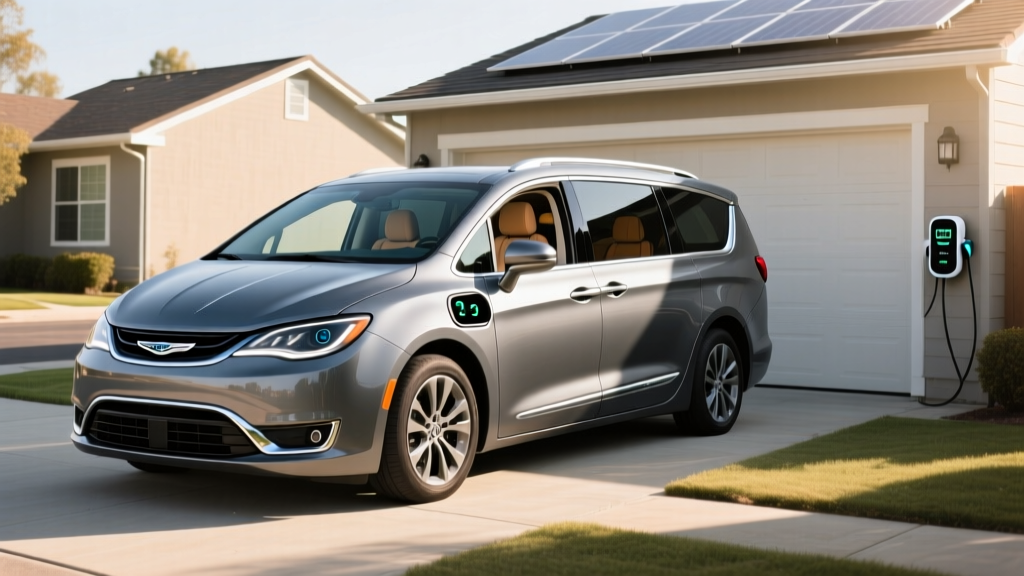
If you need to haul seven people and their cargo without committing to a fully electric vehicle, the plug-in hybrid minivan segment has exactly one option: the Chrysler Pacifica PHEV. For 2026, it remains the only PHEV van sold in the United States, giving it a monopoly on families who want electric commuting with gas-powered road-trip flexibility. But does that monopoly translate into a compelling buy?
After analyzing EPA data, real-world owner reports, and Chrysler's latest powertrain specs, here's everything you need to know about the 2026 Pacifica PHEV — from its genuine electric-only range to the total cost of ownership over five years.
HEV vs PHEV: Why the Pacifica Plug-In Is a Different Animal
Chrysler actually sells two hybrid minivans, and confusing them is the most common buyer mistake. Let's separate them clearly:
| Feature | Pacifica Hybrid (PHEV) | Conventional Hybrid (HEV) |
|---|---|---|
| Plugs in? | Yes — Level 1 & Level 2 | No — never plugs in |
| Electric-only range | 32 miles (EPA) | 0 miles (motor assists engine only) |
| Battery size | 16.0 kWh usable | ~1.0 kWh (small buffer) |
| Combined MPG (gas) | 30 MPG combined | ~28 MPG combined |
| Total range | ~520 miles | ~560 miles |
| Starting MSRP (2026) | $51,095 | Not currently offered (discontinued) |
| Federal tax credit | Potentially eligible (§30D) | Not eligible |
The critical takeaway: the Pacifica Hybrid is a plug-in hybrid (PHEV). You charge it from a wall outlet or Level 2 charger to unlock its 32-mile electric range. If you never plug it in, it operates as a conventional hybrid — but you're leaving its best feature on the table and paying a premium for battery capacity you aren't using.
Note: Chrysler discontinued the non-plug-in HEV variant in recent model years, so if you want a hybrid Pacifica in 2026, the PHEV is your only choice.
Electric-Only Range and Total Driving Range
Real-World Expectation: 26–30 miles in mixed driving; as low as 22 miles in cold weather (below 35°F) or at sustained highway speeds above 65 mph.
Total Combined Range (electric + gas): ~520 miles
EPA MPGe (electric mode): 82 MPGe
Thirty-two miles of electric range sounds modest compared to a full EV, but context matters. The EPA's official rating covers most daily school runs, grocery trips, and local errands without burning a drop of gas. According to FHWA data, the average American drives roughly 37 miles per day — meaning Pacifica PHEV owners who charge nightly can cover the vast majority of weekday driving on electricity alone.
When the battery depletes, the 3.6-liter V6 engine seamlessly takes over, and the van drives like a conventional hybrid. You'll never be stranded hunting for a charger — a major advantage over a pure EV for families who take long road trips.
Fuel Economy: EPA Numbers and Real-World MPG
| Driving Mode | City | Highway | Combined |
|---|---|---|---|
| Charge-sustaining (gas hybrid) | 29 MPG | 30 MPG | 30 MPG |
| Electric-only (MPGe) | — | — | 82 MPGe |
Real-world MPG vs. EPA: Hybrid vehicles — and PHEVs in gas mode — tend to exceed their EPA city rating because regenerative braking recovers energy in stop-and-go traffic. Many Pacifica PHEV owners report 31–34 MPG in city driving on long trips where the battery is depleted. Highway MPG is typically closer to the sticker or slightly below, especially at speeds above 70 mph or with a full load of passengers and cargo.
If you charge daily and your commute falls within 32 miles, your effective "fuel economy" is measured in electricity cost per mile — roughly 3–4 cents per mile depending on your local utility rate, compared to 12–15 cents per mile for gasoline at national average prices.
Powertrain, Battery, and Charging Specs
| Specification | 2026 Chrysler Pacifica PHEV |
|---|---|
| Engine | 3.6L V6 Atkinson-cycle |
| Electric motors | Dual motor eFlite EVT (2 motors integrated into transmission) |
| Combined system horsepower | 260 HP |
| Battery chemistry | NMC (Nickel Manganese Cobalt) lithium-ion |
| Battery capacity (usable) | 16.0 kWh |
| Level 1 charging (120V, 12A) | ~14 hours (0–100%) |
| Level 2 charging (240V, 32A) | ~2 hours (0–100%) |
| DC fast charging | Not supported |
| Charge port | J1772 (Level 1/2) |
| Transmission | eFlite electrically variable transmission (EVT) |
| Drivetrain | Front-wheel drive (FWD only; no AWD on PHEV) |
| 0–60 mph | ~7.1 seconds |
| Towing capacity | Not rated for towing (PHEV only; gas Pacifica tows up to 3,600 lbs) |
A few things demand attention here. First, the Pacifica PHEV cannot DC fast charge. That's a significant limitation if you hoped to top up on road trips. The 16 kWh battery charges fully in about 2 hours on a Level 2 home charger — which is perfectly adequate for overnight replenishment but means highway rest stops won't help you regain electric range.
Second, all-wheel drive is not available on the PHEV variant. If you need AWD for snow-belt winters, you're limited to the gas-only Pacifica, which sacrifices the plug-in capability. This trade-off eliminates the PHEV for some northern-climate buyers.
Third, the PHEV is not rated for towing. The battery pack's weight and packaging reduce the structural margin Chrysler engineered into the gas model. If you need to pull a small trailer, this isn't your van.
Pricing, Trims, and Federal Tax Credit Eligibility
The 2026 Chrysler Pacifica PHEV starts at $51,095 for the Select trim (including destination). The Limited PHEV starts around $55,095, and the top Pinnacle PHEV reaches approximately $58,595. These prices represent a meaningful premium over the gas-only Pacifica, which starts near $40,000.
- MSRP cap: Vans must be under $80,000 — the Pacifica PHEV qualifies on price.
- Buyer income cap: AGI must not exceed $150,000 (single), $225,000 (head of household), or $300,000 (joint).
- Battery sourcing: Critical minerals and battery components must meet escalating domestic-sourcing thresholds. Chrysler's compliance varies by build date — verify with your dealer before purchase.
- Point-of-sale transfer: If eligible, the credit can be applied at purchase to reduce your out-of-pocket cost.
- Maximum credit: Up to $7,500 if both critical-mineral and battery-component requirements are met; $3,750 if only one is satisfied.
Source: IRS §30D Clean Vehicle Credit. Rules are subject to change. Consult a tax professional for your specific situation.
The tax credit is the great variable. If you qualify for the full $7,500, the effective starting price drops to roughly $43,600 — much closer to a loaded gas Pacifica. If you don't qualify (income too high, or the specific vehicle's battery sourcing doesn't meet thresholds), you pay full MSRP, and the value proposition tightens considerably.
Battery Longevity, Warranty, and Replacement Cost
Capacity retention threshold: Warranty covers defects and capacity loss below ~70% of original capacity
Powertrain warranty: 5 years / 60,000 miles
Estimated out-of-warranty battery replacement: $8,000–$12,000 (parts + labor, based on current NMC pack pricing for 16 kWh)
This is where hybrid buyers typically have the most anxiety — and where the data should ease it. Chrysler's 10-year/100,000-mile battery warranty is federally mandated for PHEVs and EVs under EPA/CARB emissions warranty rules, meaning every manufacturer selling a PHEV in the US must offer at least this coverage. Many Pacifica PHEVs from the 2017–2019 launch years are still on their original batteries with minimal degradation, according to owner forums and fleet data.
NMC batteries in PHEV applications experience less stress than those in full EVs because the usable window is smaller (the system reserves a larger buffer at the top and bottom of the charge cycle). The 16 kWh pack doesn't undergo deep 0–100% cycles in daily use, which extends cycle life considerably.
If the battery does fail out of warranty, expect a replacement bill in the $8,000–$12,000 range. That's a real cost, but it's also a worst-case scenario that relatively few owners face. Third-party hybrid battery rebuilders are increasingly available and can reduce this cost to $4,000–$6,000.
Reliability and Ownership Track Record
The Pacifica PHEV has been in production since the 2017 model year, giving it one of the longest track records of any PHEV on the market. Early models (2017–2018) had some electrical gremlins and a voluntary recall related to 12V battery issues, but Chrysler addressed most of these through software updates and service campaigns.
According to NHTSA recall data, the 2024–2026 model years have had fewer open recalls than the launch vehicles, suggesting maturation of the powertrain. Consumer surveys consistently place Chrysler below Toyota and Honda in overall brand reliability, but the Pacifica PHEV specifically benefits from a relatively simple powertrain — the eFlite EVT transmission has fewer moving parts than a conventional automatic.
For buyers prioritizing maximum reliability above all else, the Toyota Sienna (hybrid-only, not PHEV) offers stronger brand reliability ratings — but sacrifices the plug-in electric range entirely.
Who Should Buy the Pacifica PHEV Van — and Who Shouldn't
- Only PHEV van on the market — no direct competitor
- 32-mile electric range covers most daily errands
- 520-mile total range eliminates road-trip anxiety
- Stow 'n Go seating (second and third rows fold into floor)
- Qualifies for up to $7,500 federal tax credit (if eligible)
- 10-year/100,000-mile battery warranty
- Smooth, quiet electric driving around town
- No AWD option (FWD only)
- No DC fast charging
- Not rated for towing
- $11,000+ premium over gas Pacifica
- Brand reliability below Toyota/Honda
- Electric range drops significantly in cold weather
- No third-row Stow 'n Go on some trims (battery packaging)
- You need 7-passenger seating and want to commute on electricity
- You can charge at home (Level 2 strongly recommended)
- Your daily driving is under 35 miles and you take occasional long trips
- You qualify for the federal tax credit
- You live in a mild-to-moderate climate (not extreme cold)
- You never want to buy gasoline again
- You have reliable home and workplace charging
- Your road trips are under 300 miles or you're comfortable with DC fast charging stops
- You can't charge at home
- You want AWD
- You prioritize brand reliability and resale value over electric-only driving
- You need to tow a trailer
- You want AWD
- Your budget won't stretch to the PHEV premium
Frequently Asked Questions
How many MPG does the Pacifica PHEV get?
In charge-sustaining (gas hybrid) mode, the EPA rates it at 29 city / 30 highway / 30 combined MPG. In real-world city driving with regenerative braking, many owners see 31–34 MPG. Highway fuel economy is typically at or slightly below the EPA rating.
How far can the Pacifica PHEV go on electric only?
The EPA rates it at 32 miles of electric-only range. In real-world conditions, expect 26–30 miles in moderate weather and 22–25 miles in freezing temperatures or at sustained highway speeds. Once the battery depletes, the gas engine takes over seamlessly.
Does the Pacifica PHEV qualify for a tax credit?
It may qualify for up to $7,500 under the federal §30D Clean Vehicle Credit, depending on your income, the vehicle's battery component and critical-mineral sourcing, and the MSRP cap (vans must be under $80,000 — the Pacifica qualifies). Eligibility changes as sourcing requirements tighten. Verify with your dealer and consult IRS guidance before purchasing.
Is the Pacifica PHEV reliable, and what does a battery replacement cost?
The Pacifica PHEV has been in production since 2017, and the high-voltage battery is covered by a 10-year/100,000-mile warranty. Out-of-warranty battery replacement is estimated at $8,000–$12,000, though third-party rebuilders can reduce this. Overall brand reliability ratings for Chrysler trail Toyota and Honda, but the PHEV powertrain itself has proven durable in fleet and owner data.
Can I charge the Pacifica PHEV at a public fast charger?
No. The Pacifica PHEV does not support DC fast charging. It charges via a J1772 port at Level 1 (120V, ~14 hours) or Level 2 (240V, ~2 hours). This is typical for PHEVs with smaller batteries — the design assumption is that you'll charge at home overnight.
Does the Pacifica PHEV have all-wheel drive?
No. The PHEV variant is front-wheel drive only. AWD is available on the gas-only Pacifica but not on the plug-in hybrid due to battery packaging constraints.
Can I still use Stow 'n Go seating with the PHEV?
Yes, but with a caveat. The Pacifica PHEV retains second-row Stow 'n Go on most trims, but the battery pack sits under the floor, which can affect third-row folding behavior depending on the model year and trim. Check the specific configuration with your dealer.
The Bottom Line: Is the Pacifica PHEV Worth the Premium?
The 2026 Chrysler Pacifica PHEV occupies a unique position: it's the only plug-in hybrid van in America, serving families who need maximum interior versatility but want to reduce fuel consumption and emissions on daily drives. If you can charge at home and your routine fits within its 32-mile electric envelope, the per-mile cost savings are genuine and substantial.
The math works best when you qualify for the federal tax credit. At $7,500 off, the effective price approaches a well-equipped gas Pacifica, and the electric commuting savings pay back the remaining premium within a few years. Without the credit, the $11,000+ price gap over the gas model takes longer to recoup — roughly 6–8 years at typical driving distances and electricity rates.
For families in cold climates who need AWD, or those who can't install a home charger, the Toyota Sienna hybrid (non-plug-in) remains a strong alternative with better brand reliability and AWD availability — though you sacrifice the electric-only driving experience entirely. The Pacifica PHEV isn't for everyone, but for the specific buyer it targets, there's still nothing else like it.