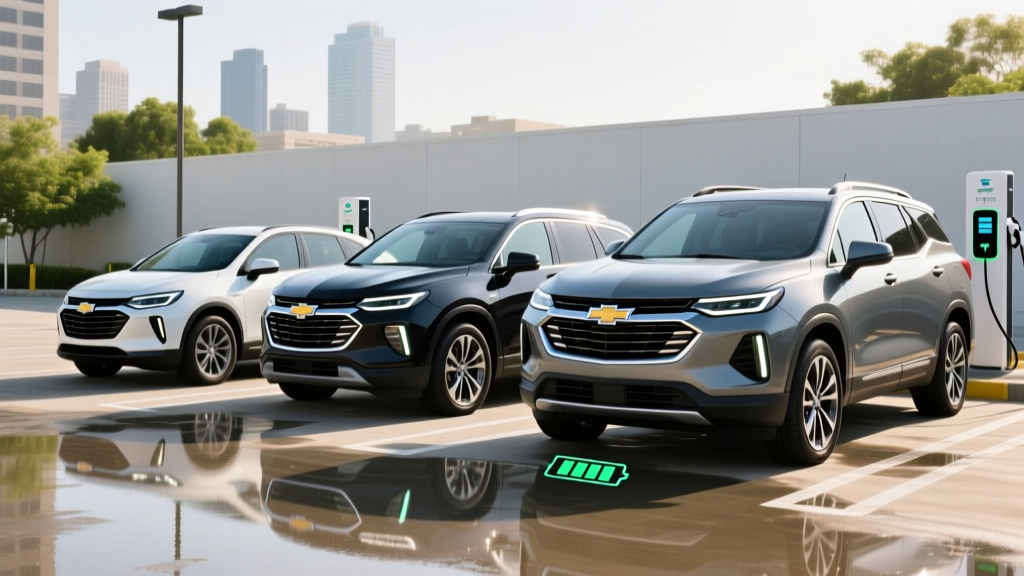
Chevrolet's hybrid SUV strategy in 2026 spans three nameplates, each targeting a different slice of the electrified-buyer spectrum. The compact Equinox, midsize Blazer, and three-row Traverse now all offer some form of hybridization — but the technology under the hood varies dramatically from model to model. Some are conventional hybrids (HEVs) that never plug in; others are plug-in hybrids (PHEVs) that deliver genuine electric-only commuting range before the gas engine kicks in.
This guide breaks down every current Chevrolet hybrid SUV with exact EPA fuel economy figures, real-world efficiency data, powertrain specs, battery warranty coverage, and federal tax credit eligibility — so you can match the right powertrain to your actual driving pattern.
HEV vs PHEV: Which Chevrolet Hybrid SUV Type Fits You?
Before comparing specific models, it's critical to understand the two hybrid architectures Chevrolet uses. Conflating them is the single most common mistake hybrid shoppers make.
| Attribute | Conventional Hybrid (HEV) | Plug-In Hybrid (PHEV) |
|---|---|---|
| Plugs in to charge? | No — charges via regenerative braking and engine | Yes — Level 1 (120V) or Level 2 (240V) |
| Electric-only driving | Brief, low-speed assist only (under ~1 mile) | 25–50+ miles on battery alone |
| Battery size | ~1.0–1.5 kWh (small buffer) | ~15–25 kWh usable |
| Federal tax credit | Not eligible for §30D new EV credit | May qualify — depends on battery sourcing, MSRP cap, income cap |
| Best for | Drivers who want better MPG with zero behavior change | Commuters with home/workplace charging and daily trips under 40 miles |
| Maintenance change vs gas | Minimal — same oil change intervals, less brake wear from regen | Slightly more complex — two full powertrains, but engine runs less |
The bottom line: If you can charge at home and your daily round-trip commute is under 40 miles, a PHEV lets you drive on electricity most days while keeping a gas engine for road trips. If you live in an apartment, street-park, or simply don't want to think about charging, a conventional HEV still delivers a meaningful MPG bump over a gas-only model — with zero lifestyle adjustment.
2026 Chevrolet Equinox Hybrid: MPG, Powertrain, and Pricing
The Equinox is Chevrolet's volume compact SUV, and for 2026 the hybrid variant continues with a 1.5L turbocharged four-cylinder paired with a front-mounted electric motor and a ~1.3 kWh lithium-ion battery pack. This is a conventional HEV — you never plug it in.
| Spec | Value |
|---|---|
| Powertrain | 1.5L turbo I4 + electric motor (HEV) |
| Combined horsepower | ~192 hp (combined system output) |
| EPA MPG (city / hwy / combined) | 37 / 34 / 36 MPG |
| Battery capacity | ~1.3 kWh (not plug-in) |
| Drivetrain | FWD standard; AWD available |
| 0–60 mph | ~7.8 seconds (est.) |
| Cargo volume | 29.9 cu ft (rear seats up) |
| Starting MSRP (LT trim) | $31,900 |
| Federal tax credit (§30D) | Not eligible (conventional HEV) |
Real-world MPG note: Conventional hybrids like the Equinox often exceed their EPA city rating in stop-and-go traffic, where regenerative braking recaptures the most energy. In mixed suburban driving, owners commonly report 36–39 MPG. Highway-heavy trips at 75+ mph will dip closer to 32–33 MPG, as the engine does more of the work and aerodynamic drag increases.
2026 Chevrolet Blazer EV and Hybrid Options
Chevrolet's approach to the Blazer is worth clarifying because it trips up shoppers. The Blazer EV is a fully electric vehicle (BEV) built on GM's Ultium platform — it is not a hybrid and has no gas engine. For 2026, the Blazer EV offers up to 320 miles of EPA range on the 2LT AWD trim with the larger battery pack, and a starting MSRP of approximately $44,600.
As of the 2026 model year, Chevrolet has not introduced a conventional hybrid (HEV) or plug-in hybrid (PHEV) variant of the Blazer. The gas-only Blazer continues alongside the EV, but if you specifically want a hybrid midsize Chevy SUV, the Traverse (below) is the model to watch.
If a PHEV Blazer matters to your purchase decision, you'll need to look at competitors like the Hyundai Santa Fe PHEV or Toyota RAV4 Prime — or wait for any future GM announcements.
2026 Chevrolet Traverse: Hybrid Availability and Fuel Economy
The three-row Traverse has historically been a gas-only V6 SUV. For 2026, Chevrolet continues the 2.5L turbocharged four-cylinder as the standard engine (introduced for the 2024 redesign), which delivers improved efficiency over the old 3.6L V6 but remains a conventional ICE powertrain.
| Powertrain | City MPG | Highway MPG | Combined MPG | Type |
|---|---|---|---|---|
| 2.5L Turbo I4 (FWD) | 22 | 29 | 25 | Gas only |
| 2.5L Turbo I4 (AWD) | 21 | 27 | 24 | Gas only |
Hybrid status for 2026: Chevrolet has not announced a hybrid or PHEV variant of the redesigned Traverse for the 2026 model year. If a three-row hybrid SUV is a must-have, current alternatives include the Toyota Grand Highlander Hybrid (36 MPG combined) and the Hyundai Santa Fe Hybrid. GM has signaled that hybrid powertrains will expand across its SUV lineup, but no confirmed timeline exists for a Traverse HEV or PHEV.
Battery Warranty and Long-Term Reliability
Battery longevity is the number-one concern for hybrid buyers, and it's where Chevrolet's coverage provides meaningful peace of mind.
Chevrolet Hybrid Battery Warranty Coverage
- Hybrid battery warranty: 8 years / 100,000 miles (whichever comes first), covering defects and capacity loss below a defined threshold — typically 60–70% of original capacity depending on the specific model and model year.
- Powertrain warranty: 5 years / 60,000 miles on the engine, transmission, and electric motor components.
- Hybrid system components: The inverter, DC-DC converter, and related electronics are covered under the hybrid-specific warranty, not just the battery pack itself.
Source: Chevrolet owner's manuals and Chevrolet warranty guide. Confirm exact terms for your trim at purchase.
Real-world battery lifespan: Modern hybrid batteries from GM have proven durable. Toyota's hybrid batteries — the segment benchmark — routinely last 150,000–200,000 miles before significant degradation. GM's lithium-ion packs in the Equinox and other HEVs use similar chemistry and thermal management. Expect 12–15 years of service under normal driving before capacity loss becomes noticeable.
Replacement cost if out of warranty: A hybrid battery pack replacement for a compact SUV HEV like the Equinox typically runs $2,000–$4,000 for the battery module itself, plus $500–$1,000 in labor. This is far less than a full EV battery replacement ($8,000–$20,000+), because hybrid packs are much smaller. PHEV battery replacement costs more ($4,000–$8,000) due to the larger pack, but PHEV batteries also carry the same 8yr/100k warranty.
Federal Tax Credits: What Chevrolet Hybrid SUVs Qualify For?
This is where the HEV vs PHEV distinction has direct financial consequences.
IRS §30D Clean Vehicle Credit — Eligibility Checklist (2026)
- Conventional hybrids (HEV): Not eligible. The §30D credit applies only to plug-in electric vehicles (BEVs and PHEVs) with a battery capacity of at least 7 kWh.
- Plug-in hybrids (PHEV): May qualify for up to $7,500, subject to ALL of the following:
- MSRP cap: $80,000 for SUVs, vans, and pickups; $55,000 for sedans
- Buyer income cap: $300,000 joint / $225,000 head of household / $150,000 single (modified AGI)
- Battery component sourcing: Must meet escalating domestic-content requirements for critical minerals and battery components (phased in annually through 2032)
- Final assembly in North America
- Point-of-sale transfer: Eligible buyers can transfer the credit to the dealer at purchase, reducing the out-of-pocket price immediately rather than waiting for tax filing.
Rules change annually. Verify current-year eligibility at IRS.gov §30D page or consult a tax professional before purchasing.
For 2026, because Chevrolet's current hybrid SUV lineup (Equinox Hybrid) is a conventional HEV, none of the hybrid SUVs qualify for the federal §30D credit. If Chevrolet introduces a PHEV variant of the Equinox, Blazer, or Traverse in future model years, that model could potentially qualify — subject to the sourcing and income rules above.
State incentives: Some states offer their own rebates or tax credits for hybrids (not just PHEVs). For example, Colorado, California, and a handful of other states have had hybrid-specific incentive programs, though amounts and eligibility vary widely by jurisdiction and change frequently. Check your state's energy office or DMV for current programs.
Hybrid vs PHEV vs Full EV: Decision Framework
Choosing between a Chevrolet hybrid SUV, a PHEV from another brand, or going fully electric depends on three practical factors: your daily mileage, your charging access, and your road-trip frequency.
Choose a Chevrolet Hybrid (HEV) If:
- You cannot charge at home (apartment, street parking, no garage)
- You want better fuel economy with zero behavior change
- Your daily driving is unpredictable — some days 10 miles, some days 200
- You want the lowest-complexity electrified option
- Budget is a priority — HEVs typically cost $1,500–$3,000 more than their gas counterparts, not $5,000–$10,000+
Choose a PHEV If:
- You can charge at home (Level 2) or at work
- Your daily commute is under 40 miles round-trip (you'll rarely use gas on weekdays)
- You take road trips a few times a year and don't want to plan around DC fast chargers
- You want to reduce emissions without range-anxiety risk
- You may qualify for the §30D federal credit (up to $7,500)
Choose a Full EV (BEV) If:
- You have reliable home Level 2 charging
- Your daily driving is under 250 miles (well within any modern EV's range)
- You want the lowest per-mile "fuel" cost and near-zero drivetrain maintenance
- You're ready to plan road-trip charging stops (or primarily drive locally)
- You want maximum federal and state incentives
Pros and Cons: Chevrolet Hybrid SUV Ownership
Pros
- Meaningful MPG improvement over gas-only models (36 MPG combined vs ~26 for gas Equinox) without plugging in
- Lower brake wear — regenerative braking extends pad life to 80,000+ miles in many cases
- No range anxiety — gas engine provides 400+ miles of total range
- Simpler ownership than PHEV or BEV — no charging equipment, no charging-curve learning curve
- Strong 8-year/100,000-mile hybrid battery warranty from Chevrolet
- Competitive starting price ($31,900 for Equinox Hybrid)
Cons
- No federal tax credit eligibility for conventional HEVs (§30D requires plug-in)
- Limited hybrid powertrain options — only the Equinox currently offers HEV in Chevy's SUV lineup
- No PHEV option available from Chevrolet in 2026 (competitors like Toyota RAV4 Prime offer 42 miles electric-only)
- AWD hybrid variants may have slightly lower MPG than FWD
- Hybrid premium over gas model adds ~$1,500–$2,500 to purchase price (recouped over 3–5 years depending on mileage)
Frequently Asked Questions
How many MPG does the 2026 Chevrolet Equinox Hybrid get?
The EPA rates the 2026 Equinox Hybrid at 37 city / 34 highway / 36 combined MPG (FWD). In real-world city driving with frequent stops, owners often see 37–39 MPG thanks to aggressive regenerative braking. Highway-only trips at 75+ mph typically yield 32–33 MPG. Over a 15,000-mile year, that combined rating saves roughly $400–$600 in fuel costs compared to the gas-only Equinox (rated at ~26 MPG combined), depending on local gas prices.
Does Chevrolet make a plug-in hybrid SUV in 2026?
As of the 2026 model year, Chevrolet does not offer a plug-in hybrid (PHEV) SUV. The Equinox is available as a conventional hybrid (HEV), and the Blazer is available as a full EV (BEV), but there is no Chevy PHEV SUV with electric-only driving range. If a PHEV is essential, look at the Toyota RAV4 Prime (42 miles electric), Hyundai Tucson PHEV (33 miles electric), or Ford Escape PHEV (37 miles electric).
Is the Chevrolet hybrid system reliable?
GM's hybrid systems have a solid reliability track record, particularly the two-motor hybrid architecture used in models like the Malibu Hybrid and Equinox Hybrid. The hybrid battery is covered by an 8-year/100,000-mile warranty. Independent reliability surveys from Consumer Reports and J.D. Power have rated recent Chevy hybrid models at or above average for the compact SUV segment. The simpler HEV system (no plug, no large battery) has fewer failure points than a PHEV or BEV.
What does it cost to replace a Chevrolet hybrid battery?
If the hybrid battery fails outside the 8-year/100,000-mile warranty window, replacement typically costs $2,000–$4,000 for the battery module plus $500–$1,000 in labor, totaling roughly $2,500–$5,000. This is significantly less than a full EV battery replacement. In practice, most hybrid batteries last 150,000–200,000+ miles before meaningful degradation, and many outlast the vehicle itself.
Does the 2026 Chevrolet Equinox Hybrid qualify for any tax credit?
No. The federal §30D Clean Vehicle Credit applies only to plug-in vehicles (BEVs and PHEVs) with battery packs of at least 7 kWh. The Equinox Hybrid is a conventional HEV with a ~1.3 kWh battery and does not plug in, so it is ineligible. Some states may offer separate hybrid incentives — check your state's energy office. If you want federal credit eligibility, you'd need to look at a PHEV or BEV like the Chevrolet Equinox EV (starting ~$33,000, potentially eligible depending on sourcing rules).
How does hybrid MPG compare to the gas-only version?
The gas-only 2026 Equinox with the 1.5L turbo rates approximately 26 MPG combined (24 city / 29 highway per fueleconomy.gov). The Equinox Hybrid achieves 36 MPG combined — a 38% improvement. Over 5 years and 75,000 miles at $3.50/gallon, that's roughly $2,500–$3,000 in fuel savings, which typically recoups the hybrid's purchase premium within the first 3–4 years of ownership.