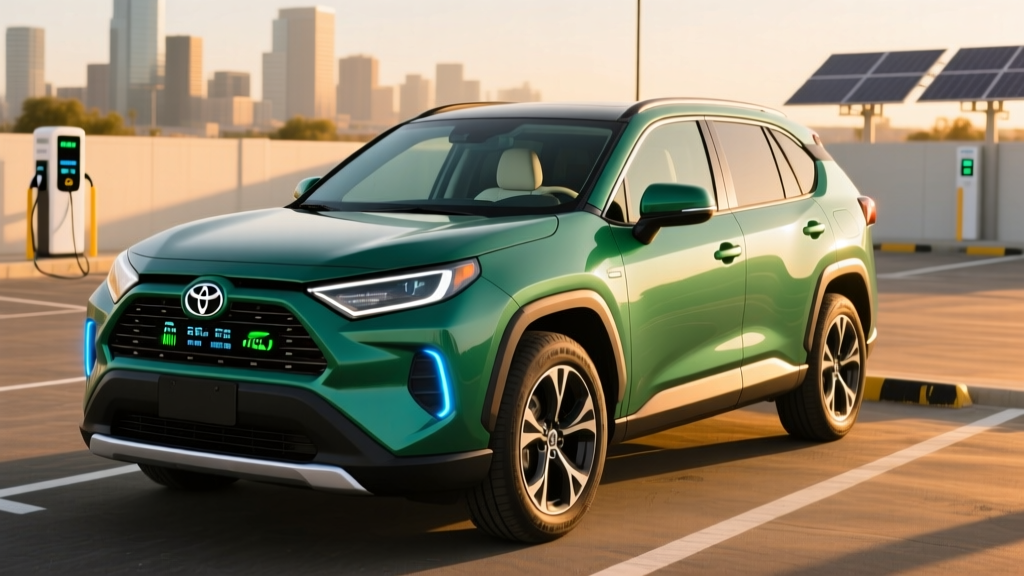
Quick Verdict: The RAV4 Prime Is Toyota's Sleeper Performance SUV
Most buyers come to the RAV4 Prime (Toyota's plug-in hybrid variant) for the 42 miles of electric-only range and the promise of skipping the gas station during a daily commute. They stay for a 0-60 mph time of 5.7 seconds — a number that embarrasses many sport-tuned crossovers costing twice as much. The 2026 RAV4 Prime pairs a 2.5-liter four-cylinder engine with front and rear electric motors for a combined 302 horsepower, all while returning 94 MPGe combined when operating in EV mode and 38 MPG combined once the battery depletes.
But the Prime isn't for everyone. It carries a price premium over the conventional RAV4 Hybrid, lacks DC fast charging, and federal tax credit eligibility has tightened significantly under current IRS rules. This guide breaks down every number you need — from real-world range to battery warranty — to decide if the RAV4 Prime is the right electrified SUV for your driveway.
RAV4 Prime vs. RAV4 Hybrid: HEV and PHEV Explained
Conventional Hybrid (HEV) — RAV4 Hybrid
The standard RAV4 Hybrid uses a small battery (1.6 kWh) that charges itself through regenerative braking and the gasoline engine. You never plug it in. It delivers strong city MPG but offers no meaningful electric-only driving range. Think of it as a gas car that's been made far more efficient.
Plug-In Hybrid (PHEV) — RAV4 Prime
The RAV4 Prime carries a much larger 18.1 kWh lithium-ion battery pack that you can charge from a wall outlet or Level 2 charger. That battery enables 42 miles of electric-only driving (EPA estimate) before the gasoline engine seamlessly takes over. Once the battery is depleted, it operates exactly like a conventional hybrid. You get the best of both worlds — EV commuting during the week, gas-hybrid road trips on weekends — with zero range anxiety.
The critical distinction: you never need to plug in a conventional hybrid. The RAV4 Hybrid charges its own small battery internally. The RAV4 Prime can also operate without plugging in, but you'd forfeit the entire reason for paying the PHEV premium. To unlock the Prime's value, home charging access (at minimum a standard 120V outlet) is strongly recommended.
2026 RAV4 Prime Performance: 0-60, Horsepower, and Powertrain Specs
| Specification | 2026 RAV4 Prime |
|---|---|
| Combined Horsepower | 302 hp |
| Gas Engine | 2.5L 4-cylinder (176 hp, 163 lb-ft) |
| Front Electric Motor | 134 kW (180 hp) |
| Rear Electric Motor | 40 kW (54 hp) |
| 0-60 mph | 5.7 seconds |
| Drivetrain | AWD (electronic on-demand rear) |
| Transmission | eCVT (electronically controlled) |
| Battery Capacity (usable) | 18.1 kWh (lithium-ion) |
| EPA Electric-Only Range | 42 miles |
| Total Combined Range (EV + Gas) | ~600 miles |
| Towing Capacity | 2,500 lbs |
The 0-60 time of 5.7 seconds is the headline number that draws search queries, and it's legitimate. Toyota achieves it through the instant torque delivery of the electric motors supplementing the gas engine. Off the line, the Prime pulls harder than a V6 Camry from just a few years ago. The eCVT keeps acceleration smooth and linear — there are no gear shifts to interrupt the rush.
Real-world note: that 5.7-second figure is achievable with a fully charged battery. Once the battery depletes and you're operating in hybrid mode with a smaller power reserve, expect 0-60 times closer to 7.0–7.5 seconds. Still brisk for a compact SUV, but not the sports-sedan shock value you get on a full charge.
Fuel Economy: EPA MPGe, MPG, and Real-World Expectations
| Mode | City | Highway | Combined |
|---|---|---|---|
| EV Mode (MPGe) | 94 MPGe | 94 MPGe | 94 MPGe |
| Hybrid Mode (MPG, battery depleted) | 40 MPG | 36 MPG | 38 MPG |
How many MPG does the RAV4 Prime get? The answer depends entirely on how you use it. On a full charge, the first 42 miles consume zero gasoline and register at 94 MPGe. After that, the vehicle operates as a conventional hybrid returning 38 MPG combined per EPA data from fueleconomy.gov.
Here's where real-world driving diverges from the sticker:
- City commuting with nightly charging: Many Prime owners report going weeks without visiting a gas station. If your round-trip commute is under 40 miles and you charge at home, your effective fuel cost approaches that of a full EV — roughly 3–4 cents per mile depending on your electricity rate.
- Highway-heavy driving: Hybrids typically underperform their EPA highway rating because the electric motor contributes less at sustained high speeds. Expect 33–35 MPG highway in hybrid mode at 70+ mph, particularly in colder weather when cabin heating draws additional energy.
- Cold-weather impact: In freezing temperatures (below 32°F), expect electric-only range to drop by 20–30%, reducing the 42-mile EPA figure to roughly 30–34 miles. The gasoline engine will engage more frequently to provide cabin heat.
Charging the RAV4 Prime: What You Need to Know
The RAV4 Prime uses a standard J1772 connector for AC charging. Here is the critical limitation every buyer should understand: the RAV4 Prime does not support DC fast charging. There is no CCS or CHAdeMO port. All charging is AC-only.
| Charging Level | Power | Time (0–Full) | Setup |
|---|---|---|---|
| Level 1 (120V household outlet) | ~1.4 kW | ~12 hours | Standard outlet, included cable |
| Level 2 (240V, 16A) | ~3.3 kW | ~5.5 hours | Home wall charger or public station |
| Level 2 (240V, 32A) | ~6.6 kW | ~2.5 hours | Requires upgraded onboard charger (available on select trims) |
For most Prime owners, a Level 1 overnight charge from a standard 120V outlet is sufficient to replenish the 18.1 kWh battery in time for a morning commute. This is one of the PHEV's key advantages over a full EV — you don't necessarily need a dedicated 240V circuit installed. However, if you want faster top-ups (for mid-day charging or multiple short trips), a Level 2 home charger dramatically reduces charge time.
The onboard charger on the base SE trim is limited to 3.3 kW. The XSE trim with the Premium Package offers a 6.6 kW onboard charger upgrade, cutting Level 2 charge time roughly in half. Confirm this option when configuring your vehicle, as it significantly affects daily usability for drivers who deplete the battery multiple times per day.
Pricing, Trims, and Tax Credit Eligibility
The 2026 RAV4 Prime starts at approximately $44,500 MSRP for the SE trim and climbs to roughly $48,000–$52,000 for the XSE with the Premium Package, depending on options and destination charges. This represents a substantial premium over the conventional RAV4 Hybrid, which starts around $33,000.
Federal Tax Credit: Does the RAV4 Prime Qualify?
Under current IRS §30D rules, the RAV4 Prime's federal tax credit eligibility is limited and subject to strict sourcing requirements. The credit can provide up to $7,500, but qualifying depends on:
- MSRP cap: SUVs must have an MSRP at or below $80,000 — the RAV4 Prime clears this easily.
- Buyer income cap: Modified adjusted gross income must not exceed $150,000 (single), $225,000 (head of household), or $300,000 (joint).
- Battery component sourcing: A percentage of battery components must be manufactured or assembled in North America. This threshold increases annually, and many PHEVs have lost partial or full credit eligibility as requirements tighten.
- Critical minerals sourcing: A percentage of critical minerals must be sourced from the U.S. or a free-trade-agreement country.
Check current eligibility before purchasing. As of the 2026 model year, many Toyota PHEVs have seen their credit reduced or eliminated due to battery-sourcing rules. Your dealer should have the latest eligibility status, and you can verify on the IRS clean vehicle credit page. Point-of-sale transfer is available if the vehicle qualifies — allowing you to apply the credit as a down payment reduction rather than waiting for a tax refund.
Additionally, some states offer separate PHEV rebates or HOV lane access. California's Clean Fuel Rebate, for example, has historically included PHEVs, though amounts vary. Check your state's energy or environmental agency for current programs.
Battery Warranty, Reliability, and Replacement Cost
Is the RAV4 Prime reliable? Toyota's hybrid system is among the most proven in the industry. The company has been refining its Hybrid Synergy Drive since the original Prius in 1997 — nearly three decades of iterative improvement. The RAV4 Prime's powertrain shares core architecture with millions of Toyota hybrids on the road. Third-party reliability data from sources like Consumer Reports consistently rates Toyota hybrids at or near the top of their segments.
What does a battery replacement cost? Outside of warranty, a RAV4 Prime traction battery replacement is estimated at $4,000–$6,000 including parts and labor. However, real-world data from Toyota's hybrid fleet suggests that complete battery failures are rare within the first 150,000 miles. More commonly, individual cell modules may degrade unevenly, and independent hybrid specialists can often replace individual modules for $500–$1,500 rather than the entire pack.
The 12V auxiliary battery (a separate, smaller battery that powers electronics and starts the system) will need replacement every 4–6 years, similar to any conventional vehicle, at a cost of roughly $200–$350.
Who Should Buy the RAV4 Prime vs. a Full EV or Gas Car?
Choose the RAV4 Prime (PHEV) if:
- Your daily round-trip commute is 25–40 miles and you can charge at home overnight
- You take road trips of 200+ miles regularly and don't want to plan around charging stations
- You want EV-like daily driving but lack access to reliable public DC fast charging
- You value the 5.7-second 0-60 performance and electronic AWD
- You live in a cold climate where EV range loss is a concern
Choose the RAV4 Hybrid (HEV) if:
- You cannot charge at home or at work (no garage, no outlet access)
- Your budget is tighter and the $10,000+ PHEV premium doesn't pencil out
- Your commute is short but unpredictable and you just want maximum MPG without plugging in
Choose a Full EV (like the Toyota bZ4X, Tesla Model Y, or Hyundai Ioniq 5) if:
- You have reliable home Level 2 charging and your daily driving is under 200 miles
- You want to eliminate gasoline entirely and minimize moving parts
- You want access to DC fast charging for road trips (20–30 minute 10–80% stops)
- You qualify for the full $7,500 federal EV tax credit (many BEVs still qualify where PHEVs may not)
The RAV4 Prime occupies a specific sweet spot: drivers who want electric commuting without committing to full EV infrastructure. If you can charge at home and your weekday driving stays under 42 miles, you'll use almost no gasoline Monday through Friday. On Saturday, you'll drive to the mountains 300 miles away without a single charging stop — the gas engine and 14.5-gallon tank handle it like any other hybrid.
Pros
- 5.7-second 0-60 mph — quickest RAV4 ever produced
- 42 miles electric-only covers most commutes
- Standard 120V charging — no electrician required for basic use
- 10-year/150,000-mile hybrid battery warranty
- Electronic AWD with no mechanical drivetrain penalty
- ~600 miles total range eliminates road-trip anxiety
Cons
- ~$10,000+ premium over the RAV4 Hybrid
- No DC fast charging — AC only
- Federal tax credit eligibility uncertain under current sourcing rules
- 3.3 kW base onboard charger is slow for Level 2
- Electric-only range drops significantly in cold weather
- Cargo space slightly reduced due to larger battery pack
Frequently Asked Questions
How fast is the RAV4 Prime from 0 to 60 mph?
The 2026 RAV4 Prime achieves 0-60 mph in 5.7 seconds with a full battery charge, producing a combined 302 horsepower from its 2.5-liter engine and dual electric motors. In hybrid mode with a depleted battery, expect approximately 7.0–7.5 seconds.
How far can the RAV4 Prime go on electric only?
The EPA rates the RAV4 Prime at 42 miles of electric-only range. In real-world moderate-weather driving, expect 36–40 miles. In freezing temperatures, plan for 28–34 miles before the gasoline engine activates.
How many MPG does the RAV4 Prime get when the battery is empty?
Once the battery is depleted, the RAV4 Prime operates as a conventional hybrid returning an EPA-estimated 40 MPG city / 36 MPG highway / 38 MPG combined. Real-world highway driving at sustained speeds may yield 33–35 MPG.
Does the RAV4 Prime qualify for the $7,500 federal tax credit?
Eligibility is determined by current IRS §30D battery-sourcing and critical-mineral requirements, which tighten annually. As of the 2026 model year, many Toyota PHEVs have seen reduced or eliminated credit eligibility. Verify with your dealer and the IRS clean vehicle credit page before purchasing. Income and MSRP caps also apply.
Do I need to install a special charger for the RAV4 Prime?
No. The RAV4 Prime can charge from a standard 120V household outlet using the included cable, though a full charge takes approximately 12 hours. For faster charging (~2.5–5.5 hours), a 240V Level 2 home charger is recommended but not required. The RAV4 Prime does not support DC fast charging.
Is the RAV4 Prime reliable? What will a battery replacement cost?
Toyota's hybrid system has nearly 30 years of proven reliability. The hybrid battery is covered by a 10-year/150,000-mile warranty. Out-of-warranty replacement is estimated at $4,000–$6,000, though full pack failures within normal ownership periods are uncommon based on Toyota's hybrid fleet data.
RAV4 Prime vs. RAV4 Hybrid: which should I buy?
Choose the Prime if you can charge at home, your commute is under 42 miles round-trip, and you want EV-mode commuting plus road-trip flexibility. Choose the standard Hybrid if you cannot charge at home, want a lower purchase price, and prefer a simpler ownership experience with no plugging in required.