The 2026 Toyota Camry is now exclusively a hybrid, and its cabin is the primary reason midsize sedan buyers keep coming back. If you've been searching for a deep look at the Camry Hybrid interior — materials, tech layout, space, and how it all pairs with a 51-MPG combined powertrain — this guide covers the real numbers, ownership costs, and decision framework you need before visiting a dealer.
Camry Hybrid Interior: What's Changed for 2026
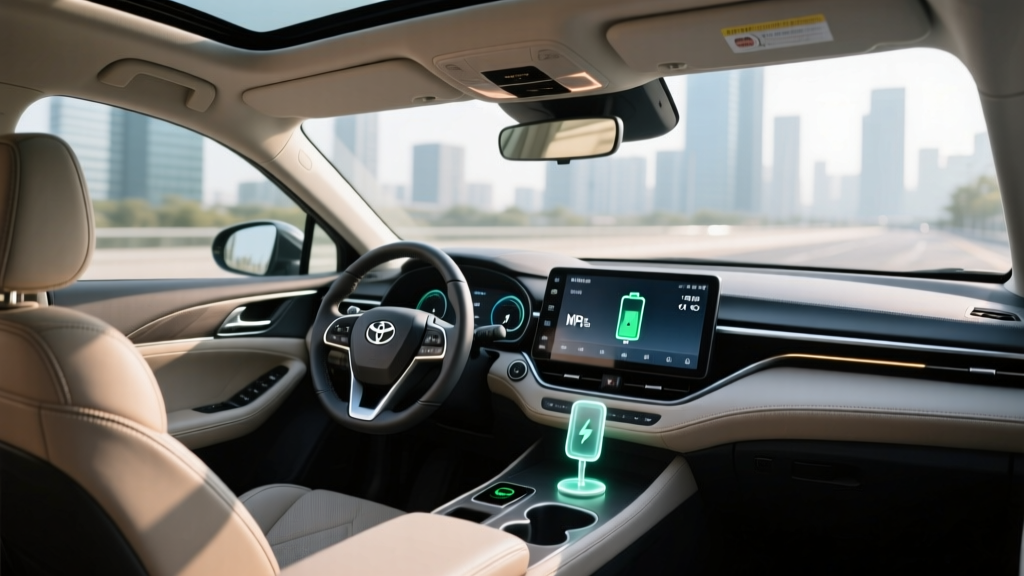
Toyota's ninth-generation Camry (introduced for 2025 and carried into 2026) moved the interior upmarket with a 12.3-inch digital instrument cluster on upper trims, an 8.0- or 12.3-inch Toyota Audio Multimedia touchscreen, and soft-touch materials across the dash and door panels. LE and SE trims use a fabric-and-trimmed upholstery, while XLE and XSE step up to SofTex synthetic leather with available genuine leather on XLE.
Front-seat comfort remains a Camry hallmark. Headroom measures 38.3 inches up front, legroom hits 42.1 inches, and the rear seat offers 38.0 inches of legroom — competitive with the Honda Accord Hybrid and Hyundai Sonata Hybrid. Cargo volume stands at 15.1 cubic feet, unchanged from the prior generation, with a 60/40 split-folding rear seatback on all trims except the base LE.
Wireless Apple CarPlay and Android Auto are standard across the lineup. A Qi-compatible wireless charging pad is available from SE upward. USB-C ports (two front, two rear) are standard on SE and above, while the LE provides a single USB-A port up front. The available 9-speaker JBL audio system with Clari-Fi remains one of the better premium audio options in the segment.
Powertrain: Fifth-Generation Hybrid System Explained
The 2026 Camry uses Toyota's fifth-generation Hybrid Synergy Drive, pairing a 2.5-liter four-cylinder engine (running on the Atkinson cycle) with two front-mounted electric motor-generators. On AWD trims, a third electric motor powers the rear axle — there is no mechanical driveshaft connecting front and rear.
| Specification | FWD | AWD (Electronic) |
|---|---|---|
| Engine | 2.5L 4-cyl Atkinson | 2.5L 4-cyl Atkinson |
| Combined Net Horsepower | 225 hp | 232 hp |
| Front Motor Output | 100 kW (134 hp) | 100 kW (134 hp) |
| Rear Motor Output | — | 30 kW (40 hp) |
| Transmission | eCVT | eCVT |
| 0–60 mph (est.) | ~7.2 sec | ~6.9 sec |
| Traction Battery | ~1.1 kWh lithium-ion | ~1.1 kWh lithium-ion |
The small 1.1 kWh traction battery is critical to understand: this is a conventional hybrid (HEV), not a plug-in hybrid. The battery is recharged entirely through regenerative braking and engine power. You never plug it in. The electric motors assist during acceleration and enable brief low-speed electric-only driving (typically under 1 mile at parking-lot speeds), but the engine is always doing the majority of the work.
EPA Fuel Economy and Real-World MPG
The 2026 Camry Hybrid's EPA ratings are among the highest in the midsize sedan segment. Here's the full breakdown by trim and drivetrain:
| Trim / Drivetrain | City | Highway | Combined |
|---|---|---|---|
| LE FWD | 53 MPG | 50 MPG | 51 MPG |
| SE / XLE FWD | 48 MPG | 47 MPG | 47 MPG |
| SE / XLE / XSE AWD | 46 MPG | 46 MPG | 46 MPG |
Source: fueleconomy.gov
HEV vs. PHEV vs. EV: Which Powertrain Fits You?
Toyota discontinued the Camry's plug-in hybrid variant years ago and does not offer one for 2026. If you want a Toyota PHEV, the RAV4 Prime is the closest alternative. Here's how the three electrified powertrains stack up for a midsize sedan buyer:
No plug needed. 51 MPG combined. $28,700 starting. Best for: drivers without home charging access who want maximum simplicity and lowest fuel cost per mile.
Plug in for ~30 miles electric-only. 40+ MPG after battery depletes. Best for: home chargers with short commutes who want electric daily driving without range anxiety on road trips.
Full electric. 300+ mile range. Best for: home-charging-capable drivers ready to eliminate gas entirely and accept DC fast-charging on road trips.
The Camry Hybrid wins on simplicity and upfront cost. You'll never think about charging, and the 13.2-gallon fuel tank gives you over 600 miles of range on a single fill-up with the LE trim.
Pricing, Trims, and Tax Credit Eligibility
The 2026 Camry Hybrid starts at an accessible price point, though upper trims climb into near-luxury territory:
| Trim | Drivetrain | MSRP |
|---|---|---|
| LE | FWD | $28,700 |
| SE | FWD | $30,200 |
| SE | AWD | $31,600 |
| XLE | FWD | $33,500 |
| XLE | AWD | $34,900 |
| XSE | AWD | $35,400 |
Federal Tax Credit: The conventional Camry Hybrid does not qualify for the IRS §30D Clean Vehicle Credit, which is reserved for plug-in electric vehicles (BEVs and PHEVs) meeting battery-sourcing and critical-mineral requirements. There is no federal tax credit for conventional hybrids as of 2026. Some states and local utilities offer rebates for hybrid purchases — check your state energy office or utility provider for current programs. Source: irs.gov.
Battery Warranty, Lifespan, and Replacement Cost
Hybrid battery longevity is the top concern for first-time hybrid buyers, and Toyota has the longest track record in the industry to address it.
- Hybrid Battery: 10 years / 150,000 miles (whichever comes first) — covers capacity loss and defects
- Hybrid System Components (inverter, motor-generators, control module): 8 years / 100,000 miles
- Basic Vehicle: 3 years / 36,000 miles
- Powertrain (engine, transaxle): 5 years / 60,000 miles
Real-World Battery Lifespan: Toyota's hybrid battery packs — now lithium-ion in the fifth-generation system — routinely last 150,000–200,000+ miles with no significant degradation issues. The Camry's hybrid battery is small (~1.1 kWh) and operates within a conservative state-of-charge window (roughly 40–80%), which dramatically reduces cell stress. Prius taxis routinely exceed 300,000 miles on original hybrid batteries.
Replacement Cost: If the hybrid battery does fail outside warranty, a new OEM replacement runs approximately $2,500–$3,500 including labor. Refurbished/remanufactured packs are available for $1,500–$2,200. Independent hybrid specialists in most metro areas can perform the swap in 2–3 hours. This is significantly less expensive than a full EV battery replacement ($10,000–$20,000+).
Camry Hybrid Interior vs. Key Competitors
How does the Camry Hybrid cabin stack up against the Accord Hybrid and Sonata Hybrid?
| Metric | Camry Hybrid | Accord Hybrid | Sonata Hybrid |
|---|---|---|---|
| Combined MPG | 51 (LE) | 48 | 47 |
| Front Legroom | 42.1 in | 40.8 in | 46.1 in |
| Rear Legroom | 38.0 in | 40.8 in | 38.2 in |
| Cargo Volume | 15.1 cu ft | 16.7 cu ft | 16.0 cu ft |
| Infotainment Screen | 8.0 or 12.3 in | 12.3 in | 12.3 in |
| Wireless CarPlay/AA | Yes | Yes | Yes |
| AWD Available | Yes | No | No |
| Starting MSRP | $28,700 | $32,995 | $30,250 |
The Camry Hybrid trades some rear-seat space and cargo volume for best-in-class fuel economy, AWD availability, and a lower starting price. If rear-seat room is your top priority, the Accord Hybrid edges it out. If you want the most MPG for the least money, the Camry Hybrid LE is unmatched.
Safety, ADAS, and Toyota Safety Sense 3.0
Every 2026 Camry Hybrid comes standard with Toyota Safety Sense 3.0, which includes:
- Pre-Collision System with Pedestrian Detection
- Full-Speed Range Dynamic Radar Cruise Control
- Lane Departure Alert with Steering Assist
- Lane Tracing Assist
- Automatic High Beams
- Road Sign Assist
- Proactive Driving Assist (gentle braking/steering support)
The Camry earned an IIHS Top Safety Pick+ rating for the prior model year; NHTSA 5-star ratings for the 2026 model year can be confirmed at nhtsa.gov/ratings once testing is published.
Decision Framework: Should You Buy the 2026 Camry Hybrid?
Choose the Camry Hybrid if:
- You want 50+ MPG without plugging in or changing habits
- You lack home charging access (apartment, street parking)
- You want AWD in an efficient sedan (rare in this class)
- Low upfront cost matters — starts under $29K
- You plan to keep the car 8–10+ years (warranty covers the battery)
Look at a PHEV or BEV instead if:
- You have home Level 2 charging and a short commute (PHEV gives you electric-only daily driving)
- You want to eliminate gasoline entirely (BEV)
- You want to claim the $7,500 federal tax credit (requires a PHEV or BEV meeting §30D sourcing rules)
- You drive fewer than 10,000 miles/year — the Camry Hybrid's fuel savings take longer to offset any price premium over a gas-only competitor at low mileage
- Best-in-class 51 MPG combined (LE)
- AWD available — unique in the segment
- 10-year/150K-mile hybrid battery warranty
- Low starting MSRP ($28,700)
- Proven Toyota hybrid reliability
- 600+ mile total range per tank
- No federal tax credit (HEV, not PHEV)
- Rear legroom trails Accord Hybrid
- Cargo space slightly below class average
- Base LE infotainment screen is small (8 in)
- No plug-in hybrid option for 2026
- eCVT drone under hard acceleration
Frequently Asked Questions
How many MPG does the 2026 Camry Hybrid get?
The LE FWD trim achieves an EPA-estimated 53 city / 50 highway / 51 combined MPG. SE and XLE FWD trims rate at 47 combined, while AWD trims rate at 46 combined. Real-world averages typically land within 2–4 MPG of the EPA combined figure in mixed driving.
Is the Camry Hybrid a plug-in hybrid?
No. The 2026 Camry Hybrid is a conventional hybrid (HEV). It charges its own small battery through regenerative braking and the gasoline engine. You never plug it in. Toyota does not offer a Camry plug-in hybrid for 2026.
How long will the Camry Hybrid battery last?
Toyota's fifth-generation lithium-ion hybrid batteries routinely last 150,000–200,000+ miles. The battery is covered by a 10-year/150,000-mile warranty. Replacement outside warranty costs approximately $2,500–$3,500 for an OEM pack.
Does the Camry Hybrid qualify for a federal tax credit?
No. The IRS §30D Clean Vehicle Credit applies only to plug-in electric vehicles (BEVs and qualifying PHEVs). Conventional hybrids like the Camry Hybrid are not eligible. Some state and utility rebates may apply — check local programs.
How does the Camry Hybrid interior compare to the Accord Hybrid?
The Camry Hybrid offers a slightly more premium feel in upper trims (XLE leather, JBL audio) and standard wireless phone integration across all trims. The Accord Hybrid provides more rear-seat legroom (40.8 vs. 38.0 inches) and more cargo space (16.7 vs. 15.1 cu ft). The Camry wins on fuel economy (51 vs. 48 combined) and price ($28,700 vs. $32,995 starting).
Is the Camry Hybrid AWD system full-time?
No. The electronic AWD system is on-demand — the rear electric motor engages only when the system detects front-wheel slip or during hard acceleration from low speeds. Under normal cruising conditions, the Camry Hybrid AWD operates as a front-wheel-drive vehicle to maximize efficiency.
Can I tow with the Camry Hybrid?
Toyota does not recommend towing with the Camry Hybrid. It is not rated for trailer towing. If you need a hybrid that can tow, consider the RAV4 Hybrid (up to 1,750 lbs) or a hybrid SUV/pickup.