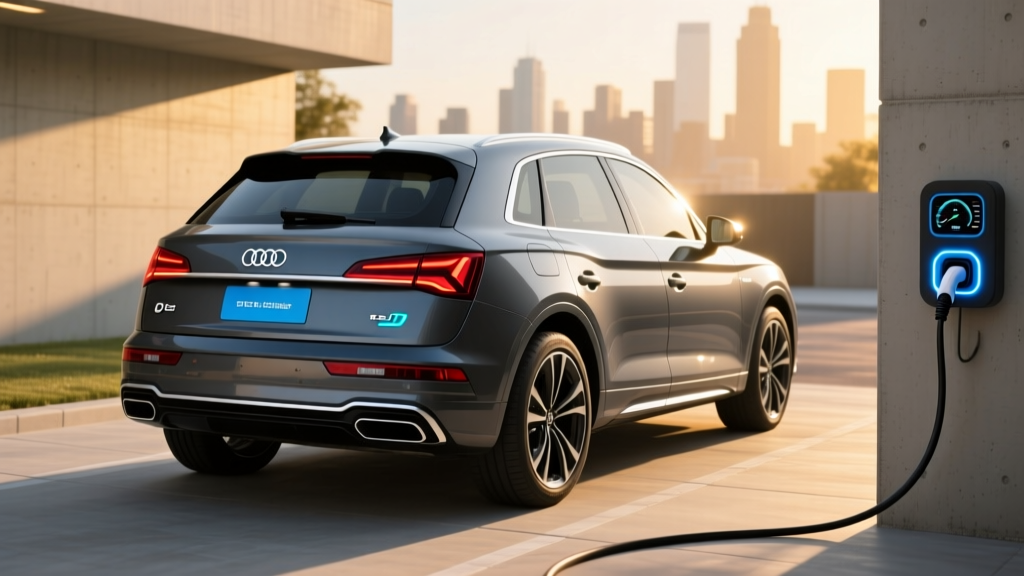
The Audi Q5 TFSI e occupies a specific niche in the luxury compact SUV segment: a plug-in hybrid (PHEV) that lets you commute on electricity while keeping a turbocharged gas engine for road trips. For the 2026 model year, Audi has refreshed the Q5 lineup, and the TFSI e variant continues to target buyers who want electric daily driving without the range limitations of a full battery-electric vehicle (BEV). But with a relatively small battery and no DC fast-charging capability, does the Q5 TFSI e deliver enough electric utility to justify its premium over the gas-only Q5?
This guide breaks down the 2026 Audi Q5 TFSI e hybrid's real-world efficiency, electric-only range, powertrain specs, charging logistics, pricing, and tax-credit eligibility — everything you need to decide if this PHEV fits your garage.
HEV vs. PHEV: Where the Audi Q5 TFSI e Fits
Before examining specs, it's essential to distinguish the two hybrid architectures available in luxury SUVs:
Conventional Hybrid (HEV)
A standard hybrid like the Toyota RAV4 Hybrid uses a small battery (typically 1–2 kWh) that recharges through regenerative braking and the gas engine. You never plug it in. Electric-only driving is limited to very low speeds and short distances. Fuel economy gains come from the engine operating more efficiently, not from grid electricity.
Plug-in Hybrid (PHEV) — The Q5 TFSI e
The Audi Q5 TFSI e is a plug-in hybrid. It carries a larger battery pack (17.9 kWh gross capacity) that you charge from a wall outlet or Level 2 charger. This enables meaningful electric-only driving — up to 23 EPA-rated miles — before the 2.0L turbocharged engine engages. Once the battery depletes, it operates as a conventional hybrid.
The Q5 does not come in a conventional HEV variant in the U.S. market. If you see "Q5 hybrid" referenced online, it's almost always the TFSI e PHEV. Audi previously offered a mild-hybrid (MHEV) system on gas Q5 models, but that's a 12-volt system that assists the engine — it cannot drive the wheels on electricity alone and does not plug in.
Powertrain and Performance Specs
| Specification | 2026 Audi Q5 55 TFSI e |
|---|---|
| Engine | 2.0L turbocharged inline-4 (261 hp) |
| Electric Motor | Integrated in transmission (141 hp) |
| Combined System Output | 362 hp / 369 lb-ft torque |
| Battery (Gross / Usable) | 17.9 kWh / ~14.1 kWh usable |
| Drivetrain | quattro all-wheel drive |
| Transmission | 7-speed S tronic dual-clutch |
| 0–60 mph | 5.0 seconds (est.) |
| EPA Electric-Only Range | 23 miles |
| EPA Combined Range (Elec + Gas) | ~380 miles |
| Max Level 2 Charge Rate | 7.7 kW (AC only) |
| DC Fast Charging | Not available |
| Towing Capacity | 4,400 lbs |
The combined 362 horsepower makes the Q5 TFSI e the most powerful variant in the Q5 lineup — significantly quicker than the gas-only Q5 45 TFSI (261 hp). The electric motor fills in torque at low RPMs, giving the PHEV a responsive, effortless feel around town that the gas model can't match. However, once the battery depletes and you're operating in hybrid mode, the vehicle is hauling extra weight from the battery and motor, which affects efficiency.
Fuel Economy: EPA Ratings and Real-World MPG
| Driving Mode | City | Highway | Combined |
|---|---|---|---|
| Charge-Depleting (EV + Hybrid) | 61 MPGe (EPA combined) | ||
| Charge-Sustaining (Hybrid Only, Battery Depleted) | 25 MPG | 27 MPG | 26 MPG |
The EPA rates the Q5 TFSI e at 26 MPG combined once the battery is depleted and it operates as a conventional hybrid. That figure is modest for a hybrid — comparable to the gas-only Q5 45 TFSI, which returns around 25 MPG combined. The efficiency advantage of the TFSI e comes entirely from those first 23 electric miles.
Real-World MPG Expectations
In mixed suburban driving with regular home charging, owners commonly report effective fuel economy between 40–55 MPGe because a large percentage of daily miles are covered on electricity. However, on a long road trip where you start with a depleted battery and drive 300+ highway miles, expect the charge-sustaining figure of roughly 24–26 MPG. Cold weather (below 35°F) reduces electric-only range by 15–25%, shrinking those zero-emission miles to roughly 17–19 in winter conditions.
This is the PHEV paradox: if you charge daily and drive under 25 miles, you'll rarely visit a gas station. If you don't charge regularly, you're carrying 400+ pounds of battery dead weight and getting worse fuel economy than a purpose-built hybrid like the Lexus NX 350h (which returns 39 MPG combined without ever plugging in).
Electric-Only Range and Charging Logistics
The 2026 Q5 TFSI e's 23-mile EPA electric-only range covers the average American's one-way commute (the U.S. Census Bureau reports an average commute of ~16 miles each way). But that range is sensitive to driving style, temperature, and terrain.
Real-world electric range breakdown:
- Mild weather, suburban driving (35–50 mph): 21–25 miles
- Highway driving (65–75 mph): 16–19 miles (higher speed = higher energy consumption)
- Cold weather (below 35°F), mixed driving: 15–19 miles (battery chemistry loses efficiency; cabin heating draws significant power)
- Hot weather with A/C: 19–22 miles (less impact than cold, but still noticeable)
Charging the Q5 TFSI e:
| Charging Level | Power | 0–100% Time | Notes |
|---|---|---|---|
| Level 1 (120V household outlet) | ~1.4 kW | ~10–11 hours | Trickle charge; works for overnight if daily use is low |
| Level 2 (240V, home or public) | 7.7 kW (max) | ~2.5 hours | Ideal for home charging; full charge by morning |
| DC Fast Charging | N/A | N/A | Not supported — no CCS or NACS DC port |
The lack of DC fast charging is the Q5 TFSI e's most significant limitation for PHEV utility. You cannot top up the battery at a highway Electrify America or Tesla Supercharger station. All charging must happen via AC power — at home, at work, or at a public Level 2 destination charger. For buyers with reliable home or workplace Level 2 access, this is manageable. For apartment dwellers or those without dedicated parking and a charger, the 23-mile electric range becomes very difficult to utilize consistently.
Pricing, Trims, and Tax Credit Eligibility
The 2026 Audi Q5 55 TFSI e is offered in Premium, Premium Plus, and Prestige trims. Pricing starts at approximately:
- Premium: ~$58,900 MSRP
- Premium Plus: ~$62,400 MSRP
- Prestige: ~$67,000 MSRP
(Destination charges and dealer options add to these figures.)
Federal §30D Tax Credit — Current Rules
The Audi Q5 TFSI e may qualify for up to $3,750 of the federal plug-in vehicle tax credit under IRS §30D, but eligibility depends on several factors that change frequently:
- Battery sourcing requirements: A percentage of critical minerals and battery components must be sourced from the U.S. or free-trade-agreement partners. The Q5 TFSI e's battery supply chain has historically met only the critical-minerals threshold ($3,750), not the full $7,500.
- MSRP cap: SUVs must have an MSRP at or below $80,000. The Q5 TFSI e qualifies on all trims.
- Buyer income cap: Modified adjusted gross income must not exceed $150,000 (single), $225,000 (head of household), or $300,000 (joint filers).
- Point-of-sale transfer: As of 2024+, eligible buyers can transfer the credit to the dealer at purchase, reducing the out-of-pocket price immediately rather than waiting for a tax refund.
Verify current eligibility on IRS.gov before purchasing, as battery-sourcing compliance is updated periodically by the Treasury Department.
Compared to the gas-only Q5 45 TFSI (starting around $46,000), the TFSI e commands a roughly $12,000–$13,000 premium. Even with a $3,750 federal credit, you're paying $8,000–$9,000 more upfront. The break-even math depends heavily on your local electricity and gas prices, your daily mileage, and how consistently you charge.
Reliability, Battery Warranty, and Long-Term Costs
Audi PHEV Battery Warranty
Audi covers the Q5 TFSI e's high-voltage battery with a 8-year / 100,000-mile warranty (whichever comes first), which is the federal minimum mandated by the EPA for emissions-related components and has become the industry standard for PHEV and BEV battery packs. The warranty covers defects and capacity loss below a specified threshold (typically 70% of original capacity).
Battery replacement cost (out of warranty): Estimated at $8,000–$12,000 for the pack itself plus labor, based on comparable VW Group PHEV platforms. However, PHEV batteries are smaller and undergo fewer full charge cycles than BEV batteries, and real-world data suggests most hybrid batteries outlast their warranty periods with moderate degradation (5–10% over 8 years).
Audi's overall reliability record has been middling in recent years. Consumer Reports typically rates Audi below average for predicted reliability, with common trouble spots including infotainment glitches, electrical gremlins, and turbocharged engine carbon buildup over high mileage. The PHEV powertrain adds complexity — two power sources, a clutch between them, and high-voltage systems — which introduces more potential failure points than a conventional hybrid like the Lexus NX 350h or a BEV with far fewer moving parts.
Maintenance costs for the Q5 TFSI e are higher than a pure EV (no oil changes needed on a BEV) but similar to the gas Q5. Expect to pay for regular oil changes, brake fluid service, and cabin air filter replacement. One advantage: regenerative braking reduces wear on the friction brakes, so pad and rotor replacement intervals are typically longer than on the gas-only Q5.
Who Should Buy the Q5 TFSI e — and Who Shouldn't
Choose the Audi Q5 TFSI e If:
- Your daily round-trip commute is under 25 miles and you have reliable Level 2 charging at home or work.
- You want a luxury compact SUV with strong acceleration (362 hp) and quattro AWD for snow or mountain driving.
- You regularly take road trips exceeding 200 miles and don't want to plan around DC fast-charging stations.
- You value Audi's interior quality, Virtual Cockit digital dash, and brand prestige over maximum fuel efficiency.
Look Elsewhere If:
- You can't charge at home or work. Without regular plug-in charging, the Q5 TFSI e returns 26 MPG — worse than a Lexus NX 350h (39 MPG) that costs $15,000 less.
- You want maximum electric range. The Toyota RAV4 Prime offers 42 miles electric-only, DC fast charging (on some trims), and starts under $45,000.
- You want a full EV experience. The Audi Q4 e-tron (265 miles EPA range) or Tesla Model Y (310+ miles) eliminate gas entirely and have lower per-mile energy costs, though they require DC fast-charging access for road trips.
- Reliability is your top priority. Lexus and Toyota hybrids have decades of proven hybrid battery longevity data that Audi's PHEV system cannot yet match.
Pros
- 362 hp makes it the quickest Q5 variant
- 23 miles electric covers many daily commutes
- Premium interior with excellent build quality
- 4,400-lb towing capacity (best in PHEV class)
- quattro AWD standard
- No range anxiety — gas engine for long trips
Cons
- No DC fast charging — AC only
- 26 MPG hybrid-only is unimpressive for a hybrid
- ~$12,000 premium over gas Q5 45 TFSI
- Cargo space reduced vs. gas Q5 (battery under floor)
- Below-average predicted reliability ratings
- Electric range drops significantly in cold weather
Q5 TFSI e vs. Key PHEV and EV Alternatives
| Attribute | Audi Q5 55 TFSI e | Toyota RAV4 Prime | BMW X3 xDrive30e | Audi Q4 55 e-tron (BEV) |
|---|---|---|---|---|
| Powertrain | PHEV | PHEV | PHEV | BEV |
| Combined HP | 362 | 302 | 288 | 335 |
| Electric-Only Range | 23 mi | 42 mi | ~28 mi | 265 mi (total) |
| Hybrid-Only MPG | 26 | 38 | ~28 | N/A (109 MPGe) |
| DC Fast Charging | No | Optional | No | Yes (175 kW) |
| Starting MSRP | ~$58,900 | ~$44,500 | ~$53,000 | ~$52,200 |
| Federal Tax Credit (est.) | Up to $3,750 | Up to $7,500* | Up to $3,750 | Up to $7,500* |
*Tax credit amounts depend on battery-sourcing compliance, buyer income, and MSRP caps. Verify at IRS.gov.
The RAV4 Prime dominates on paper: more electric range, better hybrid MPG, lower price, and potentially a larger tax credit. But it doesn't offer the Audi's luxury interior, performance, or towing capacity. The BMW X3 xDrive30e is the closest direct competitor, with slightly more electric range but less power. The Q4 e-tron is the full-EV alternative for buyers ready to commit to battery-only driving.
Frequently Asked Questions
How many MPG does the Audi Q5 TFSI e hybrid get?
The EPA rates the Q5 TFSI e at 26 MPG combined (25 city / 27 highway) once the battery is depleted and it operates as a conventional hybrid. When factoring in electric-only driving from a full charge, the combined rating is 61 MPGe. Real-world fuel economy varies widely: owners who charge daily and drive under 25 miles may use very little gasoline, while long highway trips will see 24–26 MPG.
How far can the Q5 TFSI e go on electric only?
The EPA rates the 2026 Q5 TFSI e at 23 miles of electric-only range. In real-world conditions, expect 21–25 miles in mild suburban driving, 16–19 miles on the highway, and 15–19 miles in cold weather. The 17.9 kWh battery (14.1 kWh usable) is smaller than competitors like the RAV4 Prime (18.1 kWh usable) which achieves 42 miles thanks to superior efficiency.
Does the Audi Q5 TFSI e qualify for a tax credit?
The Q5 TFSI e may qualify for up to $3,750 of the federal §30D plug-in vehicle tax credit, depending on battery-sourcing compliance at the time of purchase. The full $7,500 credit requires meeting both critical-minerals and battery-component sourcing thresholds, which the Q5 TFSI e has not consistently met. Buyer income caps ($150K single / $300K joint) and the $80,000 SUV MSRP cap also apply. Check current eligibility on fueleconomy.gov and IRS.gov before purchasing.
Is the Q5 TFSI e reliable, and what does battery replacement cost?
Audi's predicted reliability ratings are generally below average compared to Toyota and Lexus hybrids. The PHEV system adds mechanical complexity over a conventional hybrid or BEV. The high-voltage battery is warranted for 8 years / 100,000 miles. Out-of-warranty replacement is estimated at $8,000–$12,000. However, PHEV batteries experience less stress than BEV batteries due to smaller capacity and partial cycling, and most are expected to last well beyond the warranty period with moderate degradation.
Should I get the Q5 TFSI e PHEV, a conventional hybrid, or a full EV?
If you have home Level 2 charging, a commute under 25 miles, and regularly take road trips over 200 miles, the Q5 TFSI e is a strong compromise. If you can't charge at home, a conventional hybrid like the Lexus NX 350h (39 MPG, no plug-in needed) is more practical and affordable. If you have reliable charging and want to eliminate gasoline entirely, a BEV like the Audi Q4 e-tron or Tesla Model Y offers lower running costs, less maintenance, and a smoother driving experience — but requires planning for long trips around DC fast chargers.
Can the Q5 TFSI e charge at Tesla Superchargers or Electrify America?
No. The Q5 TFSI e does not support DC fast charging at all. It can only charge via AC power (Level 1 at 120V or Level 2 at 240V/7.7 kW). This means home charging and public Level 2 destination chargers are your only options. You cannot use Tesla Superchargers, Electrify America, EVgo, or any DC fast-charging network.