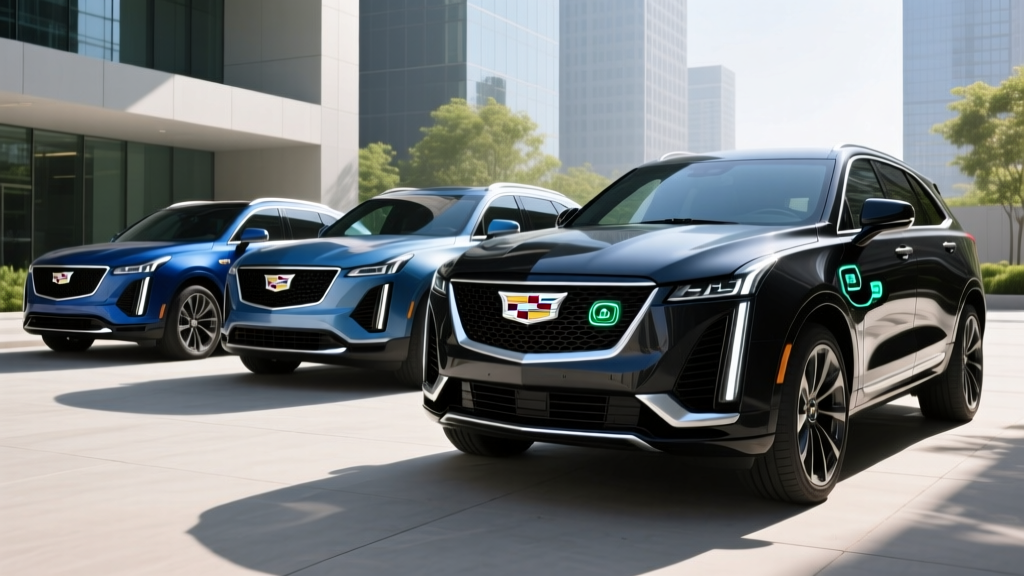
If you've been searching whether Cadillac offers a hybrid SUV in 2026, the answer requires some nuance. Cadillac's electrification strategy has evolved significantly, and the brand's current lineup includes a mix of mild-hybrid assistance, full battery-electric vehicles, and notably absent plug-in hybrid options. Here's exactly what Cadillac offers to buyers who want some level of electrification without committing fully to a BEV.
Does Cadillac Make a Hybrid SUV? The 2026 Lineup at a Glance
Cadillac does not currently sell a conventional hybrid (HEV) or plug-in hybrid (PHEV) SUV in the United States for the 2026 model year. The brand has pursued a different path: mild-hybrid systems on select models and a full pivot toward battery-electric vehicles under its IQ sub-brand. This is a deliberate strategic choice that sets Cadillac apart from competitors like BMW, Volvo, and Lincoln, all of which offer PHEV SUVs.
Understanding the Electrification Spectrum
| Type | How It Works | Plug In? | Electric-Only Range | Cadillac Availability (2026) |
|---|---|---|---|---|
| Mild Hybrid (MHEV) | Small 48V motor assists gas engine; cannot drive on electric alone | No | 0 miles | Available (XT6, select trims) |
| Full Hybrid (HEV) | Larger motor + battery; can drive short distances on electric | No | 1–2 miles at low speed | Not offered |
| Plug-In Hybrid (PHEV) | Substantial battery + motor; meaningful electric range, then gas engine | Yes | 20–50 miles typical | Not offered |
| Battery Electric (BEV) | 100% electric; no gas engine | Yes (required) | Full range (250–310+ mi) | LYRIQ, OPTIQ, Escalade IQ |
This distinction matters because many shoppers searching for a "Cadillac hybrid SUV" are actually looking for a PHEV — a vehicle that offers 30+ miles of electric commuting with a gas engine for longer trips. Cadillac does not offer this. The closest alternatives are either the mild-hybrid XT6 (which provides minimal efficiency gains) or Cadillac's growing BEV lineup.
The Cadillac XT6 Mild-Hybrid: What It Actually Offers
The 2026 Cadillac XT6 is available with a 48-volt mild-hybrid system paired with the 2.0L turbocharged four-cylinder engine. This is not a hybrid in the way most buyers think of the term — it cannot propel the vehicle on electric power alone. Instead, the mild-hybrid system smooths stop-start operation, provides a small torque fill during acceleration, and enables slightly more aggressive regenerative braking.
| Drivetrain | City MPG | Highway MPG | Combined MPG |
|---|---|---|---|
| FWD (2.0T MHEV) | 21 | 27 | 23 |
| AWD (2.0T MHEV) | 20 | 26 | 22 |
For context, a comparable PHEV from a competitor — such as the Volvo XC90 Recharge — delivers an EPA-estimated 27 MPGe combined with 32 miles of electric-only range before the gas engine engages. The XT6's mild-hybrid system offers no electric-only driving and only marginal fuel-economy improvement over a conventional turbocharged setup.
XT6 Mild-Hybrid Battery & Warranty
The 48V mild-hybrid battery is a small lithium-ion unit (under 1 kWh) designed to assist the engine, not store meaningful energy. It is covered under Cadillac's standard powertrain warranty: 6 years / 70,000 miles. Replacement cost for the 48V battery is estimated at $1,200–$2,000, far less than a full hybrid or PHEV traction battery.
Powertrain specs (XT6 2.0T MHEV): 235 hp combined (235 hp from the turbo engine, with the 48V motor providing up to ~12 kW of assist). 0–60 mph in approximately 7.8 seconds. 9-speed automatic transmission. Towing capacity: 1,000 lbs (not rated for heavy towing like the V6 variant).
Why Cadillac Skipped the PHEV SUV
Cadillac's parent company, General Motors, made a strategic decision to invest heavily in the Ultium battery-electric platform rather than develop plug-in hybrid variants for its luxury brands. While GM did offer a PHEV version of the Chevrolet Volt and briefly the Cadillac ELR (discontinued in 2016), the current luxury strategy focuses on BEVs.
This means that in 2026, if you want a Cadillac SUV with meaningful electric driving capability, you're looking at a full BEV — not a PHEV. The current Cadillac electric SUV lineup includes:
- Cadillac LYRIQ — Midsize luxury BEV, 314-mile EPA range, starting ~$50,495
- Cadillac OPTIQ — Compact luxury BEV, estimated 300+ mile range, starting ~$47,990
- Cadillac Escalade IQ — Full-size flagship BEV, estimated 450-mile range, starting ~$129,990
None of these have a gas engine. For buyers who need the flexibility of a gas backup, this is a genuine limitation in Cadillac's 2026 lineup.
Cadillac BEV SUVs vs. Competitor PHEVs: Which Approach Makes Sense?
If you're cross-shopping a "Cadillac hybrid SUV" against other luxury brands, here's how the options stack up in practical terms:
| Model | Type | Electric Range | Combined MPG/MPGe | Starting MSRP | Federal Tax Credit |
|---|---|---|---|---|---|
| Cadillac LYRIQ | BEV | 314 mi (full range) | 89 MPGe | $50,495 | Not eligible (§30D MSRP cap & sourcing) |
| Volvo XC90 Recharge | PHEV | 32 mi electric | 27 MPGe / 27 MPG gas | $76,800 | Not eligible (MSRP cap) |
| BMW X5 xDrive50e | PHEV | 38 mi electric | 56 MPGe / 23 MPG gas | $73,200 | Not eligible (MSRP cap) |
| Lincoln Corsair Grand Touring | PHEV | 28 mi electric | 78 MPGe / 24 MPG gas | $53,925 | Eligibility varies by sourcing |
| Cadillac XT6 (MHEV) | Mild Hybrid | 0 mi electric | 23 MPG combined | $52,495 | Not eligible |
The key takeaway: if a plug-in hybrid with 30+ miles of electric range is your priority, Cadillac does not compete in this segment. You'll need to look at Volvo, BMW, Lincoln, or Porsche (Cayenne E-Hybrid). If you're open to a full BEV, the LYRIQ and OPTIQ offer competitive range and luxury at lower price points than most PHEV competitors.
Tax Credit Reality for Cadillac Electrified SUVs
Under the current IRS §30D rules for 2026, the federal EV tax credit of up to $7,500 applies only to new battery-electric and plug-in hybrid vehicles that meet strict requirements:
- MSRP caps: Vans, SUVs, and pickup trucks must have an MSRP at or below $80,000
- Buyer income limits: Modified adjusted gross income must not exceed $150,000 (single), $225,000 (head of household), or $300,000 (joint)
- Battery sourcing: Increasing percentages of critical minerals and battery components must be sourced from the US or free-trade-agreement countries
- Point-of-sale transfer: Eligible buyers can transfer the credit to the dealer for an immediate price reduction
The Cadillac LYRIQ and OPTIQ fall under the $80,000 SUV MSRP cap, but eligibility for the full $7,500 depends on battery-sourcing compliance, which has tightened each year since 2023. As of early 2026, many GM Ultium-based vehicles qualify for a partial credit ($3,750) or the full $7,500 depending on the specific build date and battery component sourcing. Always verify current eligibility on IRS.gov before purchasing, and consult a tax professional for your specific situation.
The XT6 mild-hybrid does not qualify for any federal EV tax credit — mild-hybrids are excluded from §30D because they cannot drive on electric power alone.
Who Should Choose a Cadillac Mild-Hybrid vs. BEV vs. Looking Elsewhere?
Choose the Cadillac XT6 Mild-Hybrid If:
- You want a three-row Cadillac SUV and don't want to plug in
- Your daily driving is moderate (under 40 miles) and you take frequent long road trips
- You value the XT6's specific combination of size, styling, and dealer network
- You accept that fuel economy will be similar to a conventional gas SUV
Choose a Cadillac BEV (LYRIQ/OPTIQ) If:
- You have reliable home charging (Level 2, 240V)
- Your daily commute is under 200 miles round-trip
- You want the lowest per-mile "fuel" cost and minimal maintenance
- You're comfortable planning around DC fast charging on road trips
Look at Competitor PHEVs If:
- You want 25–40 miles of electric commuting but also need gas-engine flexibility
- You can't install a home Level 2 charger but can plug in at work or use public charging occasionally
- You frequently drive 300+ miles in a day and don't want to rely on DC fast-charging infrastructure
- A PHEV is the only electrified vehicle in your household
Reliability and Long-Term Ownership Considerations
For hybrid and PHEV buyers, battery longevity is a top concern. Here's how Cadillac's offerings compare:
XT6 Mild-Hybrid: The 48V battery is small, relatively inexpensive, and under minimal stress. Failures are rare, and replacement cost ($1,200–$2,000) is comparable to a conventional car's starter battery upgrade. The standard powertrain warranty covers it for 6 years/70,000 miles.
LYRIQ / OPTIQ / Escalade IQ (BEVs): These use GM's Ultium battery platform with NMC (nickel manganese cobalt) chemistry. GM covers the battery with an 8-year / 100,000-mile warranty against defects and excessive capacity loss (typically defined as dropping below 60–70% of original capacity). Real-world degradation for liquid-cooled Ultium packs is expected to be 8–12% over 8 years based on early fleet data and GM's thermal management design. A full Ultium battery replacement out of warranty is estimated at $12,000–$18,000 depending on pack size — a significant cost, but one that most owners will never face within the vehicle's practical lifespan.
Competitor PHEVs (Volvo, BMW): Hybrid battery warranties are typically 8 years/100,000 miles (federally mandated for emissions-related components in many states, and standard practice across the industry). PHEV battery replacement costs range from $8,000 to $15,000 depending on the model.
Frequently Asked Questions
Does Cadillac make a hybrid SUV in 2026?
Cadillac offers the XT6 with a 48-volt mild-hybrid system, but this is not a full hybrid or plug-in hybrid. The mild-hybrid system cannot drive the vehicle on electric power alone and provides only marginal fuel-economy improvement (23 MPG combined for FWD). Cadillac does not currently sell a conventional HEV or PHEV SUV.
How many MPG does the Cadillac XT6 mild-hybrid get?
The 2026 XT6 with the 2.0T mild-hybrid and FWD achieves an EPA-estimated 21 city / 27 highway / 23 combined MPG. The AWD variant drops slightly to 20/26/22 MPG. In real-world driving, expect numbers close to EPA figures — mild-hybrids don't see the dramatic city- MPG boosts that full hybrids do because the electric motor provides only brief assist.
Does Cadillac have a plug-in hybrid SUV?
No. As of the 2026 model year, Cadillac does not offer any plug-in hybrid SUV. The brand's electrification strategy focuses on battery-electric vehicles (LYRIQ, OPTIQ, Escalade IQ). If you need a luxury PHEV SUV, consider the Volvo XC90 Recharge, BMW X5 xDrive50e, or Lincoln Corsair Grand Touring.
Is the Cadillac XT6 mild-hybrid reliable?
The XT6's powertrain is mechanically straightforward — a turbocharged 2.0L engine with a small 48V assist system. There are no high-voltage components, and the mild-hybrid battery is under minimal stress. Long-term reliability is expected to be similar to the conventional XT6, which has average reliability ratings from major trackers. The 48V battery is covered under the 6-year/70,000-mile powertrain warranty.
Does the Cadillac XT6 mild-hybrid qualify for a tax credit?
No. Mild-hybrid vehicles are not eligible for the federal §30D clean vehicle tax credit, which requires the vehicle to have a minimum battery capacity and the ability to operate on electric power alone. Only BEVs and qualifying PHEVs are eligible. The Cadillac LYRIQ (BEV) may qualify for up to $7,500 depending on sourcing and buyer income.
What Cadillac SUV gets the best fuel economy?
Among Cadillac's current SUVs, the BEV models (LYRIQ at 89 MPGe, OPTIQ estimated at 90+ MPGe) deliver the lowest per-mile energy cost by a wide margin. Among gas-powered/mild-hybrid models, the XT6 FWD mild-hybrid at 23 MPG combined is the most efficient. The larger Escalade with the 3.0L Duramax diesel achieves 24 MPG combined but is not a hybrid.
Will Cadillac release a PHEV SUV in the future?
GM has not announced any plans for a Cadillac plug-in hybrid SUV. The company's public roadmap focuses on expanding the Ultium BEV lineup. If PHEV capability is essential for your next luxury SUV purchase, you should evaluate competitors rather than wait for a Cadillac PHEV that may never arrive.
The Bottom Line for Hybrid SUV Shoppers
If your search for a "Cadillac hybrid SUV" stems from wanting electric-assisted efficiency without full BEV commitment, Cadillac's 2026 lineup won't meet that need. The XT6 mild-hybrid is a conventional luxury SUV with marginal efficiency assistance, not a true hybrid. Cadillac's BEVs — the LYRIQ and OPTIQ — are genuinely compelling electric vehicles, but they require a commitment to electric-only driving and charging infrastructure.
For buyers who specifically need a plug-in hybrid luxury SUV with 30+ miles of electric range and a gas-engine safety net, the Volvo XC90 Recharge, BMW X5 xDrive50e, and Lincoln Corsair Grand Touring remain the strongest options in 2026. Check fueleconomy.gov for the latest EPA ratings across all these models before making a final decision.