If you have been searching for a VW Golf hybrid in the United States, you already know the story is complicated. Volkswagen discontinued the Golf hatchback for the US market after the 2021 model year, and as of the 2026 model year, there is no new-generation Golf or Golf plug-in hybrid sold through American dealerships. Yet the Golf eHybrid and Golf GTE continue to anchor Volkswagen's electrified lineup in Europe, where the Mk8.5 generation delivers meaningful improvements in electric-only range and efficiency.
This guide breaks down exactly what the current VW Golf hybrid lineup offers overseas, how those specs translate to American buyers considering an import or a future US return, and which alternatives fill the same niche stateside. Whether you are cross-shopping a potential gray-market import, planning a European relocation, or simply benchmarking PHEV technology, the numbers below give you a precise picture.
The 2026 VW Golf eHybrid and GTE: What Exists Today
Volkswagen sells two plug-in hybrid variants of the Mk8.5 Golf in Europe for the 2025–2026 model years. Both pair a 1.5-liter turbocharged four-cylinder engine with an electric motor integrated into a six-speed DSG automatic transmission. The difference lies in tuning, battery size, and electric-only range.
| Specification | Golf eHybrid | Golf GTE |
|---|---|---|
| Powertrain | 1.5L turbo I4 + electric motor | 1.5L turbo I4 + electric motor |
| Combined System Output | 204 hp / 258 lb-ft torque | 272 hp / 295 lb-ft torque |
| Battery (usable) | 19.7 kWh (NMC) | 19.7 kWh (NMC) |
| WLTP Electric Range | ~59 miles (95 km) | ~55 miles (89 km) |
| Estimated EPA Electric Range | ~45–48 miles | ~42–45 miles |
| Onboard AC Charger | 7.2 kW (single-phase) | 7.2 kW (single-phase) |
| DC Fast Charging | Not available | Not available |
| 0–100% Level 2 Charge Time | ~2 hours 45 minutes | ~2 hours 45 minutes |
| 0–62 mph (0–100 km/h) | 7.6 seconds | 6.2 seconds |
| Starting Price (Europe) | ~€41,920 | ~€47,470 |
HEV vs PHEV: Understanding What the Golf Hybrid Actually Is
The current VW Golf hybrid is exclusively a plug-in hybrid (PHEV), not a conventional hybrid (HEV). This distinction matters for daily use, fuel costs, and charging requirements.
Conventional Hybrid (HEV)
- No plug — battery charges via regenerative braking and the engine
- Small battery (typically 1–2 kWh)
- Electric-only driving limited to low speeds, short distances
- Example: Toyota Prius (non-PHEV)
Plug-In Hybrid (PHEV)
- Plugs in to charge — Level 1 (120V) or Level 2 (240V)
- Larger battery (15–25 kWh in current models)
- Substantial electric-only range at highway speeds
- Example: VW Golf eHybrid, Toyota RAV4 Prime
Previous Golf generations did offer a mild-hybrid (eTSI) variant in Europe with a 48-volt system, but this is not a full hybrid and provides no meaningful electric-only driving. If you see "Golf hybrid" referenced in older forums or articles, verify whether the source means the eHybrid/GTE plug-in or the eTSI mild-hybrid — they are fundamentally different powertrains.
Fuel Economy: Real-World MPG Expectations
Because the 2026 Golf eHybrid and GTE are not EPA-certified for US sale, official EPA MPG figures do not exist. However, we can estimate based on WLTP combined consumption data and the typical WLTP-to-EPA conversion factor.
| Metric | Golf eHybrid | Golf GTE |
|---|---|---|
| WLTP Combined (charge-depleting) | ~282 MPGe (1.2 L/100km) | ~264 MPGe (1.3 L/100km) |
| Estimated EPA MPGe | ~95–105 MPGe | ~88–98 MPGe |
| Charge-Sustaining MPG (gas only, estimated) | ~38–42 MPG combined | ~35–39 MPG combined |
| Total Combined Range (est.) | ~420–460 miles | ~400–440 miles |
Real-world MPG reality check: Plug-in hybrid fuel economy depends entirely on your charging habits. If you charge nightly and commute under 40 miles round-trip, you may burn gasoline only a handful of times per month, effectively achieving 100+ MPGe. If you never plug in, you will see only the charge-sustaining figure — roughly 38–42 MPG for the eHybrid. That is still strong for a 204-hp hatchback, but it negates the core advantage of PHEV ownership.
Battery, Charging, and Longevity
The Mk8.5 Golf eHybrid and GTE use a 19.7 kWh usable lithium-ion NMC (nickel manganese cobalt) battery pack mounted beneath the rear seats and cargo floor. This is a significant upgrade from the Mk7.5 GTE's 13 kWh pack and represents one of the largest batteries in any compact PHEV sold today.
Charging the Golf PHEV at Home
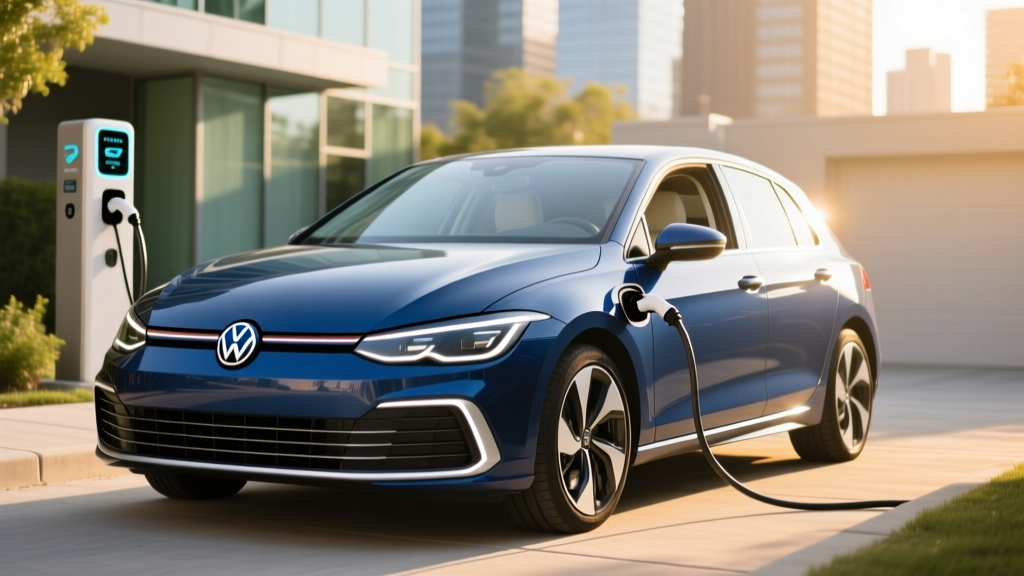
The Golf eHybrid charges exclusively via AC — there is no DC fast-charging capability, which is typical for PHEVs in this class. Here is what charge times look like:
- Level 1 (120V household outlet, ~1.4 kW): 0–100% in approximately 14 hours. Viable for overnight charging if your daily electric commute is under 35 miles.
- Level 2 (240V, 7.2 kW wallbox): 0–100% in approximately 2 hours 45 minutes. Ideal for home or workplace charging. A full charge during a lunch break restores the entire battery.
- DC Fast Charging: Not supported. The vehicle uses a Type 2 connector (European standard; J1772 equivalent in North America).
The 7.2 kW onboard charger is a step above many competitors. The Toyota RAV4 Prime, for instance, offers only 3.3 kW on its base trim and 6.6 kW on higher trims. The Golf's 7.2 kW rate means shorter Level 2 sessions and more flexibility for opportunistic top-ups.
Battery Replacement Cost
Out-of-warranty high-voltage battery replacement for a VW Golf PHEV is estimated at $6,000–$9,000 including parts and labor, based on European service data and comparable Volkswagen Group PHEV platforms. However, NMC batteries in PHEV applications typically experience slower degradation than those in full BEVs because the battery is smaller, cycles are shallower (you rarely drain from 100% to 0%), and the thermal management system is adequate for the pack size. Most PHEV owners report 5–8% degradation over the first five years of regular use.
Pricing and Tax Credit Eligibility
Since the 2026 VW Golf eHybrid and GTE are not sold in the United States, there is no US MSRP and no eligibility for the federal §30D clean vehicle tax credit. The credit applies only to new vehicles purchased from a licensed US dealer that meet North American final assembly, critical mineral sourcing, and battery component requirements.
For European buyers, pricing starts at approximately:
- Golf eHybrid: €41,920 (~$45,500 USD at current exchange rates)
- Golf GTE: €47,470 (~$51,500 USD)
Various European countries offer PHEV purchase incentives, company-car tax benefits, or reduced registration fees that can lower the effective price significantly. These vary by jurisdiction and change frequently.
What If the Golf Hybrid Returns to the US?
Volkswagen has not announced a US return for the Golf hatchback or its PHEV variants as of early 2026. If VW were to reintroduce the Golf eHybrid in America, it would need to satisfy several §30D requirements to qualify for the up-to-$7,500 federal tax credit:
- MSRP at or below $55,000 (sedan/hatchback cap)
- Buyer income within IRS limits ($150K single / $300K joint)
- North American final assembly (currently built in Wolfsburg, Germany)
- Battery critical minerals and components meeting phased-in sourcing thresholds
Given the German assembly requirement, a US-spec Golf eHybrid would likely not qualify for the full credit unless Volkswagen shifted production. Always verify current-year eligibility on IRS.gov before making a purchase decision based on tax incentives.
US Alternatives: What to Buy Instead
If you want a compact PHEV or efficient hybrid available in the US right now, several vehicles fill the space the Golf hybrid would occupy:
| Vehicle | Type | Electric Range | Combined MPG/MPGe | Starting MSRP | Federal Credit |
|---|---|---|---|---|---|
| Toyota Prius Prime | PHEV | 44 mi (EPA) | 127 MPGe / 52 MPG gas | $33,445 | Up to $3,750 |
| Hyundai Tucson PHEV | PHEV | 33 mi (EPA) | 80 MPGe / 35 MPG gas | $38,425 | Up to $3,750 |
| Toyota Prius (HEV) | HEV | N/A | 57 MPG combined | $28,345 | None |
| Ford Escape PHEV | PHEV | 37 mi (EPA) | 105 MPGe / 40 MPG gas | $39,500 | Up to $3,750 |
| VW ID.4 | BEV | 291 mi (EPA) | 115 MPGe | $40,545 | Up to $7,500 |
The Toyota Prius Prime is the closest spiritual equivalent to the Golf eHybrid — a compact, efficient PHEV with strong electric-only range and a usable hatchback form factor. It falls short on power (194 hp combined vs. 204 hp for the Golf) and interior material quality, but it is widely available, EPA-certified, and backed by Toyota's 10-year/150,000-mile hybrid battery warranty.
For buyers willing to go fully electric, the VW ID.4 — built in Chattanooga, Tennessee — offers the Volkswagen brand experience with full BEV range and potential §30D credit eligibility. It sacrifices the hatchback practicality of a Golf but gains significantly more cargo space and zero tailpipe emissions.
Who Should Want a VW Golf Hybrid — and Who Should Look Elsewhere
The Golf eHybrid Is For You If:
- You live in Europe or plan to relocate there
- You want a premium compact PHEV hatchback with 45+ electric miles
- Your commute is under 40 miles and you can charge at home nightly
- You value VW build quality and driving dynamics over maximum efficiency
- You want a PHEV that can handle occasional long road trips without range concern
Look at Alternatives If:
- You need a vehicle purchasable and warrantied in the United States
- You want a full EV with zero gasoline use
- Your budget is under $35,000 (the Golf eHybrid converts to ~$45K+ USD)
- You need DC fast charging for frequent long-distance travel
- You require an SUV or crossover body style
Frequently Asked Questions
Is the VW Golf hybrid available in the United States for 2026?
No. Volkswagen discontinued the Golf hatchback in the US after 2021 and has not announced plans to reintroduce it or its PHEV variants for 2026. The Golf eHybrid and GTE are sold exclusively in European and select international markets.
How far can the Golf eHybrid drive on electric power alone?
The 2026 Golf eHybrid achieves approximately 59 miles (95 km) on the WLTP cycle. On the more stringent EPA cycle, this would translate to an estimated 45–48 miles. Real-world range in cold weather or at sustained highway speeds may drop to 33–40 miles.
Does the VW Golf hybrid qualify for the US federal EV tax credit?
No, because it is not sold in the US. Even if it were, its German assembly would likely disqualify it from the §30D credit, which requires North American final assembly. Always check current rules at IRS.gov.
How reliable is the Golf PHEV powertrain?
Volkswagen's PHEV powertrain has been in production since the Mk7 Golf GTE (2015), and the fundamental architecture — turbocharged engine paired with a DSG-integrated electric motor — is well-proven. The high-voltage battery carries an 8-year/100,000-mile warranty with a 70% capacity retention guarantee. Independent reliability data specific to the Mk8.5 is still accumulating, but earlier Mk7.5 GTE models show average-to-above-average powertrain reliability with occasional DSG software issues.
What is the difference between the Golf eHybrid and Golf GTE?
Both share the same 19.7 kWh battery and 1.5L turbo PHEV powertrain, but the GTE is tuned for performance (272 hp vs. 204 hp) with a sport suspension, more aggressive styling, and a slightly shorter electric range due to heavier equipment. The eHybrid prioritizes efficiency and comfort. Choose the eHybrid for commuting; choose the GTE if you want hot-hatch acceleration alongside electric capability.
Should I buy a PHEV or a full EV?
Choose a PHEV if you cannot reliably charge at home or work, frequently drive more than 200 miles in a single day, or live in an area with sparse public charging infrastructure. Choose a full EV if you have dependable home Level 2 charging, your daily driving is under 250 miles, and you want to eliminate gasoline costs and maintenance entirely. PHEVs are a bridge technology — excellent for specific use cases, but more complex to maintain than either a pure EV or a conventional hybrid.