Quick Verdict: Two Tucsons, Two Very Different Ownership Experiences
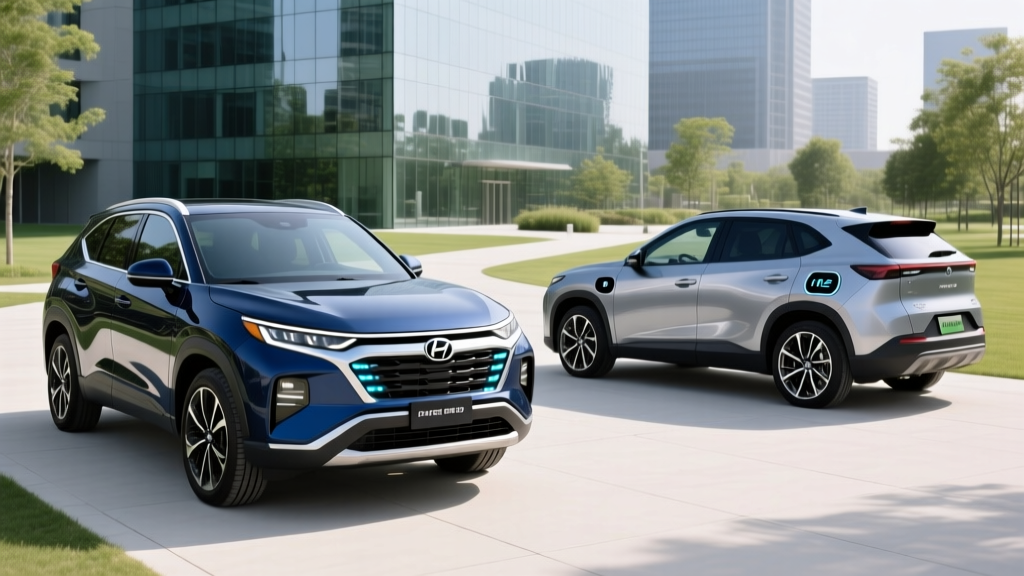
Hyundai's compact SUV lineup splits into three powertrains for 2027: a conventional gas model, a self-charging hybrid (HEV), and a plug-in hybrid (PHEV). The 2027 Tucson Hybrid targets buyers who want better fuel economy without changing their fueling habits — no plug, no range anxiety, just fill up with gas and go. The Tucson PHEV adds a larger battery and a plug for short electric-only commutes, but demands access to charging infrastructure to realize its advantage.
Both share the same turbocharged 1.6-liter four-cylinder engine paired with an electric motor, but their battery sizes, output figures, and cost-to-own profiles diverge significantly. Here's every number that matters.
HEV vs PHEV: Which Tucson Hybrid Are You Actually Looking At?
This distinction trips up more buyers than any other spec on the window sticker. Let's make it unambiguous:
Tucson Hybrid (HEV)
- Charges itself through regenerative braking and the gas engine — never plugs in
- Small battery (~1.5 kWh) acts as a buffer for electric assist
- Prioritizes fuel economy: EPA-estimated 38 MPG combined
- No electric-only driving range to speak of (under 1 mile at low speed)
- Lower starting price, no charging equipment needed
Tucson Plug-In Hybrid (PHEV)
- Plugs in to a standard outlet or Level 2 charger to fill a larger battery
- 13.8 kWh battery pack enables meaningful electric-only driving
- EPA-estimated 33 miles on electricity alone before the gas engine kicks in
- After battery depletion, operates as a conventional hybrid (~35 MPG combined)
- Higher starting price, qualifies for a federal tax credit (see below)
If you don't have reliable access to a place to plug in — at home, at work, or both — the PHEV's premium buys you nothing. The HEV is the right call. If you do have a garage or driveway outlet and a short commute, the PHEV can cover most daily driving on electricity alone, with the gas engine as backup for road trips.
Fuel Economy: EPA Numbers and Real-World MPG
| Model | City MPG | Highway MPG | Combined MPG | MPGe (PHEV Electric Mode) | Total Range |
|---|---|---|---|---|---|
| Tucson Hybrid (HEV) AWD | 38 | 38 | 38 | N/A | ~522 mi (13.7-gal tank) |
| Tucson PHEV AWD | 35 (hybrid mode) | 35 (hybrid mode) | 35 | 80 MPGe | ~33 mi electric + ~400 mi gas |
Real-World MPG vs. the EPA Sticker
Hyundai's hybrid system, like most series-parallel setups, tends to exceed its EPA city rating in stop-and-go traffic, where regenerative braking recaptures energy constantly. Owners on fueleconomy.gov report real-world combined averages between 34 and 41 MPG for the HEV, with city-heavy drivers frequently seeing 40+ MPG in warm weather.
Highway driving is where hybrids lose their edge. At sustained 75-80 MPH speeds, the electric motor contributes less and aerodynamic drag dominates. Expect highway-only trips to return 33-36 MPG in the HEV — a few ticks below the EPA estimate. Cold weather (below 30°F) drops efficiency another 5-10% across both models due to increased engine runtime for cabin heating and reduced battery efficiency.
The PHEV's real-world electric range depends heavily on temperature and driving style. The EPA's 33-mile estimate assumes moderate conditions. In summer with light acceleration, 35-37 miles is achievable. In winter, expect 24-28 miles before the engine fires up.
Powertrain Specs: What's Under the Hood
| Specification | Tucson HEV | Tucson PHEV |
|---|---|---|
| Engine | 1.6L turbocharged 4-cylinder | 1.6L turbocharged 4-cylinder |
| Engine Output | 178 hp / 195 lb-ft | 178 hp / 195 lb-ft |
| Electric Motor | 47.7 kW (64 hp) | 74.2 kW (99 hp) |
| Combined System Output | 226 hp / 258 lb-ft | 261 hp / 258 lb-ft |
| Transmission | 6-speed automatic | 6-speed automatic |
| Drivetrain | AWD (standard) | AWD (standard) |
| Battery Capacity | ~1.5 kWh (buffer) | 13.8 kWh usable |
| Battery Chemistry | Lithium-ion polymer | Lithium-ion polymer |
| 0-60 MPH (est.) | ~7.1 seconds | ~6.5 seconds |
| Towing Capacity | 2,000 lbs | 2,000 lbs |
The PHEV's more powerful electric motor gives it noticeably quicker off-the-line acceleration — useful for highway merging and passing. Both models use a conventional 6-speed automatic rather than a CVT, which Hyundai has stuck with for drivability; there's no rubber-band effect under hard throttle.
PHEV Charging: What You Need to Know Before You Plug In
The Tucson PHEV's 13.8 kWh battery charges via the J1772 connector standard on all non-Tesla electrified vehicles sold in the US. Here's what that looks like in practice:
| Charging Level | Power (kW) | 0-100% Time | Notes |
|---|---|---|---|
| Level 1 (120V household outlet) | ~1.4 kW | ~10 hours | Works for overnight top-ups if commute is short |
| Level 2 (240V home/public) | 7.2 kW | ~2 hours | Recommended — full charge before bed |
| DC Fast Charge | Not supported | N/A | No DCFC capability — typical for PHEVs |
The absence of DC fast charging is standard for the PHEV segment. With only 13.8 kWh to fill, a Level 2 charger gets you from empty to full in roughly two hours — plenty for an overnight session or a workplace top-up. A standard 120V outlet can handle nightly replenishment if your daily electric driving stays under 25 miles or so.
Hybrid & PHEV Battery Warranty
Hyundai covers both the HEV and PHEV traction batteries with a 10-year/100,000-mile warranty (8 years/100,000 miles in states that don't follow California emissions standards). This warranty covers defects and capacity loss below a defined threshold — typically 70% of original capacity. Hyundai's hybrid batteries have proven durable; widespread replacement claims are rare within the warranty period. Out-of-warranty replacement cost, should it ever be needed, typically runs $2,500-$4,500 depending on the model and labor rates.
Pricing, Trims, and Tax Credit Eligibility
| Trim | Tucson HEV MSRP | Tucson PHEV MSRP |
|---|---|---|
| Blue / SE (base) | $34,460 | $40,725 |
| SEL Convenience | $36,850 | $43,100 |
| Limited / N Line | $40,250 | $46,500 |
All prices include destination charge. AWD is standard on every hybrid and PHEV trim — there's no FWD-only entry point.
Federal Tax Credit: PHEV Qualifies, HEV Does Not
Under current IRS §30D Clean Vehicle Credit rules, the Tucson PHEV qualifies for a federal tax credit — potentially up to $3,750 depending on battery-component and critical-mineral sourcing compliance for the model year. The conventional Tucson HEV does not qualify for §30D, as the credit requires a minimum battery capacity of 7 kWh (the HEV's ~1.5 kWh falls far short).
- MSRP cap: SUVs must have an MSRP at or below $80,000 — all Tucson PHEV trims clear this easily
- Buyer income cap: Modified AGI must not exceed $150,000 (single), $225,000 (head of household), or $300,000 (joint filers)
- Battery sourcing: Credit amount depends on percentage of battery components and critical minerals sourced from the US or free-trade-agreement countries — check the specific VIN on fueleconomy.gov before purchasing
- Point-of-sale transfer: You can transfer the credit to the dealer at purchase to reduce your out-of-pocket cost, rather than waiting to claim it on your tax return
Tax credit rules are subject to change. Consult a tax professional and verify your specific vehicle's eligibility on the IRS website before relying on credit amounts in your purchase decision.
Reliability and Long-Term Ownership
Hyundai's turbo-hybrid powertrain has been in production since the 2022 model year refresh, and the architecture carries forward into 2027 with incremental software and efficiency refinements. The 1.6L turbo engine is shared across the Hyundai/Kia/Genesis family and has accumulated millions of real-world miles. Common hybrid-specific failure points — the electric motor, inverter, and battery management system — have proven robust across Hyundai's lineup.
For context, Hyundai earned a solid reliability standing in J.D. Power and Consumer Reports assessments for its hybrid models, with fewer reported issues than some competitors' early hybrid systems. The 6-speed automatic transmission is a conventional planetary-gear unit, avoiding the CVT reliability questions that plague some rival hybrids.
The 10-year/100,000-mile hybrid battery warranty (in California-emissions states) is among the longest in the segment, rivaling Toyota's equivalent coverage. This significantly reduces long-term risk for original owners and second owners who purchase within the warranty window.
Who Should Choose the Tucson Hybrid, PHEV, or a Full EV?
Choose the Tucson HEV if:
- You want better MPG without changing any habits — no plug, no app, no charging
- Your budget tops out around $38,000-$42,000
- You drive 12,000-18,000 miles/year with a mix of city and highway
- You live in an apartment or lack reliable home charging access
Choose the Tucson PHEV if:
- You have a garage, driveway, or workplace charger and a commute under 30 miles
- You want to drive mostly electric on weekdays but take gas-powered road trips on weekends
- You qualify for the federal tax credit, narrowing the price gap with the HEV
- You're not ready for a full EV but want to reduce gas consumption significantly
Choose a full EV (e.g., Ioniq 5 or EV6) if:
- You have reliable Level 2 home charging and your daily driving is under 250 miles
- You want the lowest per-mile energy cost (electricity is typically 3-5¢/mile vs. 10-14¢/mile for gas)
- You're eligible for the full $7,500 federal EV credit on a qualifying model
- You want to eliminate oil changes, transmission fluid, and engine maintenance entirely
Tucson Hybrid Pros
- 38 MPG combined with zero behavior change required
- AWD standard — uncommon at this price point for hybrids
- Spacious cargo area (38.7 cu ft behind rear seats)
- 10-year hybrid battery warranty
- Smooth, conventional automatic — no CVT drone
Tucson Hybrid Cons
- Highway MPG dips below city — typical for this hybrid architecture
- No federal tax credit for the HEV
- Modest 2,000-lb towing capacity
- Turbo engine requires premium fuel for maximum output (regular acceptable with reduced power)
- Some road noise at highway speeds vs. quieter competitors
Frequently Asked Questions
How many MPG does the 2027 Tucson Hybrid get?
The EPA rates the Tucson Hybrid AWD at 38 MPG city, 38 highway, and 38 combined. Real-world results vary: city-heavy drivers often see 40+ MPG in warm weather, while sustained highway driving at 75+ MPH may return 33-36 MPG. Cold weather reduces efficiency by 5-10%.
How far can the Tucson PHEV go on electric only?
The EPA estimates 33 miles of electric-only range for the Tucson PHEV. In warm weather with gentle driving, 35-37 miles is realistic. In cold weather (below freezing), expect 24-28 miles before the gas engine engages.
Is the Tucson Hybrid reliable?
Hyundai's 1.6L turbo-hybrid powertrain has been in production since 2022 with generally positive reliability data. The conventional 6-speed automatic avoids CVT-related complaints. The hybrid battery carries a 10-year/100,000-mile warranty (in applicable states), and out-of-warranty replacement costs are estimated at $2,500-$4,500.
Does the Tucson Hybrid qualify for a tax credit?
The conventional Tucson HEV does not qualify for the federal §30D Clean Vehicle Credit (battery capacity is too small). The Tucson PHEV may qualify for up to $3,750 depending on battery-sourcing compliance and your income level. Verify eligibility on irs.gov and check the specific VIN on fueleconomy.gov before purchasing.
Do I need to plug in the Tucson Hybrid?
No. The conventional Tucson HEV charges its small battery entirely through regenerative braking and the gas engine. You fuel it like any other gas car. Only the Tucson PHEV requires plugging in to realize its electric-only range benefit.
Hybrid vs PHEV vs EV — which is right for me?
Choose the HEV if you lack charging access and want simplicity. Choose the PHEV if you can plug in at home and have a short commute but want gas-engine range for longer trips. Choose a full EV if you have reliable home charging, drive under 250 miles daily, and want the lowest operating cost and minimal maintenance.