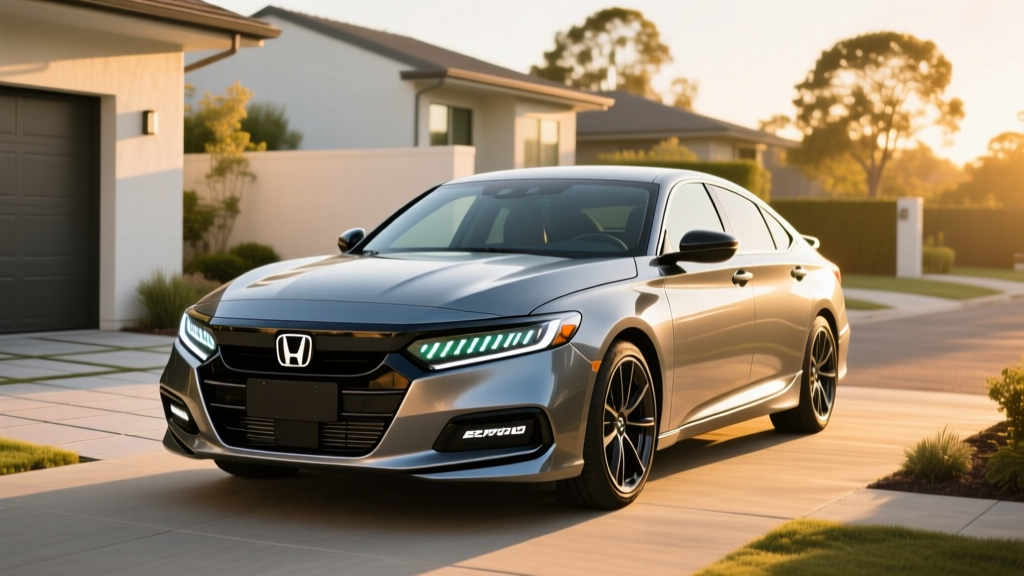
The midsize sedan segment has thinned out, but the Honda Accord remains a benchmark — and the 2026 Honda Accord Sport Hybrid is the version most buyers should actually consider. It pairs a 2.0-liter Atkinson-cycle four-cylinder with Honda's two-motor hybrid system to deliver 48 MPG combined, 204 combined horsepower, and a starting MSRP around $33,000. No plug required, no range anxiety, and a hybrid battery backed by a 10-year/150,000-mile warranty.
This guide breaks down the real-world fuel economy you can expect, how the Accord Hybrid compares to plug-in hybrids and full EVs, and whether it still qualifies for any federal or state incentives in 2026.
HEV vs. PHEV: Where the Accord Sport Hybrid Fits
Before diving into specs, it's worth clarifying what the Accord Sport Hybrid is — and what it isn't. Honda offers the Accord exclusively as a conventional hybrid (HEV). There is no plug-in hybrid (PHEV) variant for 2026, and Honda has not announced one.
| Feature | Conventional Hybrid (HEV) | Plug-In Hybrid (PHEV) |
|---|---|---|
| Plug-in charging required? | No — self-charging via regen & engine | Yes — Level 1 or Level 2 |
| Electric-only range | ~1 mile at low speed (EV mode) | Typically 20–45 miles |
| Battery size | ~1.0–1.5 kWh (small buffer) | 10–25 kWh usable |
| Federal tax credit (§30D) | Not eligible | Up to $7,500 (if eligible) |
| Best for | No home charging access; long commutes | Home charging + short daily trips |
The Accord Sport Hybrid is an HEV. You never plug it in. It captures energy through regenerative braking and the gasoline engine to recharge its small lithium-ion battery pack. If you need 25+ miles of electric-only commuting, you'd need to look at a PHEV like the Toyota Prius Prime or Hyundai Tucson PHEV instead.
Fuel Economy: EPA Ratings and Real-World MPG
The 2026 Accord Sport Hybrid carries the same two-motor hybrid powertrain Honda introduced with the 11th-generation Accord. EPA estimates have been consistent across recent model years.
| Driving Cycle | EPA Estimate | Real-World Expectation |
|---|---|---|
| City | 51 MPG | 48–55 MPG (hybrids excel in stop-and-go) |
| Highway | 44 MPG | 40–46 MPG (sustained 75+ mph reduces advantage) |
| Combined | 48 MPG | 44–50 MPG depending on mix |
Source: fueleconomy.gov
The Accord Hybrid's city MPG actually exceeds its highway number — a hallmark of series-parallel hybrid systems. At low speeds, the electric motor does most of the work, and the engine acts primarily as a generator. On the highway, the engine connects directly to the wheels via a lockup clutch for efficiency, but you lose the regenerative-braking advantage that helps so much in urban driving.
Real-world note: In mixed suburban-and-highway driving over several hundred miles, owners consistently report 44–50 MPG. Short city trips with warm weather can push above 52 MPG. Sustained 80-mph interstate runs in winter can dip to 38–40 MPG. Cold weather reduces efficiency roughly 5–10% due to increased engine runtime for cabin heat and reduced battery efficiency.
Powertrain Specs: What Moves the Accord Sport Hybrid
| Specification | 2026 Accord Sport Hybrid |
|---|---|
| Engine | 2.0L Atkinson-cycle inline-4 |
| Engine output | 146 HP @ 6,100 rpm / 134 lb-ft torque |
| Electric motors | Two-motor system (traction + generator) |
| Electric motor output | 184 HP / 247 lb-ft torque |
| Combined system output | 204 HP / 247 lb-ft torque |
| Transmission | e-CVT (direct-drive, no belt) |
| Drivetrain | Front-wheel drive |
| 0–60 mph | ~7.2 seconds |
| Hybrid battery | Lithium-ion, ~1.0 kWh (nominal) |
| Fuel tank | 12.8 gallons |
| Total range | ~614 miles (EPA combined) |
Honda's two-motor hybrid system is one of the smoothest in the segment. Unlike Toyota's planetary-gear e-CVT, Honda uses a primarily series-hybrid architecture at lower speeds: the engine drives a generator motor that feeds electricity to the traction motor, which turns the wheels. Above ~45 mph in steady-state cruising, a lockup clutch connects the engine directly to the drivetrain for better highway efficiency. The result is seamless, linear acceleration with no rubber-band CVV drone.
Pricing, Trims, and Tax Credit Eligibility
The 2026 Accord Sport Hybrid slots into the middle of the Accord lineup. Pricing reflects Honda's strategy of making the hybrid powertrain available across multiple trims rather than as a standalone upgrade.
| Trim | MSRP (est.) | Powertrain |
|---|---|---|
| LX (base, gas) | ~$29,500 | 1.5L turbo (non-hybrid) |
| Sport Hybrid | ~$33,000 | 2.0L hybrid |
| Sport-L Hybrid | ~$35,500 | 2.0L hybrid |
| EX-L Hybrid | ~$37,000 | 2.0L hybrid |
| Touring Hybrid | ~$40,000 | 2.0L hybrid |
Does the Accord Hybrid qualify for a federal tax credit?
No. The 2026 Honda Accord Sport Hybrid is a conventional hybrid (HEV), not a plug-in hybrid or battery electric vehicle. Under IRS §30D Clean Vehicle Credit rules, only PHEVs and BEVs with sufficient battery capacity and qualifying critical-mineral/battery-component sourcing are eligible for the up-to-$7,500 federal credit. The Accord Hybrid's small ~1 kWh battery does not meet the minimum 7 kWh threshold.
Some states offer rebates for conventional hybrids, but these vary by jurisdiction and change frequently. Check your state energy office or AFDC state incentive database for current programs. A few states have historically offered $500–$1,500 hybrid rebates, but most incentive dollars have shifted toward PHEVs and BEVs.
Battery Warranty, Lifespan, and Replacement Cost
Honda Hybrid Battery Warranty: 10 years or 150,000 miles (whichever comes first) in CARB states; 8 years or 100,000 miles in non-CARB states. Coverage includes capacity loss below a defined threshold and defects.
This is one of the top concerns hybrid buyers raise, and it deserves a thorough answer.
Honda's hybrid battery in the Accord is a lithium-ion pack with a relatively small capacity (~1.0 kWh nominal). Because the system manages charge within a narrow state-of-charge window — typically keeping the battery between roughly 30% and 70% — the cells experience minimal stress compared to a full EV battery that cycles from 10% to 90% regularly.
How long do Accord Hybrid batteries last? Based on data from Honda's hybrid fleet going back to the 2014 Accord Hybrid and similar powertrains in the CR-V Hybrid, most hybrid battery packs last well beyond 150,000 miles with minimal degradation. Real-world failure before 100,000 miles is uncommon. The battery is designed to last the life of the vehicle under normal use.
What does replacement cost? If the hybrid battery does fail outside warranty, replacement typically runs $2,500–$4,500 including parts and labor at a Honda dealership. Independent hybrid specialists may offer refurbished packs for $1,500–$2,500. This is dramatically less than EV battery replacement, which can exceed $10,000–$20,000.
For comparison, a conventional gas Accord's transmission replacement or turbo-related repair can approach similar costs — the hybrid system isn't adding significant long-term risk.
Reliability and Safety Ratings
Honda's hybrid powertrain has proven reliable over multiple model years and millions of vehicles. The two-motor system eliminates the conventional transmission entirely — no torque converter, no clutch packs, no CVT belt to fail. The e-CVT is a direct-drive unit with fewer moving parts than a traditional automatic.
The 11th-generation Accord (2023–present) has earned strong safety marks:
- IIHS: Top Safety Pick+ (when equipped with specific headlights) — IIHS.org
- NHTSA: 5-Star Overall Safety Rating (historically for this generation)
- Honda Sensing suite: Standard on all trims — includes adaptive cruise control, lane-keeping assist, collision mitigation braking, road departure mitigation, and traffic sign recognition. This is an SAE Level 2 driver-assistance system; the driver must remain engaged at all times.
Who Should Choose the Accord Sport Hybrid vs. an EV or PHEV?
Choose the Accord Sport Hybrid if:
- You lack access to home or workplace charging (apartment, street parking, no garage outlet)
- You regularly drive 400+ miles in a single day and can't afford 30-minute charging stops
- You want maximum fuel savings without changing your refueling habits
- Your budget is $30K–$40K and you want a proven, low-risk powertrain
- You live in a region with extreme cold where EV range loss is significant
Choose a PHEV (like the Prius Prime) if:
- You have home Level 2 charging and a commute under 40 miles round-trip
- You want electric-only daily driving but gas flexibility for road trips
- You can qualify for the $7,500 federal tax credit (subject to income, MSRP, and sourcing rules)
Choose a full EV (like the Tesla Model 3 or Hyundai Ioniq 6) if:
- You have reliable home charging (Level 2, 240V)
- Your daily driving is under 250 miles and you can plan road-trip charging
- You want zero tailpipe emissions and lower per-mile "fuel" costs (~$0.04–$0.06/mile on home electricity vs. ~$0.10–$0.13/mile at 48 MPG with $3.50/gal gas)
Pros
- 48 MPG combined — among the best in the midsize segment
- No plug-in charging required — works with any gas station
- 614-mile total range eliminates range anxiety entirely
- Smooth, linear electric-motor acceleration in city driving
- 10-year/150K-mile hybrid battery warranty (CARB states)
- Spacious cabin with 16.7 cu-ft trunk (hybrid battery doesn't eat cargo space)
- Top Safety Pick+ from IIHS
Cons
- No federal tax credit eligibility (HEV, not PHEV/BEV)
- FWD only — no AWD option for snow-belt buyers
- Highway MPG drops at sustained 75+ mph (expect ~40 MPG)
- Not eligible for HOV lane stickers in most states (unlike PHEVs)
- Infotainment learning curve; no physical volume knob on base trims
- Cabin noise from engine under hard acceleration (less refined than EV silence)
Frequently Asked Questions
How many MPG does the 2026 Honda Accord Sport Hybrid get?
The EPA rates it at 51 city / 44 highway / 48 combined MPG. Real-world results typically land between 44 and 50 MPG depending on driving mix. City-heavy commutes can push above 50 MPG; sustained highway driving at high speeds drops to around 40 MPG.
Does the Accord Hybrid need to be plugged in?
No. The Accord Sport Hybrid is a conventional hybrid (HEV). It charges its own battery through regenerative braking and the gasoline engine. You refuel it at any gas station like a normal car.
How far can the Accord Hybrid go on electric only?
Under 1 mile at very low speeds (parking lots, stop-and-go traffic). The electric motor assists constantly, but the small ~1 kWh battery isn't designed for sustained electric-only driving. If you want 25–40 miles of EV range, you need a PHEV.
Is the Accord Hybrid reliable long-term?
Yes. Honda's two-motor hybrid system has been in production since 2014 with strong reliability data. The e-CVT eliminates the conventional transmission — one of the most failure-prone components in gas cars. The hybrid battery is warrantied for 8–10 years / 100K–150K miles depending on your state, and replacement (if ever needed) costs $2,500–$4,500.
Does the 2026 Accord Hybrid qualify for any tax credit?
It does not qualify for the federal §30D Clean Vehicle Credit, which requires a plug-in vehicle with at least 7 kWh of battery capacity and meeting critical-mineral and battery-component sourcing rules. Some states may offer small hybrid rebates — check the AFDC incentive database for your area.
How does the Accord Hybrid compare to the Toyota Camry Hybrid?
The 2026 Camry Hybrid (now exclusively hybrid) offers a similar 52 MPG combined EPA rating and available AWD. The Accord edges ahead on interior space (16.7 vs. ~15.1 cu-ft trunk), rear legroom, and driving dynamics. The Camry Hybrid offers AWD, which the Accord does not. Both carry strong hybrid battery warranties and proven reliability.
What's the total cost of ownership over 5 years?
At 48 MPG combined and $3.50/gallon gas, the Accord Hybrid costs roughly $1,094/year in fuel for 15,000 miles of driving. A comparable gas-only midsize sedan at 30 MPG would cost about $1,750/year. That's approximately $3,280 in fuel savings over 5 years. Factor in the hybrid's slightly higher purchase price (~$3,000–$4,000 premium over the base gas Accord LX), and the fuel savings largely offset the premium within the ownership period — with the added benefit of lower emissions and the hybrid battery warranty covering the most expensive component.