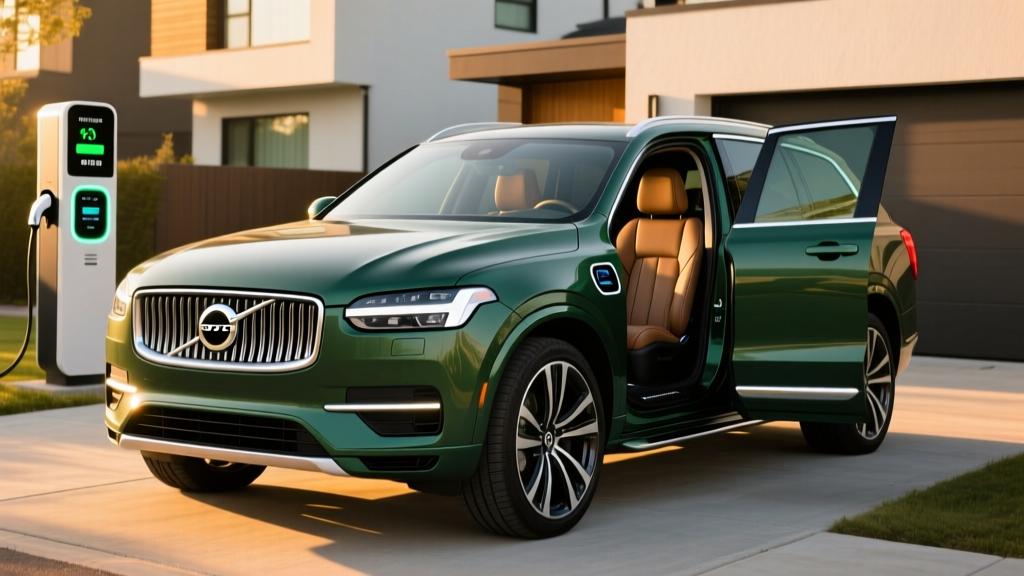
The 2026 Volvo XC90 plug-in hybrid (badged as the XC90 Recharge T8 eAWD) occupies a specific niche: a three-row luxury SUV that handles daily school runs and commutes on battery power alone, then fires up its turbocharged and supercharged four-cylinder engine for weekend road trips. It's not a full EV, and it's not a conventional hybrid — it's a bridge vehicle for buyers who want electric daily driving without range anxiety on longer hauls.
But does the math work? With a starting MSRP around $80,000 and a battery that delivers roughly 35 miles of electric-only range, the XC90 Recharge demands careful consideration. Below, we break down every spec that matters — from EPA MPG and real-world efficiency to battery warranty, charging logistics, and whether you qualify for any federal tax incentives under current IRS §30D rules.
2026 Volvo XC90 Recharge: Core Specs at a Glance
| Specification | 2026 Volvo XC90 Recharge T8 eAWD |
|---|---|
| Powertrain | 2.0L turbo + supercharged I-4 + rear electric motor (eAWD) |
| Combined Horsepower | 455 hp / 523 lb-ft torque |
| Battery (usable) | 18.8 kWh (lithium-ion NMC) |
| EPA Electric-Only Range | 35 miles |
| Total Combined Range | ~430 miles (electric + gas) |
| EPA MPGe (electric + gas) | 55 MPGe combined |
| EPA MPG (gas-only, charge-sustaining) | 27 city / 28 hwy / 27 combined |
| 0-60 mph | 5.5 seconds |
| Level 2 Charge Time (0-100%) | ~5 hours at 3.6 kW (16A/240V) |
| DC Fast Charging | Not supported |
| Drivetrain | eAWD (engine drives front wheels, motor drives rear) |
| Seating | 6 or 7 passengers |
| Cargo Volume (behind 3rd row) | 15.8 cu ft |
| Base MSRP (Core trim) | ~$80,350 (incl. destination) |
| Battery Warranty | 8 years / 100,000 miles |
HEV vs PHEV: What the XC90 Recharge Actually Is
Volvo sells the XC90 exclusively as a plug-in hybrid in the U.S. market for 2026. There is no conventional hybrid (HEV) version — the mild-hybrid B5 and B6 powertrains were phased out in North America after the 2024 model year. Here's the distinction that matters:
Conventional Hybrid (HEV): Uses a small battery (typically 1-2 kWh) charged entirely by regenerative braking and the engine. You never plug it in. It improves fuel economy by 20-40% over a gas-only equivalent. Think Toyota Highlander Hybrid.
Plug-In Hybrid (PHEV): Carries a much larger battery (18.8 kWh usable in the XC90 Recharge) that you charge from a wall outlet or Level 2 charger. It can drive 35 miles on electricity alone before the gas engine engages. After the battery depletes, it operates like a conventional hybrid.
The XC90 Recharge is firmly a PHEV. If you don't plug it in regularly, you're carrying 500+ pounds of battery dead weight and getting the same 27 MPG combined that a conventional hybrid version would deliver — defeating the purpose of the premium you paid for the Recharge powertrain.
Fuel Economy and Electric Range: EPA vs Real World
| Driving Mode | EPA Estimate | Real-World Expectation |
|---|---|---|
| Electric-only range | 35 miles | 28-33 mi (highway/cold); 33-38 mi (city/mild weather) |
| MPGe (combined EV + gas) | 55 MPGe | 45-60 MPGe depending on charging frequency |
| Gas-only city MPG | 27 MPG | 25-28 MPG (regen helps in stop-and-go) |
| Gas-only highway MPG | 28 MPG | 24-27 MPG (aero drag at 70+ mph) |
| Gas-only combined MPG | 27 MPG | 25-27 MPG |
The EPA's 35-mile electric range figure assumes a mix of city and highway driving at moderate temperatures. In practice, owners who do mostly city driving at speeds under 45 mph in mild weather (60-75°F) routinely report 37-40 miles from a full charge. The regenerative braking in stop-and-go traffic extends range significantly.
Conversely, highway driving at 75 mph in winter conditions (below 30°F) can shrink electric range to 25-28 miles. Cold temperatures increase battery internal resistance, and cabin heating draws heavily from the 18.8 kWh pack. The XC90 Recharge uses a heat pump for cabin heating, which helps mitigate cold-weather losses compared to resistive heaters, but physics still wins in deep winter.
Once the battery depletes, the charge-sustaining mode delivers a respectable 27 MPG combined. That's competitive with the EPA-rated figures for midsize luxury SUVs, though a dedicated HEV like the Toyota Highlander Hybrid (35 MPG combined) beats it handily if you never plan to plug in.
Real-World Range Verdict: Plan for 30-33 miles of usable electric range in mixed driving. If your one-way commute is under 15 miles and you charge nightly, you'll burn almost no gasoline on weekdays. Owners who charge daily report using 8-12 gallons per month for weekend trips and errands beyond electric range.
Powertrain Deep Dive: 455 Horsepower from Four Cylinders
The XC90 Recharge's powertrain is one of the most complex in the luxury SUV segment. Here's how the 455 hp breaks down:
- Gasoline engine: 2.0-liter inline-four with both a turbocharger and a supercharger, producing 312 hp and 295 lb-ft. The supercharger provides low-end torque before the turbo spools up, eliminating lag.
- Rear electric motor: 143 hp and 228 lb-ft, mounted on the rear axle. This provides all-wheel drive without a mechanical driveshaft — Volvo calls it eAWD.
- Combined output: 455 hp and 523 lb-ft. The eight-speed automatic transmission handles power from the engine; the rear motor uses a single-speed reduction gear.
The result is a 5.5-second 0-60 mph time — genuinely quick for a 5,100-pound three-row SUV. The electric motor's instant torque makes the XC90 Recharge feel responsive off the line, and the transition from electric to hybrid mode is nearly imperceptible under normal acceleration.
One engineering note: Volvo moved to the larger 18.8 kWh battery (up from 11.6 kWh in pre-2023 models) specifically to extend electric-only range. This battery uses NMC (nickel-manganese-cobalt) chemistry, which offers higher energy density than LFP but requires more careful thermal management. The pack is liquid-cooled and positioned low in the chassis between the axles, preserving cargo space.
Charging the XC90 Recharge: What You Need at Home
The 2026 XC90 Recharge supports Level 1 (120V) and Level 2 (240V) AC charging. It does not support DC fast charging — a limitation shared with most PHEVs, since the 18.8 kWh battery is too small to justify the cost and weight of DC fast-charge hardware.
| Charging Level | Power | 0-100% Time | Miles of Range Added/Hour |
|---|---|---|---|
| Level 1 (120V standard outlet) | ~1.4 kW | ~13-14 hours | ~3 miles/hour |
| Level 2 (240V, 16A) | 3.6 kW | ~5 hours | ~7 miles/hour |
| Level 2 (240V, 32A+) | Limited to 3.6 kW onboard | ~5 hours | ~7 miles/hour |
| DC Fast Charge | Not supported | N/A | N/A |
The onboard charger is capped at 3.6 kW. Even if you plug into a 48-amp Level 2 station capable of delivering 11.5 kW, the XC90 Recharge will only accept 3.6 kW. This means a higher-amperage home charger won't speed up charging — but it also means you don't need an expensive 48-amp unit. A basic 16-amp, 240V Level 2 charger (roughly $250-$400 for the hardware) is sufficient.
Home charging setup: Most XC90 Recharge owners install a 240V NEMA 14-50 outlet or a hardwired Level 2 charger in their garage. Expect to pay $500-$1,200 for a licensed electrician to run a 240V circuit if your panel has capacity. If your home's electrical panel needs an upgrade (common in older homes with 100-amp service), costs can reach $2,000-$4,000.
For daily use, a full overnight charge on Level 2 easily replenishes the 18.8 kWh battery in 5 hours. Most owners plug in when they get home and wake up to a full battery every morning. Level 1 charging from a standard 120V outlet works in a pinch but requires 13+ hours — feasible only if the car sits for extended periods.
Pricing, Trims, and Tax Credit Eligibility
The 2026 XC90 Recharge lineup starts at approximately $80,350 (including destination) for the Core trim and climbs to roughly $96,000 for the Ultra trim with optional packages. Key trims:
- Core: ~$80,350 — includes panoramic sunroof, 11.2-inch infotainment, Pilot Assist, heated front seats
- Plus: ~$85,000 — adds head-up display, 360-degree camera, Harman Kardon audio
- Ultra: ~$91,000 — adds Bowers & Wilkins audio, Nappa leather, ventilated front seats
Federal Tax Credit: Does the XC90 Recharge Qualify?
Under current IRS §30D rules, the 2026 Volvo XC90 Recharge faces significant hurdles for the federal clean vehicle credit:
- MSRP cap: SUVs must have an MSRP at or below $80,000 to qualify. The XC90 Recharge Core starts at ~$80,350 — likely above the threshold, though final MSRP confirmation is needed.
- Battery sourcing: Critical minerals and battery components must meet phased-in sourcing requirements from U.S. free-trade partners. Volvo's battery supply chain may not fully comply for 2026.
- Buyer income caps: AGI must not exceed $300,000 (joint) / $225,000 (head of household) / $150,000 (single).
- Assembly: The XC90 is assembled in Gothenburg, Sweden — not in North America, which disqualifies it from the new-vehicle §30D credit.
Bottom line: The XC90 Recharge almost certainly does not qualify for the federal $7,500 new clean vehicle credit due to its foreign assembly. Some state-level incentives may still apply — check your state's energy office or the AFDC state incentive database.
The lack of federal credit eligibility is a meaningful financial disadvantage versus PHEVs assembled in the U.S. (like the Jeep Grand Cherokee 4xe). Factor this into your total cost comparison.
Battery Longevity, Warranty, and Replacement Costs
Volvo Hybrid Battery Warranty: 8 years or 100,000 miles (whichever comes first), covering defects and capacity loss below 70% of original capacity. This is the industry-standard PHEV battery warranty, matching BMW, Audi, and Mercedes-Benz.
The 18.8 kWh NMC battery in the XC90 Recharge is liquid-cooled, which significantly extends lifespan compared to passively cooled packs. Real-world data from earlier-generation Volvo T8 powertrains (2016-2022) shows typical degradation of 8-12% over 6-8 years of daily charging — meaning a battery that started at 35 miles of range might deliver 30-32 miles after 100,000 miles.
Volvo's warranty covers capacity loss below 70%. If your battery drops below roughly 24.5 miles of electric range within 8 years/100,000 miles, Volvo will repair or replace it at no cost. In practice, very few owners report hitting this threshold — NMC chemistry with active thermal management degrades slowly under normal use.
Out-of-warranty replacement cost: If the battery fails after the warranty period, expect a replacement cost between $8,000 and $12,000 (parts and labor) based on current Volvo service pricing. This is a real financial risk for second owners or high-mileage drivers, though the failure rate for liquid-cooled PHEV batteries remains low.
Reliability: Volvo's overall reliability ratings are midpack among luxury brands. The T8 powertrain is complex — two power sources, a high-voltage system, and an eight-speed transmission — which means more potential failure points than a simpler BEV or conventional hybrid. That said, the electric motor and battery systems have proven robust. Most reported issues center on software glitches and infotainment bugs rather than powertrain hardware.
Who Should Buy the XC90 Recharge — And Who Shouldn't
Choose the 2026 Volvo XC90 Recharge if:
- You need three rows but want electric daily driving for short commutes (under 30 miles round-trip)
- You can charge at home every night (Level 2 strongly recommended)
- You want a luxury badge, Scandinavian design, and Volvo's safety reputation without going full EV
- You take road trips beyond 300 miles regularly and don't want to plan around charging stops
Look elsewhere if:
- You can't charge at home or work — without plugging in, you're paying a premium for a 27 MPG hybrid
- Your daily commute exceeds 35 miles one-way — you'll burn gas on most trips
- You want the lowest total cost of ownership — the lack of federal tax credit and premium MSRP hurt the financial case
- You'd rather go full EV — the BMW iX, Tesla Model X, or Rivian R1S offer 300+ miles of range with zero gasoline
Hybrid vs PHEV vs Full EV: Which Is Right for You?
The XC90 Recharge exists in a spectrum. Here's how to position yourself:
| Factor | Conventional Hybrid (HEV) | PHEV (XC90 Recharge) | Full EV (BEV) |
|---|---|---|---|
| Daily electric range | 0 miles (engine always runs) | ~30-35 miles | 250-350+ miles |
| Plug-in required? | No | Yes (for benefit) | Yes |
| Home charging needed? | No | Strongly recommended | Essential |
| Gasoline use | Every trip | Trips beyond ~35 mi | None |
| Maintenance | Engine + hybrid system | Engine + EV system (most complex) | Minimal (no engine) |
| Best for | No charging access, budget-conscious | Home charging, short commutes + long road trips | Home charging, most daily driving, lowest fuel cost |
If you have reliable home charging and your daily driving stays under 35 miles, the XC90 Recharge lets you drive electric Monday through Friday and take a 500-mile road trip on Saturday without a second thought. That flexibility is the PHEV value proposition. But if your commute is 50 miles each way, or you can't install a Level 2 charger at home, the math collapses — you'd be better served by a full EV or a simpler, cheaper conventional hybrid.
Pros and Cons: 2026 Volvo XC90 Recharge
Pros
- 35 miles of electric range covers most daily commutes
- 455 hp delivers genuinely quick acceleration (5.5s 0-60)
- Three-row seating with no compromise on cargo vs battery placement
- Liquid-cooled battery with 8-year/100,000-mile warranty
- Heat pump improves cold-weather EV range
- Volvo's Pilot Assist is among the better Level 2 driver-assist systems
- Premium Scandinavian interior with Google-based infotainment
Cons
- No DC fast charging — Level 2 only, capped at 3.6 kW
- Likely ineligible for the $7,500 federal tax credit (foreign assembly)
- $80,000+ MSRP is steep, especially without credit offset
- Complex powertrain = more potential service points than a BEV
- 27 MPG gas-only is unremarkable for the segment
- Third row is tight for adults on long trips
- Onboard charger limited to 3.6 kW even on higher-amperage stations
Frequently Asked Questions
How many MPG does the 2026 Volvo XC90 plug-in hybrid get?
The EPA rates the XC90 Recharge at 27 MPG combined (27 city / 28 highway) when operating in charge-sustaining (gas-only) mode after the battery is depleted. In real-world driving, expect 25-27 MPG combined. When factoring in electric driving, the EPA rates it at 55 MPGe combined — but your actual MPGe depends entirely on how often you charge and how much of your driving stays within the 35-mile electric range.
How far can the XC90 Recharge go on electric only?
The EPA estimates 35 miles of electric-only range. In real-world conditions, plan for 28-33 miles on the highway or in cold weather, and up to 38 miles in city driving during mild temperatures. The 18.8 kWh usable battery capacity and heat pump contribute to respectable efficiency for a 5,100-pound SUV.
Does the XC90 Recharge qualify for any tax credit?
Almost certainly not the federal §30D new clean vehicle credit. The XC90 is assembled in Sweden, which fails the North American final assembly requirement. Additionally, the MSRP may exceed the $80,000 SUV cap. Some states offer their own PHEV incentives — check the AFDC state incentive database for your jurisdiction. Always consult a tax professional before relying on credit eligibility.
Is the XC90 plug-in hybrid reliable, and what does battery replacement cost?
The T8 powertrain has proven mechanically sound over multiple model years, though Volvo's overall brand reliability sits in the middle of the luxury pack. The high-voltage battery is covered by an 8-year/100,000-mile warranty against defects and capacity loss below 70%. Out-of-warranty replacement runs $8,000-$12,000. Most owners report minimal degradation (8-12%) over 6-8 years of daily charging thanks to liquid cooling.
Do I need a special charger at home for the XC90 Recharge?
You need a 240V Level 2 outlet or charger for practical daily use. A 16-amp, 240V circuit delivering 3.6 kW is sufficient — the XC90's onboard charger caps at 3.6 kW regardless of station capacity. Installation typically costs $500-$1,200 if your electrical panel has room. A standard 120V outlet works for occasional top-ups but takes 13+ hours for a full charge.
Should I buy the XC90 Recharge or a full electric SUV?
If you can charge at home, rarely drive more than 35 miles daily, and regularly take road trips beyond 300 miles, the XC90 Recharge offers genuine flexibility. If you drive more than 35 miles daily, have access to reliable DC fast charging, and want the lowest long-term operating cost, a full EV like the BMW iX or Rivian R1S eliminates gasoline entirely and qualifies for more incentives. The PHEV is a bridge — ideal for some, a compromise for others.