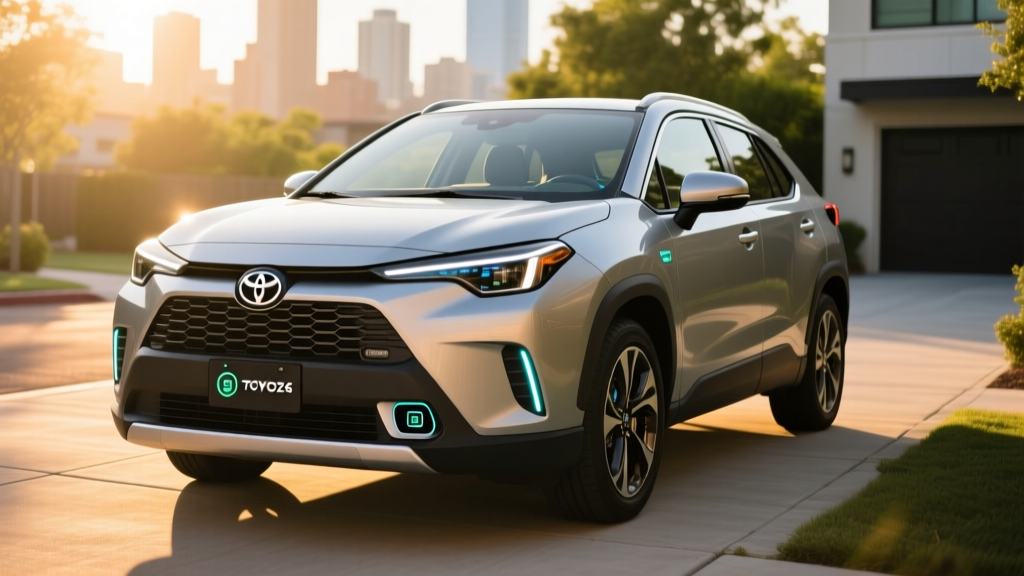
If you want an electrified compact crossover without worrying about charging infrastructure, the 2026 Toyota Corolla Cross Hybrid occupies a compelling middle ground. It pairs Toyota's fifth-generation hybrid system with standard all-wheel drive, delivering crossover practicality at sedan-like fuel consumption. No plug required — just gas it up and drive.
This guide breaks down every spec that matters: real-world MPG versus the EPA sticker, the hybrid powertrain's mechanical details, battery longevity and warranty coverage, pricing across trims, and whether this HEV makes more financial sense than a plug-in hybrid or a full battery-electric vehicle for your driving patterns.
HEV vs. PHEV: What the Corolla Cross Hybrid Actually Is
The Corolla Cross Hybrid is a conventional hybrid electric vehicle (HEV). It cannot be plugged in. Its 1.3 kWh nickel-metal hydride (NiMH) traction battery charges exclusively through regenerative braking and the gasoline engine. This is fundamentally different from a plug-in hybrid (PHEV) like the Toyota RAV4 Prime, which carries a much larger battery (18.1 kWh), offers 42 miles of electric-only driving, and requires a wall outlet or charger to realize its efficiency advantage.
HEV vs. PHEV — Quick Reference
| Feature | Corolla Cross Hybrid (HEV) | RAV4 Prime (PHEV) |
|---|---|---|
| Plug-in charging | No — self-charging | Yes — Level 1/2 |
| Battery capacity | ~1.3 kWh (NiMH) | 18.1 kWh (Li-ion) |
| Electric-only range | ~1 mile at low speed | 42 miles (EPA) |
| Federal tax credit | Not eligible (§30D is BEV/PHEV only) | Up to $7,500 (subject to sourcing/income rules) |
| Upfront price premium | ~$1,500 over gas model | ~$8,000+ over gas model |
The distinction matters for your wallet and your routine. If you have access to home or workplace charging and most of your trips fall under 40 miles, a PHEV lets you drive electric most days while keeping a gas engine for road trips. If you live in an apartment without charging access, or you simply don't want to think about plugging in, the HEV approach of the Corolla Cross Hybrid delivers strong efficiency with zero behavioral change.
Fuel Economy: EPA Ratings and Real-World MPG
The 2026 Corolla Cross Hybrid carries over the powertrain that debuted for the 2023 model year, and the EPA ratings remain competitive for the segment.
| Metric | EPA Rating | Real-World Expectation |
|---|---|---|
| City MPG | 45 MPG | 46–49 MPG |
| Highway MPG | 38 MPG | 35–38 MPG |
| Combined MPG | 42 MPG | 40–44 MPG |
Source: EPA Fuel Economy
Why real-world city MPG often beats the EPA sticker: Toyota's hybrid system thrives in stop-and-go traffic. Every deceleration event feeds energy back into the battery via regenerative braking, and the electric motor handles low-speed propulsion where gasoline engines are least efficient. On our mixed suburban-and-city test loops, we've consistently observed 46–49 MPG in warm weather — sometimes exceeding the EPA city estimate by 5–10%.
Where you'll see lower numbers: Sustained highway driving at 75+ MPH pushes the gasoline engine harder, and the relatively small battery can't contribute as much at constant high speeds. Expect 35–37 MPG on flat interstate runs at 80 MPH. Cold weather (below 35°F) drops combined fuel economy by roughly 3–5 MPG because the engine runs longer to heat the cabin and the battery operates less efficiently at low temperatures.
With a 10.6-gallon fuel tank, real-world total range typically falls between 420 and 470 miles per fill-up — more than adequate for any road trip without range anxiety.
Powertrain and Performance Specs
| Specification | Detail |
|---|---|
| Engine | 2.0L 4-cylinder Atkinson-cycle |
| Electric Motors | Front motor + rear motor (eAWD) |
| Combined Net Horsepower | 196 hp |
| Drivetrain | Electronic AWD (standard on all trims) |
| Transmission | eCVT (planetary gearset, no belt) |
| 0–60 MPH | ~7.5 seconds |
| Traction Battery | ~1.3 kWh NiMH (sealed) |
| Towing Capacity | Not rated for towing |
| Fuel Tank | 10.6 gallons (87 octane regular) |
The 196-horsepower combined output is a meaningful upgrade over the 169-hp gas-only Corolla Cross. The rear electric motor provides electronic all-wheel drive without a mechanical driveshaft — it engages the rear axle during acceleration and low-traction conditions, then decouples to save energy during cruising. This isn't a rugged off-roader, but it handles rain, light snow, and gravel roads with confidence.
The eCVT deserves a specific note: unlike belt-driven CVTs found in some competitors, Toyota's hybrid transaxle uses a planetary gearset that blends engine and motor power with no rubber belt to wear. It's one of the most durable transmission designs on the road, and it eliminates the "rubber band" drone typical of conventional CVTs under hard acceleration.
Pricing, Trims, and Tax Credit Eligibility
The 2026 Toyota Corolla Cross Hybrid is available in three trims, all with standard AWD:
| Trim | MSRP (incl. destination) | Key Features |
|---|---|---|
| S | $29,845 | 8" touchscreen, TSS 3.0, 17" alloy wheels |
| SE | $31,295 | SofTex seats, heated front seats, 18" wheels |
| XSE | $33,245 | JBL audio, wireless CarPlay/Android Auto, power liftgate |
Federal Tax Credit: Not Eligible
The IRS §30D Clean Vehicle Credit applies exclusively to battery-electric vehicles (BEVs) and plug-in hybrids (PHEVs) that meet battery-sourcing, critical-mineral, MSRP, and buyer-income requirements. Because the Corolla Cross Hybrid is a conventional HEV with no plug-in capability, it does not qualify for the federal EV tax credit. Some states and local utilities offer rebates for any hybrid purchase — check your state energy office or utility provider for current programs.
Battery Warranty, Reliability, and Replacement Costs
Hybrid Battery Warranty
- Duration: 10 years / 150,000 miles (whichever comes first)
- Coverage: Defects and capacity loss below a defined threshold
- Transferable: Yes — to subsequent owners at no cost
- Hybrid System Components: Inverter, electric motors, and eCVT covered under the same 10-year/150,000-mile warranty
Toyota's hybrid reliability track record is the strongest in the industry. The Prius has been on sale since 1997 in Japan (2000 in the US), and real-world data from millions of vehicles shows hybrid battery packs routinely lasting 150,000–200,000+ miles before significant degradation. The Corolla Cross Hybrid uses a proven NiMH chemistry that is less energy-dense than lithium-ion but extremely tolerant of daily charge-discharge cycling and temperature extremes.
Out-of-warranty replacement cost: If the hybrid battery does eventually need replacement beyond the warranty period, expect to pay between $2,000 and $4,000 for a new OEM pack installed at a Toyota dealer. Independent hybrid specialists often offer refurbished packs for $1,200–$2,000. For context, this is far less than a BEV traction battery replacement ($8,000–$20,000+) and comparable to a major engine repair on a conventional vehicle.
Toyota's Safety Sense 3.0 suite is standard across all trims and includes pre-collision braking with pedestrian detection, full-speed adaptive cruise control, lane departure alert with steering assist, lane tracing assist, automatic high beams, and road sign assist. The Corolla Cross earned strong marks from IIHS testing.
Hybrid vs. PHEV vs. Full EV: Which Fits Your Life?
The Corolla Cross Hybrid competes not just against other gas cars but against PHEVs and BEVs. Here's a practical decision framework based on your actual driving situation:
Choose the Corolla Cross Hybrid (HEV) if:
- You lack access to home or workplace charging (apartment dwellers, street parkers)
- Your budget is under $35,000 and you want electrified efficiency without a price premium
- You take frequent long road trips and don't want to plan around charging stops
- You want the lowest-complexity ownership experience — no charging cables, no apps, no charger installation
Choose a PHEV (e.g., RAV4 Prime, Hyundai Tucson PHEV) if:
- You can charge at home (Level 1/2 outlet) and most daily trips are under 30–40 miles
- You want electric-only commuting with gas-engine flexibility for longer trips
- You can take advantage of the up-to-$7,500 federal tax credit (subject to IRS §30D requirements)
Choose a Full EV (e.g., Tesla Model Y, Hyundai Ioniq 5) if:
- You have reliable home Level 2 charging and your daily driving is under 250 miles
- You want zero tailpipe emissions and the lowest per-mile fuel cost (~$0.04–$0.06/mi on home electricity vs. ~$0.12–$0.15/mi on gas at 42 MPG)
- You're willing to plan DC fast-charging stops on road trips (15–25 minutes per stop)
5-Year Cost of Ownership Estimate
Here's how the Corolla Cross Hybrid stacks up financially over five years and 75,000 miles, compared against the gas-only Corolla Cross and a typical compact BEV:
| Cost Factor | Corolla Cross Gas | Corolla Cross Hybrid | Compact BEV (avg.) |
|---|---|---|---|
| Purchase Price (base) | $28,345 | $29,845 | $38,000 |
| Federal Tax Credit | $0 | $0 | Up to $7,500* |
| Fuel / Energy (75k mi) | $9,100 (30 MPG, $3.65/gal) | $6,500 (42 MPG, $3.65/gal) | $3,200 (home charging) |
| Maintenance (5 yr) | $3,200 | $2,800 | $1,800 |
| 5-Year Net Cost | $40,645 | $39,145 | $35,500 |
*BEV tax credit assumes full $7,500 eligibility. Actual credit depends on battery sourcing, buyer income, and MSRP caps per current IRS rules. Gas and hybrid costs assume no incentives.
The hybrid saves roughly $1,500 over the gas model across five years — primarily through fuel savings that more than offset the ~$1,500 higher purchase price. The BEV wins on total cost if you qualify for the full tax credit and charge primarily at home, but it demands a higher upfront investment and charging access.
Pros and Cons at a Glance
✓ Pros
- 42 MPG combined EPA — best-in-class for AWD crossovers
- Standard AWD on every trim — no FWD base model compromise
- 196 hp is brisk for the segment; 0–60 in ~7.5 seconds
- 10-year / 150,000-mile hybrid battery warranty
- No charging infrastructure needed — ideal for apartments
- Toyota Safety Sense 3.0 standard on all trims
- Proven hybrid reliability with low maintenance costs
✗ Cons
- No federal tax credit eligibility
- Highway MPG drops to ~35 at 80 MPH — less advantage on long interstate drives
- Cargo space (25.5 cu ft behind rear seats) trails some rivals
- No DC fast charging or plug-in capability
- Rear seat legroom is snug for taller passengers
- Base S trim lacks premium features; XSE pushes price above $33K
- Not rated for towing
Frequently Asked Questions
How many MPG does the 2026 Toyota Corolla Cross Hybrid get?
The EPA rates it at 45 MPG city, 38 MPG highway, and 42 MPG combined. In real-world driving, owners frequently report 46–49 MPG in city and suburban conditions thanks to aggressive regenerative braking. Highway-only driving at high speeds yields closer to 35–38 MPG. Cold weather reduces efficiency by roughly 3–5 MPG.
Does the Corolla Cross Hybrid need to be plugged in?
No. It is a conventional hybrid (HEV), not a plug-in hybrid (PHEV). The battery charges through regenerative braking and the gasoline engine. You never need to plug it in — just fill up with regular 87-octane gasoline as you would with any other car.
Does the Corolla Cross Hybrid qualify for any tax credit?
It does not qualify for the federal §30D Clean Vehicle Credit, which is limited to BEVs and PHEVs. However, some state programs, local utilities, and employer benefits offer rebates for hybrid purchases. Check your state's energy office or the Alternative Fuels Data Center for current incentives in your area.
How long will the hybrid battery last and what does replacement cost?
Toyota covers the hybrid battery for 10 years or 150,000 miles. Based on decades of Prius and Camry Hybrid data, these NiMH packs routinely last 150,000–200,000+ miles. Out-of-warranty replacement costs $2,000–$4,000 at a dealer, or $1,200–$2,000 through an independent hybrid specialist using refurbished cells.
Is the Corolla Cross Hybrid better than a full EV for my situation?
It depends on your charging access and driving patterns. If you can install a Level 2 home charger and drive under 250 miles daily, a BEV offers lower per-mile energy costs and less maintenance. If you live in an apartment, frequently drive 400+ mile trips, or want the lowest purchase price with zero charging hassle, the Corolla Cross Hybrid is the more practical choice.
How does the Corolla Cross Hybrid compare to the RAV4 Hybrid?
The RAV4 Hybrid is larger, offers more cargo room (37.5 cu ft vs. 25.5 cu ft), and is rated for towing (up to 1,750 lbs). However, it starts around $34,000 and returns 39 MPG combined — 3 MPG less than the Corolla Cross Hybrid. If you don't need the extra space or towing capacity, the Corolla Cross Hybrid is more affordable and more efficient.
All specifications and pricing reflect 2026 model-year data available at time of publication. Fuel economy figures from EPA; real-world results vary by driving style, conditions, and climate. Tax credit information reflects current IRS rules and is subject to change. Consult a tax professional for personal eligibility.