Quick Verdict: The 2026 Nissan Rogue Hybrid at a Glance
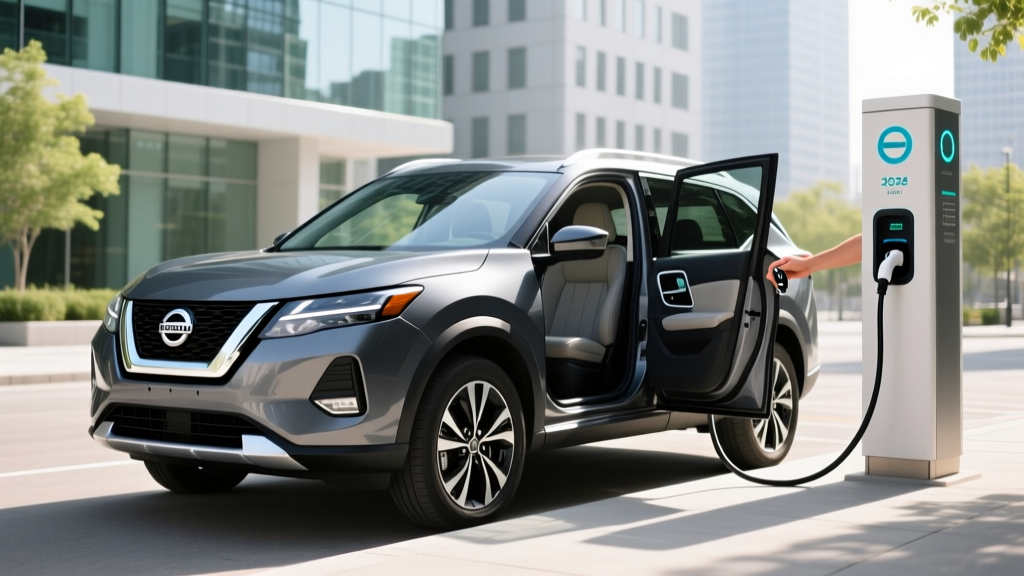
The 2026 Nissan Rogue Hybrid returns as a conventional hybrid electric vehicle (HEV) — meaning it does not plug in. Nissan pairs a 1.5-liter turbocharged three-cylinder engine with an electric motor integrated into the transmission, delivering a combined 201 horsepower while targeting fuel economy in the mid-to-upper 30s MPG combined. For compact-SUV buyers who want meaningful fuel savings without the lifestyle change of plugging in or committing to a full battery-electric vehicle, the Rogue Hybrid occupies a practical middle ground.
This guide breaks down every number that matters: EPA city/highway/combined MPG, real-world fuel economy expectations, powertrain details, battery warranty coverage, pricing across trims, and whether any federal or state incentives apply. If you're cross-shopping the Toyota RAV4 Hybrid, Honda CR-V Hybrid, or Ford Escape Hybrid, the data below will help you decide where the Rogue Hybrid stacks up.
HEV vs. PHEV vs. EV: Where the Rogue Hybrid Fits
Before diving into specs, it's essential to clarify what the 2026 Nissan Rogue Hybrid is — and what it is not. Nissan offers the Rogue Hybrid strictly as a conventional hybrid (HEV). There is no plug-in hybrid (PHEV) variant in the current lineup, and Nissan has not announced a Rogue PHEV for the US market.
HEV vs. PHEV vs. BEV — Which Powertrain Is Right for You?
| Factor | HEV (Rogue Hybrid) | PHEV (e.g., RAV4 Prime) | BEV (e.g., Ariya) |
|---|---|---|---|
| Plugs in? | No | Yes (Level 1/2) | Yes (Level 1/2/DC) |
| Electric-only range | ~1 mi (low-speed creep) | 25-42 mi typical | 200-320 mi |
| Home charging needed? | No — refuels at gas station | Recommended for EV range | Essential |
| Federal tax credit (§30D) | Not eligible | Up to $7,500 if eligible | Up to $7,500 if eligible |
| Best for | No home charging, simple ownership | Short commutes + road trips | Home charging access, max savings |
The bottom line: If you live in an apartment, lack garage access, or simply don't want to think about charging infrastructure, the conventional HEV layout of the Rogue Hybrid eliminates that barrier entirely. You refuel at any gas station, exactly as you do today, while the hybrid system silently reduces your fuel consumption by roughly 30-40% compared to the gas-only Rogue.
2026 Nissan Rogue Hybrid: Powertrain & Performance Specs
| Specification | Detail |
|---|---|
| Powertrain type | Conventional hybrid (HEV) — no plug |
| Engine | 1.5L turbocharged 3-cylinder (VC-Turbo) |
| Combined system horsepower | 201 hp |
| Electric motor | Integrated AC synchronous motor |
| Transmission | Xtronic CVT with hybrid motor assist |
| Hybrid battery | ~1.5 kWh lithium-ion (self-charging, no plug) |
| Drivetrain | FWD standard; Intelligent AWD available |
| 0-60 mph (est.) | ~7.8 seconds |
| Towing capacity | 1,500 lbs (when properly equipped) |
| Cargo volume (behind rear seats) | ~31.6 cu ft |
The VC-Turbo engine is Nissan's variable-compression-ratio technology, which adjusts the piston stroke dynamically to optimize between power and efficiency. In the hybrid application, the electric motor fills in torque at low RPMs — the exact scenario where small turbocharged engines tend to feel sluggish. The result is surprisingly responsive acceleration from a stop, even though this is a fuel-economy-focused powertrain.
AWD models use a separate rear-mounted electric motor rather than a mechanical driveshaft, which improves packaging and allows the hybrid system to manage torque distribution electronically. This is the same approach Toyota uses in the RAV4 Hybrid AWD and Honda in the CR-V Hybrid AWD.
Fuel Economy: EPA MPG and Real-World Expectations
| Configuration | City | Highway | Combined |
|---|---|---|---|
| FWD (EPA est.) | 39 MPG | 37 MPG | 38 MPG |
| AWD (EPA est.) | 37 MPG | 35 MPG | 36 MPG |
| Gas-only Rogue AWD (baseline) | 28 MPG | 35 MPG | 31 MPG |
| Hybrid advantage vs. gas AWD | +32% | — | +16% |
Real-World MPG: What to Actually Expect
Hybrids typically exceed their EPA city rating in stop-and-go traffic because regenerative braking recovers energy that a gas car wastes as heat. In urban driving with frequent stops, owners of comparable Nissan hybrid systems report seeing 40-43 MPG on the trip computer.
Highway driving is where hybrids lose their advantage — at steady 70-80 mph speeds, the engine runs continuously and the electric motor contributes little. Expect 33-36 MPG on the highway at 75 mph, slightly below the EPA sticker. Cold weather (below 35°F) further reduces efficiency by 5-10% as the engine runs more often to provide cabin heat.
For verified EPA figures, check the official listing at fueleconomy.gov.
Pricing, Trims & Tax Credit Eligibility
The 2026 Nissan Rogue Hybrid is offered across multiple trims. Pricing below reflects MSRP before destination charges:
| Trim | FWD MSRP | AWD MSRP |
|---|---|---|
| S (base) | $31,490 | $32,990 |
| SV | $34,190 | $35,690 |
| SL | $38,490 | $39,990 |
| Platinum | $41,990 | $43,490 |
Federal Tax Credit: Not Eligible
The 2026 Nissan Rogue Hybrid is a conventional HEV — it does not have a plug, and its battery capacity (~1.5 kWh) falls far below the minimum 7 kWh threshold required by IRS §30D clean vehicle credit rules. This means the Rogue Hybrid does not qualify for the federal $7,500 EV tax credit.
However, some states and local utilities offer rebates for hybrid vehicles. Check your state's energy office or utility provider for available programs — these vary widely by jurisdiction and change frequently.
Battery Warranty, Reliability & Replacement Costs
Hybrid Battery Warranty Coverage
- Hybrid battery: 8 years / 100,000 miles (whichever comes first) — standard across all trims
- Hybrid system components: 8 years / 100,000 miles (includes inverter, electric motor, control module)
- Powertrain warranty: 5 years / 60,000 miles
- Bumper-to-bumper: 3 years / 36,000 miles
Hybrid battery longevity has been thoroughly proven across the industry. Toyota's hybrid systems, now in their third decade, routinely exceed 200,000 miles on the original battery pack. Nissan's hybrid system uses a smaller battery than a PHEV or BEV, which means fewer charge cycles and less thermal stress — factors that directly extend cell life.
Replacement cost if out of warranty: A Nissan Rogue Hybrid battery pack replacement runs approximately $2,500–$4,000 including labor at a dealership. This is dramatically less than a BEV battery replacement ($8,000–$20,000+) because the HEV pack is small (~1.5 kWh). Independent hybrid specialists often offer refurbished packs for $1,500–$2,500.
For reliability data, check IIHS ratings and owner surveys from Consumer Reports as the model year progresses. Nissan's VC-Turbo engine has been in production since 2019, and the hybrid transaxle design shares architecture with proven Nissan hybrid systems in global markets.
Competitor Comparison: Rogue Hybrid vs. RAV4, CR-V & Escape Hybrids
| Spec | Nissan Rogue Hybrid | Toyota RAV4 Hybrid | Honda CR-V Hybrid | Ford Escape Hybrid |
|---|---|---|---|---|
| Combined HP | 201 | 219 | 204 | 198 |
| EPA Combined MPG | 36-38 | 39-41 | 37-40 | 39-42 |
| Starting MSRP | $31,490 | $33,495 | $35,395 | $34,990 |
| Cargo (cu ft) | 31.6 | 37.6 | 36.3 | 34.4 |
| Hybrid Battery Warranty | 8yr/100k | 10yr/150k | 8yr/100k | 8yr/100k |
The Rogue Hybrid's key competitive advantage is entry price — it undercuts the RAV4 Hybrid by roughly $2,000 and the CR-V Hybrid by nearly $4,000 at the base trim. The trade-off is slightly lower combined MPG (2-4 MPG behind class leaders) and less cargo volume. If you prioritize a lower purchase price and Nissan's ProPILOT Assist driver-assistance suite, the Rogue Hybrid makes a strong value case. If maximum fuel economy and cargo space are your top priorities, the RAV4 Hybrid remains the segment benchmark.
Who Should Buy the 2026 Nissan Rogue Hybrid?
✓ Pros
- Lowest starting MSRP in the hybrid compact-SUV segment
- No plug required — zero lifestyle change from a gas car
- Strong city MPG (39 EPA, often 40+ real-world)
- Standard ProPILOT Assist with stop-and-go
- AWD available across all trims
- 8-year/100,000-mile hybrid battery warranty
✗ Cons
- 2-4 MPG behind RAV4/Escape Hybrid combined
- Less cargo volume than key rivals
- No PHEV option for electric-only commuting
- Not eligible for federal §30D tax credit
- CVT drone under hard acceleration
- Toyota offers longer 10yr/150k hybrid warranty
Decision Framework
Choose the Rogue Hybrid if: You want the most affordable entry point into a hybrid compact SUV, you don't have access to home charging (making a PHEV impractical), and you value Nissan's tech-forward interior and ProPILOT Assist.
Choose the RAV4 Hybrid instead if: Maximum fuel economy and cargo space are non-negotiable, and you want Toyota's class-leading 10-year/150,000-mile hybrid battery warranty.
Consider a PHEV or full EV if: You have home charging access and a commute under 40 miles — the fuel savings from electric-only driving will dramatically outpace what any HEV can deliver, and you may qualify for the $7,500 federal tax credit.
Frequently Asked Questions
How many MPG does the 2026 Nissan Rogue Hybrid get?
The EPA estimates 39 city / 37 highway / 38 combined for FWD models, and 37/35/36 for AWD. In real-world city driving with frequent stops, expect 40-43 MPG thanks to regenerative braking. Highway driving at 75 mph typically returns 33-36 MPG.
Does the Rogue Hybrid need to be plugged in?
No. The 2026 Rogue Hybrid is a conventional HEV. It charges its small battery pack through regenerative braking and the gasoline engine. You refuel it exclusively at gas stations, exactly like a traditional vehicle.
Is there a plug-in hybrid (PHEV) version of the Nissan Rogue?
Not for the US market. Nissan has not announced a Rogue PHEV. If plug-in hybrid capability is a priority, look at the Toyota RAV4 Prime (42 mi electric-only range) or the Ford Escape PHEV (37 mi electric-only range).
Is the hybrid battery reliable, and what does replacement cost?
Hybrid batteries are among the most reliable components in modern vehicles. Nissan covers the Rogue Hybrid battery for 8 years/100,000 miles. Out-of-warranty replacement costs approximately $2,500–$4,000 at a dealer, or $1,500–$2,500 from an independent hybrid specialist — far less than a full EV battery.
Does the 2026 Nissan Rogue Hybrid qualify for any tax credit?
No. The federal §30D clean vehicle credit requires a minimum battery capacity of 7 kWh and plug-in capability. The Rogue Hybrid's ~1.5 kWh battery and HEV layout make it ineligible. Some state or utility-level hybrid incentives may apply — check your local programs.
How does the Rogue Hybrid compare to the gas-only Rogue on fuel economy?
The gas-only 2026 Rogue AWD is rated at 28 city / 35 highway / 31 combined. The hybrid AWD achieves 37/35/36 — a 32% improvement in city driving and a 16% combined improvement. Over 15,000 miles per year at $3.50/gallon, the hybrid saves roughly $400–$500 annually in fuel costs.
What's the total driving range on a full tank?
With a 14.5-gallon fuel tank and 36-38 MPG combined, the Rogue Hybrid delivers approximately 520–550 miles of total range per fill-up — competitive with or slightly better than the gas-only Rogue and in line with rival hybrids.