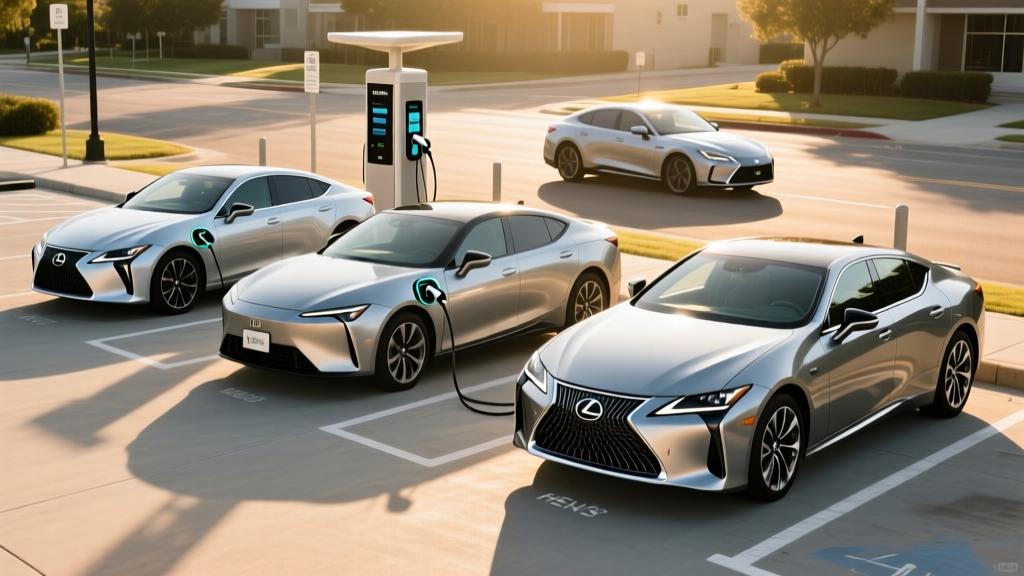
Lexus has built its reputation on hybrid powertrains long before battery-electric vehicles entered the mainstream conversation. For 2026, the brand offers one of the most comprehensive hybrid lineups in the luxury segment — spanning conventional hybrids (HEVs) that need no plug and plug-in hybrids (PHEVs) that deliver meaningful electric-only range. But with models ranging from the compact UX to the full-size TX, choosing the right 2026 Lexus hybrid requires understanding exactly what each powertrain delivers in real-world driving, what it costs, and where the value lies.
This guide breaks down every current 2026 Lexus hybrid and PHEV by the numbers: EPA fuel economy, electric-only range, battery capacity, horsepower, pricing, and warranty coverage. We'll also clarify which models qualify for federal tax credits under current IRS §30D rules and help you decide whether a Lexus HEV, PHEV, or full BEV fits your driving pattern.
Understanding the 2026 Lexus Hybrid Lineup: HEV vs PHEV
Conventional Hybrid (HEV) vs Plug-In Hybrid (PHEV)
| Feature | Lexus HEV (e.g., RX 350h, ES 300h) | Lexus PHEV (e.g., RX 450h+, TX 550h+) |
|---|---|---|
| Plug-in required? | No — charges via regenerative braking and engine | Yes — plug in to access electric-only range |
| Battery size | ~1.0–2.0 kWh (small buffer) | 18.1–23.3 kWh usable |
| Electric-only driving | Limited to low-speed, short distances (~1 mi) | 30–33 miles EPA-rated |
| Fueling | Gasoline only | Gasoline + Level 1/Level 2 electric charging |
| Federal tax credit | Not eligible under §30D | Potentially eligible (subject to sourcing/income rules) |
| Best for | Drivers without home charging access | Drivers with home charging and short commutes |
The distinction matters enormously for your daily routine. A Lexus HEV like the ES 300h operates exactly like a gasoline car from the driver's perspective — you fill up at the pump and never think about charging. The hybrid system simply recaptures braking energy and uses electric motors to assist the engine, reducing fuel consumption by 30–40% compared to a conventional gas powertrain.
A Lexus PHEV like the RX 450h+ adds a substantially larger battery pack and more powerful electric motors. Plug it in overnight on a standard 120V outlet (Level 1) or a 240V Level 2 charger, and you get roughly 30–33 miles of purely electric driving before the gasoline engine engages. For many commuters, that covers the entire round trip without burning a drop of fuel.
2026 Lexus Hybrid and PHEV Fuel Economy: EPA MPG Breakdown
Fuel economy is the primary reason buyers choose a Lexus hybrid. Here's how every current electrified Lexus model rates according to EPA estimates on fueleconomy.gov:
| Model | Powertrain | City MPG | Highway MPG | Combined MPG | Combined MPGe (PHEV) |
|---|---|---|---|---|---|
| UX 300h | HEV | 43 | 41 | 42 | — |
| ES 300h | HEV | 43 | 44 | 44 | — |
| NX 350h | HEV | 41 | 37 | 39 | — |
| NX 450h+ | PHEV | 37 (gas) | 34 (gas) | 36 (gas) | 84 MPGe |
| RX 350h | HEV | 37 | 34 | 36 | — |
| RX 450h+ | PHEV | 36 (gas) | 33 (gas) | 35 (gas) | 83 MPGe |
| TX 500h | HEV | 27 | 28 | 27 | — |
| TX 550h+ | PHEV | 29 (gas) | 28 (gas) | 29 (gas) | 76 MPGe |
| LC 500h | HEV | 26 | 33 | 29 | — |
Real-World MPG: What to Actually Expect
Lexus hybrids — particularly those using the brand's fourth- and fifth-generation hybrid systems — tend to perform close to or even slightly above EPA estimates in city driving. This is the opposite of most gasoline cars, which typically fall short of their stickers in stop-and-go traffic. The reason: city driving maximizes regenerative braking and low-speed electric assist, which is precisely where hybrids shine.
In real-world mixed driving, expect:
- UX 300h and ES 300h: 40–45 MPG combined in moderate climates; city-heavy routes may push above 45 MPG.
- RX 350h: 33–37 MPG combined; highway-dominant commutes at 75+ mph will pull this toward the low 30s.
- TX 500h: 25–28 MPG combined; this three-row SUV's weight and aerodynamics limit gains.
Cold weather reduces hybrid fuel economy by roughly 5–10% due to increased engine idling for cabin heat and reduced battery efficiency. This penalty is far smaller than the 20–30% range loss seen in full EVs, but it's still worth noting for northern-climate buyers.
PHEV Electric-Only Range and Charging Specs
For the three PHEV models in the 2026 Lexus lineup, electric-only range determines how much daily driving you can complete without using gasoline:
| Model | Battery (kWh usable) | EPA Electric Range | Total Range (gas + electric) | Level 2 Charge Time (0–100%) | DC Fast Charge |
|---|---|---|---|---|---|
| NX 450h+ | 18.1 kWh | 37 miles | ~470 miles | ~2.5 hours (3.3 kW) | No |
| RX 450h+ | 18.1 kWh | 37 miles | ~450 miles | ~2.5 hours (3.3 kW) | No |
| TX 550h+ | 23.3 kWh | 33 miles | ~430 miles | ~3.0 hours (6.6 kW onboard) | No |
Critical Charging Detail: No DC Fast Charging
None of the current Lexus PHEVs support DC fast charging (CCS or NACS). They charge exclusively via AC power — Level 1 (120V household outlet at ~1.4 kW) or Level 2 (240V at 3.3–6.6 kW depending on model). This means a full charge takes 2.5–5 hours depending on your equipment. For overnight home charging, this is perfectly adequate. But you won't be topping up at Electrify America or Tesla Supercharger stations on road trips.
Level 1 charging on a standard 120V outlet adds roughly 4–5 miles of electric range per hour of charging — enough to fully replenish the NX 450h+ overnight (8–10 hours). Level 2 at 240V cuts that to 2.5–3 hours.
The TX 550h+ stands out with a larger 23.3 kWh battery and an available 6.6 kW onboard charger, which is meaningfully faster than the 3.3 kW chargers in the NX and RX plug-in models. If you install a Level 2 home charger — typically a 240V/32A circuit delivering 7.7 kW — the TX 550h+ can actually use more of that capacity, while the NX and RX will bottleneck at 3.3 kW regardless of your charger's output.
Powertrain Specs: Horsepower and Performance
| Model | Engine | Combined System HP | 0–60 mph (est.) | Drivetrain |
|---|---|---|---|---|
| UX 300h | 2.0L 4-cyl + 2 motors | 196 hp | 8.0 sec | AWD (E-Four) |
| ES 300h | 2.5L 4-cyl + 1 motor | 215 hp | 8.1 sec | FWD |
| NX 350h | 2.5L 4-cyl + 2 motors | 240 hp | 7.2 sec | AWD (E-Four) |
| NX 450h+ | 2.5L 4-cyl + 2 motors | 304 hp | 6.0 sec | AWD (E-Four) |
| RX 350h | 2.5L 4-cyl + 2 motors | 246 hp | 7.4 sec | AWD (E-Four) |
| RX 450h+ | 2.5L 4-cyl + 2 motors | 304 hp | 6.3 sec | AWD (E-Four) |
| TX 500h | 2.4L turbo 4-cyl + 2 motors | 366 hp | 5.9 sec | AWD (DIRECT4) |
| TX 550h+ | 3.5L V6 + 2 motors | 406 hp | 5.6 sec | AWD (E-Four) |
| LC 500h | 3.5L V6 + 2 motors (Multi-Stage) | 354 hp | 4.7 sec | RWD |
The PHEV variants consistently deliver 50–100 more horsepower than their HEV siblings, thanks to more powerful electric motors and the ability to draw sustained current from the larger battery. The NX 450h+ and RX 450h+ both hit 304 hp — a substantial upgrade over the 240–246 hp in their conventional-hybrid counterparts. The TX 550h+ tops the lineup at 406 hp, making it the most powerful Lexus SUV currently available.
Pricing and Federal Tax Credit Eligibility
| Model | Base MSRP (2026 est.) | Federal §30D Tax Credit |
|---|---|---|
| UX 300h | ~$39,500 | Not eligible (HEV) |
| ES 300h | ~$46,500 | Not eligible (HEV) |
| NX 350h | ~$44,500 | Not eligible (HEV) |
| NX 450h+ | ~$57,000 | Potentially up to $3,750* |
| RX 350h | ~$53,000 | Not eligible (HEV) |
| RX 450h+ | ~$65,000 | Potentially up to $3,750* |
| TX 500h | ~$63,000 | Not eligible (HEV) |
| TX 550h+ | ~$74,000 | Potentially up to $3,750* |
| LC 500h | ~$102,000 | Not eligible (HEV, exceeds MSRP cap) |
*Tax credit amounts are estimates based on current-year IRS §30D rules and are subject to change. Eligibility depends on battery critical-mineral sourcing, buyer income limits ($150K single / $300K joint AGI), MSRP caps ($80K for SUVs/vans, $55K for sedans), and final assembly requirements. Consult a tax professional before relying on credit amounts for purchase decisions.
A key detail many buyers miss: the MSRP cap for sedans under §30D is $55,000, while SUVs and vans qualify up to $80,000. This means the NX 450h+ (classified as a small SUV) qualifies under the higher cap, but the ES 300h — even if it were a PHEV — would need to stay under $55K. The TX 550h+ at approximately $74,000 still clears the $80K SUV threshold.
Conventional Lexus hybrids do not qualify for the §30D new clean vehicle credit, as that credit requires a minimum 7 kWh battery capacity and plug-in capability. However, some states offer separate incentives for HEVs — check your state energy office or Alternative Fuels Data Center for local programs.
Reliability and Battery Warranty: What Lexus Hybrid Owners Should Know
Lexus Hybrid Battery Warranty
- Coverage: 10 years or 150,000 miles (whichever comes first) on hybrid battery and hybrid system components
- Applies to: All 2026 Lexus HEV and PHEV models
- Transferable: Yes — transfers to subsequent owners automatically
- Capacity retention: Lexus does not publish a specific degradation threshold (unlike EV warranties that guarantee 70% SoH); coverage applies to defects and failures
Lexus hybrids rank among the most reliable vehicles on the road, and the hybrid powertrain is a significant reason why. Toyota/Lexus has produced millions of hybrids since the original Prius in 1997, and the technology is thoroughly mature. The hybrid synergy drive system uses a planetary gearset instead of a traditional transmission — there are no clutch packs, torque converters, or belts to wear out.
Battery Replacement Cost
If a hybrid battery does fail outside warranty, replacement costs vary by model:
- HEV models (UX 300h, ES 300h, RX 350h): $2,500–$5,000 for the battery pack. These are relatively small nickel-metal hydride or lithium-ion packs (1–2 kWh), and third-party refurbished options are increasingly available for $1,500–$2,500.
- PHEV models (NX 450h+, RX 450h+, TX 550h+): $6,000–$10,000+ for the larger lithium-ion pack. These are more expensive due to the 18–23 kWh capacity, though failures are exceedingly rare within the first 150,000 miles.
For context, independent data from repair networks shows Lexus hybrid battery failure rates below 2% within the first 10 years. Most failures that do occur happen within the warranty period. The 10-year/150,000-mile warranty provides substantial peace of mind, and Lexus dealerships can often replace individual battery modules rather than the entire pack, reducing out-of-pocket costs.
Who Should Buy a 2026 Lexus Hybrid vs a PHEV or Full EV?
Decision Framework
Choose a Lexus HEV (UX 300h, ES 300h, RX 350h, TX 500h) if:
- You don't have access to home or workplace charging (apartment, street parking)
- You want maximum simplicity — no charging cables, no plug-in routine
- Your driving is varied and unpredictable (long road trips, towing, rural routes)
- You want 40+ MPG without changing any habits
- Budget is a priority — HEV trims typically cost $8,000–$12,000 less than PHEV equivalents
Choose a Lexus PHEV (NX 450h+, RX 450h+, TX 550h+) if:
- You have reliable Level 2 home charging (240V garage or driveway)
- Your daily commute is under 35 miles round-trip
- You want to drive on electricity most weekdays but need gasoline flexibility for weekend trips
- You want the performance boost (304–406 hp) that PHEV powertrains deliver
- You may qualify for the §30D tax credit, narrowing the price gap with HEV trims
Choose a full BEV (e.g., Lexus RZ 450e) instead if:
- You have home charging and want zero gasoline expenses
- Your typical trips fall within 200–220 miles (the RZ's real-world range)
- You want the lowest per-mile energy cost (~$0.04–$0.06/mile on home electricity vs $0.12–$0.18/mile for hybrid gas)
- You want to maximize federal tax credit benefits ($7,500 potential for qualifying BEVs)
Pros and Cons of the 2026 Lexus Hybrid Lineup
Pros
- Class-leading reliability and 10-year/150K-mile hybrid warranty
- HEV models deliver 36–44 MPG combined without any lifestyle change
- PHEV electric range (33–37 mi) covers most daily commutes
- Refined, quiet cabin with excellent build quality across all models
- No range anxiety — gasoline backup on all models
- Strong resale value; Lexus hybrids hold value better than most competitors
Cons
- PHEV models carry a $10,000–$14,000 price premium over HEV equivalents
- No DC fast charging on any PHEV — limits road-trip electric replenishment
- 3.3 kW onboard charger in NX/RX PHEVs is slow for a 2026 vehicle
- HEV models not eligible for federal §30D tax credit
- Infotainment system still lags behind German competitors in responsiveness
- TX 550h+ starting price near $74K is steep for a three-row family SUV
Frequently Asked Questions
How many MPG does a 2026 Lexus hybrid get?
It depends on the model. The ES 300h and UX 300h lead the lineup at 42–44 MPG combined. The NX 350h achieves 39 MPG combined, the RX 350h gets 36 MPG combined, and the three-row TX 500h manages 27 MPG combined. PHEV models achieve similar gas-only MPG once the battery is depleted, plus 76–84 MPGe when operating on electric power. In real-world city driving, expect ES 300h and UX 300h owners to regularly see 43–47 MPG thanks to heavy regenerative braking in stop-and-go traffic.
How far can the Lexus PHEV models go on electric only?
The NX 450h+ and RX 450h+ both deliver 37 miles of EPA-rated electric-only range. The TX 550h+, despite its larger 23.3 kWh battery, achieves 33 miles due to the vehicle's greater weight and aerodynamic profile. In real-world conditions with moderate temperatures and conservative driving, expect 30–35 miles from the NX/RX and 28–32 miles from the TX before the gasoline engine engages. Cold weather (below 32°F) will reduce these figures by roughly 15–20%.
Do Lexus hybrids need to be plugged in?
No. Conventional Lexus hybrids (HEVs) like the UX 300h, ES 300h, NX 350h, RX 350h, TX 500h, and LC 500h never require plugging in. They charge their small battery packs through regenerative braking and the gasoline engine. Only the PHEV models (NX 450h+, RX 450h+, TX 550h+) benefit from being plugged in — and even they will operate as conventional hybrids if you never charge them, just without the electric-only range advantage.
Is the 2026 Lexus hybrid reliable, and what does battery replacement cost?
Lexus hybrids are among the most reliable vehicles in the automotive industry. The hybrid system uses a proven planetary gearset with no traditional transmission components to fail. The hybrid battery is covered by a 10-year/150,000-mile warranty. Out-of-warranty HEV battery replacement typically costs $2,500–$5,000, while PHEV battery replacement can cost $6,000–$10,000+. However, real-world failure rates are well below 2% within the first decade of ownership.
Does a 2026 Lexus hybrid qualify for a federal tax credit?
Conventional Lexus hybrids (HEVs) do not qualify for the federal §30D new clean vehicle credit, which requires plug-in capability and a minimum 7 kWh battery. Lexus PHEVs (NX 450h+, RX 450h+, TX 550h+) may qualify for up to $3,750 depending on battery mineral sourcing compliance, your adjusted gross income, MSRP caps, and final assembly requirements. Credit rules change frequently — always verify current eligibility on IRS.gov and consult a tax professional before purchasing.
Can I charge a Lexus PHEV at a public fast-charging station?
No. Lexus PHEVs do not support DC fast charging. They use a J1772 AC charging connector for Level 1 (120V) and Level 2 (240V) charging only. Public DC fast chargers (CCS, NACS, CHAdeMO) will not connect to a Lexus PHEV. You can use public Level 2 chargers at shopping centers, workplaces, and parking garages, but charge times will be 2.5–5 hours depending on the model's onboard charger capacity (3.3 kW or 6.6 kW).
Should I buy a Lexus hybrid or wait for a full electric Lexus?
This depends on your charging access and driving patterns. If you have reliable home charging and your daily driving stays under 200 miles, the Lexus RZ 450e (a full BEV with ~220 miles of real-world range) may offer lower running costs. But if you lack home charging, regularly drive 300+ miles in a day, or live in an area with sparse public charging infrastructure, a Lexus hybrid or PHEV eliminates range anxiety entirely while still significantly reducing fuel consumption. The hybrid is the pragmatic choice for drivers not yet ready to commit to full electrification.