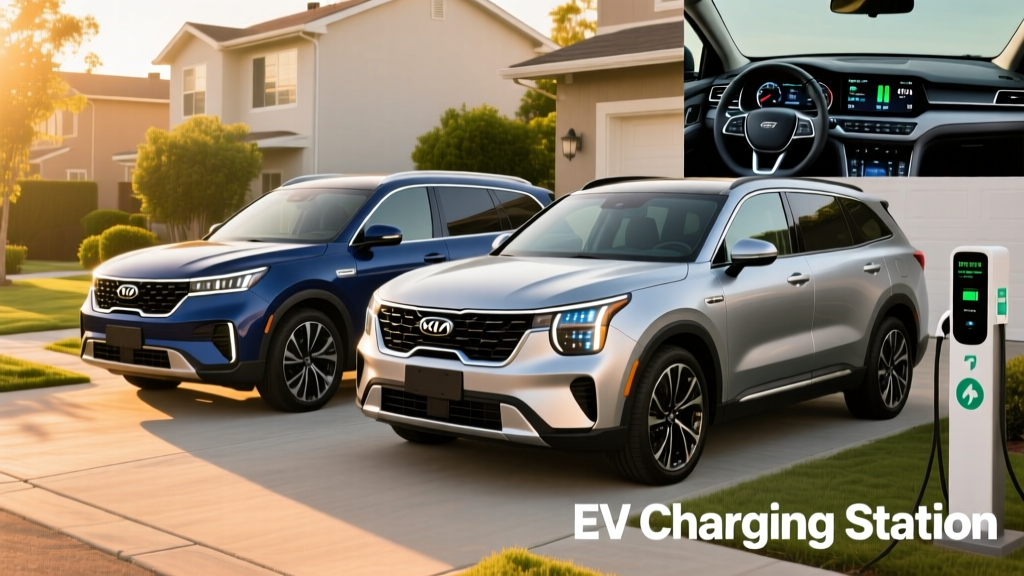
Midsize three-row SUV buyers who want to cut fuel costs without committing to a fully electric vehicle keep landing on the same shortlist, and the 2025 Kia Sorento Hybrid occupies a strong position on it. Kia offers the Sorento in two electrified flavors: a conventional hybrid (HEV) that never needs to be plugged in, and a plug-in hybrid (PHEV) that delivers meaningful electric-only commuting range. Both seat up to six, both come with all-wheel drive, and both undercut many rivals on price. But the differences between the two powertrains—and how they perform in the real world—matter enormously when you're writing the check.
This guide breaks down every number that matters: EPA MPG, electric-only range, battery capacity, charging time, horsepower, pricing by trim, federal tax credit eligibility under current IRS §30D rules, and what you can actually expect once you're behind the wheel. If you're cross-shopping the Toyota Highlander Hybrid, Honda CR-V Hybrid, or considering whether to stretch for a full EV, this is the data you need.
HEV vs PHEV: Which Sorento Powertrain Is Which?
Before diving into specs, let's make the distinction airtight, because confusing these two powertrains is the single most common mistake buyers make in this segment.
Conventional Hybrid (HEV)
The Sorento HEV pairs a 1.6-liter turbocharged gasoline engine with a small electric motor and a compact battery (roughly 1.5 kWh). You never plug it in. The battery recharges through regenerative braking and the engine itself. Think of it as a more efficient gas car—the electric system assists the engine, reducing fuel consumption by 30-40% compared to the gas-only Sorento, but it cannot drive on electricity alone for any meaningful distance.
Plug-In Hybrid (PHEV)
The Sorento PHEV uses a larger 1.6-liter turbo engine mated to a more powerful electric motor and a significantly bigger 13.8 kWh battery pack. You plug it in to charge (Level 1 or Level 2). Fully charged, it can travel 32 miles on electricity alone before the gas engine kicks in, functioning as a conventional hybrid afterward. This means many commuters can complete daily round trips without burning a drop of gasoline—provided they charge at home or work.
Key rule: The HEV requires zero lifestyle change from a gas car. The PHEV rewards you most if you have reliable access to a plug—ideally a home Level 2 charger or a standard 120V outlet for overnight charging.
Fuel Economy and Electric-Only Range: The Numbers
Here's where the rubber meets the road. The EPA rates the 2025 Sorento HEV at 34 MPG city / 35 MPG highway / 35 MPG combined for the EX trim with all-wheel drive. The SX Prestige Hybrid, which adds more weight and larger wheels, dips slightly to 33 MPG combined. These are strong figures for a three-row AWD SUV.
| Model | City MPG | Highway MPG | Combined MPG | Electric-Only Range |
|---|---|---|---|---|
| Sorento HEV (EX AWD) | 34 | 35 | 35 | N/A |
| Sorento HEV (SX Prestige AWD) | 33 | 34 | 33 | N/A |
| Sorento PHEV (all trims AWD) | 33 (gas-only) | 34 (gas-only) | 34 (gas-only) | 32 miles |
| Sorento PHEV (combined MPGe) | 79 MPGe (electric + gas) | 32 miles | ||
Source: fueleconomy.gov, EPA estimates.
Real-World MPG vs. EPA Sticker
Kia's hybrid system, like Toyota's, tends to deliver real-world city MPG that meets or slightly exceeds the EPA estimate. In mixed suburban driving with moderate stop-and-go traffic, owners commonly report 34-37 MPG from the HEV. Highway driving at sustained 75+ MPH may drop to 30-32 MPG, as the aerodynamic profile of a boxy three-row SUV and the reduced benefit of regenerative braking at constant speed work against efficiency.
For the PHEV, the 32-mile electric-only range is an EPA estimate. Expect 28-30 miles in cold weather (below 40°F) or with aggressive highway acceleration. In mild conditions with light throttle use, some drivers squeeze out 34-35 miles before the engine fires. Once the battery depletes, the PHEV operates as a conventional hybrid and returns roughly 33-34 MPG combined—only slightly less than the HEV due to the extra weight of the larger battery.
Real-world check: The PHEV's 32-mile electric range covers the average American one-way commute (roughly 16 miles each way per the Census Bureau). If you charge nightly at home, you may go weeks without visiting a gas station. But if your commute is 40+ miles each way, the PHEV advantage shrinks and the HEV becomes the simpler, more cost-effective choice.
Powertrain Specs: Horsepower, Torque, and the Drivetrain
Both Sorento electrified models use variants of Kia's 1.6-liter turbocharged four-cylinder, but the electric assist differs substantially.
| Specification | Sorento HEV | Sorento PHEV |
|---|---|---|
| Engine | 1.6L turbo I4 | 1.6L turbo I4 |
| Electric Motor Output | 47.7 kW (64 hp) | 72 kW (97 hp) |
| Combined System Horsepower | 232 hp | 261 hp |
| Combined System Torque | 258 lb-ft | 258 lb-ft |
| Transmission | 6-speed automatic | 6-speed automatic |
| Drivetrain | AWD | AWD |
| Battery Capacity | ~1.5 kWh | 13.8 kWh |
| 0-60 MPH (est.) | ~7.8 sec | ~7.0 sec |
| Towing Capacity | 2,000 lbs | 2,000 lbs |
The PHEV's additional 29 horsepower comes from its more powerful electric motor, and the difference is noticeable in daily driving. The PHEV pulls away from stops with immediate electric torque and feels more responsive during highway merging. The HEV is perfectly adequate but relies more heavily on the turbo engine, which can sound strained under hard acceleration.
Both models come standard with all-wheel drive—there's no front-wheel-drive option for the hybrid or PHEV in 2025. This is a plus for buyers in snow-belt states but does cost roughly 1-2 MPG compared to what a hypothetical FWD variant might achieve.
Charging the PHEV: Times, Levels, and What You Need
The Sorento PHEV's 13.8 kWh battery can be charged two ways. It does not support DC fast charging—this is standard for plug-in hybrids in this class, as the relatively small battery doesn't justify the cost and weight of DC fast-charge hardware.
| Charging Level | Power (kW) | 0-100% Time | Notes |
|---|---|---|---|
| Level 1 (120V household outlet) | ~1.4 kW | ~10-11 hours | Sufficient for overnight charging |
| Level 2 (240V home charger) | ~3.3 kW (vehicle max) | ~3.5-4 hours | Recommended; requires 240V outlet |
| DC Fast Charge | N/A | N/A | Not supported |
The PHEV's onboard charger is rated at 3.3 kW, meaning even if you connect it to a 48-amp Level 2 home charger capable of delivering 11.5 kW, the vehicle will only accept 3.3 kW. This is a limitation worth knowing: don't overspend on a high-amperage home charger solely for the Sorento PHEV. A basic 16-amp Level 2 unit (such as a Kia-branded charger or a ChargePoint Home Flex set to 16A) is all you need.
For most owners, Level 1 charging on a standard 120V outlet is adequate. Plug in when you get home, and the battery is full by morning—10 hours is plenty of time for a 13.8 kWh pack. If you need faster turnaround (say, charging between a morning commute and an afternoon errand), a Level 2 setup cuts the time to under four hours.
Pricing, Trims, and Federal Tax Credit Eligibility
The 2025 Sorento Hybrid and PHEV are positioned as value-oriented options in the three-row midsize segment. Here's the trim-by-trim MSRP breakdown, including Kia's $1,395 destination charge:
| Trim | MSRP (incl. destination) | Key Features |
|---|---|---|
| Sorento HEV EX | $40,385 | 6 seats, 12.3" touchscreen, heated front seats, Smart Power Liftgate |
| Sorento HEV SX Prestige | $46,585 | Panoramic sunroof, leather, ventilated front seats, Bose audio, HUD |
| Sorento PHEV EX | $52,485 | Same as HEV EX plus 32-mi EV range, PHEV-specific displays |
| Sorento PHEV SX Prestige | $56,085 | Top trim, all HEV SX Prestige features plus PHEV powertrain |
Does the Sorento PHEV Qualify for the Federal Tax Credit?
Under current IRS §30D rules, the Sorento PHEV may qualify for up to $7,500 in federal tax credits, but eligibility depends on several factors that change periodically. Here's the checklist:
- MSRP cap: SUVs must be under $80,000 MSRP. All Sorento PHEV trims qualify.
- Buyer income cap: Modified AGI must not exceed $150,000 (single), $225,000 (head of household), or $300,000 (joint). Check your tax return.
- Battery sourcing: A percentage of critical minerals and battery components must be sourced from the U.S. or free-trade-agreement partners. These thresholds tighten annually. Verify current-year compliance on IRS.gov or via the dealer's point-of-sale verification tool.
- Point-of-sale transfer: As of 2024, you can transfer the credit to the dealer for an upfront price reduction rather than waiting to claim it on your tax return.
Important: The Sorento HEV (conventional hybrid) does not qualify for the §30D federal EV tax credit. The credit is reserved for plug-in vehicles with a battery capacity of at least 7 kWh. Some states offer separate hybrid incentives—check your state energy office or AFDC for details.
Tax credit math: If you qualify for the full $7,500 credit on the Sorento PHEV EX ($52,485 MSRP), your effective price drops to roughly $44,985—only about $4,600 more than the comparably equipped HEV EX. At that gap, the PHEV's 32 miles of electric commuting and extra 29 hp make it the stronger value. But if you don't qualify (income above cap, sourcing non-compliance), the premium widens to $12,100.
Battery Warranty, Reliability, and Replacement Cost
This is the question that stops many first-time hybrid buyers from signing: what happens when the battery dies?
Kia backs both the Sorento HEV and PHEV hybrid battery with a 10-year / 100,000-mile warranty (in states that follow California emissions standards; 10/100,000 is standard for California-emissions states, which includes most of the Northeast, West Coast, and several other adopting states). In non-CARB states, the hybrid battery warranty may be 10 years / 100,000 miles as well, but verify with your dealer, as Kia's warranty structure can differ by jurisdiction. The broader powertrain warranty covers 10 years/100,000 miles, and the basic vehicle warranty is 5 years/60,000 miles.
The hybrid battery warranty specifically covers capacity loss below a defined threshold—typically around 70% of original capacity—along with any manufacturing defects. In practice, modern lithium-ion hybrid batteries rarely fail catastrophically. Data from Hyundai/Kia's hybrid fleet (which shares powertrain architecture) shows degradation of roughly 1-2% per year in normal use. A 10-year-old Sorento hybrid battery might retain 80-85% of its original capacity, which is well within warranty tolerance.
What Does Hybrid Battery Replacement Cost?
If your battery does eventually need replacement outside of warranty, expect to pay between $2,500 and $4,500 for the HEV's smaller battery pack, and $4,000 to $7,000 for the PHEV's larger 13.8 kWh unit, including labor. These figures are based on current Hyundai/Kia dealer pricing and may decline as the supply of refurbished and aftermarket battery packs grows. For context, Toyota Prius batteries from the 2004-2009 generation are still being replaced today for roughly $2,000-$3,000 at independent shops, suggesting long-term costs will trend downward.
Reliability data for the Sorento Hybrid specifically is still accumulating, as the model launched for the 2021 model year. Kia as a brand has scored in the middle of the pack in recent IIHS safety evaluations and J.D. Power dependability studies. The turbocharged 1.6L engine and 6-speed automatic are proven components shared across the Hyundai/Kia lineup.
Who Should Buy the Sorento Hybrid vs. a PHEV or Full EV?
The decision framework for the Sorento comes down to three variables: your daily mileage, your access to charging, and your budget sensitivity.
Choose the Sorento HEV if:
- You drive 30-60 miles per day and want zero plug-in hassle
- You lack home or workplace charging access (apartment, street parking)
- You want the lowest purchase price and don't qualify for the PHEV tax credit
- You take frequent long road trips where electric-only range provides minimal benefit
Choose the Sorento PHEV if:
- Your daily round-trip commute is under 35 miles and you can charge at home
- You qualify for the full $7,500 federal tax credit (narrowing the price gap to ~$4,600)
- You want the option of electric-only driving for school runs, errands, and commutes
- You plan to keep the vehicle 5+ years and want to insulate against gas price spikes
Consider a full EV (like the Kia EV9 or Hyundai Ioniq 5) if:
- You have reliable Level 2 home charging and rarely drive more than 250 miles between stops
- You want to eliminate gasoline entirely and minimize maintenance (no oil changes, no engine)
- Your household has a second vehicle for the rare 400-mile road trip
Sorento HEV Pros
- 35 MPG combined is excellent for a 3-row AWD SUV
- No charging infrastructure required
- Competitive starting price under $41K
- Strong 10-year powertrain and hybrid battery warranty
- Six-passenger seating with usable third row
Sorento HEV Cons
- No federal tax credit eligibility
- Engine noise under hard acceleration is noticeable
- Third row is tight for adults on long trips
- Real-world highway MPG can drop to low 30s
- No DC fast charging (irrelevant for HEV, but limits future flexibility)
Sorento PHEV Pros
- 32 miles electric-only covers most commutes gas-free
- Up to $7,500 federal tax credit dramatically narrows price gap
- 261 hp makes it the quickest Sorento variant
- Same 10-year hybrid battery warranty as HEV
- Operates as efficient hybrid after battery depletes
Sorento PHEV Cons
- $52K+ starting price before incentives
- 3.3 kW onboard charger limits Level 2 speed
- No DC fast charging capability
- Electric range drops in cold weather and at highway speeds
- Tax credit eligibility depends on sourcing rules that change annually
Frequently Asked Questions
How many MPG does the 2025 Kia Sorento Hybrid get?
The EPA rates the Sorento HEV EX at 34 city / 35 highway / 35 combined MPG. Real-world owners typically see 34-37 MPG in mixed city/suburban driving and 30-32 MPG on sustained highway trips. The SX Prestige trim drops to 33 combined due to larger wheels and added weight.
How far can the Sorento PHEV go on electric power alone?
The EPA estimates 32 miles of electric-only range. In practice, expect 28-30 miles in cold weather or aggressive driving, and up to 34-35 miles in mild conditions with gentle throttle input. After the battery depletes, the PHEV operates as a conventional hybrid at roughly 33-34 MPG combined.
Does the Sorento Hybrid need to be plugged in?
No. The conventional Sorento HEV charges its small battery through regenerative braking and the gasoline engine. You fuel it like any other gas car. Only the Sorento PHEV requires (and benefits from) plug-in charging to access its 32-mile electric range.
Does the 2025 Sorento PHEV qualify for the $7,500 federal tax credit?
It may, depending on your income, the vehicle's battery sourcing compliance in the current year, and MSRP limits. The Sorento PHEV's MSRP is well under the $80,000 SUV cap. Income limits are $150K (single), $225K (head of household), and $300K (joint filers). Verify current sourcing compliance at IRS.gov before purchasing. The conventional HEV does not qualify for §30D credits.
Is the Sorento Hybrid reliable, and what does a battery replacement cost?
The Sorento Hybrid uses proven Hyundai/Kia turbo and hybrid components. The hybrid battery is warranted for 10 years/100,000 miles. Out-of-warranty replacement costs range from $2,500-$4,500 (HEV) or $4,000-$7,000 (PHEV). Real-world data from the Hyundai/Kia hybrid fleet suggests batteries retain 80-85% capacity after 10 years of normal use.
Can the Sorento PHEV charge at public DC fast chargers?
No. The Sorento PHEV does not have DC fast-charge capability. It charges via Level 1 (120V, ~10 hours) or Level 2 (240V at 3.3 kW, ~3.5 hours). This is typical for plug-in hybrids—the 13.8 kWh battery is small enough that overnight charging is sufficient for daily use.
How does the Sorento Hybrid compare to the Toyota Highlander Hybrid?
The Highlander Hybrid achieves 35-36 MPG combined and starts around $42,000—slightly more expensive than the Sorento HEV. The Highlander is larger with a more usable third row but lacks a PHEV option. If you want plug-in capability, the Sorento PHEV is the only game in this segment at this price point. If third-row comfort is paramount and you don't need plug-in, the Highlander is a strong alternative.
Always verify current pricing, tax credit eligibility, and specifications with your local Kia dealer and the EPA's fueleconomy.gov database before purchasing. Federal and state incentive rules are subject to change.