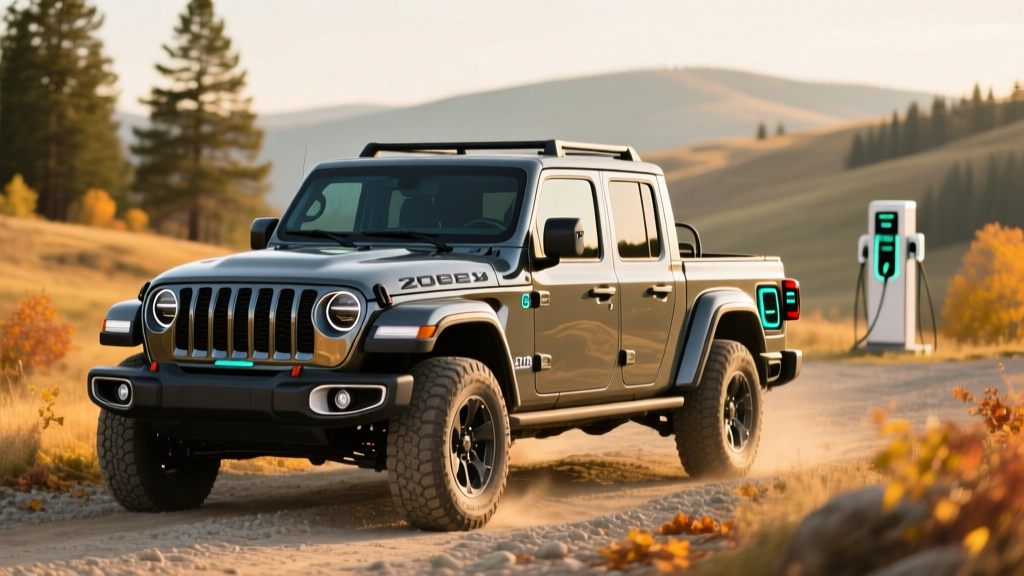
The midsize pickup segment has been slow to electrify, but the 2026 Jeep Gladiator 4xe finally brings plug-in hybrid capability to Jeep's truck lineup. Sharing its powertrain architecture with the proven Wrangler 4xe, the Gladiator 4xe pairs a turbocharged gasoline engine with dual electric motors and a 17.3 kWh battery pack — delivering a meaningful electric-only commute range while preserving the towing and off-road credentials truck buyers demand.
This guide breaks down everything buyers need to know about the hybrid Gladiator: real-world MPG expectations, electric-only range, charging logistics, towing impact, and whether the §30D federal tax credit applies. We'll also clarify how this plug-in hybrid (PHEV) differs from a conventional hybrid (HEV) and where it fits against full EV trucks like the Ford F-150 Lightning or Rivian R1T.
HEV vs PHEV: What the Gladiator 4xe Actually Is
Before diving into specs, it's critical to understand what the Gladiator 4xe is — and what it isn't. The automotive market has two types of hybrids, and confusing them leads to bad purchase decisions.
Conventional Hybrid (HEV)
- How it works: A small battery (typically 1-2 kWh) is charged exclusively by the gasoline engine and regenerative braking. You never plug it in.
- Electric-only driving: None or negligible (under 1 mile at low speed).
- Examples: Toyota Tacoma i-FORCE MAX, Ford Maverick Hybrid.
- Fuel economy benefit: Moderate — typically 20-35% better than a comparable gas-only truck.
Plug-In Hybrid (PHEV) — Gladiator 4xe
- How it works: A larger battery (17.3 kWh in the Gladiator 4xe) can be charged from a wall outlet or public charger, enabling genuine electric-only driving before the gas engine engages.
- Electric-only driving: EPA-rated ~25 miles on battery alone.
- Examples: Jeep Gladiator 4xe, Jeep Wrangler 4xe, Ford Escape PHEV, Toyota RAV4 Prime.
- Fuel economy benefit: High for short commutes (zero gas for sub-25-mile trips); moderate for long highway drives once the battery is depleted.
Key takeaway: The Gladiator 4xe is a PHEV. You plug it in to unlock its electric range. If you never plug it in, it functions as a heavy, less-efficient conventional hybrid — you'd be carrying around 800+ pounds of battery and motors without the benefit.
2026 Gladiator 4xe Powertrain and Performance Specs
| Specification | 2026 Jeep Gladiator 4xe |
|---|---|
| Engine | 2.0L turbocharged inline-4 |
| Electric Motors | Dual motor-generators (one integrated in transmission, one engine-mounted) |
| Combined Horsepower | 375 hp |
| Combined Torque | 470 lb-ft |
| Battery (Usable) | 17.3 kWh (NMC lithium-ion) |
| Transmission | 8-speed automatic (TorqueFlite) |
| Drivetrain | 4WD (Selec-Trac or Rock-Trac depending on trim) |
| 0-60 mph | ~6.5 seconds (estimated) |
| Max Towing Capacity | ~5,000 lbs (reduced from gas Gladiator's 7,700 lbs) |
| Payload Capacity | ~1,100 lbs (estimated) |
The 2.0L turbo four-cylinder may seem undersized for a body-on-frame truck, but the combined 470 lb-ft of torque — available instantly from the electric motors — gives the Gladiator 4xe strong off-the-line acceleration and low-speed crawling ability. The 375 combined horsepower figure is competitive with V6 rivals, and the electric torque fill eliminates the turbo lag inherent to the gas-only 2.0L.
Towing reality check: The 4xe powertrain adds substantial weight (roughly 600-800 lbs over the gas Gladiator), and the battery occupies space that affects weight distribution. Expect a maximum towing rating around 5,000 lbs — adequate for a small boat or utility trailer but well short of the gas Gladiator's 7,700-lb max. If you regularly tow over 5,000 lbs, the 4xe is not the right configuration.
Fuel Economy: EPA MPG and Real-World Expectations
PHEV fuel economy is measured in two ways: MPGe (miles per gallon equivalent) when the battery is charged, and standard MPG once the battery depletes and the gas engine takes over. Both matter, and which one applies to you depends entirely on your driving patterns.
| Mode | City | Highway | Combined |
|---|---|---|---|
| Charge-Sustaining (gas only, battery depleted) | ~20 MPG | ~22 MPG | ~21 MPG |
| Charge-Depleting (electric + gas, full battery) | ~49 MPGe (combined, EPA est.) | ||
Real-world MPG context: The charge-sustaining (gas-only) figure of approximately 21 MPG combined is underwhelming for a hybrid, but it reflects physics: the Gladiator 4xe is a heavy, boxy, body-on-frame truck with all-terrain tires and the aerodynamics of a brick. For comparison, the gas-only Gladiator with the 3.6L V6 and mild-hybrid eTorque system achieves about 19 MPG combined per fueleconomy.gov. The 4xe's advantage isn't in highway cruising efficiency — it's in the ability to complete short trips entirely on electricity.
Real-World Range Expectations
EPA Electric-Only Range: ~25 miles
Real-world electric range: Expect 18-22 miles in mixed driving; as low as 14-16 miles at sustained highway speeds (70+ mph) or in cold weather (below 32°F). Electric range drops significantly when towing or hauling heavy payloads.
Total Combined Range (full tank + full battery): ~370-400 miles
Gas Tank: ~21.5 gallons (estimated, similar to gas Gladiator)
If your daily commute is under 20 miles round-trip and you charge every night, you may go weeks without visiting a gas station. If your commute is 60 miles each way, the battery will deplete within the first 20 miles, and you'll average roughly 21 MPG for the remaining 100 miles — only marginally better than the gas model.
Battery, Charging, and Electric-Only Range
The Gladiator 4xe uses a 17.3 kWh (total capacity) NMC (nickel-manganese-cobalt) lithium-ion battery pack, with approximately 14-15 kWh usable. This is the same battery architecture proven in the Wrangler 4xe since the 2021 model year.
| Charging Level | Power (kW) | 0-100% Time | Where |
|---|---|---|---|
| Level 1 (120V household outlet) | ~1.4 kW | ~12 hours | Any standard outlet |
| Level 2 (240V home/public) | ~7.2 kW | ~2.5 hours | Home wallbox, public Level 2 stations |
| DC Fast Charge | Not supported | N/A | N/A |
No DC fast charging. Like nearly all PHEVs on the market (with the rare exception of the Mitsubishi Outlander PHEV), the Gladiator 4xe cannot accept DC fast charging. The battery is too small to justify the hardware cost, and PHEV owners are expected to charge primarily at home overnight. A full Level 2 charge in roughly 2.5 hours means you can top up during a workday if your workplace offers Level 2 charging.
Level 1 viability: If you drive less than 20 miles per day and have access to a standard 120V outlet in your garage or driveway, Level 1 charging (~5-6 miles of range per hour of charging) can replenish the battery overnight. This eliminates the need for a dedicated Level 2 home charger installation, which typically costs $500-$1,500 for the equipment and electrician labor.
Pricing, Trims, and Federal Tax Credit Eligibility
The 2026 Gladiator 4xe is expected to start at approximately $52,000 MSRP (including destination) for the base Sport or Willys trim, with higher trims (Rubicon, Mojave, High Altitude) pushing into the $60,000-$65,000 range. For context, the gas-only Gladiator starts around $40,000, making the 4xe premium roughly $10,000-$12,000.
Does the Gladiator 4xe Qualify for the §30D Federal Tax Credit?
This is where PHEV buyers must pay close attention. Under current IRS rules (IRS §30D), the new clean vehicle credit offers up to $7,500, but eligibility depends on several requirements that change periodically:
- MSRP Cap: Vans, SUVs, and pickup trucks must have an MSRP at or below $80,000. The Gladiator 4xe clears this threshold on most trims.
- Buyer Income Cap: Modified adjusted gross income must not exceed $150,000 (single), $225,000 (head of household), or $300,000 (joint filers).
- Battery Sourcing Requirements: A percentage of critical minerals and battery components must be sourced from the U.S. or free-trade-agreement countries. These thresholds increase annually and may disqualify some model-year/battery combinations.
- Battery Capacity Minimum: The battery must have at least 7 kWh of capacity. The Gladiator 4xe's 17.3 kWh pack easily meets this.
- Point-of-Sale Transfer: As of 2024, buyers can transfer the credit to the dealer at point of sale, reducing the purchase price directly rather than waiting for a tax refund.
Honest assessment: Battery-sourcing requirements have disqualified several PHEVs and EVs in recent years, and the rules tighten annually. Before purchasing, verify the specific Gladiator 4xe trim's credit eligibility on the fueleconomy.gov tax credit page or consult a tax professional. Never assume the full $7,500 applies without confirming current-year sourcing compliance.
Reliability, Battery Warranty, and Replacement Cost
Jeep 4xe Battery Warranty
Coverage: 8 years / 100,000 miles (whichever comes first)
Capacity retention threshold: Warranty covers the battery if it degrades below approximately 70% of original capacity within the warranty period.
Hybrid component warranty: 8 years / 100,000 miles for electric motors, power inverter, and related hybrid-system components.
The 4xe powertrain has been in the Wrangler since 2021, giving Jeep/Stellantis roughly five years of real-world data. Early Wrangler 4xe models experienced some software-related issues (rough engine-generator transitions, battery management faults), but most were addressed through over-the-air updates and service campaigns. The mechanical hardware — the ZF 8-speed transmission, the 2.0L turbo engine, and the electric motor-generators — has proven robust.
Battery replacement cost: If the 17.3 kWh pack fails outside warranty, expect a replacement cost between $8,000 and $12,000 (parts and labor). This is significantly less than a full EV battery replacement ($15,000-$25,000+) because the PHEV battery is much smaller. However, NMC chemistry in a PHEV application typically sees 1,000-2,000 full charge cycles before significant degradation — translating to well over 100,000 miles of electric-assisted driving before meaningful capacity loss.
Reliability ratings: As of this writing, the Gladiator 4xe is too new for dedicated reliability scores from IIHS or Consumer Reports. The Wrangler 4xe has earned average to slightly-below-average reliability ratings, primarily due to electrical-system complaints rather than powertrain failures. The Gladiator 4xe shares these components, so expect a similar trajectory.
Who Should Choose the Gladiator 4xe vs. a Full EV or Gas Truck?
Choose the Gladiator 4xe (PHEV) If:
- Your daily commute is under 25 miles round-trip and you can charge at home nightly.
- You need a body-on-frame truck with genuine off-road capability (solid axles, low-range transfer case, locking differentials) but want to reduce fuel consumption on weekday driving.
- You tow occasionally but stay under 5,000 lbs.
- You want to reduce gas consumption without committing to full-electric range limitations on long trips or in remote areas.
- You value the instant electric torque for rock crawling and low-speed trail work.
Choose a Gas Gladiator If:
- You regularly tow above 5,000 lbs or carry heavy payloads.
- You cannot charge at home or work (the PHEV premium is wasted if you never plug in).
- Your budget is closer to $40,000-$45,000 and the $10,000+ 4xe premium doesn't pencil out in fuel savings.
- You drive primarily long highway trips where the PHEV's gas-only MPG is barely better than the gas model.
Choose a Full EV Truck (Rivian R1T, Ford F-150 Lightning) If:
- You want zero tailpipe emissions and minimal maintenance (no oil changes, no spark plugs, no transmission fluid).
- You have reliable home charging and access to DC fast charging for road trips.
- You don't need solid-axle off-road capability (the R1T and Lightning use independent suspension).
- You want full-size truck utility — the F-150 Lightning offers 7,700+ lbs of towing and significantly more interior and bed space than the midsize Gladiator.
Pros and Cons at a Glance
Pros
- ~25 miles of electric-only range covers most daily commutes
- 470 lb-ft of combined torque is excellent for off-road crawling
- Genuine Jeep off-road hardware (Rubicon/Mojave trims)
- No range anxiety — gas engine covers long trips
- Level 1 (120V) charging is viable for low-mileage drivers
- Proven Wrangler 4xe powertrain with 5+ years of field data
Cons
- Gas-only MPG (~21 combined) is barely better than the V6 gas Gladiator
- Towing capacity reduced to ~5,000 lbs (vs. 7,700 lbs gas)
- $10,000-$12,000 price premium over equivalent gas trims
- No DC fast charging capability
- Heavy: added battery weight hurts payload and handling
- Tax credit eligibility uncertain due to evolving sourcing rules
- Electric range drops significantly in cold weather and when towing
Frequently Asked Questions
How many MPG does the hybrid Gladiator get?
Once the battery is depleted, the Gladiator 4xe achieves approximately 21 MPG combined (roughly 20 city / 22 highway) in charge-sustaining mode. When the battery is fully charged and you're driving within the electric range, the MPGe rating is approximately 49 MPGe combined. For short commutes under 25 miles with nightly charging, your effective fuel consumption can approach zero.
How far can the Gladiator 4xe go on electric only?
The EPA-rated electric-only range is approximately 25 miles. In real-world conditions, expect 18-22 miles in mixed driving, dropping to 14-16 miles at sustained highway speeds or in freezing temperatures. Towing or hauling will further reduce electric range.
Is the Gladiator 4xe a conventional hybrid or a plug-in hybrid?
It's a plug-in hybrid (PHEV). You must plug it in to access the electric-only range. Unlike a conventional hybrid (HEV) like the Toyota Tacoma i-FORCE MAX, the Gladiator 4xe has a larger battery that charges from an external power source. If you never plug it in, it will operate as a heavy conventional hybrid with only marginal fuel savings over the gas model.
Does the Gladiator 4xe qualify for the $7,500 federal tax credit?
It may, but eligibility is not guaranteed. Under IRS §30D rules, the vehicle must meet battery-sourcing and critical-mineral requirements that tighten each year, the buyer must fall under income caps ($150K single / $300K joint), and the truck's MSRP must be at or below $80,000. Check fueleconomy.gov for the specific model year's eligibility status before purchasing.
Is the Gladiator 4xe reliable, and what does a battery replacement cost?
The 4xe powertrain has been in production since 2021 (Wrangler) with generally acceptable reliability, though early models had software-related issues that were largely resolved. The hybrid battery is warrantied for 8 years / 100,000 miles. Out-of-warranty battery replacement is estimated at $8,000-$12,000, which is less than a full EV battery due to the smaller pack size.
Can I tow with the Gladiator 4xe?
Yes, but with reduced capacity. The Gladiator 4xe is rated to tow approximately 5,000 lbs — down from the gas Gladiator's maximum of 7,700 lbs. The added weight of the hybrid system and the battery's impact on weight distribution are the primary reasons for the reduction. For light trailers, small boats, or ATV hauls, 5,000 lbs is sufficient. For larger campers or heavy equipment, consider the gas Gladiator or a full-size truck.
How long does it take to charge the Gladiator 4xe?
On a Level 2 (240V) charger at 7.2 kW, a full charge takes approximately 2.5 hours. On a standard 120V household outlet (Level 1), expect roughly 12 hours for a full charge. DC fast charging is not supported.