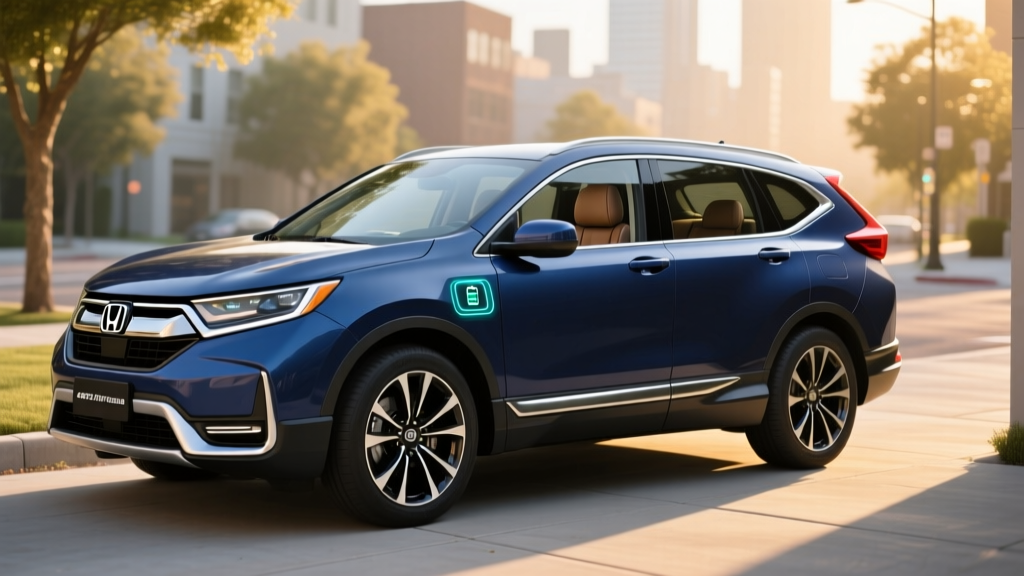
The 2026 Honda CR-V Hybrid Touring sits at the top of Honda's hybrid SUV lineup, blending a proven two-motor hybrid system with the premium features buyers expect from a range-topping trim. If you're researching this specific model, you likely want hard numbers on fuel economy, a clear picture of what the Touring trim actually gets you, and an honest answer to whether a conventional hybrid (HEV) still makes sense in a market increasingly crowded with plug-in hybrids and full EVs.
This guide breaks down the 2026 Honda CR-V Hybrid Touring with the data-driven precision we apply to every electrified vehicle — EPA figures, real-world MPG expectations, powertrain specs, battery warranty details, and total cost of ownership. No marketing fluff, just the numbers you need to decide.
2026 Honda CR-V Hybrid Touring: Quick Specs at a Glance
| Specification | 2026 CR-V Hybrid Touring AWD |
|---|---|
| Powertrain | 2.0L Atkinson-cycle 4-cyl + 2 electric motors (HEV) |
| Combined Horsepower | 204 hp |
| Combined Torque | 247 lb-ft (electric motor) |
| Drivetrain | AWD (standard on Touring) |
| EPA MPG (City / Hwy / Combined) | 40 / 34 / 37 |
| Fuel Tank Capacity | 14.0 gallons |
| Total Range | ~518 miles |
| 0-60 mph | ~7.8 seconds (est.) |
| Cargo Volume (behind 2nd row) | 36.3 cu ft |
| Hybrid Battery Warranty | 8 years / 100,000 miles |
| MSRP (Touring AWD) | ~$42,350 |
Source: fueleconomy.gov and Honda official specs. MPG figures reflect EPA estimates for the AWD Hybrid configuration. Final 2026 MSRP subject to Honda confirmation.
Fuel Economy: EPA Estimates vs. Real-World MPG
The 2026 CR-V Hybrid AWD carries EPA ratings of 40 MPG city, 34 MPG highway, and 37 MPG combined. These numbers are specific to the AWD Hybrid powertrain; the FWD Hybrid variant rates slightly higher at 43/36/40 MPG combined, but the Touring trim comes exclusively with AWD.
| Driving Scenario | EPA Estimate | Real-World Expectation |
|---|---|---|
| City / Stop-and-Go | 40 MPG | 38–44 MPG (regen braking excels here) |
| Highway (70+ mph) | 34 MPG | 30–34 MPG (aero drag, less regen benefit) |
| Combined Mixed | 37 MPG | 35–40 MPG |
| Cold Weather (below 30°F) | — | 30–34 MPG (engine runs more for cabin heat) |
Conventional hybrids like the CR-V often exceed their EPA city rating in real-world stop-and-go driving because regenerative braking recaptures energy that a gas-only vehicle wastes as heat. Highway driving is the opposite story — sustained high speeds reduce the hybrid system's advantage, and you'll see numbers closer to 30-32 MPG on flat interstate runs at 75 mph.
In cold weather, expect a noticeable dip. The gasoline engine must run more frequently to provide cabin heat (unlike an EV with a heat pump), which erodes the hybrid efficiency advantage. Owners in northern climates typically report winter combined MPG in the low-to-mid 30s.
HEV vs. PHEV vs. EV: Which Powertrain Fits You?
The CR-V Hybrid is a conventional hybrid (HEV) — it does not plug in. Honda currently does not offer a plug-in hybrid (PHEV) version of the CR-V in the US market. Here's how the three electrified powertrain types compare for a buyer cross-shopping this segment:
| Factor | HEV (CR-V Hybrid) | PHEV (e.g., Toyota RAV4 Prime) | BEV (e.g., Tesla Model Y) |
|---|---|---|---|
| Plugs In? | No | Yes (Level 1/2) | Yes (Level 1/2/DC) |
| Electric-Only Range | ~1 mile (low-speed) | 35–42 miles | 280–330 miles |
| Total Range | ~518 miles | ~550+ miles | 280–330 miles |
| Combined MPG / MPGe | 37 MPG | 94 MPGe (elec) / 38 MPG (gas) | 117–123 MPGe |
| Home Charging Needed? | No | Recommended (240V) | Essential |
| Federal Tax Credit | None | Up to $7,500 (§30D) | Up to $7,500 (§30D) |
| Starting Price Range | ~$36,000–$42,000 | ~$44,000–$50,000 | ~$44,000–$55,000 |
| Best For | No home charging access; simple ownership | Home charging + daily short commutes | Home charging + low running costs |
Choose the CR-V Hybrid (HEV) if: You don't have access to home or workplace charging, you want a lower purchase price, you take frequent long road trips, or you simply want maximum simplicity with no plug-in routine.
Consider a PHEV instead if: You can install a Level 2 charger at home, your daily commute is under 40 miles round-trip, and you want to drive mostly on electricity while keeping a gas engine for road trips.
Consider a full EV instead if: You have reliable home charging, your daily driving is under 250 miles, and you want the lowest per-mile fuel cost and minimal maintenance.
Powertrain Deep Dive: How the CR-V Hybrid System Works
The 2026 CR-V Hybrid uses Honda's fourth-generation two-motor hybrid system, paired with a 2.0-liter Atkinson-cycle four-cylinder engine. Here's how the components break down:
- Gasoline Engine: 2.0L DOHC Atkinson-cycle 4-cylinder producing approximately 145 hp and 134 lb-ft of torque. The Atkinson cycle sacrifices peak power for thermal efficiency, which is ideal for a hybrid where electric motors fill in the torque gaps.
- Propulsion Motor: One electric motor drives the front wheels, producing up to 181 hp and 247 lb-ft of torque. This is the primary motivation in most driving scenarios.
- Generator Motor: A second motor acts primarily as a generator, converting engine output to electricity or recapturing energy during braking.
- Combined System Output: 204 hp. Note that combined hybrid horsepower is not simply engine + motor added together — the system manages power delivery based on battery state of charge and driving demand.
- AWD System: The Touring trim includes a rear-mounted electric motor that provides torque to the rear axle when needed (acceleration, low-traction surfaces). This is an on-demand system, not full-time mechanical AWD.
In practice, the CR-V Hybrid operates in three modes: EV Drive (electric motor only, at low speeds and light loads), Hybrid Drive (engine generates electricity to feed the drive motor), and Engine Drive (engine directly drives the wheels via a lock-up clutch at steady highway speeds). The transitions are nearly seamless — most drivers won't notice which mode is active without watching the power-flow display.
What the Touring Trim Gets You (and What It Costs)
The Touring sits at the top of the CR-V Hybrid trim ladder for 2026. Based on Honda's current pricing structure, here's the trim hierarchy:
- CR-V Hybrid Sport: ~$36,350 — base hybrid entry
- CR-V Hybrid Sport-L: ~$38,000 — adds leather, heated rear seats
- CR-V Hybrid Sport Touring: ~$40,850 — adds navigation, Bose audio, wireless CarPlay/Android Auto, hands-free power tailgate
- CR-V Hybrid Touring (range-topping): ~$42,350 — full feature load including premium interior materials and advanced convenience features
The Touring trim's key additions over lower hybrid trims include a 9-inch touchscreen with embedded navigation, a 12-speaker Bose premium audio system, wireless Apple CarPlay and Android Auto, a hands-free power tailgate, heated rear outboard seats, a heated steering wheel, and rain-sensing wipers. All CR-V Hybrid trims come standard with Honda Sensing (the brand's ADAS suite), which includes adaptive cruise control, lane-keeping assist, forward collision warning with automatic emergency braking, and traffic sign recognition.
Federal and State Tax Credit Eligibility
The 2026 Honda CR-V Hybrid is a conventional hybrid (HEV), not a plug-in hybrid or battery electric vehicle. As such, it does not qualify for the federal §30D Clean Vehicle Credit (up to $7,500). That credit is reserved for new plug-in vehicles meeting battery sourcing, MSRP cap, and buyer income requirements under current IRS rules.
Some states and local utilities offer modest rebates or incentives for conventional hybrids, but these vary widely by jurisdiction and are typically smaller ($250–$1,000). Check your state energy office or utility provider for current programs. Do not count on a meaningful purchase incentive for the CR-V Hybrid.
Battery Longevity, Warranty, and Replacement Cost
Hybrid battery anxiety is the number-one concern we hear from prospective hybrid buyers. Here's what the data actually shows:
2026 Honda CR-V Hybrid Battery Warranty:
- Coverage: 8 years / 100,000 miles (10 years / 150,000 miles in CARB states including CA, NY, MA, and others)
- What's Covered: Hybrid battery pack and hybrid system components (inverter, DC-DC converter)
- Capacity Threshold: Honda warrants against defects and abnormal loss of capacity; there is no published minimum SoH percentage, but warranty claims are honored for significant degradation affecting vehicle operation
The CR-V Hybrid uses a relatively small lithium-ion battery pack (approximately 1.1 kWh usable capacity). Unlike a full EV battery, this pack isn't subjected to deep charge-discharge cycles — the hybrid system keeps it in a narrow state-of-charge window (roughly 40–80%) to maximize longevity. This shallow-cycling approach is why hybrid batteries routinely last 150,000+ miles without significant degradation.
Real-world failure data from Honda's previous-generation hybrid systems (used in the Accord Hybrid and earlier CR-V Hybrid) shows a very low out-of-warranty failure rate. When replacements are needed outside warranty, expect a cost in the range of $2,000–$4,000 for a refurbished or new hybrid battery pack, including labor. This is substantially less than an EV traction battery replacement, which can run $10,000–$20,000+.
The conventional 12-volt auxiliary battery (which powers the electronics and starts the hybrid system) is a separate maintenance item and typically needs replacement every 4–6 years at a cost of $150–$300, same as any modern vehicle.
Reliability Track Record and Ownership Costs
Honda's hybrid powertrain has built a strong reliability reputation over multiple generations. The two-motor system used in the current CR-V Hybrid is mechanically simpler than a conventional automatic transmission — there's no multi-speed gearbox, just a single fixed-ratio reduction gear and a lock-up clutch for highway cruising. Fewer moving parts generally means fewer failure points.
For total cost of ownership, the CR-V Hybrid's advantages compound over time:
- Fuel Savings: At 37 MPG combined vs. a comparable gas-only compact SUV at ~28 MPG combined, and with regular unleaded at approximately $3.40/gallon (2026 national average), you'll save roughly $450–$600 per year driving 15,000 miles annually.
- Maintenance: Hybrid-specific maintenance is minimal. The regenerative braking system reduces brake pad wear significantly — many hybrid owners report original brake pads lasting 80,000+ miles. Oil changes are still required but can sometimes be extended slightly due to the engine operating less frequently in city driving.
- Insurance: Hybrid insurance premiums are typically comparable to gas equivalents for the CR-V, unlike some EVs that carry higher premiums due to repair-cost concerns.
- Depreciation: The CR-V Hybrid has held strong resale value, with hybrid versions often depreciating less than gas-only counterparts in the same model line — a trend driven by strong used-market demand for fuel-efficient vehicles.
Pros and Cons: The Honest Verdict
Pros
- Excellent real-world city MPG, often exceeding EPA estimates
- No plug-in charging required — works with any lifestyle
- Strong 8-year/100k-mile hybrid battery warranty (10/150k in CARB states)
- Smooth, quiet powertrain transitions
- Competitive cargo space vs. gas CR-V (minimal battery intrusion)
- AWD standard on Touring with electric rear-axle torque
- Honda Sensing ADAS suite standard on all trims
Cons
- No federal tax credit eligibility (HEV, not PHEV/BEV)
- Highway MPG drops noticeably at 75+ mph
- Cold-weather efficiency loss greater than EVs with heat pumps
- Touring trim pushes past $42,000 — premium over Sport by ~$6,000
- No PHEV option in the CR-V lineup for US buyers
- Infotainment system functional but not class-leading in responsiveness
Frequently Asked Questions
How many MPG does the 2026 Honda CR-V Hybrid Touring actually get?
The EPA rates the CR-V Hybrid AWD at 40 city / 34 highway / 37 combined MPG. In real-world driving, city and suburban routes often yield 38–44 MPG thanks to regenerative braking. Highway driving at sustained 70+ mph typically returns 30–34 MPG. Cold weather can drop combined figures to the low 30s.
Does the CR-V Hybrid need to be plugged in?
No. The CR-V Hybrid is a conventional hybrid (HEV). It charges its own small battery pack through regenerative braking and the gasoline engine. You never plug it in — you simply fill it with gas like any other vehicle.
Is there a plug-in hybrid (PHEV) version of the 2026 CR-V?
No. Honda does not currently offer a PHEV variant of the CR-V in the United States. If plug-in capability and electric-only commuting are priorities, competitors like the Toyota RAV4 Prime (42 miles electric-only, up to $7,500 federal credit) or the Hyundai Tucson PHEV (33 miles electric-only) are worth cross-shopping.
Does the 2026 CR-V Hybrid qualify for any tax credit?
The CR-V Hybrid does not qualify for the federal §30D Clean Vehicle Credit, which is limited to plug-in hybrids and battery electric vehicles. Some state or utility incentives may apply to conventional hybrids, but these are typically modest ($250–$1,000) and vary by location. Consult your state energy office or a tax professional for specifics.
How long will the hybrid battery last, and what does replacement cost?
Honda warranties the hybrid battery for 8 years/100,000 miles (10 years/150,000 miles in CARB states). Real-world data from Honda's hybrid lineup suggests these batteries routinely last 150,000+ miles without significant issues due to shallow charge-discharge cycling. If replacement is needed out of warranty, expect $2,000–$4,000 for parts and labor — far less than a full EV battery replacement.
How does the CR-V Hybrid Touring compare to the gas-only CR-V?
The gas-only CR-V AWD rates around 29 MPG combined, while the Hybrid AWD achieves 37 MPG — a roughly 28% improvement. The hybrid also delivers smoother acceleration from a stop (electric motor torque) and quieter low-speed operation. The trade-off is a higher purchase price (roughly $2,500–$3,500 more for equivalent trims) and no federal tax credit to offset it. At 15,000 miles per year, fuel savings typically recoup the price premium in 5–7 years.
Is Honda Sensing on the Touring trim considered self-driving?
No. Honda Sensing is a Level 2 driver-assistance system per SAE classification. It provides adaptive cruise control, lane-centering, and automatic emergency braking, but the driver must remain fully engaged with hands on the wheel and eyes on the road at all times. It is not autonomous or self-driving.
The 2026 Honda CR-V Hybrid Touring is a compelling choice for buyers who want maximum fuel efficiency without changing their refueling habits. It won't match a PHEV's electric-only commuting or an EV's per-mile cost, but it eliminates range anxiety entirely, asks nothing of your electrical panel, and delivers consistent real-world MPG that undercuts most competitors in the compact SUV segment. If your lifestyle doesn't accommodate plug-in charging — or you simply prefer the simplicity of gas-and-go — this is one of the strongest hybrid SUVs available.