Ford Explorer Hybrid Mileage: What the EPA Says vs. Real-World Driving
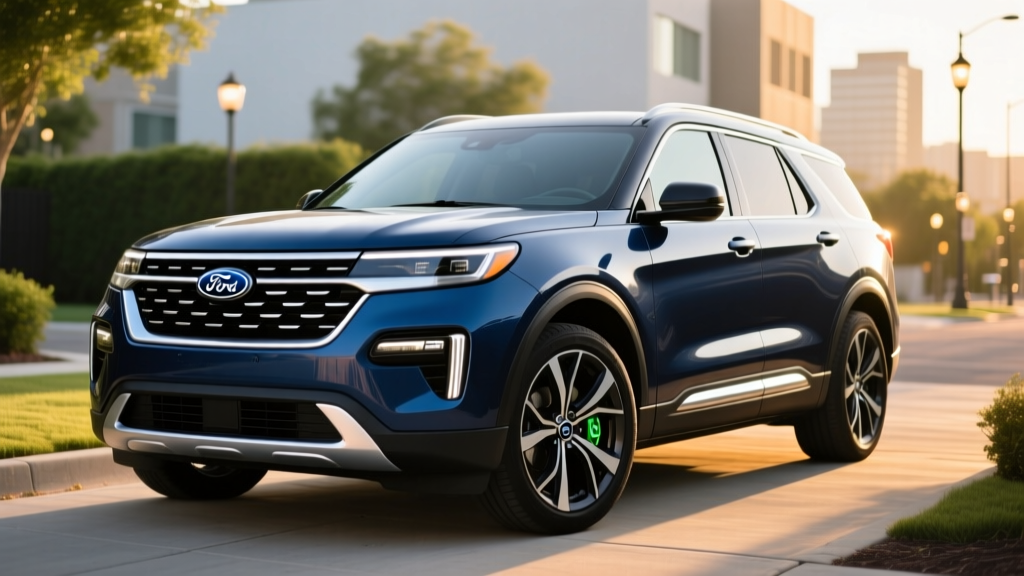
If you need a three-row family hauler but aren't ready to commit to a full battery-electric vehicle, the 2026 Ford Explorer Hybrid occupies a practical middle ground. It pairs a turbocharged engine with an electric motor to deliver meaningful fuel savings over the gas-only Explorer — without ever needing a plug. The headline question for most shoppers: how many MPG does the Ford Explorer Hybrid actually get?
The EPA rates the 2026 Ford Explorer Hybrid at 28 MPG combined (27 city / 28 highway) in rear-wheel-drive form. The all-wheel-drive variant drops slightly to 26 MPG combined (23 city / 28 highway), according to fueleconomy.gov. That's a roughly 30-35% improvement over the gas-only Explorer's 21 MPG combined — and it translates to roughly 450-500 miles of total range per tank.
HEV vs. PHEV: The Explorer Is a Conventional Hybrid — Here's What That Means
Ford currently offers the Explorer Hybrid as a conventional hybrid electric vehicle (HEV), not a plug-in hybrid (PHEV). This is a critical distinction that confuses many shoppers, so let's break it down clearly.
| Feature | Explorer Hybrid (HEV) | Typical PHEV (e.g., RAV4 Prime) |
|---|---|---|
| Plug-in charging? | No — charges itself via engine & regen | Yes — plug in to access electric-only range |
| Electric-only range | ~1-2 miles at low speeds only | 25-42 miles typical |
| Battery size | ~1.5 kWh (small, self-charging) | 13-18 kWh |
| Federal tax credit | Not eligible (§30D requires plug-in) | Up to $7,500 if sourcing/income rules met |
| Driving experience | Seamless gas-like, better MPG | EV-like daily commute, gas for road trips |
The Explorer Hybrid's small battery charges automatically through regenerative braking and the gasoline engine. You never plug it in, and there's no meaningful electric-only driving range. If you want 30+ miles of electric commuting before the engine kicks in, you'd need to look at a PHEV like the Toyota Grand Highlander Hybrid (PHEV variant expected) or shift to a full BEV like the Ford Explorer EV (sold in Europe, not currently available in the U.S.).
Powertrain Specs: What Powers the Explorer Hybrid
The 2026 Explorer Hybrid uses Ford's 3.3-liter V6 hybrid powertrain, pairing a naturally aspirated V6 with a permanent-magnet electric motor integrated into the transmission housing.
| Specification | 2026 Ford Explorer Hybrid |
|---|---|
| Engine | 3.3L V6 naturally aspirated |
| Combined Horsepower | 318 HP (engine + electric motor) |
| Electric Motor | Permanent-magnet AC synchronous, ~47 HP |
| Transmission | 10-speed automatic (modular hybrid) |
| Drivetrain | RWD standard, AWD available |
| Hybrid Battery | ~1.5 kWh lithium-ion (self-charging) |
| Fuel Tank | 18.0 gallons |
| Total Range | ~500 miles (RWD) / ~470 miles (AWD) |
| Towing Capacity | 5,000 lbs (properly equipped) |
| Seating | 6 or 7 passengers |
The 318 combined horsepower figure is competitive with the Explorer's 2.3L EcoBoost four-cylinder (300 HP) and delivers noticeably smoother acceleration from stops, where the electric motor provides instant torque fill before the V6 spools up. The 0-60 MPH time lands around 7.2 seconds — adequate for a 4,800-pound three-row SUV.
EPA Fuel Economy Breakdown: City, Highway, and Combined
| Drivetrain | City MPG | Highway MPG | Combined MPG |
|---|---|---|---|
| RWD Hybrid | 27 | 28 | 28 |
| AWD Hybrid | 23 | 28 | 26 |
| Gas-Only Explorer (2.3L EcoBoost AWD) | 20 | 27 | 22 |
The AWD hybrid's city MPG drops to 23 because the mechanical AWD system adds parasitic drag at low speeds where regenerative braking can't fully compensate. Highway figures remain identical between RWD and AWD at 28 MPG, since aerodynamic drag dominates and the AWD system disconnects under steady-state cruising.
Compared to the gas-only Explorer with the 2.3L EcoBoost and AWD (22 MPG combined), the hybrid saves roughly 4-6 gallons per 100 miles driven. At $3.40/gallon (2026 national average), that's approximately $600-$800 in annual fuel savings for a driver covering 15,000 miles per year.
Pricing, Trims, and Tax Credit Eligibility
The 2026 Ford Explorer Hybrid is available exclusively in the Limited trim level, which positions it as the premium offering in the Explorer lineup.
- Explorer Hybrid Limited RWD: ~$56,250 MSRP (including destination)
- Explorer Hybrid Limited AWD: ~$58,250 MSRP (including destination)
The hybrid powertrain commands a premium of roughly $3,000-$4,000 over an equivalently equipped gas-only Explorer Limited. At the fuel savings calculated above, the hybrid premium pays for itself in approximately 4-5 years of average driving — shorter if you do mostly city miles.
Battery Warranty, Lifespan, and Replacement Costs
Hybrid battery longevity is the single most common concern among first-time hybrid buyers. Here's the reality: modern hybrid batteries are engineered to last the life of the vehicle, and Ford backs that claim with strong warranty coverage.
• Duration: 8 years / 100,000 miles (whichever comes first)
• Coverage: Defects and capacity loss below a defined threshold
• California & CARB states: Extended to 10 years / 150,000 miles under emissions warranty requirements
• Transferable: Yes — warranty transfers to subsequent owners at no cost
The Explorer Hybrid's lithium-ion battery pack is relatively small (~1.5 kWh) and operates within a conservative state-of-charge window — it never fully charges or fully depletes. This shallow cycling dramatically reduces degradation compared to a full EV battery that regularly cycles between 10-90%.
Real-world longevity data: Ford's hybrid system (shared with the F-150 PowerBoost and Maverick Hybrid) has demonstrated strong durability in fleet and taxi service. Toyota's hybrid systems, the segment benchmark, routinely exceed 200,000 miles without battery replacement. There is no widespread pattern of premature hybrid battery failure in the Explorer Hybrid.
Out-of-warranty replacement cost: If the hybrid battery does require replacement beyond the warranty period, expect to pay $2,000-$4,000 for a new OEM battery pack plus installation. Refurbished units are available for $1,200-$2,000. This is significantly cheaper than a full EV battery replacement ($8,000-$20,000+) because the hybrid battery is small.
Who Should Buy the Explorer Hybrid — and Who Shouldn't
✓ Choose the Explorer Hybrid If:
- You need three rows and 5,000-lb towing without going full electric
- Your driving is 60%+ city/suburban where hybrid MPG shines
- You lack home charging access (apartment, street parking)
- You want a simpler ownership experience — no plugs, no charging apps
- You plan to keep the SUV 5+ years to recoup the hybrid premium
✗ Look Elsewhere If:
- You want electric-only commuting — you need a PHEV or BEV
- You do mostly highway miles (the MPG advantage shrinks at 75+ MPH)
- Budget is tight — the hybrid Limited trim starts above $56,000
- You want the maximum federal tax credit — only PHEVs/BEVs qualify
- You prefer a smaller SUV — the hybrid system adds ~150 lbs
Hybrid vs. PHEV vs. Full EV: Which Fits Your Life?
| Scenario | Best Choice | Why |
|---|---|---|
| No home charging, city-heavy commute | HEV (Explorer Hybrid) | Self-charging, best city MPG, no infrastructure needed |
| Home Level 2 charger, 30-mile daily commute | PHEV | Electric-only daily driving, gas engine for road trips |
| Home charging + under 250-mile daily driving | Full BEV | Lowest per-mile cost, $7,500 credit, minimal maintenance |
| Frequent 400+ mile road trips, towing | HEV or PHEV | No charging stops, gas station convenience, tow capacity |
Frequently Asked Questions
How many MPG does the 2026 Ford Explorer Hybrid get?
The EPA rates the Explorer Hybrid at 28 MPG combined (27 city / 28 highway) with rear-wheel drive, and 26 MPG combined (23 city / 28 highway) with all-wheel drive. In real-world city driving with frequent stops, many owners report 29-31 MPG thanks to aggressive regenerative braking. Highway-only trips at 75+ MPH typically yield 25-27 MPG.
Does the Ford Explorer Hybrid need to be plugged in?
No. The Explorer Hybrid is a conventional (self-charging) hybrid. Its small battery recharges automatically through regenerative braking and the gasoline engine. There is no charging port, no plug, and no electric-only driving range beyond brief low-speed maneuvers.
Does the Explorer Hybrid qualify for any tax credit?
The Explorer Hybrid does not qualify for the federal §30D Clean Vehicle Credit because it is a conventional hybrid without plug-in capability. The federal credit requires a minimum 7 kWh battery and the ability to charge from an external source. Some states may offer minor incentives for hybrids — check your state energy office.
How long will the Explorer Hybrid battery last?
Ford warranties the hybrid battery for 8 years/100,000 miles (10 years/150,000 miles in CARB states). In practice, modern hybrid batteries routinely last 150,000-200,000+ miles because they operate in a shallow charge cycle — never fully depleted, never fully charged. Out-of-warranty replacement costs $2,000-$4,000 if ever needed.
Is the Explorer Hybrid worth the premium over the gas model?
If you drive 15,000+ miles per year with significant city/suburban driving, the hybrid's $3,000-$4,000 premium typically pays for itself in 4-5 years through fuel savings. Beyond the math, you get smoother stop-start behavior, quieter low-speed operation, and reduced brake wear from regenerative braking. If your driving is mostly highway or your annual mileage is under 10,000, the payback period extends and the premium is harder to justify purely on economics.
Can I get the Explorer Hybrid with all-wheel drive?
Yes. The Explorer Hybrid is available in both RWD and AWD configurations. The AWD version sacrifices about 2 MPG combined (26 vs. 28) and adds approximately $2,000 to the MSRP. For buyers in snow-belt states, the AWD hybrid offers the best combination of traction and fuel efficiency in the Explorer lineup.