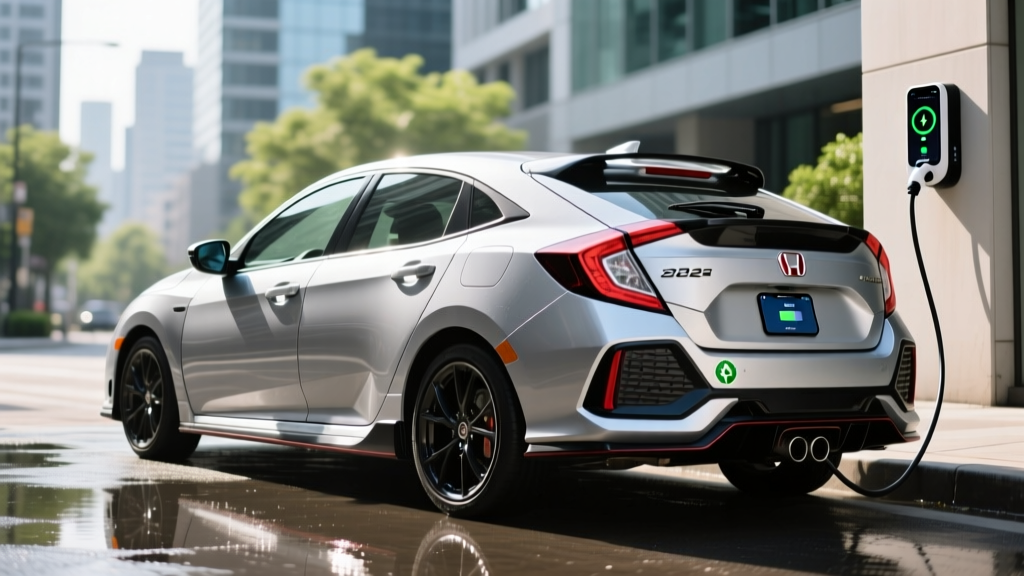
The 2026 Honda Civic Hybrid Sport Touring Hatchback occupies a specific niche: it delivers hybrid fuel economy without requiring a plug, adds meaningful cargo versatility over the sedan, and packages it all in Honda's most feature-rich trim. For buyers weighing electrification but lacking home charging access, this conventional hybrid (HEV) eliminates the behavioral changes a plug-in hybrid (PHEV) or battery-electric vehicle (BEV) demands while still cutting fuel consumption roughly in half compared to a gas-only compact.
This guide covers the exact specs, real-world MPG expectations, powertrain details, battery longevity, pricing, and tax-credit eligibility you need to decide whether this is the right electrified vehicle for your situation — or whether a PHEV or full EV serves you better.
HEV vs PHEV: What the Civic Hybrid Actually Is
Before examining the numbers, it's essential to classify this vehicle correctly. The 2026 Civic Hybrid is a conventional hybrid electric vehicle (HEV). It has no plug, no electric-only driving mode of meaningful distance, and no external charging capability. Its small lithium-ion battery recharges exclusively through regenerative braking and the gasoline engine.
| Attribute | HEV (Civic Hybrid) | PHEV (e.g., Toyota Prius Prime) | BEV (e.g., Chevy Bolt EV) |
|---|---|---|---|
| Plug-in charging | No | Yes | Yes |
| Electric-only range | ~1 mi at low speed | 25–45 mi typical | 200–350+ mi |
| Battery size | ~1.0 kWh | 10–18 kWh | 50–100+ kWh |
| Fuel required | Yes (regular unleaded) | Yes (regular unleaded) | No |
| Home charger needed | No | Recommended (Level 2) | Essential (Level 2) |
| Federal tax credit (§30D) | Not eligible | Up to $7,500 (if qualified) | Up to $7,500 (if qualified) |
The distinction matters because many shoppers say "hybrid" when they mean "plug-in." If you want 30+ miles of electric-only commuting before the engine starts, you need a PHEV, not this car. If you want maximum simplicity — fill up with gas and drive — the Civic Hybrid HEV delivers that with dramatically better efficiency than a gas-only Civic.
Fuel Economy: EPA Ratings and Real-World MPG
The 2026 Honda Civic Hybrid Sport Touring Hatchback carries an EPA-estimated 50 MPG combined, with a city/highway split of 50 city / 47 highway according to fueleconomy.gov. This represents the top-tier efficiency for the Civic lineup and matches some of the best non-plug-in vehicles on the market.
| Driving Condition | EPA Estimate | Real-World Expectation |
|---|---|---|
| City | 50 MPG | 48–54 MPG (hybrids often exceed EPA in stop-and-go) |
| Highway (65–70 mph) | 47 MPG | 42–46 MPG (aero drag, sustained speed reduces regen benefit) |
| Combined | 50 MPG | 46–50 MPG |
| Cold weather (below 32°F) | — | 40–45 MPG (engine runs more for cabin heat, battery less efficient) |
| Aggressive/hilly driving | — | 38–43 MPG |
Why hybrids often beat EPA in the city: The EPA city test cycle includes frequent stops and low-speed driving — exactly where the Civic Hybrid's two-motor system shines. The electric motor handles launch and low-speed cruising, the engine shuts off at stops, and regenerative braking recaptures energy that a gas car wastes as heat. On the highway, however, the engine must run continuously to maintain speed, and aerodynamic drag dominates, reducing the hybrid advantage.
Over a 12.4-gallon fuel tank, the EPA combined rating translates to approximately 620 miles of total range — enough for most drivers to go two weeks between fill-ups.
Powertrain and Performance Specs
The 2026 Civic Hybrid uses Honda's fourth-generation two-motor hybrid system, pairing a 2.0-liter Atkinson-cycle four-cylinder engine with two electric motors and a lithium-ion battery pack. Unlike Toyota's planetary-gear hybrid system, Honda's setup uses a clutch-based arrangement where the engine primarily acts as a generator at lower speeds and connects directly to the wheels only at highway cruising.
| Specification | 2026 Civic Hybrid Sport Touring Hatchback |
|---|---|
| Engine | 2.0L Atkinson-cycle DOHC 4-cylinder |
| Combined system output | 200 hp / 232 lb-ft torque |
| Electric motors | Two (one propulsion, one generator) |
| Transmission | Electronic continuously variable (e-CVT) |
| Drivetrain | Front-wheel drive |
| 0–60 mph | ~7.3 seconds (estimated) |
| Battery type | Lithium-ion (~1.0 kWh) |
| Fuel type | Regular unleaded (87 octane) |
| Fuel tank capacity | 12.4 gallons |
| Cargo volume (rear seats up) | 25.0 cu ft |
| Cargo volume (rear seats folded) | ~46 cu ft |
The 200-horsepower combined output makes the Civic Hybrid meaningfully quicker than the non-hybrid Civic's 158-hp 2.0L engine. The electric motor's instant torque delivery gives strong off-the-line acceleration, and the system seamlessly blends engine and motor power. The e-CVT avoids the rubber-band feeling of older CVTs because Honda's system uses fixed-ratio engine engagement at highway speeds.
Sport Touring Trim: Features and Pricing
The Sport Touring sits at the top of the Civic Hybrid Hatchback lineup. For 2026, Honda includes the following as standard equipment on this trim:
- Honda Sensing suite (adaptive cruise control, lane-keeping assist, collision mitigation braking, traffic sign recognition)
- 9-inch touchscreen with wireless Apple CarPlay and Android Auto
- Bose 12-speaker premium audio system
- Wireless phone charging pad
- Heated front seats and heated steering wheel
- Leather-trimmed seats
- Power moonroof
- LED headlights with auto high-beam
- Smart entry with walk-away auto lock
- Blind-spot information system with cross-traffic monitor
- Low-speed braking control and front/rear parking sensors
| Pricing | Amount |
|---|---|
| MSRP (Sport Touring Hybrid Hatchback) | ~$32,850 (including destination) |
| Federal tax credit (§30D) | $0 — not eligible |
| Estimated out-the-door (varies by state/dealer) | $34,500–$36,500 |
Tax credit reality: The 2026 Civic Hybrid does not qualify for the federal IRS §30D clean vehicle credit. That credit requires a plug-in electric vehicle (PHEV or BEV) with a battery capacity of at least 7 kWh. The Civic Hybrid's ~1.0 kWh battery falls far short. Some states offer separate hybrid incentives — check your state energy office or utility company — but at the federal level, there is no tax benefit for choosing this HEV over a gas-only Civic.
Hybrid Battery Warranty
Honda covers the Civic Hybrid's lithium-ion battery pack for 8 years or 100,000 miles (whichever comes first) under the hybrid system warranty. In states that follow California Air Resources Board (CARB) emissions standards — including CA, NY, NJ, MA, WA, OR, CT, RI, VT, ME, CO, and others — the hybrid battery warranty extends to 10 years or 150,000 miles.
Battery replacement cost: If the hybrid battery fails outside warranty, replacement typically runs $2,000–$3,500 including labor at a Honda dealer. However, hybrid battery failure before 150,000+ miles is uncommon based on historical data from Honda's hybrid systems. Many first-generation Insight and Civic Hybrid batteries lasted well beyond 200,000 miles.
Hybrid vs PHEV vs EV: Which Fits Your Life?
The Civic Hybrid Sport Touring Hatchback makes sense for a specific buyer profile. Here's a practical decision framework:
Choose the Civic Hybrid (HEV) if:
- You lack access to home or workplace charging (apartment, street parking, no garage)
- You want better fuel economy without changing any driving or refueling habits
- You take frequent road trips and don't want to plan around charging stops
- You want a lower purchase price than a comparable BEV or PHEV
- You live in an area with limited public charging infrastructure
Choose a PHEV (e.g., Toyota Prius Prime) if:
- You can install a Level 2 charger at home and have a short commute (<40 miles round trip)
- You want electric-only daily driving but gas flexibility for road trips
- You want to qualify for the federal tax credit (up to $7,500 on eligible models)
Choose a full BEV (e.g., Chevy Equinox EV, Hyundai Ioniq 5) if:
- You have reliable home Level 2 charging
- Your daily driving is under 200 miles and you road-trip fewer than 5 times a year
- You want the lowest per-mile fuel cost and minimal maintenance
- You want to maximize federal and state incentives
The fundamental trade-off is convenience versus cost savings. The Civic Hybrid asks nothing of you behaviorally — drive it like any gas car — and rewards you with roughly half the fuel consumption. A PHEV or BEV demands charging infrastructure but delivers lower operating costs and, in the PHEV/BEV case, potential tax-credit savings that can offset a higher sticker price.
Reliability, Ownership Costs, and Long-Term Outlook
Honda's hybrid powertrain has matured through multiple generations, and the two-motor system used in the current Civic Hybrid has been deployed in the Accord Hybrid and CR-V Hybrid since 2023 with no widespread reliability concerns. The system has fewer wear components than a conventional automatic transmission — no torque converter, no multi-speed gearbox, no traditional starter motor.
Maintenance advantages over gas-only Civic:
- Regenerative braking reduces brake pad wear (many hybrid owners report 80,000+ miles on original pads)
- No conventional starter motor to replace
- Engine runs less at idle and low speed, potentially extending oil life
- Honda still recommends standard maintenance intervals (oil changes at ~7,500 miles with synthetic)
Insurance considerations: Hybrid vehicles typically carry insurance premiums 5–10% higher than their gas counterparts due to higher repair costs for the hybrid-specific components. However, the difference is much smaller than the premium gap for full BEVs. Get quotes from your insurer before purchasing.
Resale value: Honda Civics historically hold value well, and hybrid variants have seen strong demand as fuel prices fluctuate. The hatchback body style adds a resale premium over the sedan for cargo versatility. Expect 5-year depreciation in the 35–45% range based on historical Civic Hybrid trends.
Pros and Cons at a Glance
Pros
- 50 MPG combined EPA — real-world city driving can exceed this
- 200 hp with strong low-end electric torque
- No plug required — zero behavior change from a gas car
- 25 cu ft cargo with hatchback versatility
- Sport Touring trim is fully loaded at ~$32,850
- 8-year/100,000-mile hybrid battery warranty (10 yr/150k in CARB states)
- Honda Sensing ADAS suite standard
Cons
- No federal tax credit eligibility (HEV, not PHEV/BEV)
- No electric-only driving mode for zero-emission commuting
- FWD only — no AWD option (available on CR-V Hybrid)
- e-CVT lacks the engagement of a geared transmission
- Highway MPG drops to low 40s at sustained 75+ mph
- Cold-weather efficiency loss of 10–15% is typical
Frequently Asked Questions
How many MPG does the 2026 Civic Hybrid Hatchback get?
The EPA rates the 2026 Honda Civic Hybrid Sport Touring Hatchback at 50 MPG city, 47 MPG highway, and 50 MPG combined. In real-world city driving with frequent stops, many owners report 48–54 MPG. Highway driving at 70+ mph typically yields 42–46 MPG. Cold weather reduces efficiency by 10–15% due to increased engine run time for cabin heating.
Does the Civic Hybrid need to be plugged in?
No. The 2026 Civic Hybrid is a conventional hybrid (HEV), not a plug-in hybrid (PHEV). Its battery charges entirely through regenerative braking and the gasoline engine. You refuel it exclusively at gas stations with regular 87-octane unleaded fuel.
Does the 2026 Civic Hybrid qualify for any tax credit?
The federal §30D clean vehicle credit does not apply to conventional hybrids like the Civic Hybrid — it requires a plug-in vehicle with at least 7 kWh of battery capacity. Some states, local utilities, or municipalities may offer separate incentives for hybrid vehicles, but these vary widely. Check your state energy office and local utility for current programs. Consult a tax professional for advice specific to your situation.
How long will the Civic Hybrid battery last?
Honda warrants the hybrid battery for 8 years/100,000 miles (10 years/150,000 miles in CARB states). Based on data from previous-generation Honda hybrid systems, most batteries last well beyond the warranty period. Replacement cost outside warranty is typically $2,000–$3,500. Hybrid battery degradation in Honda's system is gradual — you may notice slightly reduced electric-only assist at very high mileages (150,000+), but complete failure before 200,000 miles is uncommon.
Is the Civic Hybrid Hatchback better than the sedan?
The hybrid powertrain and MPG ratings are essentially identical between the Civic Hybrid Sedan and Hatchback. The hatchback adds approximately 10 cu ft of maximum cargo space with the rear seats folded and offers a wider rear opening for loading bulky items. If you regularly carry cargo, pets, or gear, the hatchback justifies its modest price premium. If you primarily carry passengers and small items, the sedan offers the same efficiency at a slightly lower price.
How does the Civic Hybrid compare to the Toyota Prius?
The Toyota Prius (also a conventional HEV in its base form) achieves an EPA-estimated 57 MPG combined — 7 MPG more than the Civic Hybrid. However, the Prius has less cargo space (in liftback form, about 20 cu ft behind the rear seats vs. 25 cu ft in the Civic Hatchback), a less powerful powertrain (196 hp combined), and a more polarizing design. The Civic Hybrid prioritizes driving dynamics and interior space; the Prius prioritizes maximum efficiency. Both are excellent choices in the segment.
Can the Civic Hybrid run on electric power alone?
Only briefly and at very low speeds (under ~25 mph for short distances, such as creeping through a parking lot). The battery is too small (~1.0 kWh) to sustain electric-only driving at meaningful speeds or distances. The engine starts automatically when more power is needed or when the battery depletes. This is normal for all conventional hybrids — if you want substantial electric-only range, you need a PHEV with a larger battery.