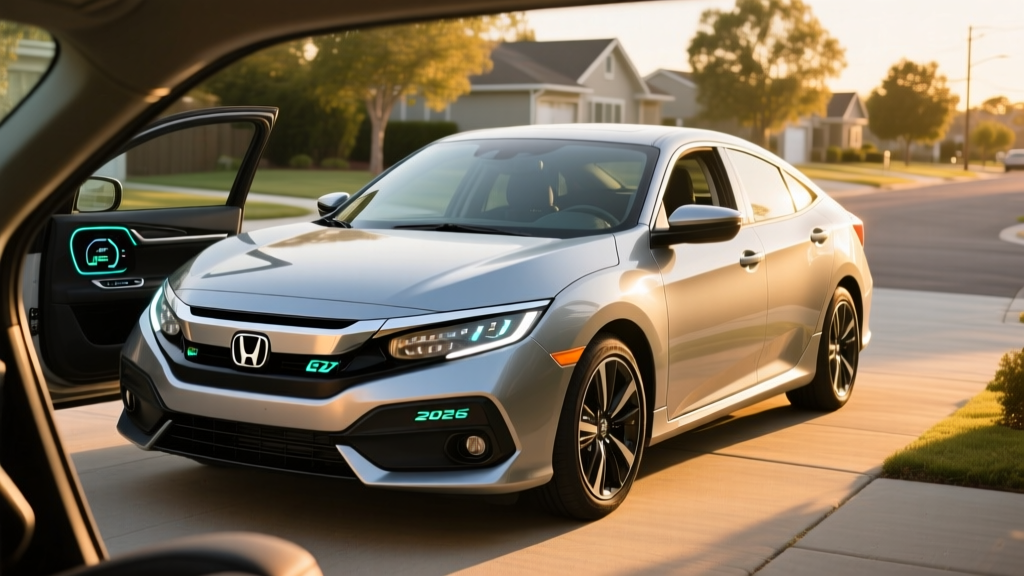
The 2026 Honda Civic Hybrid Sedan occupies a specific niche in the electrified-vehicle market: it requires zero behavioral change from its owner. No plug, no charging app, no route planning around DC fast chargers. You fill it with gas and drive. In exchange, Honda's two-motor hybrid system delivers an EPA-estimated 49 MPG combined, 200 horsepower, and a starting price that undercuts many conventional gas compacts once you factor in fuel savings over time.
This guide breaks down everything a prospective buyer needs — from real-world MPG expectations and powertrain architecture to battery warranty coverage and how the Civic Hybrid stacks up against plug-in hybrids and full battery-electric vehicles.
HEV vs. PHEV: What the 2026 Civic Hybrid Actually Is
Before examining specs, it's critical to establish what the 2026 Honda Civic Hybrid is not: it is not a plug-in hybrid (PHEV). It is a conventional hybrid electric vehicle (HEV). This distinction drives every ownership expectation.
HEV vs. PHEV at a Glance
| Feature | HEV (Civic Hybrid) | PHEV (e.g., Toyota Prius Prime) |
|---|---|---|
| Plug-in charging required? | No — never plugs in | Yes — for electric-only range |
| Electric-only range | ~1 mile at low speed | 25–45 miles typical |
| Battery size | ~1.1 kWh (small buffer) | 10–14 kWh |
| Federal tax credit (§30D) | Not eligible | Up to $7,500 if eligible |
| Home charger needed? | No | Recommended (Level 2) |
The Civic Hybrid recovers energy through regenerative braking and engine-driven generation. Its small battery acts as a buffer, not a primary energy source.
If you have reliable access to home or workplace charging and a commute under 40 miles, a PHEV may offer greater fuel savings. If you live in an apartment, street-park, or simply don't want to think about charging infrastructure, the HEV architecture of the Civic Hybrid removes that friction entirely.
Fuel Economy: EPA Ratings and Real-World MPG
The 2026 Honda Civic Hybrid Sedan carries EPA estimates of 50 MPG city / 47 MPG highway / 49 MPG combined for the Sport Touring Hybrid trim with its standard 18-inch wheels. The Sport Hybrid trim shares these figures. Honda's two-motor system is optimized for city driving, where the electric motor handles most low-speed propulsion while the 2.0-liter Atkinson-cycle engine operates primarily as a generator.
| Driving Cycle | EPA Estimate | Real-World Expectation |
|---|---|---|
| City | 50 MPG | 48–53 MPG (hybrids often beat EPA in city) |
| Highway | 47 MPG | 42–46 MPG (sustained 75+ mph reduces regen benefit) |
| Combined | 49 MPG | 45–50 MPG (varies with driving mix) |
| Cold weather (below 32°F) | N/A | 38–44 MPG (engine runs more for cabin heat) |
Why real-world MPG varies: Hybrids like the Civic excel in stop-and-go traffic where regenerative braking recaptures energy that a gas car wastes as heat. On sustained highway runs at 75–80 mph, the engine does more direct propulsion and the electric motor's advantage narrows. In winter, the gasoline engine must run continuously to provide cabin heat (unlike an EV with a heat pump), which drops fuel economy noticeably on short trips.
For context, the non-hybrid 2026 Civic with the 2.0L engine rates at 31/40/34 MPG (city/highway/combined) per fueleconomy.gov. The hybrid nearly halves fuel consumption in city driving.
Powertrain and Performance Specs
Honda's fourth-generation two-motor hybrid system pairs a 2.0-liter direct-injected Atkinson-cycle four-cylinder engine with two electric motors — one primarily for propulsion, one primarily as a generator/starter. The system prioritizes electric drive in most conditions below highway speed, with the engine engaging a lock-up clutch for direct mechanical drive only at steady cruising speeds where it's most efficient.
| Specification | Value |
|---|---|
| Combined system horsepower | 200 hp |
| Combined system torque | 232 lb-ft |
| Engine | 2.0L Atkinson-cycle I4, 143 hp / 134 lb-ft |
| Propulsion motor | 174 hp / 232 lb-ft (peak) |
| Battery capacity | ~1.1 kWh (lithium-ion, not plug-in) |
| 0–60 mph (est.) | ~7.1 seconds |
| Drivetrain | Front-wheel drive (FWD) |
| Transmission | e-CVT (single-speed direct drive + engine clutch) |
| Fuel tank | 12.4 gallons |
| Total driving range | ~607 miles (EPA combined) |
| Cargo volume | 14.8 cu ft (trunk) |
The 232 lb-ft of electric motor torque gives the Civic Hybrid strong off-the-line acceleration that makes it feel quicker than its 0–60 time suggests. In everyday driving, the instant torque fill from the propulsion motor masks the engine's modest 143-hp output. The system seamlessly transitions between EV drive (battery-only, low speeds), hybrid drive (engine generates electricity for the motor), and engine drive (clutch engaged at highway cruise).
Pricing, Trims, and Tax Credit Eligibility
The 2026 Civic Hybrid is offered in two trims. Pricing below includes Honda's destination charge:
- Sport Hybrid: ~$30,750 MSRP (includes destination)
- Sport Touring Hybrid: ~$33,750 MSRP (includes destination)
The Sport Touring adds a Bose 12-speaker audio system, wireless phone charging, a 9-inch touchscreen with wireless Apple CarPlay/Android Auto, heated rear seats, and low-speed braking control. Both trims include Honda Sensing (adaptive cruise control, lane-keeping assist, collision mitigation braking) as standard equipment.
Federal Tax Credit: Not Eligible
The 2026 Honda Civic Hybrid is a conventional HEV and does not qualify for the IRS §30D Clean Vehicle Credit (up to $7,500). That credit applies only to plug-in electric vehicles (BEVs and PHEVs) meeting battery sourcing, MSRP caps, and buyer income requirements per irs.gov.
Some states may offer modest rebates for conventional hybrids, but these vary by jurisdiction and change frequently. Check your state energy office or the AFDC state incentive database for current local programs.
Despite the lack of a federal credit, the Civic Hybrid's value proposition rests on fuel savings. At $3.30/gallon and 12,000 miles/year, a driver averaging 49 MPG spends roughly $808/year on fuel versus $1,255/year in the non-hybrid Civic (34 MPG combined) — a savings of approximately $447/year, or $2,235 over five years.
Battery Warranty, Reliability, and Replacement Cost
Hybrid Battery Warranty
Coverage: 8 years / 100,000 miles (10 years / 150,000 miles in CARB states including CA, CO, CT, ME, MD, MA, NJ, NY, OR, RI, VT, WA)
What's covered: Defects and capacity loss below a functional threshold that impairs hybrid system operation
Replacement cost (out of warranty): $2,000–$4,000 for the hybrid battery pack, plus ~$500–$800 labor
Honda's hybrid systems have demonstrated strong long-term reliability. The Civic Hybrid's lithium-ion battery pack is small (~1.1 kWh) and operates within a narrow state-of-charge window — Honda's battery management system never fully charges or fully depletes it, which significantly reduces degradation stress. This is fundamentally different from a full EV battery that cycles through a much wider range daily.
Real-world longevity data: Honda's hybrid battery packs in the Accord Hybrid and CR-V Hybrid have shown minimal capacity loss at 150,000+ miles in fleet and owner reports. The small buffer battery in the Civic Hybrid operates under even less stress than those larger packs. Out-of-warranty replacement is unlikely for most original owners, but the $2,000–$4,000 range is worth noting for second-hand buyers or high-mileage drivers.
The broader powertrain — engine, electric motors, e-CVT — carries Honda's standard 5-year/60,000-mile powertrain warranty. The e-CVT has no belts, bands, or traditional friction components and has proven durable in Honda's hybrid lineup.
Who Should Choose the Civic Hybrid vs. a PHEV or Full EV?
Pros
- 49 MPG combined with zero lifestyle change — no plug, no apps
- 200 hp and 232 lb-ft torque — genuinely quick for a compact sedan
- 607-mile total range eliminates any refueling concern
- Strong city MPG where most commuters spend their time
- Honda Sensing safety suite standard on every trim
- Proven hybrid reliability with robust 8–10 year battery warranty
Cons
- No federal tax credit (unlike qualifying PHEVs/BEVs)
- FWD only — no AWD option for snow-belt buyers
- Highway MPG drops to 42–46 at sustained 75+ mph
- Cold-weather fuel economy penalty on short trips (engine runs for heat)
- Only two trims available — limited customization
- No electric-only commuting capability
Decision Framework: Civic Hybrid vs. PHEV vs. BEV
Choose the Civic Hybrid (HEV) if:
- You lack access to home or workplace charging (apartment, street parking)
- You want maximum fuel efficiency with zero plug-in routine
- Your budget is under $35,000 and you don't qualify for or want to navigate EV tax credits
- You regularly take road trips exceeding 300 miles and don't want to plan charging stops
Choose a PHEV (e.g., Toyota Prius Prime) if:
- You have home Level 2 charging and a commute under 40 miles
- You want electric-only daily driving with a gas backup for longer trips
- You qualify for the §30D credit (income under $150K single / $300K joint; vehicle under $55K MSRP)
Choose a full EV (e.g., Chevy Equinox EV, Tesla Model 3) if:
- You have reliable home charging and want to eliminate gas entirely
- Your daily driving is under 250 miles and you can plan around DC fast charging for road trips
- You want the lowest per-mile fuel cost (~$0.04–$0.06/mile on home electricity vs. ~$0.07/mile in the Civic Hybrid at $3.30/gal)
Ownership Costs Over 5 Years
| Category | Civic Hybrid | Civic Gas (2.0L) |
|---|---|---|
| Fuel cost (60K mi) | ~$4,040 | ~$6,275 |
| Maintenance (oil, filters, brakes) | ~$2,200 | ~$2,800 |
| Insurance (avg.) | ~$7,500 | ~$7,200 |
| Purchase price (Sport Touring) | ~$33,750 | ~$30,550 |
| 5-year total (before depreciation) | ~$47,490 | ~$46,825 |
The Civic Hybrid's fuel savings of ~$2,235 over five years nearly offsets its ~$3,200 price premium over an equivalently equipped gas Civic. The break-even point arrives around year six for most drivers. Factor in reduced brake wear (regenerative braking extends pad life significantly) and the hybrid pulls slightly ahead for long-term owners.
Frequently Asked Questions
How many MPG does the 2026 Honda Civic Hybrid get?
The EPA rates the 2026 Civic Hybrid at 50 MPG city, 47 MPG highway, and 49 MPG combined. In real-world mixed driving, expect 45–50 MPG. City-heavy commutes may exceed 50 MPG thanks to generous regenerative braking, while sustained highway driving at 75+ mph typically returns 42–46 MPG. Cold weather below freezing can drop short-trip economy to 38–44 MPG as the engine runs more frequently for cabin heat.
Does the Civic Hybrid need to be plugged in?
No. The 2026 Civic Hybrid is a conventional HEV, not a plug-in hybrid. It charges its small battery exclusively through regenerative braking and engine-driven generation. You never plug it in — you simply refuel at any gas station. The total range on a single 12.4-gallon tank is approximately 607 miles.
Is the 2026 Civic Hybrid reliable, and what does battery replacement cost?
Honda's hybrid systems have a strong reliability track record across the Accord Hybrid, CR-V Hybrid, and now the Civic Hybrid. The lithium-ion battery pack is covered by an 8-year/100,000-mile warranty (10 years/150,000 miles in CARB states). Out-of-warranty replacement runs $2,000–$4,000 for the battery plus $500–$800 in labor, though most owners will never need this service. The small battery operates under minimal stress compared to full EV packs, which supports long service life.
Does the 2026 Civic Hybrid qualify for a federal tax credit?
No. The federal §30D Clean Vehicle Credit applies only to plug-in electric vehicles (battery-electric and plug-in hybrid). As a conventional hybrid, the Civic Hybrid is not eligible for the $7,500 federal credit or the $4,000 used-EV credit. Some states may offer small hybrid incentives — check the AFDC state laws database for your jurisdiction.
How does the Civic Hybrid compare to the Toyota Prius?
The 2026 Toyota Prius (LE AWD) rates at 57 MPG combined and starts around $29,000, giving it a fuel-economy edge. However, the Civic Hybrid offers 200 hp versus the Prius's 196 hp, a more conventional sedan trunk (14.8 cu ft vs. the Prius's hatchback), and Honda's interior quality and infotainment interface. The Prius also offers AWD, which the Civic Hybrid does not. If maximum MPG is your sole priority, the Prius wins. If driving dynamics, interior refinement, and trunk space matter, the Civic Hybrid is the stronger pick.
Is the Civic Hybrid available with all-wheel drive?
No. The 2026 Civic Hybrid is front-wheel drive only. If AWD is a priority for snow or wet-weather traction, consider the Toyota Prius AWD, Subaru Impreza (gas), or a compact AWD PHEV like the Toyota RAV4 Prime (SUV segment).
Sources: EPA fuel economy data via fueleconomy.gov; IRS §30D credit rules via irs.gov; Honda specifications via automobiles.honda.com. Pricing and incentive data reflects 2026 model year information available at time of publication. Verify current eligibility with a tax professional.