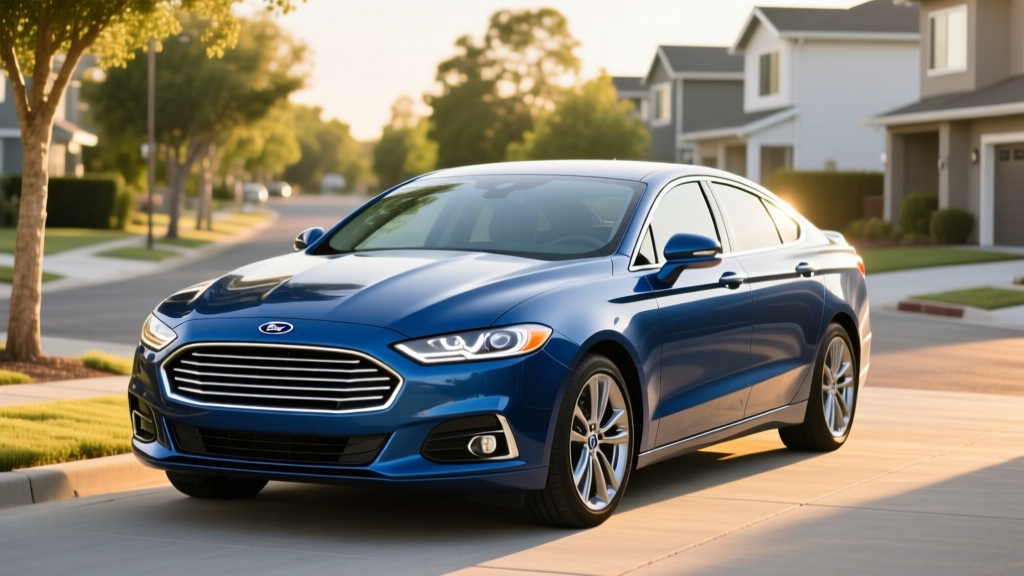
Quick Verdict: The 2020 Fusion Hybrid Titanium in 2026
Ford killed the Fusion after the 2020 model year, but the Titanium trim remains one of the most well-equipped midsize hybrid sedans on the used market. With an EPA-rated 44 MPG city / 41 MPG highway / 42 MPG combined, a proven Atkinson-cycle powertrain, and a premium interior that punches above its class, the 2020 Ford Fusion Hybrid Titanium is a compelling buy for commuters who want hybrid efficiency without plugging in — or worrying about range.
This is a conventional hybrid (HEV), not a plug-in hybrid (PHEV). You never plug it in. The gasoline engine and regenerative braking recharge the small traction battery automatically. If you were looking for the plug-in variant, that was the Fusion Energi, which Ford also discontinued after 2020. We'll clarify the differences below.
| Powertrain | 2.0L Atkinson-cycle I4 + electric motor |
| Combined Horsepower | 195 hp |
| EPA Fuel Economy | 44 city / 41 highway / 42 combined MPG |
| Traction Battery | 1.4 kWh lithium-ion |
| Drivetrain | FWD, eCVT |
| 0-60 mph | ~7.8 seconds |
| Battery Warranty | 8 years / 100,000 miles |
| Original MSRP (Titanium) | $34,595 |
| $16,000–$22,000 |
HEV vs. PHEV vs. EV: Where Does the Fusion Hybrid Fit?
Before diving into the numbers, it's worth clarifying exactly what you're buying — because the naming around Ford's electrified Fusions was confusing even when the car was new.
Conventional Hybrid (HEV)
This car. The Fusion Hybrid uses a small 1.4 kWh battery recharged by the engine and regen braking. No plug. No electric-only driving beyond brief low-speed assists. You just drive it like a normal car and it delivers ~42 MPG.
Plug-In Hybrid (PHEV)
The Fusion Energi (discontinued 2020) had a larger 9.0 kWh battery, ~25 miles of electric-only range, and a charge port. It qualified for a partial federal tax credit when new. No longer available new.
Full Electric (BEV)
Zero gasoline. Large battery (60-100+ kWh), 250-400 mile range, requires charging infrastructure. Examples: Tesla Model 3, Hyundai Ioniq 6, Ford Mustang Mach-E.
Who should choose the Fusion Hybrid over a PHEV or EV? Drivers who lack reliable home charging access, who take frequent long road trips where charging stops would be inconvenient, or who want a lower purchase price and minimal behavioral change. The HEV delivers most of the fuel savings of a PHEV for city commuters without any plug-in logistics.
Fuel Economy: EPA Ratings vs. Real-World MPG
The EPA rates the 2020 Ford Fusion Hybrid at 44 MPG city, 41 MPG highway, and 42 MPG combined (source: fueleconomy.gov). These numbers apply across all trims including the Titanium — the higher trim level adds weight from features like leather seats and a premium audio system, but not enough to change the EPA rating.
| Driving Cycle | EPA Rating | Real-World Expectation |
|---|---|---|
| City | 44 MPG | 44–48 MPG (hybrids often exceed EPA in stop-and-go) |
| Highway (70-80 mph) | 41 MPG | 37–40 MPG (aerodynamic drag dominates at speed) |
| Combined | 42 MPG | 40–44 MPG depending on driving mix |
| Cold Weather (below 30°F) | — | 35–39 MPG (engine runs more for cabin heat) |
Real-world note: Like most Toyota- and Ford-based hybrids using Atkinson-cycle engines, the Fusion Hybrid tends to exceed its EPA city rating in genuine stop-and-go traffic. The electric motor handles low-speed propulsion where gas engines are least efficient, and regenerative braking recaptures energy that would otherwise be lost as heat. Owner-reported averages on FuelEconomy.gov's My MPG tracker cluster around 40–44 MPG combined, validating the sticker.
Highway efficiency drops relative to city because the electric motor contributes less at sustained high speeds and the sedan's 0.27 drag coefficient can't fully overcome aerodynamic losses above 70 mph. In winter, expect a 5–8 MPG penalty as the engine runs more frequently to provide cabin heat and maintain battery temperature.
Powertrain Deep Dive: 195 HP Through an eCVT
The Fusion Hybrid pairs a 2.0-liter Atkinson-cycle four-cylinder engine (141 hp, 129 lb-ft) with a permanent-magnet synchronous electric motor (120 hp, 166 lb-ft) routed through Ford's eCVT — an electronically controlled continuously variable transmission that uses planetary gearsets rather than a belt or chain.
Combined system output is 195 horsepower. The 0-60 mph time sits around 7.8 seconds, which is adequate for merging and passing but won't feel quick compared to turbocharged competitors or any modern EV. The eCVT delivers seamless, shift-free acceleration — there are no gear changes to feel — but it also produces the characteristic "rubber band" drone under hard acceleration that some drivers find unrefined.
The 1.4 kWh lithium-ion traction battery is mounted behind the rear seats. It's small by modern standards — a contemporary PHEV uses 15-20 kWh, and a full EV uses 60-100 kWh — but an HEV battery doesn't need to store much energy. Its job is to buffer regenerative braking energy and provide brief electric-motor assists, not to drive the car independently for meaningful distances. The battery is air-cooled, which is simpler but means performance can degrade slightly on very hot days during sustained high-load driving.
What the Titanium Trim Actually Gets You
The Titanium was the top-of-line Fusion Hybrid trim for 2020, and at an original MSRP of $34,595 (before destination), it was well-equipped. Key standard equipment on the Titanium over the mid-level SEL:
- Leather-trimmed heated and ventilated front seats
- 12-speaker Sony premium audio system
- 8-inch SYNC 3 touchscreen with Apple CarPlay and Android Auto
- Navigation system
- Ambient interior lighting
- Auto-dimming rearview mirror
- Universal garage door opener
- 18-inch machine-finish aluminum wheels
- LED headlamps with auto high beams
Standard driver-assistance features across all Fusion Hybrid trims include Ford Co-Pilot360: automatic emergency braking with pedestrian detection, blind-spot monitoring, lane-keeping assist, and a rearview camera. The Titanium adds adaptive cruise control with stop-and-go, which functions as a basic Level 2 driver-assist system on highways — but requires continuous driver supervision and hand-on-wheel confirmation.
Battery Longevity, Warranty, and Replacement Cost
Ford covers the Fusion Hybrid's high-voltage battery and hybrid-specific components for 8 years or 100,000 miles (whichever comes first). In states that follow California Air Resources Board (CARB) emissions standards — including California, New York, Massachusetts, and several others — hybrid battery coverage extends to 10 years / 150,000 miles.
The warranty guarantees the battery will retain sufficient capacity to function as designed. Ford's threshold is generally 60% of original capacity during the warranty period.
Is the Fusion Hybrid reliable? The 2020 model year benefits from being the final production year of a platform that launched in 2013. By 2020, Ford had addressed most early-generation hybrid system issues. The 2.0L Atkinson-cycle engine is lightly stressed (it doesn't produce peak power often, since the electric motor shares the load), and the eCVT planetary gearset has no clutch packs or belts to wear out — making it inherently more durable than a conventional automatic or belt-driven CVT.
Real-world data from high-mileage Fusion Hybrid owners (including extensive taxi and rideshare fleets) shows the 1.4 kWh lithium-ion battery holding up well past 150,000 miles with minimal capacity loss. This is partly because the HEV battery operates in a narrow state-of-charge window — the car's computer never fully charges or fully depletes it, which dramatically reduces degradation compared to a full EV battery that cycles through deeper charge ranges.
Battery replacement cost: If the hybrid battery does fail outside of warranty, a new OEM replacement from Ford runs approximately $2,500–$3,500 for the battery pack itself, plus $500–$800 in labor. Third-party refurbished packs are available for $1,200–$2,000. This is far less than a full EV battery replacement, which can exceed $10,000–$20,000.
Tax Credits and Incentives: What Applies in 2026?
Federal tax credit: The 2020 Ford Fusion Hybrid does not qualify for the federal §30D new clean vehicle credit — that credit applies only to new plug-in vehicles (PHEVs and BEVs) with batteries of at least 7 kWh. The Fusion Hybrid's 1.4 kWh battery is far below the threshold, and as a conventional hybrid, it was never eligible for §30D even when sold new.
Used vehicle credit (§25E): If you purchase a used 2020 Fusion Hybrid from a dealer in 2026 for $25,000 or less, you may qualify for the Used Clean Vehicle Credit — up to $4,000 or 30% of the sale price, whichever is less. However, this credit requires the vehicle to be a qualified plug-in EV or fuel-cell vehicle. A conventional HEV like the Fusion Hybrid does not qualify for §25E either. Only the Fusion Energi (PHEV) would potentially qualify.
State incentives: A handful of states offer rebates or HOV-lane access for conventional hybrids, but these are increasingly rare as states redirect incentive funding toward plug-in vehicles. Check your state's energy office or DMV for current programs.
Who Should Buy the 2020 Fusion Hybrid Titanium in 2026?
✓ Choose This Car If…
- You commute in stop-and-go city traffic where hybrid MPG shines
- You don't have access to home or workplace charging
- You want a loaded midsize sedan for under $22,000
- You take regular road trips and don't want to plan around charging
- You value a quiet, comfortable ride over sporty handling
- You want proven reliability from a final-year production model
✗ Look Elsewhere If…
- You want plug-in electric-only driving (consider a used Fusion Energi, Prius Prime, or RAV4 Prime)
- You need AWD (the Fusion Hybrid is FWD only; look at the Toyota Camry Hybrid AWD or RAV4 Hybrid)
- You want the latest infotainment and driver-assist tech (2020 SYNC 3 is functional but dated)
- You prioritize brisk acceleration (7.8s 0-60 is adequate, not quick)
- You need more than 16 cu-ft of trunk space (the hybrid battery reduces cargo vs. gas Fusion)
For the right buyer, the 2020 Fusion Hybrid Titanium represents a sweet spot: a fully depreciated, well-equipped hybrid sedan with real-world 40+ MPG, low running costs, and a battery system with a strong reliability track record. At $16,000–$22,000 used in 2026, the total cost of ownership — factoring in fuel savings versus a comparable gas sedan — can make this one of the most economical daily drivers available.
Frequently Asked Questions
How many MPG does the 2020 Ford Fusion Hybrid get?
The EPA rates it at 44 city / 41 highway / 42 combined MPG. In real-world driving, owners typically report 40–44 MPG combined, with city driving sometimes exceeding 44 MPG thanks to regenerative braking and electric-motor assist at low speeds. Highway driving at 75+ mph will drop to 37–40 MPG.
Does the Fusion Hybrid need to be plugged in?
No. The 2020 Fusion Hybrid is a conventional HEV — it has no charge port. The battery recharges through the gasoline engine and regenerative braking. You fuel it like any other car at a gas station. If you want a Fusion that plugs in, you're looking for the Fusion Energi (PHEV), which was sold separately.
How far can the Fusion Hybrid drive on electric power alone?
Effectively zero miles in sustained electric-only mode. The 1.4 kWh battery is too small for meaningful EV driving. The electric motor assists the gas engine during acceleration and can propel the car at very low speeds (under ~25 mph) for brief distances in stop-and-go traffic, but the engine engages almost immediately under any meaningful load. This is by design — HEVs optimize for fuel efficiency through constant power-source blending, not electric-only range.
Is the 2020 Fusion Hybrid reliable?
Yes. The 2020 model year is the eighth and final year of the second-generation Fusion platform, and the hybrid powertrain had been refined across multiple model years. The eCVT is mechanically simpler than a conventional automatic. The lithium-ion hybrid battery operates in a narrow charge window, which promotes longevity. Fleet data from taxi and rideshare use shows these batteries lasting well beyond 150,000 miles. NHTSA gave the 2020 Fusion a 5-Star Overall Safety Rating.
What does a replacement hybrid battery cost?
An OEM replacement battery from Ford costs approximately $2,500–$3,500 for the part, plus $500–$800 in labor. Refurbished aftermarket packs are available for $1,200–$2,000. Given the strong longevity track record, most owners will never need a replacement — but the cost is manageable if it does arise.
Does the 2020 Fusion Hybrid qualify for any tax credit?
Not in 2026. The federal §30D credit applies only to new plug-in vehicles, and the §25E used-vehicle credit requires a plug-in EV or fuel-cell vehicle. As a conventional hybrid, the Fusion Hybrid qualifies for neither. When sold new, it also did not qualify for the federal credit — only the Fusion Energi (PHEV) was eligible for a partial credit.
How does the Fusion Hybrid compare to the Toyota Camry Hybrid?
The 2020 Camry Hybrid LE is rated at 52 MPG combined (51 city / 53 highway), significantly outperforming the Fusion's 42 MPG combined. The Camry also offers AWD as an option. However, the Fusion Titanium's interior materials, ride quality, and cabin insulation were generally considered a step above the Camry's at comparable price points. On the used market in 2026, the Fusion Hybrid Titanium typically costs $2,000–$4,000 less than a similarly equipped Camry Hybrid XLE, which can offset the MPG gap over several years of ownership depending on your annual mileage.