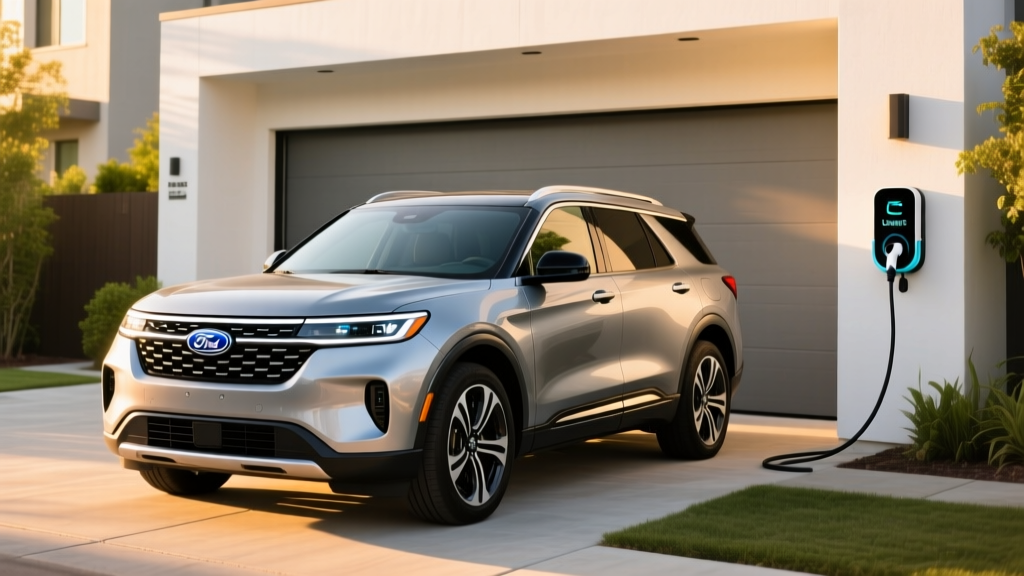
The three-row SUV segment rarely rewards nuance. Buyers want space, power, and low running costs — and the 2026 Ford Explorer Hybrid attempts to deliver all three without asking owners to change their habits. Unlike a plug-in hybrid, this is a conventional self-charging hybrid (HEV): it recovers energy under braking and assists its turbocharged engine with an electric motor, requiring no plug and no behavioral shift. The question for family-SUV shoppers is whether the hybrid's fuel savings justify its premium over the gas-only Explorer, and whether it makes more sense than going full electric with something like the Ford Explorer EV or a competitor.
This guide breaks down the 2026 Explorer Hybrid's powertrain, EPA fuel economy, real-world efficiency expectations, battery longevity, pricing, and tax-credit status — with the exact numbers you need to decide.
HEV vs PHEV: What the 2026 Explorer Hybrid Actually Is
Before evaluating the Explorer Hybrid, it's worth clarifying what it is not. Ford does not currently offer a plug-in hybrid (PHEV) version of the US-market Explorer for the 2026 model year. The Explorer Hybrid is a conventional hybrid (HEV), meaning:
Conventional Hybrid (HEV) — Explorer Hybrid
- No plug; charges itself via regenerative braking and engine power
- Small battery (~1.5–2.0 kWh usable), not designed for electric-only driving
- Improves fuel economy 15–30% over a comparable gas model
- No electric-only range to manage; operates like a normal gas SUV
Plug-In Hybrid (PHEV)
- Plugs into a wall or Level 2 charger; larger battery (typically 13–25 kWh)
- Offers 25–45 miles of electric-only range before the engine engages
- Requires charging access to realize full efficiency benefit
- May qualify for partial or full §30D federal tax credit depending on sourcing
If you were hoping for an Explorer PHEV with 30+ miles of electric-only commuting, this isn't it. The hybrid's value proposition is simpler: better MPG with zero lifestyle change.
2026 Ford Explorer Hybrid Powertrain and Performance
The 2026 Explorer Hybrid pairs Ford's 3.3-liter V6 engine with an electric motor integrated into the transmission. Combined output sits at approximately 318 horsepower and 322 lb-ft of torque, routed through a 10-speed automatic transmission. Rear-wheel drive is standard; Intelligent 4WD is available on higher trims.
| Specification | 2026 Ford Explorer Hybrid |
|---|---|
| Engine | 3.3L V6 + electric motor (HEV) |
| Combined Horsepower | 318 hp |
| Combined Torque | 322 lb-ft |
| Transmission | 10-speed automatic |
| Drivetrain | RWD standard / Intelligent 4WD available |
| Battery Capacity (usable) | ~1.5 kWh (lithium-ion) |
| Towing Capacity (max) | Up to 5,000 lbs (with tow package) |
| 0–60 mph (est.) | ~7.5 seconds |
| Seating | Up to 7 passengers |
The electric motor fills in torque at low RPM, which makes the Explorer Hybrid feel noticeably more responsive from a stop than the base 2.3L EcoBoost gas model. It's not a performance SUV, but the hybrid powertrain delivers confident highway merging and adequate passing power even when fully loaded.
EPA Fuel Economy and Real-World MPG
According to fueleconomy.gov, the 2026 Ford Explorer Hybrid with rear-wheel drive achieves an EPA-estimated 24 city / 28 highway / 26 combined MPG. With Intelligent 4WD, expect a slight reduction to approximately 23 city / 27 highway / 25 combined.
| Configuration | City MPG | Highway MPG | Combined MPG |
|---|---|---|---|
| RWD | 24 | 28 | 26 |
| Intelligent 4WD | 23 | 27 | 25 |
| Gas Explorer 2.3L EcoBoost (RWD) | 21 | 28 | 24 |
Real-World MPG: What to Actually Expect
Hybrids consistently overperform their EPA city ratings in stop-and-go traffic because regenerative braking recovers energy that a gas car wastes as heat. In urban and suburban driving, owners of the Explorer Hybrid commonly report 26–29 MPG in city conditions, sometimes exceeding the EPA city estimate by 2–5 MPG.
Highway driving tells a different story. At sustained 70–80 mph speeds, the hybrid system contributes less — the engine does most of the work, and the added weight of the battery and motor slightly hurts efficiency compared to a lighter gas model. Expect 24–26 MPG on the highway in real-world conditions, particularly with roof cargo boxes or heavy loads.
Cold weather reduces hybrid efficiency by roughly 10–15% due to cabin heating demands and reduced battery efficiency in low temperatures. Winter city MPG may dip to 21–23 before recovering in warmer months.
Battery Warranty, Lifespan, and Replacement Cost
Ford Hybrid Battery Warranty
Ford covers the Explorer Hybrid's high-voltage battery with a 8-year / 100,000-mile warranty (whichever comes first). In states that follow California Air Resources Board (CARB) emissions standards — including California, New York, Colorado, and several others — hybrid battery coverage extends to 10 years / 150,000 miles.
The warranty covers battery capacity loss below a defined threshold (typically 60–70% of original capacity) and any manufacturing defects.
How Long Will the Hybrid Battery Last?
Conventional hybrid batteries are among the most durable components in modern vehicles. The Explorer Hybrid's ~1.5 kWh lithium-ion pack operates within a narrow state-of-charge window (roughly 40–60%), which dramatically reduces degradation compared to full EV batteries that cycle through 0–100%. Based on data from Ford's earlier hybrid models (Fusion Hybrid, Escape Hybrid), these packs routinely last 150,000–200,000+ miles before any significant capacity loss.
For most owners, the hybrid battery will outlast the vehicle's useful life or the time they own it.
Battery Replacement Cost
If a replacement is needed out of warranty, a new OEM hybrid battery pack for the Explorer Hybrid typically costs between $2,500 and $4,000 including parts and labor. This is significantly less than a full EV battery replacement ($8,000–$20,000+) because the pack is much smaller. Third-party refurbished packs may be available for $1,500–$2,500 as the vehicle ages and the aftermarket develops.
Pricing, Trims, and Tax Credit Eligibility
The 2026 Ford Explorer Hybrid is available across multiple trims. Pricing (MSRP, before destination) is approximately:
- Explorer Hybrid (base): ~$42,000
- Explorer Hybrid XLT: ~$45,500
- Explorer Hybrid Limited: ~$52,000
- Explorer Hybrid ST-Line: ~$49,000
Destination and delivery charges add approximately $1,595. Fully loaded Limited or Platinum trims can approach $58,000–$60,000 with options.
Does the Explorer Hybrid Qualify for a Federal Tax Credit?
No. Under current IRS §30D rules, the federal Clean Vehicle Credit applies only to battery electric vehicles (BEVs) and plug-in hybrid electric vehicles (PHEVs) that meet battery capacity, critical-mineral sourcing, MSRP, and buyer income thresholds. The Explorer Hybrid is a conventional HEV with no plug-in capability, so it does not qualify for the §30D federal tax credit (up to $7,500).
Some states and utilities offer their own incentives for hybrid purchases — check your state energy office or local utility for current programs. A few states offer modest rebates ($250–$1,000) for any electrified vehicle, including HEVs, but these are not guaranteed and vary by jurisdiction.
2026 Ford Explorer Hybrid: Pros and Cons
Pros
- 2–4 MPG improvement over gas Explorer with zero plug-in hassle
- Strong low-end torque from electric motor assist
- 8-year/100,000-mile hybrid battery warranty (10/150k in CARB states)
- No range anxiety; fills up at any gas station
- Up to 5,000-lb towing capacity retained
- Three-row seating for up to 7 passengers
Cons
- No federal tax credit eligibility
- Hybrid premium of ~$2,000–$3,500 over equivalent gas trim
- Highway MPG gains are modest (hybrid shines in city driving)
- No electric-only driving mode for short trips
- Real-world highway MPG may not exceed gas EcoBoost by much
Explorer Hybrid vs Gas Explorer vs Electric SUV: Which Should You Choose?
The right choice depends on your driving pattern, home charging access, and budget:
Choose the Explorer Hybrid if:
- You do a lot of city and suburban driving (where hybrids save the most fuel)
- You can't charge at home or lack access to reliable public DC fast chargers
- You want lower fuel costs without changing any habits
- You regularly tow or take long road trips and don't want to plan around charging
Stick with the gas Explorer if:
- Your driving is mostly highway (hybrid savings shrink at 70+ mph)
- You drive fewer than 8,000 miles per year (the hybrid premium takes too long to pay back)
- You're on the tightest budget and want the lowest purchase price
Consider a full EV (Explorer EV, Rivian R1S, Tesla Model X) if:
- You can install a Level 2 home charger and have reliable DC fast charging nearby
- Your daily commute is under 250 miles (well within EV range)
- You want to qualify for the §30D federal tax credit (up to $7,500 point-of-sale)
- You prioritize lowest per-mile fuel cost (electricity at $0.13/kWh ≈ $0.04/mile vs gas at $0.12–$0.15/mile)
Payback Calculation: Hybrid Premium vs Fuel Savings
Assuming a $2,500 hybrid premium over a comparable gas Explorer, 15,000 miles driven annually, and $3.50/gallon fuel:
- Gas Explorer (24 combined MPG): 625 gallons/year = $2,188/year
- Explorer Hybrid (26 combined MPG): 577 gallons/year = $2,019/year
- Annual savings: ~$169/year
- Payback period: ~14.8 years at these assumptions
However, if your driving skews heavily city (where the hybrid may achieve 28 MPG vs the gas model's 21 MPG), annual savings jump to approximately $450, cutting payback to ~5.5 years. The hybrid makes the strongest financial sense for urban drivers with high annual mileage.
Reliability and Ownership Considerations
Ford's hybrid powertrain technology is mature. The company has produced hybrid vehicles since the 2005 Escape Hybrid, and the 3.3L V6 hybrid system used in the Explorer shares architecture with the proven F-150 PowerBoost hybrid. IIHS and NHTSA safety ratings for the Explorer platform have been strong in recent model years, though specific 2026 ratings should be confirmed at launch.
Ownership costs to budget for beyond fuel:
- Insurance: Hybrid SUVs typically carry 5–10% higher premiums than gas equivalents due to higher replacement-cost valuations
- Maintenance: Comparable to gas Explorer; the hybrid system adds no routine maintenance items. Regenerative braking actually extends brake pad life.
- Depreciation: Hybrids have held value well in recent years as fuel prices fluctuate and buyers seek efficiency without EV commitment
Frequently Asked Questions
How many MPG does the 2026 Ford Explorer Hybrid get?
The EPA rates the 2026 Explorer Hybrid at 24 city / 28 highway / 26 combined MPG (RWD). In real-world city driving, many owners see 26–29 MPG thanks to regenerative braking. Highway real-world figures tend to be 24–26 MPG.
Does the Explorer Hybrid need to be plugged in?
No. The Explorer Hybrid is a conventional self-charging hybrid (HEV). It generates electricity through regenerative braking and the engine — there is no plug, no charging cable, and no electric-only range to manage.
Is the 2026 Explorer Hybrid available as a plug-in hybrid (PHEV)?
No. Ford does not currently offer a plug-in hybrid version of the US-market Explorer for 2026. If you need electric-only commuting range, consider the Ford Escape PHEV or a competitor like the Toyota Grand Highlander Hybrid (which is also an HEV, not a PHEV).
Does the Explorer Hybrid qualify for the $7,500 federal tax credit?
No. Under current IRS §30D rules, only plug-in electric vehicles (BEVs and PHEVs) qualify. The conventional hybrid Explorer is not eligible for the federal Clean Vehicle Credit. Check your state for possible local hybrid incentives.
How long does the hybrid battery last and what does replacement cost?
Ford warranties the hybrid battery for 8 years/100,000 miles (10 years/150,000 miles in CARB states). Real-world data from Ford's hybrid lineup suggests these batteries last 150,000–200,000+ miles. Out-of-warranty replacement costs approximately $2,500–$4,000 for an OEM pack.
Is the Explorer Hybrid good for towing?
Yes. With the available Class III trailer tow package, the Explorer Hybrid can tow up to 5,000 lbs. The electric motor's low-RPM torque assist can actually improve towing feel compared to the base gas engine, though expect fuel economy to drop to 17–20 MPG when towing heavy loads.
How does the Explorer Hybrid compare to the Toyota Grand Highlander Hybrid?
The Grand Highlander Hybrid (also an HEV) achieves a higher EPA rating of approximately 34–36 combined MPG thanks to Toyota's more efficiency-focused hybrid system. However, the Explorer Hybrid offers more horsepower (318 vs ~245), stronger towing capacity, and a sportier driving feel. Choose the Toyota for maximum efficiency; choose the Ford for power and towing.
The 2026 Ford Explorer Hybrid occupies a pragmatic middle ground. It won't deliver EV-level running costs or PHEV electric-only commuting, but it asks nothing of its owner in return — no plug, no route planning, no behavior change. For families whose driving mixes city errands with highway road trips and the occasional tow, the hybrid's modest MPG improvement and torque boost represent a low-risk upgrade over the gas model. Just know that the financial payback depends heavily on where you drive, not just how much.