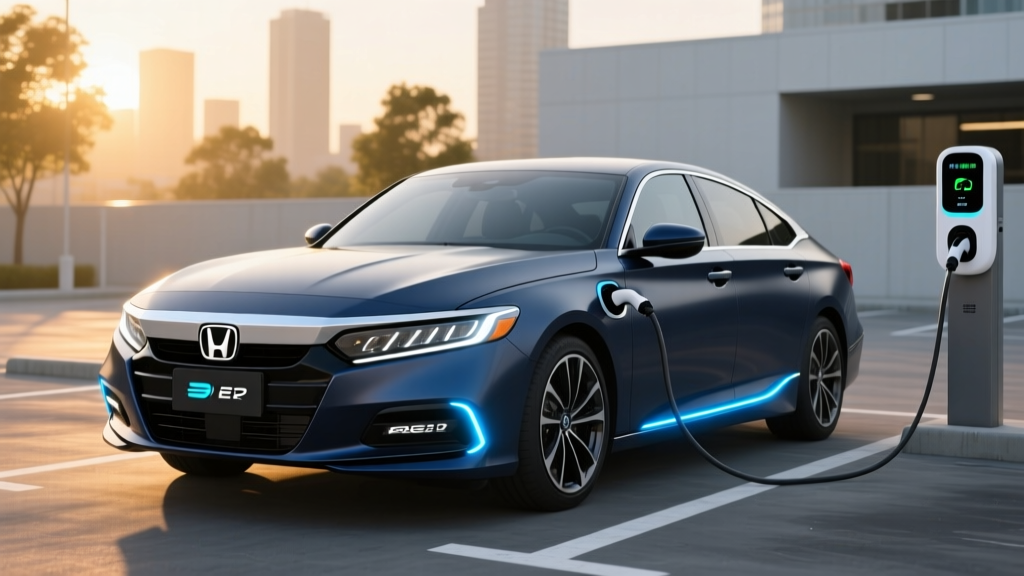
The Honda Accord has long been a benchmark midsize sedan, but buyers searching for an Accord plug-in hybrid face a complicated reality in 2026: Honda does not currently sell a plug-in hybrid (PHEV) version of the Accord in the United States. The Accord lineup offers a conventional hybrid (HEV) that delivers outstanding fuel economy without ever needing to be plugged in, but the plug-in variant that once existed — the 2014 Accord Plug-In — was discontinued over a decade ago and has not returned.
This guide breaks down exactly what Honda offers today, explains the critical difference between the Accord Hybrid (HEV) and the plug-in hybrid concept, compares the Accord to rival PHEV sedans, and helps you decide whether Honda's hybrid, a competitor's PHEV, or a full battery-electric vehicle (BEV) is the right move for your driveway.
HEV vs PHEV: What the Accord Actually Offers
Before diving into specs, it is essential to understand the distinction between the two electrified powertrain types, because confusing them leads to bad purchase decisions.
Conventional Hybrid (HEV) — Honda Accord Hybrid
- No plug required. The battery recharges via regenerative braking and the gasoline engine.
- Small battery (~1.3 kWh): enough to assist acceleration and enable brief low-speed EV mode, but not sustained electric-only driving.
- Fuel economy advantage comes from the engine running at optimal efficiency more often, with the electric motor filling in torque gaps.
- No federal tax credit under current IRS §30D rules — only new PHEVs and BEVs qualify.
Plug-In Hybrid (PHEV) — Not Available on the Accord
- Plug required for maximum benefit. A larger battery (typically 13–20 kWh) provides 25–45 miles of electric-only range before the gas engine engages.
- Can DC fast charge on some models (CCS or NACS), though many PHEVs are Level 2 AC-only.
- May qualify for up to $7,500 in federal tax credits under IRS §30D, subject to MSRP caps, buyer income limits, and battery-sourcing requirements.
- Best for drivers with short commutes who can charge at home but want gas-engine flexibility for longer trips.
The 2026 Honda Accord Hybrid is firmly in the HEV category. If you specifically want a plug-in hybrid sedan, you will need to look at competitors — which we cover below.
2026 Honda Accord Hybrid: EPA MPG, Powertrain, and Real-World Efficiency
For buyers who do not need plug-in capability and simply want excellent fuel economy with zero lifestyle change, the Accord Hybrid remains one of the strongest choices in the midsize segment.
| Trim | City MPG | Highway MPG | Combined MPG |
|---|---|---|---|
| Sport Hybrid | 46 | 41 | 44 |
| Sport-L Hybrid | 46 | 41 | 44 |
| EX-L Hybrid | 51 | 44 | 48 |
| Sport Touring Hybrid | 46 | 41 | 44 |
Source: fueleconomy.gov
The spread between trims comes down to wheel size and tuning: the EX-L Hybrid rides on smaller, lower-rolling-resistance wheels and achieves the headline 48 MPG combined figure, while the sportier trims with 19-inch wheels drop to 44 MPG combined. Both are excellent.
Real-World MPG vs. EPA Sticker
Hybrids typically exceed their EPA city estimates in stop-and-go traffic because regenerative braking recaptures energy that a gas-only car wastes as heat. In our experience and owner-reported data, the Accord Hybrid consistently achieves 47–52 MPG in urban and suburban driving on EX-L trims. Highway fuel economy tends to land closer to or slightly below the EPA figure — expect 40–43 MPG at 70–75 mph on flat terrain. Cold weather (below 35°F) can reduce efficiency by 5–10% as the engine runs more frequently to provide cabin heat.
| Specification | Value |
|---|---|
| Powertrain | 2.0L Atkinson-cycle 4-cyl + 2 electric motors (e-CVT) |
| Combined Horsepower | 204 hp |
| Combined Torque | 247 lb-ft (electric motor peak) |
| Battery Capacity | ~1.3 kWh (lithium-ion) |
| Electric-Only Range | ~1 mile at low speed (not a PHEV) |
| 0–60 mph | ~7.2 seconds |
| Drivetrain | Front-wheel drive |
| Total Range (est.) | ~560 miles (12.8-gal tank × 44 MPG combined) |
| Starting MSRP | ~$33,995 (Sport Hybrid) |
| Federal Tax Credit | Not eligible (HEV, not PHEV/BEV) |
Battery Warranty, Reliability, and Replacement Cost
Battery longevity is the top concern for hybrid buyers, and Honda addresses it with strong warranty coverage.
Honda Accord Hybrid Battery Warranty
- Hybrid battery: 8 years / 100,000 miles (10 years / 150,000 miles in CARB states including California, New York, Massachusetts, and others that follow California emissions standards)
- Hybrid system components (inverter, converter, control unit): 8 years / 100,000 miles
- Capacity retention threshold: Honda does not publish a specific degradation percentage trigger, but warranty covers defects and abnormal capacity loss
Real-World Reliability
Honda's two-motor hybrid system has been in production since 2014 (across the Accord, CR-V, and Civic lines) and has proven durable. The Accord's hybrid battery is small (~1.3 kWh) and rarely cycles deeply — it operates in a narrow state-of-charge window, which dramatically reduces wear compared to the deep cycles a PHEV or BEV battery endures. Owner reports of hybrid battery failures before 150,000 miles are rare.
Battery Replacement Cost
If the hybrid battery does need replacement outside of warranty, expect a parts-and-labor cost of approximately $2,000–$3,500 at a Honda dealer. Because the battery pack is small, this is far less expensive than a PHEV or BEV battery replacement (which can run $8,000–$20,000+). Third-party refurbishment shops may offer rebuilt packs for $1,200–$2,000.
Why There Is No 2026 Accord Plug-In Hybrid
Honda briefly sold an Accord Plug-In Hybrid for the 2014 model year (California and New York only, limited volumes). That car offered 13 miles of electric-only range from a 6.7 kWh battery and a combined 196 hp. It was discontinued after one model year due to low demand, high pricing (~$40,000 MSRP before incentives), and Honda's strategic pivot toward the more cost-effective two-motor HEV system.
Since then, Honda has not reintroduced a PHEV sedan in the U.S. market. The company's electrification strategy for 2026 focuses on:
- HEVs across the Accord, Civic, and CR-V lineups for mass-market efficiency gains
- BEVs via the Prologue (midsize SUV) and upcoming models on the dedicated 0 Series platform
If Honda were to introduce a future Accord PHEV, industry speculation points to a system similar to the e:PHEV variants sold in China and Europe, potentially offering 30–40 miles of electric range from a ~17 kWh battery. However, as of the 2026 model year, this remains unannounced for the U.S. market.
PHEV Sedan Alternatives: What to Buy If You Need Plug-In Capability
If your goal is a midsize plug-in hybrid sedan with genuine electric-only commuting range, these are the Accord's closest competitors:
| Model | EV Range | Battery | Combined HP | Combined MPG (gas) | Starting MSRP | Federal Credit |
|---|---|---|---|---|---|---|
| Toyota Prius Prime | 44 mi | 13.6 kWh | 220 hp | 48 MPG | ~$33,445 | Up to $3,750* |
| Hyundai Sonata PHEV | 32 mi | 13.7 kWh | 192 hp | 40 MPG | ~$36,250 | Check eligibility* |
| BMW 330e | 23 mi | 19.5 kWh | 288 hp | 28 MPG | ~$47,000 | Not eligible (MSRP cap) |
*Federal tax credit amounts and eligibility under IRS §30D vary by battery sourcing, buyer income, and MSRP caps. Verify current eligibility at irs.gov. The Prius Prime may qualify for a partial credit depending on critical-mineral and battery-component sourcing. The Sonata PHEV's credit status depends on current-year sourcing compliance. Always confirm with your tax professional.
Pros: Honda Accord Hybrid (HEV)
- Up to 48 MPG combined — no plug, no behavior change
- Spacious midsize cabin with 16.7 cu ft trunk (hybrid battery does not intrude)
- Smooth, torque-rich acceleration from the two-motor system
- Proven reliability with strong 8–10 year battery warranty
- Low battery replacement cost (~$2,000–$3,500) if needed
- Honda Sensing suite standard across all trims
Cons: Honda Accord Hybrid (HEV)
- No plug-in option — cannot commute on electricity alone
- Not eligible for any federal EV/PHEV tax credit
- Front-wheel drive only (no AWD option, unlike the Toyota Camry Hybrid)
- Sport trims with 19" wheels drop to 44 MPG combined
- e-CVT drone under hard acceleration (no traditional gear shifts)
Hybrid vs PHEV vs EV: Which Powertrain Fits You?
Choose the Honda Accord Hybrid (HEV) if:
- You cannot charge at home (apartment, street parking, no garage outlet)
- You want maximum MPG with zero lifestyle adjustment
- You drive more than 40 miles daily and don't want to think about plugging in
- You want a proven midsize sedan under $40,000
Choose a PHEV sedan (Prius Prime, Sonata PHEV) if:
- You can charge at home (Level 1 or Level 2) and your commute is under 40 miles round-trip
- You want electric-only daily driving but need gas-engine range for road trips
- You want to reduce (not eliminate) gasoline consumption
- You may qualify for a partial federal tax credit
Choose a full BEV (Tesla Model 3, Hyundai Ioniq 6, BMW i4) if:
- You have reliable home Level 2 charging
- Your daily driving is under 250 miles and you road-trip infrequently (or are willing to plan DC fast-charging stops)
- You want the lowest per-mile fuel cost (~$0.04–$0.06/mi on home electricity vs. ~$0.10–$0.13/mi for a 48-MPG hybrid on $3.50/gal gas)
- You want to qualify for the full $7,500 federal tax credit (subject to §30D eligibility)
Pricing and Ownership Costs for the Accord Hybrid
| Trim | MSRP | Key Additions |
|---|---|---|
| Sport Hybrid | ~$33,995 | 19" wheels, sport styling, wireless CarPlay/Android Auto |
| Sport-L Hybrid | ~$35,295 | Leather-trimmed seats, heated front seats |
| EX-L Hybrid | ~$36,495 | 17" wheels (best MPG), power moonroof, premium audio |
| Sport Touring Hybrid | ~$39,995 | BOSE 12-speaker audio, navigation, wireless charging, heated rear seats |
Five-Year Fuel Cost Comparison
Using 15,000 miles/year, $3.50/gallon regular unleaded, and EPA combined figures:
- Accord Hybrid (48 MPG combined, EX-L): ~$5,470 over 5 years
- Accord 1.5T gas (30 MPG combined): ~$8,750 over 5 years
- Prius Prime PHEV (assume 70% electric, $0.14/kWh): ~$2,800 over 5 years
- Tesla Model 3 RWD ($0.14/kWh, 4.0 mi/kWh): ~$2,625 over 5 years
The Accord Hybrid saves roughly $3,280 in fuel over five years compared to the gas-only Accord, but a PHEV or BEV with home charging saves an additional $2,500–$2,800 on top of that. The trade-off is upfront cost, charging access, and trip flexibility.
Frequently Asked Questions
Does the 2026 Honda Accord have a plug-in hybrid option?
No. Honda does not offer a plug-in hybrid (PHEV) version of the Accord in the U.S. market for the 2026 model year. The Accord Hybrid is a conventional hybrid (HEV) that never needs to be plugged in. Honda's only U.S. PHEV was the 2014 Accord Plug-In, which was discontinued after one model year.
How many MPG does the Honda Accord Hybrid get?
The 2026 Accord Hybrid achieves an EPA-estimated 51 city / 44 highway / 48 combined MPG on the EX-L trim with 17-inch wheels. Sport and Sport Touring trims with 19-inch wheels rate at 46 city / 41 highway / 44 combined MPG. In real-world city driving, many owners report exceeding the EPA city figure thanks to aggressive regenerative braking.
How far can the Accord Hybrid go on electric only?
Less than one mile at very low speeds (under 25 mph). The Accord Hybrid's ~1.3 kWh battery is designed to assist the gasoline engine, not to provide sustained electric-only driving. This is a fundamental difference from a PHEV, which offers 25–45 miles of electric range from a much larger battery.
Does the Honda Accord Hybrid qualify for a federal tax credit?
No. Under current IRS §30D rules, the federal clean vehicle credit applies only to new plug-in electric vehicles (BEVs and PHEVs) that meet battery-sourcing, MSRP, and buyer income requirements. Conventional hybrids like the Accord Hybrid do not qualify. Some states may offer minor incentives for hybrids — check your state's energy office for details.
Is the Honda Accord Hybrid reliable? What about battery replacement cost?
Yes. Honda's two-motor hybrid system has been in production since 2014 with strong reliability records. The hybrid battery is covered by an 8-year/100,000-mile warranty (10 years/150,000 miles in CARB states). Because the battery is small (~1.3 kWh) and operates in a narrow charge window, degradation is minimal. Out-of-warranty replacement costs approximately $2,000–$3,500 at a dealer — far less than a PHEV or BEV battery.
Should I wait for Honda to release an Accord PHEV?
There is no confirmed timeline for a U.S.-market Accord PHEV. Honda sells e:PHEV variants of the Accord in China and Europe, but has not announced plans to bring this powertrain to North America. If plug-in capability is a priority now, consider the Toyota Prius Prime, Hyundai Sonata PHEV, or transitioning directly to a BEV like the Tesla Model 3 or Hyundai Ioniq 6.
How does the Accord Hybrid compare to the Toyota Camry Hybrid?
Both achieve similar combined MPG (the Camry Hybrid rates at 44–52 MPG depending on trim, with available all-wheel drive). The Accord Hybrid offers slightly more rear-seat legroom and trunk space. The Camry Hybrid's AWD option is an advantage in snow-belt states. Neither offers a PHEV variant in the U.S. — for a Toyota PHEV, you would look at the Prius Prime or RAV4 Prime.
Sources: fueleconomy.gov, Honda Accord Hybrid official page, IRS §30D Clean Vehicle Credit