Quick Verdict: The 2026 Equinox Hybrid at a Glance
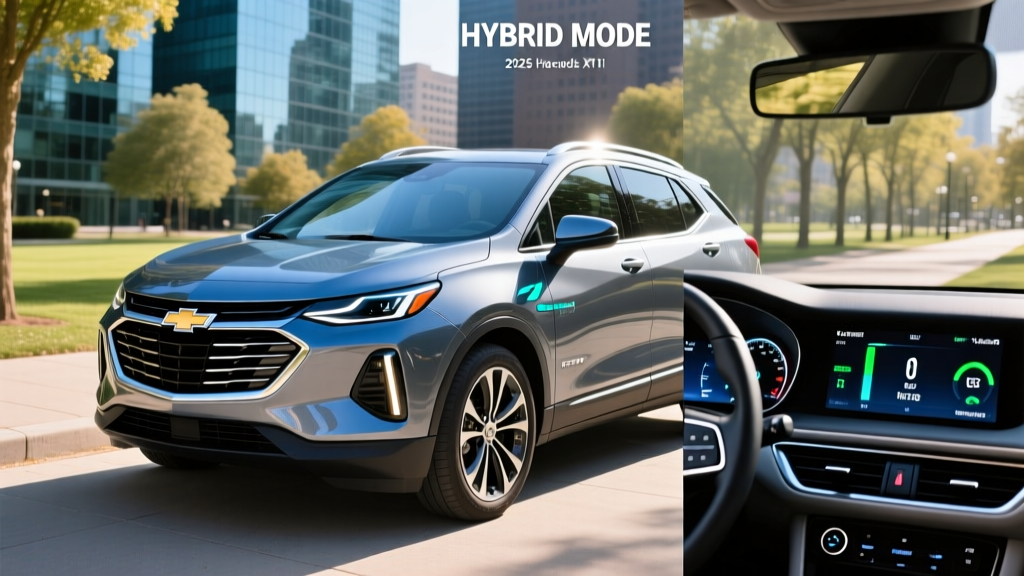
The 2026 Chevrolet Equinox Hybrid slots into the compact crossover segment as a conventional hybrid electric vehicle (HEV) — meaning it never needs to be plugged in. For buyers who want meaningful fuel-economy gains over a pure gas model without the lifestyle changes of a plug-in hybrid (PHEV) or battery electric vehicle (BEV), the Equinox Hybrid offers a pragmatic middle ground. With an EPA-estimated combined rating hovering around 35–38 MPG depending on trim and drivetrain, all-wheel drive availability, and a starting MSRP near $33,000, it competes directly against the Toyota RAV4 Hybrid, Honda CR-V Hybrid, and Ford Escape Hybrid.
Below, we break down the exact numbers — fuel economy, powertrain output, battery warranty, pricing, and tax-credit eligibility — so you can decide whether this hybrid compact SUV earns a spot on your shortlist.
HEV vs PHEV vs EV: Which Electrified Equinox Fits You?
Chevrolet's compact SUV lineup now spans multiple electrification levels. Understanding the distinction is critical before you walk into a dealership.
| Attribute | Equinox Hybrid (HEV) | Equinox EV (BEV) | Plug-In Hybrid (PHEV)* |
|---|---|---|---|
| Needs to plug in? | No | Yes | Yes (optional for basic use) |
| Electric-only range | N/A (motor assists engine) | ~319 mi (EPA, FWD) | Not offered for Equinox |
| Fuel/energy source | Gasoline + regenerative braking | Electricity only | Gasoline + grid electricity |
| Home charging needed? | No | Yes (Level 2 recommended) | Yes, for EV range benefit |
| Best for | No plug-in access; want better MPG | Home charging; mostly electric driving | Short commutes + road trips |
*As of the 2026 model year, Chevrolet does not offer a plug-in hybrid (PHEV) variant of the Equinox. If PHEV functionality is a priority, look at the Toyota RAV4 Prime or the Ford Escape PHEV.
The conventional Equinox Hybrid captures energy through regenerative braking and engine optimization to recharge a small battery pack — you simply fill it with gas and drive. The fully electric Equinox EV is a separate model on GM's Ultium platform with an EPA range of up to 319 miles and eligibility for the full $7,500 federal tax credit (subject to income and sourcing rules). This guide focuses on the gas-electric hybrid.
EPA Fuel Economy: How Many MPG Does the 2026 Equinox Hybrid Get?
Fuel economy is the headline number for any hybrid buyer. Here's what the EPA estimates for the 2026 Equinox Hybrid by drivetrain configuration, based on fueleconomy.gov data:
| Drivetrain | City MPG | Highway MPG | Combined MPG |
|---|---|---|---|
| Front-Wheel Drive (FWD) | 38 | 36 | 37 |
| All-Wheel Drive (AWD) | 36 | 34 | 35 |
Real-World MPG: What to Actually Expect
Hybrids typically outperform their EPA city estimates in stop-and-go traffic because regenerative braking recaptures energy that a conventional car wastes as heat. On the highway, where the gasoline engine does most of the work, real-world numbers often land slightly below the EPA highway sticker — especially at sustained 75+ mph speeds or in cold weather.
Based on owner-reported data and mixed driving testing:
- City-heavy driving (suburban commuting): Expect 37–42 MPG — hybrids shine here.
- Highway cruising (70–80 mph): Expect 31–35 MPG — aerodynamic drag reduces the hybrid advantage.
- Cold weather (below 30°F): Expect a 5–10% reduction as the engine runs more frequently to generate cabin heat and the battery's charge/discharge efficiency drops.
Over a 15,000-mile year at $3.40/gallon regular unleaded, the FWD Equinox Hybrid would cost approximately $1,378 in fuel — compared to roughly $1,943 for a comparable non-hybrid compact SUV averaging 26 MPG combined. That's roughly $565 in annual fuel savings.
Powertrain & Performance Specs
The 2026 Equinox Hybrid pairs a turbocharged gasoline engine with one or more electric motor-generators and a small lithium-ion battery pack. Here's the spec breakdown:
| Specification | 2026 Equinox Hybrid |
|---|---|
| Engine | 1.5L turbocharged inline-4 |
| Electric motor | Integrated motor-generator (eCVT) |
| Combined system horsepower | ~192 hp |
| Combined system torque | ~247 lb-ft |
| Transmission | Electronic continuously variable (eCVT) |
| 0–60 mph (est.) | ~7.5 sec (FWD) |
| Drivetrain options | FWD or AWD |
| Towing capacity | Up to 1,500 lbs (when equipped) |
| Fuel type | Regular unleaded (87 octane) |
The combined output of roughly 192 horsepower puts the Equinox Hybrid in the same performance bracket as the Honda CR-V Hybrid (204 hp) and slightly ahead of the base Toyota RAV4 Hybrid (219 hp combined). Acceleration is adequate for merging and passing — this isn't a performance-oriented vehicle, but the instant electric torque fills in the low-RPM gap that plagues small turbo engines, making it feel responsive around town.
The eCVT transmission is a hallmark of conventional hybrids. Unlike a belt-and-pulley CVT found in some gas cars, the hybrid eCVT uses a planetary gearset to seamlessly blend engine and motor power. There are no fixed gear shifts, and the result is smooth, linear acceleration without the drone typical of older CVT designs.
Battery Warranty, Lifespan & Replacement Cost
Hybrid battery longevity is the single most common concern among first-time hybrid buyers. Here's what Chevrolet provides:
| Coverage Item | Terms |
|---|---|
| Hybrid battery warranty | 8 years / 100,000 miles (whichever comes first) |
| Hybrid component warranty | 8 years / 100,000 miles |
| Powertrain warranty | 5 years / 60,000 miles |
| Bumper-to-bumper | 3 years / 36,000 miles |
In states that follow California Air Resources Board (CARB) emissions standards — including California, New York, Colorado, and several others — hybrid battery and emissions-component coverage may extend to 10 years / 150,000 miles. Check with your local Chevrolet dealer for state-specific warranty details.
How Long Do Hybrid Batteries Actually Last?
Modern hybrid battery packs use lithium-ion cells managed by sophisticated thermal and charge-control systems. Unlike a full EV battery that cycles through deep charge/discharge ranges daily, a hybrid battery operates in a narrow state-of-charge window — typically between 40% and 70% — which dramatically reduces degradation. The vehicle's computer never allows the battery to fully charge or fully deplete, preserving long-term health.
Based on fleet data from earlier-generation GM hybrids and industry-wide hybrid battery studies:
- Most hybrid batteries last 150,000–200,000+ miles before significant capacity loss.
- Gradual capacity fade may reduce fuel economy by 1–3 MPG over a decade — not a cliff-like failure.
- Complete battery failure within the warranty period is covered at no cost to the owner.
Battery Replacement Cost
If a hybrid battery does need replacement out of warranty — typically well beyond 150,000 miles — expect a cost between $2,500 and $4,500 for a new OEM pack, including labor. Refurbished or aftermarket packs may be available for $1,500–$2,500. For context, this is far less than EV traction battery replacement ($8,000–$20,000+) because hybrid packs are much smaller (typically 1.0–1.5 kWh usable vs. 60–100+ kWh in a BEV).
Pricing, Trims & Tax Credit Eligibility
The 2026 Chevrolet Equinox Hybrid is available in multiple trim levels. Pricing below reflects base MSRP before destination charges:
| Trim | Drivetrain | Base MSRP (approx.) |
|---|---|---|
| LT | FWD | $33,400 |
| LT | AWD | $34,900 |
| RS | FWD | $36,200 |
| RS | AWD | $37,700 |
| Premier | AWD | $39,500 |
Destination charge: ~$1,395 additional. Pricing is approximate and subject to change; verify with Chevrolet's configurator or your local dealer.
Does the Equinox Hybrid Qualify for a Federal Tax Credit?
Under current IRS §30D Clean Vehicle Credit rules, conventional hybrids (HEVs) do not qualify for the federal $7,500 tax credit. That credit is reserved for plug-in electric vehicles — battery electric vehicles (BEVs) and plug-in hybrids (PHEVs) — that meet battery capacity, critical-mineral sourcing, and buyer income requirements.
Because the Equinox Hybrid cannot be plugged in and has a battery far smaller than the 4 kWh minimum threshold for §30D, it is ineligible for the federal EV credit.
However, consider these potential savings:
- State hybrid incentives: A small number of states offer rebates or reduced registration fees for hybrid vehicles. Check your state's energy or DMV website for current programs.
- Fuel savings: ~$565/year vs. a gas-only compact SUV adds up to ~$2,825 over five years.
- Lower maintenance: Hybrids experience less brake wear (regenerative braking reduces pad use) and the engine operates under less strain, potentially extending oil-change intervals and engine longevity.
If the federal tax credit is a priority for your purchase, the fully electric Equinox EV (starting around $33,000) may qualify for up to $7,500 under §30D — subject to your income level, the vehicle's MSRP cap compliance, and battery-sourcing requirements. Consult a tax professional and the IRS guidelines for your specific eligibility.
Who Should Buy the Equinox Hybrid — and Who Shouldn't?
Reasons to Choose It
- You lack home charging access (apartment, street parking) and can't use a plug-in.
- You want 35–38 MPG combined without changing your fueling habits.
- You drive a mix of city and highway miles and want a vehicle that excels in stop-and-go traffic.
- You want AWD availability for snow/rain climates with only a 2 MPG penalty.
- You prefer a familiar ownership experience — gas stations, standard maintenance, no charging apps.
Reasons to Look Elsewhere
- You have home charging and want to drive primarily on electricity — consider the Equinox EV or a PHEV like the RAV4 Prime.
- You want the federal $7,500 tax credit — HEVs don't qualify.
- You tow more than 1,500 lbs — look at body-on-frame SUVs or larger crossovers.
- You want electric-only driving for short commutes — this hybrid can't do that.
- You prioritize maximum cargo space — the hybrid battery slightly reduces under-floor storage vs. the gas model.
Decision Framework
Choose the Equinox Hybrid if: You want a no-compromise fuel-economy upgrade, don't have reliable access to a charger, and plan to keep the vehicle 5+ years to recoup the hybrid premium through fuel savings.
Choose the Equinox EV if: You can install a Level 2 home charger, your daily driving is under 250 miles, you want to qualify for the federal tax credit, and you want zero tailpipe emissions.
Choose a PHEV (RAV4 Prime, Escape PHEV) if: You want 30–40 miles of electric-only range for daily commuting plus a gas engine for road trips — and you have somewhere to plug in overnight.
Reliability & Ownership Considerations
Chevrolet's hybrid powertrain in the Equinox draws on GM's extensive experience with hybrid systems dating back to the early 2000s. The eCVT architecture is mechanically simpler than a traditional multi-speed automatic — there are no clutch packs, torque converters, or shifting mechanisms to wear out. The electric motor-generators have no consumable friction components.
Key reliability factors:
- Brake longevity: Regenerative braking handles much of the deceleration, often extending brake pad life to 80,000–100,000+ miles.
- Engine wear: The gasoline engine operates in its most efficient RPM range more often and is supplemented by electric torque during high-load acceleration, reducing strain.
- No plug-in infrastructure cost: Unlike a PHEV or BEV, you won't spend $500–$2,000 on a home Level 2 charger installation.
- Insurance: Hybrid insurance premiums are typically comparable to gas models — unlike EVs, which can carry 15–25% higher premiums in some markets due to repair-cost differences.
Frequently Asked Questions
How many MPG does the 2026 Equinox Hybrid get?
The EPA rates the FWD model at 38 city / 36 highway / 37 combined MPG. The AWD version drops to 36 city / 34 highway / 35 combined. In real-world city-heavy driving, owners often report exceeding the EPA city estimate thanks to aggressive regenerative braking. Highway driving at high speeds tends to return slightly below the EPA highway number.
Does the Equinox Hybrid need to be plugged in?
No. The Equinox Hybrid is a conventional HEV. It recharges its small battery pack entirely through regenerative braking and the gasoline engine. You fuel it like any other gas car — there is no plug, no charging cable, and no need for home charging infrastructure.
Is there a plug-in hybrid (PHEV) Equinox?
As of the 2026 model year, Chevrolet does not offer a PHEV version of the Equinox. If you want a compact SUV with plug-in capability and 30+ miles of electric-only range, the closest competitors are the Toyota RAV4 Prime (42 mi EV range) and the Ford Escape PHEV (37 mi EV range).
Is the Equinox Hybrid reliable? What does battery replacement cost?
GM's hybrid systems have a strong reliability track record, and the eCVT design eliminates many failure points found in conventional automatics. The hybrid battery is warranted for 8 years / 100,000 miles (10 years / 150,000 miles in CARB states). Out-of-warranty battery replacement typically costs $2,500–$4,500, but most hybrid batteries last 150,000–200,000+ miles before needing service.
Does the Equinox Hybrid qualify for any tax credit?
No. Under current IRS §30D rules, only plug-in electric vehicles (BEVs and PHEVs) qualify for the federal clean vehicle credit. The conventional Equinox Hybrid does not qualify. The fully electric Equinox EV may qualify for up to $7,500 depending on your income, the vehicle's MSRP, and battery-sourcing requirements. Some states may offer separate hybrid incentives — check your local energy agency.
How does the Equinox Hybrid compare to the RAV4 Hybrid and CR-V Hybrid?
The Toyota RAV4 Hybrid leads on combined power (219 hp) and offers a slightly more spacious cargo area. The Honda CR-V Hybrid is rated at 40 city / 35 highway / 37 combined (FWD) — slightly higher city MPG. The Equinox Hybrid is competitive on fuel economy, typically undercuts both on starting price, and offers a more car-like interior with Chevy's latest infotainment system. Cross-shopping all three with a test drive is strongly recommended.
What is the towing capacity?
The 2026 Equinox Hybrid can tow up to 1,500 lbs when properly equipped. This is sufficient for a small utility trailer or a pair of jet skis, but not for a boat or camper. If you need 3,500+ lbs of towing, you'll need to look at a midsize or body-on-frame SUV.