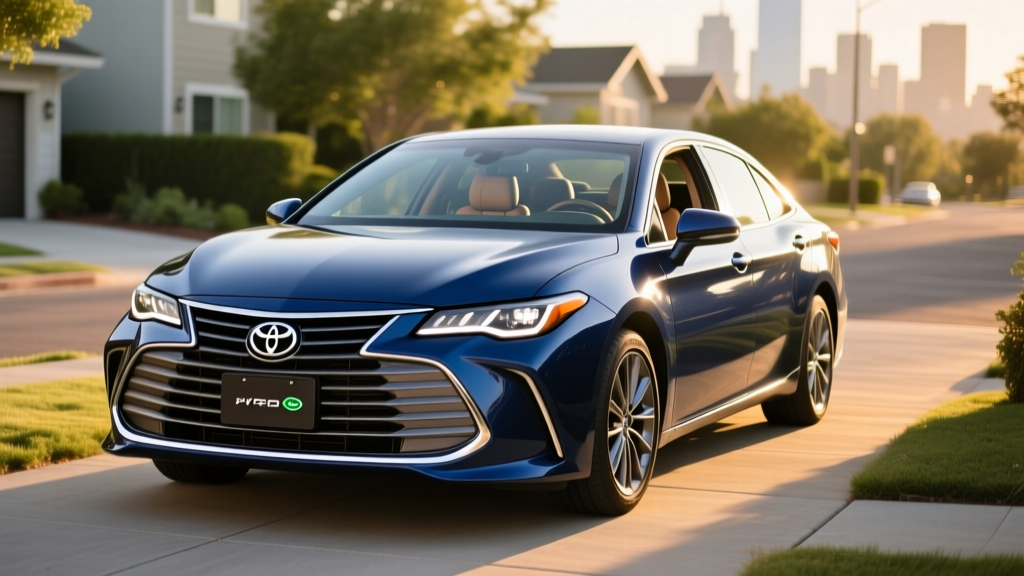
The 2018 Toyota Avalon Hybrid occupies a specific niche in the used-car market: a full-size, comfortable sedan that sips fuel without requiring a plug. As Toyota's flagship hybrid sedan before the Camry-based redesign arrived for 2019, the 2018 model year represents the final iteration of the fourth-generation Avalon platform. For buyers in 2026 evaluating a used hybrid against newer plug-in hybrids (PHEVs) or full battery-electric vehicles (BEVs), the Avalon Hybrid's proven powertrain and low running costs remain compelling — provided you understand exactly what you're getting.
This guide covers the 2018 Toyota Avalon Hybrid's real-world fuel economy, hybrid battery longevity, ownership costs, and how it stacks up against modern electrified alternatives.
HEV vs. PHEV: What the 2018 Avalon Hybrid Actually Is
Before examining specs, it's essential to classify this vehicle correctly. The 2018 Toyota Avalon Hybrid is a conventional hybrid electric vehicle (HEV) — sometimes called a "self-charging hybrid." It does not plug in. It has no electric-only driving range to speak of (roughly 1 mile at very low speeds). It recovers energy through regenerative braking and the gasoline engine, storing it in a small nickel-metal hydride (NiMH) battery to assist acceleration and enable brief engine-off coasting.
HEV (This Car) vs. PHEV vs. BEV — At a Glance
| Attribute | HEV (2018 Avalon Hybrid) | PHEV (e.g., 2026 Toyota RAV4 Prime) | BEV (e.g., 2026 Tesla Model 3) |
|---|---|---|---|
| Plugs in? | No | Yes | Yes |
| Electric-only range | ~1 mi (low speed) | 25–42 mi typical | 250–360 mi typical |
| Battery size | 1.6 kWh (NiMH) | 13–18 kWh (Li-ion) | 60–82 kWh (Li-ion) |
| Fueling | Gasoline only | Gasoline + electricity | Electricity only |
| Federal tax credit (new) | None | Up to $7,500 (§30D) | Up to $7,500 (§30D) |
| Home charging needed? | No | Recommended | Required |
If you're looking for electric-only commuting, the Avalon Hybrid won't deliver that. But if you want a large, comfortable sedan that achieves compact-car fuel economy without any change to your fueling habits, this HEV approach is purpose-built for you.
Fuel Economy: EPA Ratings and Real-World MPG
The 2018 Toyota Avalon Hybrid carries EPA ratings that remain impressive for a full-size sedan, even by 2026 standards:
| Driving Cycle | EPA MPG |
|---|---|
| City | 40 MPG |
| Highway | 39 MPG |
| Combined | 40 MPG |
Source: fueleconomy.gov
Real-World MPG: What Owners Actually Report
Toyota's Hybrid Synergy Drive system excels in stop-and-go city driving, where regenerative braking recaptures kinetic energy and the electric motor handles low-speed propulsion. In real-world use, many owners report matching or slightly exceeding the 40 MPG city rating in urban commutes — a rarity where real-world figures typically fall below EPA estimates.
Highway driving tells a different story. At sustained 75–80 mph speeds, expect 35–37 MPG in real-world conditions. Aerodynamic drag increases exponentially at highway speeds, and the 2.5-liter four-cylinder engine carries more of the load without the stop-start regen advantage. Cold-weather highway driving (below 30°F) can push this to 32–34 MPG as the engine runs more frequently for cabin heat and battery conditioning.
Powertrain Specs: Engine, Motor, and Combined Output
| Specification | 2018 Toyota Avalon Hybrid |
|---|---|
| Engine | 2.5L inline-4 Atkinson-cycle |
| Engine horsepower | 156 hp @ 5,700 rpm |
| Electric motor output | 105 kW (141 hp) |
| Net combined system horsepower | 200 hp |
| Transmission | eCVT (planetary gearset) |
| Drivetrain | Front-wheel drive |
| 0–60 mph | ~7.8 seconds |
| Hybrid battery | 1.6 kWh NiMH (244.8V nominal) |
| Curb weight | ~3,638 lbs |
| Cargo volume | 14.0 cu ft (trunk) |
The Avalon Hybrid uses Toyota's well-proven Hybrid Synergy Drive, pairing an Atkinson-cycle gasoline engine (which sacrifices low-RPM torque for thermal efficiency) with a pair of motor-generators through a planetary gearset. There are no fixed gear ratios — the eCVT seamlessly blends engine and motor power. The result is smooth, linear acceleration without the rubber-band feel of belt-driven CVTs found in some competitors.
At 200 combined horsepower, the Avalon Hybrid is adequately quick for merging and passing. It's not a performance sedan, but the instant torque from the electric motor gives it responsive off-the-line behavior that belies its 7.8-second 0–60 time.
Hybrid Battery Lifespan, Warranty, and Replacement Cost
Battery longevity is the single most common concern among used-hybrid buyers. Here's what the data shows for the 2018 Avalon Hybrid's NiMH pack:
Original Battery Warranty
- Hybrid battery: 8 years / 100,000 miles (10 years / 150,000 miles in California and states adopting CARB emissions standards)
- Hybrid system components: 8 years / 100,000 miles (inverter, transaxle, control module)
- Basic warranty: 3 years / 36,000 miles (expired on all 2018 models)
- Powertrain: 5 years / 60,000 miles (expired on most 2018 models by 2023)
Real-World Battery Degradation
Toyota's NiMH hybrid batteries have demonstrated exceptional longevity in fleet and owner data. Unlike the larger lithium-ion packs in BEVs, which degrade proportionally with charge cycles and calendar age, the Avalon Hybrid's small NiMH pack is managed conservatively — the system never allows full charge or full discharge, using roughly the middle 40% of capacity. This shallow cycling dramatically extends cell life.
Based on data from high-mileage Toyota hybrid owners and fleet operators:
- 100,000–150,000 miles: Most packs show negligible capacity loss; fuel economy remains within 1–2 MPG of new
- 150,000–200,000 miles: Some packs begin showing minor degradation; individual cell failures may trigger warning codes
- 200,000+ miles: A growing percentage of packs require refurbishment or replacement, though many originals survive past this point
Battery Replacement Cost
If the hybrid battery does fail outside warranty, replacement options for the 2018 Avalon Hybrid include:
- New OEM Toyota battery: $2,500–$3,500 (parts) + $500–$800 (labor) = $3,000–$4,300 total
- Refurbished/remanufactured pack: $1,500–$2,200 installed (typically with 1–3 year warranty)
- Individual cell replacement: $500–$1,200 at a hybrid specialist (replacing only failed modules)
For context, a conventional gasoline Avalon of the same vintage would likely need $3,000–$5,000 in transmission work, timing components, or other major mechanical repairs at similar mileage. The hybrid battery replacement cost is comparable to a major ICE repair — not the catastrophic expense some buyers fear.
Used Pricing and Tax Credit Eligibility in 2026
The 2018 Toyota Avalon Hybrid is available only on the used market. As of early 2026, typical pricing by trim:
| Trim Level | Original MSRP | 2026 Used Price Range (est.) |
|---|---|---|
| XLE Premium | $37,955 | $18,000–$22,000 |
| XLE Touring | $40,155 | $20,000–$24,500 |
| Limited | $43,055 | $22,000–$27,000 |
Prices vary significantly by mileage, condition, and regional demand. Hybrids tend to command a $1,000–$2,500 premium over equivalent gasoline Avalon trims on the used market, reflecting buyer demand for fuel efficiency.
Federal Tax Credit: Not Applicable
The 2018 Toyota Avalon Hybrid does not qualify for the federal §30D Clean Vehicle Credit. Conventional HEVs have never been eligible for the federal EV tax credit, which is reserved for plug-in vehicles (PHEVs and BEVs) meeting battery capacity and sourcing requirements. The hybrid tax credits that existed under the Energy Policy Act of 2005 for early HEVs (including the original Prius) expired long ago.
Some states offer used-EV rebates that include PHEVs but not conventional hybrids. Check your state's energy office or the IRS §30D guidelines for specifics. For used plug-in vehicles, the §25E used clean vehicle credit offers up to $4,000 (30% of sale price, capped) for qualifying used PHEVs and BEVs — but again, not HEVs.
Who Should Buy the 2018 Avalon Hybrid vs. a PHEV or BEV
Choose the 2018 Avalon Hybrid If:
- You lack access to home or workplace charging (no garage, apartment living, no outlet nearby)
- Your commute is mostly city/suburban stop-and-go driving where the hybrid system shines (40+ MPG)
- You want a full-size sedan with a spacious rear seat and trunk for under $25,000
- You prefer zero change to your fueling routine — just fill up at any gas station
- You plan to keep the car to 200,000+ miles and value Toyota's long-term reliability reputation
Choose a Used PHEV Instead If:
- You have Level 2 charging access at home and a commute under 30 miles (enabling electric-only daily driving)
- You want to reduce gasoline consumption by 60–80% on typical weekday driving
- You qualify for the §25E used clean vehicle credit (up to $4,000 on qualifying used PHEVs)
Choose a Used BEV Instead If:
- You have reliable home charging and rarely drive more than 200 miles in a single day
- You want to eliminate gasoline expenses entirely and minimize maintenance (no oil changes, no transmission fluid)
- You want the lowest cost-per-mile fueling (electricity at $0.13/kWh ≈ $0.04/mile vs. $0.12–$0.15/mile for the Avalon Hybrid at 38 MPG and $3.50/gal)
Ownership Costs: Fuel Savings vs. Gasoline Avalon
To quantify the Avalon Hybrid's value proposition, here's a 5-year fuel cost comparison against the gasoline 2018 Avalon (3.5L V6, EPA 24 MPG combined) and a comparable BEV, assuming 15,000 miles/year:
| Vehicle | EPA Combined | Annual Fuel Cost* | 5-Year Fuel Cost |
|---|---|---|---|
| 2018 Avalon V6 (gas) | 24 MPG | $2,188 | $10,938 |
| 2018 Avalon Hybrid | 40 MPG | $1,313 | $6,563 |
| BEV (120 MPGe avg) | 120 MPGe | $650 | $3,250 |
*Based on $3.50/gallon gasoline and $0.13/kWh electricity. Actual costs vary by region and driving pattern.
The Avalon Hybrid saves roughly $4,375 in fuel over 5 years versus the V6 gasoline model. Against a BEV, it costs about $3,300 more in fuel over the same period — but without the upfront price premium, charging infrastructure investment, or range-planning considerations that accompany battery-electric ownership.
Reliability, Safety, and Known Issues
The 2018 Avalon Hybrid benefits from Toyota's strongest reliability reputation. The 2AR-FXE 2.5L hybrid powertrain has been in continuous production since 2012 with minimal design changes, meaning most early-production issues were resolved years before the 2018 model year. The eCVT planetary gearset has no clutch packs, belts, or bands to wear — it's among the most durable transmissions in any vehicle, hybrid or otherwise.
Safety ratings from the NHTSA gave the 2018 Avalon a 5-star overall rating. Standard safety equipment includes Toyota Safety Sense P (TSS-P): pre-collision system with pedestrian detection, lane departure alert with steering assist, automatic high beams, and full-speed-range adaptive cruise control.
Common Issues to Check in a Used 2018 Avalon Hybrid
- Hybrid battery health: Request a hybrid battery health report from a Toyota dealer (SoH check via Techstream diagnostic tool). Look for voltage delta between modules — a spread greater than 0.3V under load suggests aging cells.
- Inverter coolant pump: Listen for the inverter coolant pump running when the car is in Ready mode. A silent pump may indicate failure.
- Brake actuator: Toyota issued a service campaign for the brake booster assembly on some 2013–2018 Avalon models. Confirm this was addressed by checking VIN on NHTSA's recall lookup.
- 12V auxiliary battery: Like all hybrids, the Avalon has a 12V battery (in the trunk) that can fail independently of the hybrid pack. A dead 12V battery will prevent the car from starting even with a fully charged hybrid battery.
Frequently Asked Questions
How many MPG does the 2018 Toyota Avalon Hybrid get?
The EPA rates the 2018 Avalon Hybrid at 40 MPG city, 39 MPG highway, and 40 MPG combined. In real-world driving, owners typically see 38–42 MPG in city conditions and 34–37 MPG on the highway. Cold weather and sustained high-speed driving reduce these figures.
Does the 2018 Avalon Hybrid plug in?
No. The 2018 Avalon Hybrid is a conventional hybrid (HEV) that charges its battery exclusively through regenerative braking and the gasoline engine. There is no plug, no charging port, and no meaningful electric-only range. You fuel it exactly like a gasoline car.
Is the 2018 Avalon Hybrid reliable?
Yes. The 2018 Avalon Hybrid uses Toyota's proven Hybrid Synergy Drive with the 2AR-FXE engine, a powertrain that has been refined over more than a decade. The eCVT transmission has no wearable friction components. With proper maintenance (regular oil changes, inverter coolant service), these vehicles routinely reach 200,000+ miles. The hybrid battery is the primary long-term wear item, with most lasting 150,000–200,000 miles before needing attention.
What does a hybrid battery replacement cost for the 2018 Avalon?
A new OEM Toyota hybrid battery costs approximately $3,000–$4,300 installed. Refurbished packs are available for $1,500–$2,200 installed, and individual cell module replacement at a hybrid specialist runs $500–$1,200. Given that most packs last 150,000+ miles, many owners never need a replacement during their ownership.
Does the 2018 Avalon Hybrid qualify for any tax credit?
No. Conventional hybrids (HEVs) are not eligible for the federal §30D Clean Vehicle Credit or the §25E used clean vehicle credit. These credits are reserved for plug-in vehicles (PHEVs and BEVs). Some states may offer minimal incentives for hybrids, but no federal tax benefit applies.
Hybrid vs. PHEV vs. EV — which should I choose?
Choose the HEV (Avalon Hybrid) if you have no charging access and want fuel savings with zero routine change. Choose a PHEV if you can charge at home and want electric-only commuting for short trips with gasoline backup for road trips. Choose a BEV if you have reliable charging, want the lowest per-mile fuel cost, and are comfortable planning longer road trips around DC fast charging.
How does the 2018 Avalon Hybrid compare to a 2026 hybrid?
Modern hybrids like the 2026 Toyota Camry Hybrid (EPA 52 MPG combined) offer roughly 25–30% better fuel economy thanks to newer battery chemistry (lithium-ion), more powerful electric motors, and improved aerodynamics. However, the 2018 Avalon Hybrid provides a larger interior, a smoother ride, and a significantly lower purchase price on the used market. If cabin space and comfort matter more than squeezing out every last MPG, the 2018 Avalon Hybrid remains a strong value.
Pros
- 40 MPG combined in a full-size sedan — still competitive in 2026
- Proven, durable powertrain with minimal maintenance needs
- Spacious rear seat and 14.0 cu ft trunk
- No plug required — works with existing gas-station infrastructure
- Standard Toyota Safety Sense P (adaptive cruise, lane keep, AEB)
- 600+ mile real-world driving range per tank
Cons
- No electric-only driving capability
- No federal tax credit eligibility (new or used)
- Highway MPG drops to 34–37 in real-world driving
- Older infotainment system (no wireless CarPlay, dated interface)
- Hybrid battery replacement cost ($3,000–$4,300 OEM) is a long-term consideration
- Final-year generation — 2019+ Avalon moved to more modern TNGA platform