Quick Verdict: The 2026 Camry Hybrid XLE at a Glance
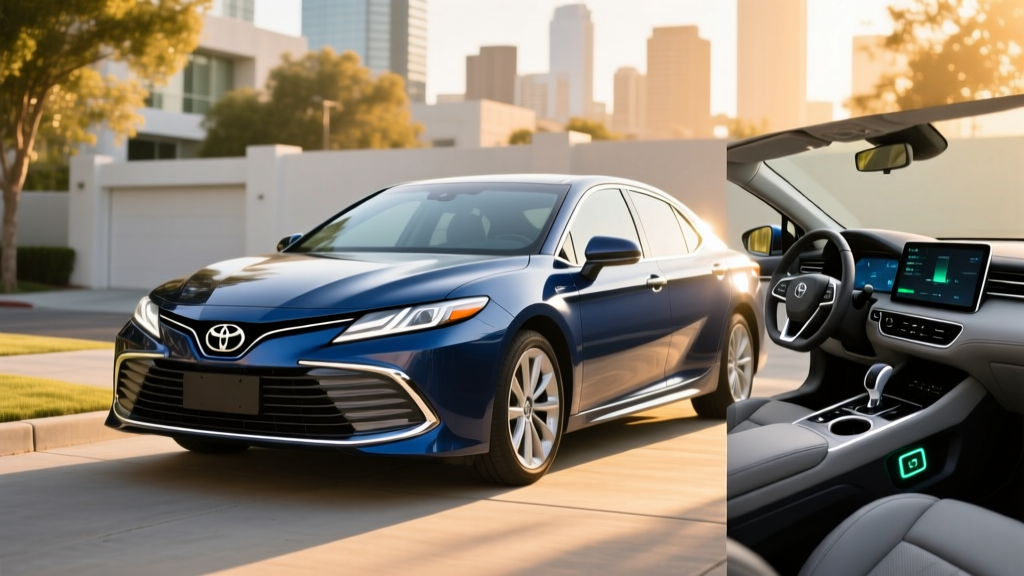
The 2026 Toyota Camry Hybrid XLE sits in a rare sweet spot for sedan buyers who want electrified efficiency without plugging in. Now in its second year of the ninth-generation redesign, the Camry Hybrid pairs a 2.5-liter four-cylinder with Toyota's fifth-generation hybrid system to deliver an EPA-estimated 44 MPG combined — a figure many owners beat in city driving. The XLE trim adds premium touches like a 12.3-inch infotainment display, heated front seats, and Toyota Safety Sense 3.0 without pushing the MSRP past $35,000 before destination.
This is a conventional hybrid (HEV), not a plug-in hybrid (PHEV). That distinction matters: you never plug it in, there is no electric-only driving range to manage, and it does not qualify for the federal §30D EV tax credit. What you get instead is seamless, proven hybrid operation with the reliability backing of Toyota's hybrid battery warranty.
| Spec | Value |
|---|---|
| Powertrain | 2.5L 4-cyl + 2 electric motors (FWD) / 3 motors (AWD) |
| Combined Horsepower | 225 hp (FWD) / 232 hp (AWD) |
| EPA MPG (City / Hwy / Combined) | 48 / 41 / 44 (FWD) — 46 / 40 / 43 (AWD) |
| Hybrid Battery | ~1.0 kWh lithium-ion (sealed, self-charging) |
| Drivetrain | FWD standard, AWD available |
| 0–60 mph | ~7.1 seconds (FWD) |
| Base MSRP (XLE trim) | $33,995 (FWD) / $35,395 (AWD, est.) |
| Destination Charge | $1,195 |
| Battery Warranty | 10 years / 150,000 miles |
| Powertrain Warranty | 5 years / 60,000 miles |
Hybrid vs Plug-In Hybrid: What the Camry Actually Is
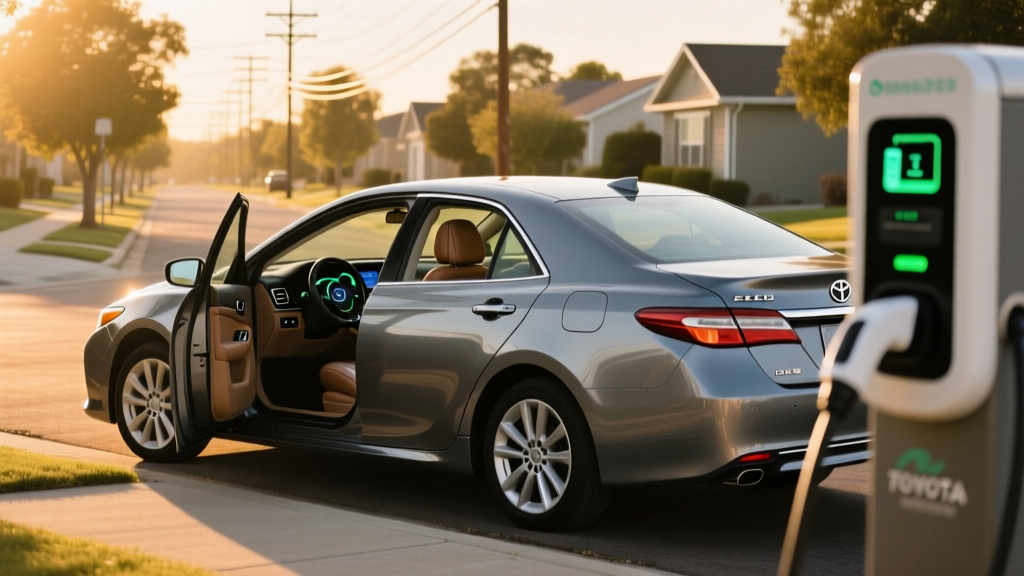
A common source of confusion in the showroom is whether the Camry Hybrid needs to be plugged in. It does not. The 2026 Camry Hybrid is a conventional hybrid electric vehicle (HEV). Its small lithium-ion battery recharges through regenerative braking and the gasoline engine. You fuel it like any other car and never think about charging infrastructure.
HEV vs PHEV vs BEV — Which Fits You?
| Factor | HEV (Camry Hybrid) | PHEV (e.g., Prius Prime) | BEV (e.g., Tesla Model 3) |
|---|---|---|---|
| Plug in required? | No | Yes (for EV range) | Yes (always) |
| Electric-only range | None (EV assist only) | ~40 miles typical | 250–360+ miles |
| Fuel/energy source | Gasoline only | Gasoline + electricity | Electricity only |
| Federal tax credit (§30D) | Not eligible | Up to $7,500 if eligible | Up to $7,500 if eligible |
| Home charging needed | No | Recommended (Level 2) | Essential |
| Best for | No garage/outlet access | Short commutes + road trips | Home charging + daily driving |
Toyota does not currently offer a Camry PHEV in the US market. If plug-in capability is a priority, the Toyota Prius Prime (up to 44 miles of electric-only range) or the RAV4 Prime (42 miles EV range) are the closest Toyota alternatives with a plug.
Fuel Economy: EPA Numbers and Real-World MPG
The EPA rates the 2026 Camry Hybrid XLE at 48 city / 41 highway / 44 combined MPG with front-wheel drive. Adding all-wheel drive drops those figures slightly to 46/40/43.
| Drivetrain | City | Highway | Combined | Annual Fuel Cost* |
|---|---|---|---|---|
| FWD | 48 MPG | 41 MPG | 44 MPG | ~$1,350 |
| AWD | 46 MPG | 40 MPG | 43 MPG | ~$1,380 |
*Based on 15,000 miles/year, 55% city driving, $3.30/gal regular unleaded. Your costs will vary with local fuel prices and driving habits.
Real-World MPG: What Owners Actually See
Toyota's hybrid system excels in stop-and-go traffic where regenerative braking recaptures energy frequently. In real-world driving, many Camry Hybrid owners report 46–52 MPG in city and suburban conditions, sometimes exceeding the EPA city estimate. Highway-only driving at 75+ mph tends to yield 38–42 MPG, below the EPA highway number, because aerodynamic drag dominates and the electric motor provides less assistance at sustained high speeds.
In cold weather (below 30°F), expect a 5–10% drop in fuel economy as the engine runs more frequently to maintain cabin heat and the battery operates less efficiently. This is modest compared to the 20–30% range loss a battery-electric vehicle experiences in the same conditions.
Powertrain and Performance
The 2026 Camry Hybrid uses Toyota's fifth-generation Hybrid Synergy Drive. A 2.5-liter Dynamic Force four-cylinder engine (184 hp on its own) pairs with two front-mounted electric motor-generators for a net system output of 225 horsepower in FWD configuration. Opt for the electronic on-demand AWD, and a third rear-mounted motor brings total output to 232 hp.
The result is confident acceleration — 0–60 mph in roughly 7.1 seconds for FWD — and seamless transitions between electric and gas power that most drivers never notice. The eCVT transmission eliminates shift shock entirely. At low speeds and in parking lots, the Camry Hybrid operates on electric power alone for short bursts, though this is measured in hundreds of feet, not miles.
The AWD system is worth considering for buyers in snow-belt states. It engages the rear motor automatically when front-wheel slip is detected and does not carry the fuel-economy penalty of a traditional mechanical AWD system — only 1 MPG combined separates FWD from AWD.
Pricing, Trims, and Tax Credit Eligibility
The 2026 Camry Hybrid XLE starts at an MSRP of $33,995 for FWD, with the AWD option adding approximately $1,400, bringing the AWD XLE to roughly $35,395. Adding the $1,195 destination charge puts the out-the-door starting price near $35,190 before any dealer adjustments, taxes, or registration.
Does the Camry Hybrid Qualify for a Federal Tax Credit?
No. The federal §30D Clean Vehicle Credit applies only to plug-in electric vehicles — battery-electric vehicles (BEVs) and plug-in hybrids (PHEVs) that meet battery capacity, critical-mineral sourcing, MSRP, and buyer income requirements. As a conventional hybrid, the 2026 Camry Hybrid XLE does not qualify for the §30D credit or the point-of-sale transfer option.
Federal Tax Credit Eligibility Checklist (§30D)
- ❌ Vehicle must be a BEV or PHEV with ≥7 kWh battery — Camry Hybrid has ~1.0 kWh (not eligible)
- ❌ MSRP cap: $55,000 for sedans — Camry Hybrid XLE is under cap, but vehicle type disqualifies
- ✅ Buyer income caps apply to qualifying vehicles: $150K single / $300K joint AGI
- ✅ Critical minerals and battery component sourcing rules apply to qualifying vehicles
Source: IRS §30D Clean Vehicle Credit. Rules current for 2026; consult a tax professional for personal eligibility.
Some states and utilities offer rebates or incentives for conventional hybrids, though these are less common than EV incentives. Check your state energy office or local utility for current programs.
Battery Warranty, Reliability, and Replacement Costs
The hybrid battery is the component that worries first-time hybrid buyers most. Toyota addresses this directly with one of the strongest warranties in the industry: 10 years or 150,000 miles (whichever comes first) on the hybrid battery and all hybrid-system components, including the inverter and motor-generators. This warranty is transferable to subsequent owners.
How Long Do Camry Hybrid Batteries Actually Last?
Toyota's hybrid batteries are engineered for longevity. Unlike a BEV battery that undergoes deep charge-discharge cycles, the Camry Hybrid's ~1.0 kWh battery operates in a narrow state-of-charge window — typically between 40% and 80% — which dramatically reduces degradation stress. Real-world data from millions of Toyota hybrids on the road shows most hybrid batteries last well beyond 150,000 miles, with many reaching 200,000+ miles without replacement.
What Does a Hybrid Battery Replacement Cost?
If a replacement is needed outside of warranty, a new OEM hybrid battery for the Camry Hybrid typically costs between $2,500 and $4,000 including labor at a Toyota dealership. Independent hybrid specialists often offer refurbished or reconditioned battery packs for $1,500–$2,500. For context, this is a fraction of a BEV battery replacement, which can exceed $10,000–$18,000.
Toyota's track record with hybrid reliability is well-established. The Camry Hybrid has consistently earned high marks from Consumer Reports and J.D. Power for long-term dependability. The hybrid system actually reduces wear on certain components — regenerative braking extends brake pad life significantly, and the engine's start-stop operation is managed smoothly by the electric motor, reducing starter motor wear.
Safety and Driver Assistance
Every 2026 Camry Hybrid XLE comes equipped with Toyota Safety Sense 3.0, which includes:
- Pre-Collision System with Pedestrian Detection
- Full-Speed Range Dynamic Radar Cruise Control
- Lane Departure Alert with Steering Assist
- Lane Tracing Assist
- Road Sign Assist
- Automatic High Beams
- Proactive Driving Assist (subtle braking and steering support)
This is an SAE Level 2 driver-assistance system — it provides combined steering and speed support but requires the driver to remain fully engaged, with hands on the wheel and eyes on the road at all times. It is not autonomous or self-driving. The Camry earned the IIHS Top Safety Pick+ designation for the previous model year; 2026 crash-test results from IIHS and NHTSA should be checked for the latest ratings.
XLE Trim Features: What You Get for the Price
The XLE sits above the SE and XSE sport trims in comfort orientation and includes premium features that justify its position in the lineup:
- 12.3-inch Toyota Audio Multimedia touchscreen with wireless Apple CarPlay and Android Auto
- Wireless phone charging pad
- Heated front seats with 8-way power driver's seat
- Dual-zone automatic climate control
- Smart Key System with push-button start
- 18-inch alloy wheels
- LED headlights and taillights
- Blind Spot Monitor with Rear Cross-Traffic Alert
- Available panoramic glass roof ($1,000+ option)
- Available JBL premium audio with 9 speakers
The XLE's ride quality benefits from a tuned suspension that prioritizes comfort over the sportier XSE setup. Cabin noise levels are among the lowest in the midsize sedan segment, aided by acoustic glass and generous insulation.
Pros
- 48 MPG city EPA — among the best of any midsize sedan
- No plug-in charging required; fuel and go
- 10-year / 150,000-mile hybrid battery warranty
- Comprehensive Toyota Safety Sense 3.0 standard
- AWD available with minimal fuel economy penalty
- Strong resale value and proven reliability record
- Premium XLE features at a sub-$35K starting price
Cons
- No electric-only driving range (HEV, not PHEV)
- No federal tax credit eligibility
- eCVT can feel drone-y under hard acceleration
- Rear seat space slightly tighter than some competitors
- No DC fast charging capability (not applicable for HEV)
- AWD adds ~$1,400 and is not available with all option packages
Who Should Buy the 2026 Camry Hybrid XLE?
Choose the Camry Hybrid XLE If:
- You want maximum MPG without changing your fueling habits
- You don't have access to home or workplace charging for a plug-in vehicle
- You regularly drive in city or suburban stop-and-go traffic (where hybrids shine)
- You want a midsize sedan with proven long-term reliability and strong resale
- You value comfort-oriented features over sport handling
Consider a PHEV or BEV Instead If:
- You have home charging and want to drive on electricity for daily commutes
- You want to qualify for the federal §30D tax credit (up to $7,500)
- Your commute is under 40 miles round-trip (a PHEV like the Prius Prime covers this on electricity alone)
- You want zero tailpipe emissions for local air quality
Ownership Costs: 5-Year Estimate
| Category | Estimated Cost |
|---|---|
| Purchase Price (MSRP + destination) | $35,190 |
| Fuel (15,000 mi/yr × 5 yrs @ $3.30/gal, 44 MPG) | $5,625 |
| Insurance (national avg for midsize sedan) | $7,500 |
| Maintenance (oil changes, tires, brakes) | $2,800 |
| Estimated Depreciation (5 years) | $12,000 |
| Total Estimated 5-Year Cost | ~$63,115 |
Depreciation estimate based on historical Camry Hybrid resale trends. Actual costs vary by location, driving habits, insurance profile, and market conditions.
Compared to a gasoline-only midsize sedan averaging 28 MPG combined, the Camry Hybrid saves approximately $2,800 in fuel costs over five years at 15,000 miles annually — a meaningful offset to its slightly higher purchase price.
Frequently Asked Questions
How many MPG does the 2026 Camry Hybrid XLE get?
The EPA rates the FWD Camry Hybrid XLE at 48 city / 41 highway / 44 combined MPG. The AWD version is rated at 46/40/43. In real-world city driving, many owners report 46–52 MPG thanks to the hybrid system's regenerative braking efficiency.
Does the Camry Hybrid need to be plugged in?
No. The 2026 Camry Hybrid is a conventional HEV (hybrid electric vehicle). Its battery charges through regenerative braking and the gasoline engine. You never plug it in.
Does the 2026 Camry Hybrid qualify for a federal tax credit?
No. The federal §30D Clean Vehicle Credit applies only to plug-in vehicles (BEVs and PHEVs). The Camry Hybrid, as a conventional HEV, does not qualify. Some state or utility incentives may apply — check local programs.
How long does the Camry Hybrid battery last, and what does replacement cost?
Toyota warranties the hybrid battery for 10 years or 150,000 miles. Most Toyota hybrid batteries last well beyond 150,000 miles in real-world use. If replacement is needed out of warranty, expect to pay $2,500–$4,000 for a new OEM battery at a dealership, or $1,500–$2,500 for a refurbished unit from an independent specialist.
Is the Camry Hybrid XLE available with all-wheel drive?
Yes. The electronic on-demand AWD system is available on the XLE trim for an additional ~$1,400. It adds a rear electric motor, raises combined output to 232 hp, and costs only 1 MPG combined compared to FWD.
Hybrid vs PHEV vs EV — which should I choose?
Choose the Camry Hybrid (HEV) if you lack charging access and want hassle-free efficiency. Choose a PHEV (like the Prius Prime) if you can charge at home and want 40+ miles of electric commuting with gas backup for road trips. Choose a BEV (like the Tesla Model 3 or Hyundai Ioniq 6) if you have reliable home charging, want zero tailpipe emissions, and want to maximize fuel savings and tax incentives.
How does the Camry Hybrid compare to the Honda Accord Hybrid?
The 2026 Honda Accord Hybrid is rated at 48 city / 47 highway / 48 combined MPG (Sport/LX trims), giving it a slight highway and combined advantage. The Camry Hybrid counters with available AWD, a slightly lower starting price, and Toyota's longer hybrid battery warranty (10yr/150K vs Honda's 8yr/100K on the hybrid battery). Both are excellent choices; the Camry edges ahead for cold-climate buyers who want AWD.