Quick Verdict: The 2025 Honda CR-V Hybrid at a Glance
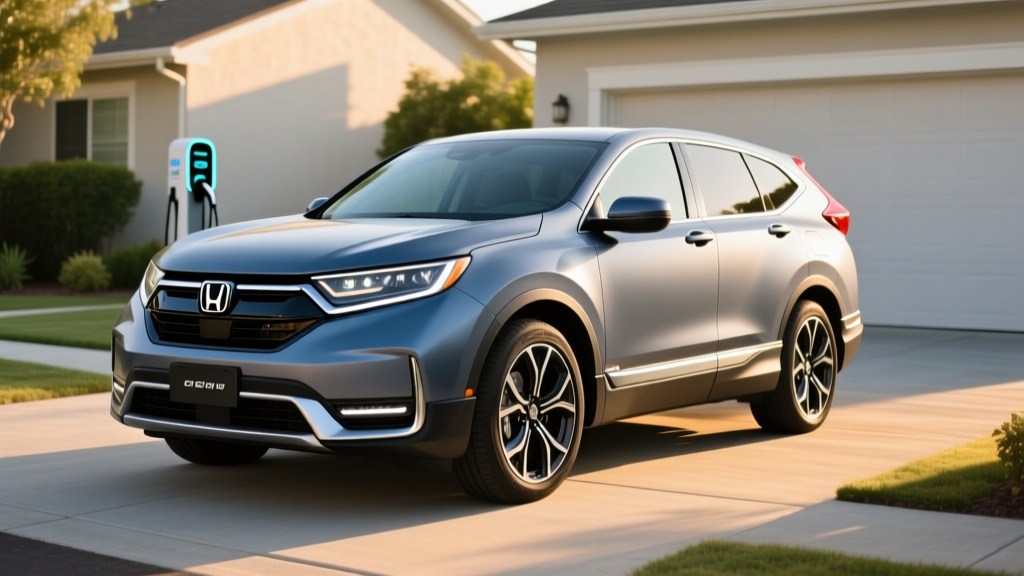
The 2025 Honda CR-V Hybrid remains one of the most compelling compact SUVs for buyers who want electric-motor efficiency without ever plugging in. Honda pairs a 2.0-liter Atkinson-cycle four-cylinder engine with a two-motor hybrid system producing a combined 204 horsepower and 247 lb-ft of torque. The result is a spacious five-passenger SUV that returns an EPA-estimated 40 MPG combined — while offering all-wheel drive availability, Honda Sensing safety tech as standard, and a starting price under $36,000.
This is a conventional hybrid (HEV), not a plug-in hybrid (PHEV). That means no charging cable, no electric-only range to manage, and no federal EV tax credit. For many buyers, that simplicity is the point. Let's break down exactly what the 2025 CR-V Hybrid delivers — and where it falls short.
HEV vs. PHEV: What the 2025 CR-V Hybrid Is (and Isn't)
Conventional Hybrid (HEV) — The 2025 CR-V Hybrid is an HEV. Its small battery (approximately 1.06 kWh) recharges through regenerative braking and the gas engine. You never plug it in. The electric motor assists the engine and enables brief low-speed electric-only driving, but the gasoline engine remains the primary energy source.
Plug-in Hybrid (PHEV) — A PHEV like the Toyota RAV4 Prime or Hyundai Tucson PHEV carries a larger battery (13–18 kWh) that you plug in to recharge, offering 30–42 miles of electric-only driving before the gas engine takes over. Honda does not currently offer a CR-V PHEV in the U.S. market.
Battery Electric Vehicle (BEV) — A full EV like the Hyundai Ioniq 5 or Tesla Model Y runs exclusively on electricity stored in a large battery pack (60–80+ kWh). No gas engine. Requires home or public charging infrastructure.
If you're cross-shopping the 2025 Honda CR-V Hybrid, you're likely deciding between this HEV, a competitor PHEV, or a full EV. The right choice depends on your driving pattern, charging access, and budget — a framework we'll cover in detail below.
Fuel Economy: EPA Ratings and Real-World MPG
Fuel efficiency is the primary reason buyers choose the CR-V Hybrid over the gasoline-only CR-V. Here are the official EPA estimates from fueleconomy.gov:
| Drivetrain | City MPG | Highway MPG | Combined MPG |
|---|---|---|---|
| FWD (Sport / Sport Touring) | 43 | 36 | 40 |
| AWD (Sport / Sport Touring) | 40 | 34 | 37 |
Real-World MPG: What to Actually Expect
Honda's hybrid system excels in stop-and-go city driving, where regenerative braking recaptures energy and the electric motor handles low-speed propulsion. FWD models can exceed their 43 MPG city EPA estimate in mild weather on suburban routes — drivers on Fuelly and similar tracking platforms regularly report 41–45 MPG in mixed city driving.
Highway efficiency drops noticeably. At sustained 70–80 mph speeds, expect 32–35 MPG in the AWD model and 34–37 MPG in FWD. The Atkinson-cycle engine is optimized for efficiency at lower loads, and aerodynamic drag dominates at highway speeds where the electric motor provides less benefit.
Cold-weather impact: In temperatures below 35°F, expect a 3–5 MPG reduction in combined driving. The engine runs more frequently to provide cabin heat and maintain operating temperature, reducing the hybrid system's electric-assist advantage.
Powertrain and Performance Specs
| Specification | 2025 Honda CR-V Hybrid |
|---|---|
| Powertrain Type | Conventional Hybrid (HEV) |
| Engine | 2.0L Atkinson-cycle 4-cylinder |
| Engine Output | 145 hp @ 6,100 rpm |
| Electric Motors | Two-motor hybrid system |
| Combined System Output | 204 hp / 247 lb-ft torque |
| Transmission | e-CVT (direct-drive) |
| Drivetrain | FWD standard; Real Time AWD available |
| 0–60 mph | ~7.6 seconds (AWD) |
| Towing Capacity | 1,000 lbs |
| Battery Type | Lithium-ion (~1.06 kWh) |
| Fuel Tank | 14.0 gallons |
| Total Driving Range | ~518–560 miles (FWD/AWD) |
The two-motor system uses one motor primarily as a generator and the other as the drive motor. At highway speeds, a lock-up clutch connects the engine directly to the drive wheels for improved efficiency — a design Honda has refined over multiple generations. The result is smooth, linear acceleration without the rubber-band feel that older e-CVT systems produced.
At 7.6 seconds to 60 mph, the CR-V Hybrid AWD is quicker than most compact hybrid SUV competitors (the Toyota RAV4 Hybrid clocks in around 7.4 seconds, while the Hyundai Tucson Hybrid runs about 7.1 seconds). It's adequate for merging and passing, though not sporty. The 1,000-pound towing capacity is modest — if you need to tow a small trailer, the gas CR-V's 1,500-pound rating or a body-on-frame SUV is a better fit.
Pricing, Trims, and Tax Credit Eligibility
The 2025 CR-V Hybrid is offered in two trims, both positioned in the mid-to-upper range of the CR-V lineup:
| Trim | Drivetrain | MSRP |
|---|---|---|
| Sport Hybrid | FWD | $35,850 |
| Sport Hybrid | AWD | $37,350 |
| Sport Touring Hybrid | AWD (standard) | $40,850 |
Prices include destination charge. Source: Honda's official 2025 CR-V Hybrid page.
Does the 2025 CR-V Hybrid Qualify for a Federal Tax Credit?
No. The 2025 Honda CR-V Hybrid is a conventional hybrid (HEV), not a plug-in vehicle. Under IRS §30D rules, only battery electric vehicles (BEVs) and plug-in hybrids (PHEVs) with sufficient battery capacity and qualifying battery sourcing are eligible for the federal clean vehicle credit of up to $7,500. Conventional hybrids do not qualify for any federal purchase incentive.
Some states may offer minor incentives for hybrid vehicles, and certain employers or utilities provide fuel-efficiency rebates, but these vary by jurisdiction. Check your state energy office or utility provider for local programs. There is no federal or widely available state tax credit for the CR-V Hybrid specifically.
Total Cost of Ownership vs. Gas CR-V
The Hybrid carries a roughly $2,500–$3,000 premium over the comparably equipped gas-only CR-V. At current fuel prices (~$3.40/gallon national average), a driver covering 15,000 miles per year would save approximately $600–$800 annually in fuel costs with the Hybrid (40 MPG combined vs. 30 MPG combined for the gas model). That premium pays for itself in roughly 3.5–5 years, depending on driving mix and local fuel prices.
Battery Warranty, Reliability, and Replacement Cost
Honda Hybrid Battery Warranty: 8 years / 100,000 miles (10 years / 150,000 miles in CARB states including California, New York, Massachusetts, and others adopting California emissions standards).
Coverage: Defects and capacity loss below a defined threshold (typically 60–70% state of health). Honda's hybrid battery warranty is among the strongest in the segment.
Long-Term Reliability
Honda's two-motor hybrid system is now in its fourth generation and has proven durable. The lithium-ion hybrid battery is small (~1.06 kWh) and operates within a narrow state-of-charge window — it never fully charges or fully depletes — which significantly reduces degradation compared to a BEV or PHEV battery that cycles through a wider range.
Real-world failure data from CR-V Hybrids in service since 2020 shows very low hybrid battery replacement rates within the first 100,000 miles. The e-CVT transmission is a direct-drive unit with no traditional belts or bands to wear, contributing to powertrain longevity.
Battery Replacement Cost
If the hybrid battery does require replacement outside warranty coverage, expect a cost between $2,000 and $4,000 including parts and labor at a Honda dealership. This is considerably less than a BEV or large PHEV battery replacement (which can exceed $10,000–$20,000) because the CR-V Hybrid's battery pack is small. Third-party hybrid battery refurbishers may offer reconditioned units for $1,200–$2,000.
Overall Vehicle Reliability
The 2025 CR-V carries strong reliability projections based on Honda's track record. IIHS has awarded the CR-V top safety ratings, and Honda Sensing — including adaptive cruise control, lane-keeping assist, automatic emergency braking, and road departure mitigation — comes standard on every trim. Note that Honda Sensing is a Level 2 driver-assist system per SAE classification: the driver must remain fully engaged and cannot delegate driving responsibility to the system.
Who Should Choose the CR-V Hybrid vs. a PHEV or Full EV?
Choose the 2025 CR-V Hybrid If:
- You lack access to home or workplace charging (apartment, street parking, no garage outlet)
- You want EV-like city fuel economy with zero behavior change — just fill up with gas
- Your annual mileage is high (15,000+ miles), making the MPG savings meaningful
- You want a proven, low-risk powertrain with strong warranty coverage
- You value cargo space and practicality (the hybrid battery is under the rear seats, preserving cargo volume)
- You frequently take road trips and don't want to plan around charging stops
Consider a PHEV or Full EV Instead If:
- You have reliable Level 2 home charging and a short commute (a PHEV can cover 30–40 miles daily on electricity alone)
- You want to eliminate tailpipe emissions for daily driving (a BEV produces zero direct emissions)
- You qualify for the $7,500 federal tax credit on a BEV or PHEV, which significantly narrows the price gap
- You want one-pedal driving and instant electric torque (the CR-V Hybrid's electric assist is subtle)
- Your state offers additional EV-only incentives (HOV lane access, rebates, reduced registration fees)
Decision Framework
CR-V Hybrid (HEV): Best for drivers without charging access who want maximum simplicity. Total fuel cost: ~$1,275/year at 15,000 miles and 40 MPG. No infrastructure investment needed.
PHEV (e.g., RAV4 Prime, Tucson PHEV): Best for drivers with home charging and commutes under 35 miles. You'll drive most weekdays on electricity (~$0.12/kWh at home = ~$540/year for 15,000 miles of mixed electric/gas driving). Higher upfront cost ($40,000–$45,000) but potential $7,500 federal credit.
Full EV (e.g., Ioniq 5, Model Y): Best for drivers with reliable charging who want zero gas station visits. Annual fuel cost: ~$540–$720 at home charging rates. Higher purchase price but lowest operating cost and potential $7,500 federal credit.
Frequently Asked Questions
How many MPG does the 2025 Honda CR-V Hybrid get?
The FWD model is EPA-rated at 43 city / 36 highway / 40 combined MPG. The AWD model drops to 40 city / 34 highway / 37 combined. Real-world city driving often matches or slightly exceeds the EPA estimate, while highway driving at 75+ mph typically returns 2–4 MPG below the sticker.
Does the 2025 CR-V Hybrid need to be plugged in?
No. The CR-V Hybrid is a conventional hybrid (HEV). Its small lithium-ion battery charges through regenerative braking and the gasoline engine. There is no plug, no charging cable, and no electric-only range to manage.
How far can the 2025 CR-V Hybrid drive on electric power alone?
Only about 1 mile or less at very low speeds (under 25 mph). The hybrid system uses electric assist to improve efficiency, not to provide meaningful electric-only range. If you want 30+ miles of electric-only driving, you need a plug-in hybrid or a full EV.
Is the 2025 Honda CR-V Hybrid reliable?
Honda's fourth-generation two-motor hybrid system has demonstrated strong reliability since its introduction. The hybrid battery operates within a narrow charge window to minimize degradation, and the e-CVT has no traditional wear components. The hybrid battery carries an 8-year/100,000-mile warranty (10 years/150,000 miles in CARB states).
How much does it cost to replace the CR-V Hybrid battery?
Out-of-warranty replacement costs range from $2,000–$4,000 at a Honda dealer, or $1,200–$2,000 through a third-party refurbisher. Because the battery is small (~1.06 kWh), replacement is far less expensive than a BEV or PHEV battery swap.
Does the 2025 CR-V Hybrid qualify for any tax credit?
No federal tax credit applies. The IRS §30D clean vehicle credit is available only for plug-in vehicles (BEVs and PHEVs) meeting battery sourcing and MSRP requirements. Conventional hybrids like the CR-V Hybrid are not eligible. Check your state and local utility for any hybrid-specific incentives, though these are uncommon.
What's the difference between the CR-V Hybrid Sport and Sport Touring trims?
The Sport trim starts at $35,850 (FWD) and includes a 7-inch touchscreen, wireless Apple CarPlay/Android Auto, heated front seats, and dual-zone climate control. The Sport Touring ($40,850, AWD only) adds a 9-inch touchscreen with wireless CarPlay/Android Auto, navigation, a premium Bose audio system, wireless phone charging, heated rear seats, a heated steering wheel, and a hands-free power tailgate.
Can the 2025 CR-V Hybrid tow?
Yes, but the towing capacity is limited to 1,000 pounds — suitable for a small utility trailer or a pair of dirt bikes, but not a boat or camping trailer. The gasoline CR-V offers a slightly higher 1,500-pound rating.