Quick Verdict: A Practical Hybrid SUV That Doesn't Ask You to Plug In
The 2025 Honda CR-V Hybrid targets buyers who want meaningful fuel savings without changing their refueling habits. It's a conventional hybrid (HEV), not a plug-in — meaning you never need to search for a charger or install home charging equipment. You simply fill up with gas and let Honda's two-motor hybrid system recapture energy during braking and low-speed driving. For 2025, Honda continues the CR-V Hybrid across Sport, Sport-L, and Sport Touring trims, all powered by the same proven fourth-generation two-motor hybrid powertrain paired with a 2.0-liter Atkinson-cycle four-cylinder engine.
This guide covers everything a research-driven buyer needs: the interior dimensions and cargo space that make the CR-V Hybrid a family favorite, exact EPA fuel economy figures, real-world MPG expectations, powertrain specs, battery warranty details, and a clear framework for deciding whether this HEV, a PHEV, or a full BEV is the right fit for your driving pattern.
2025 Honda CR-V Hybrid Interior: Dimensions, Cargo, and Cabin Quality
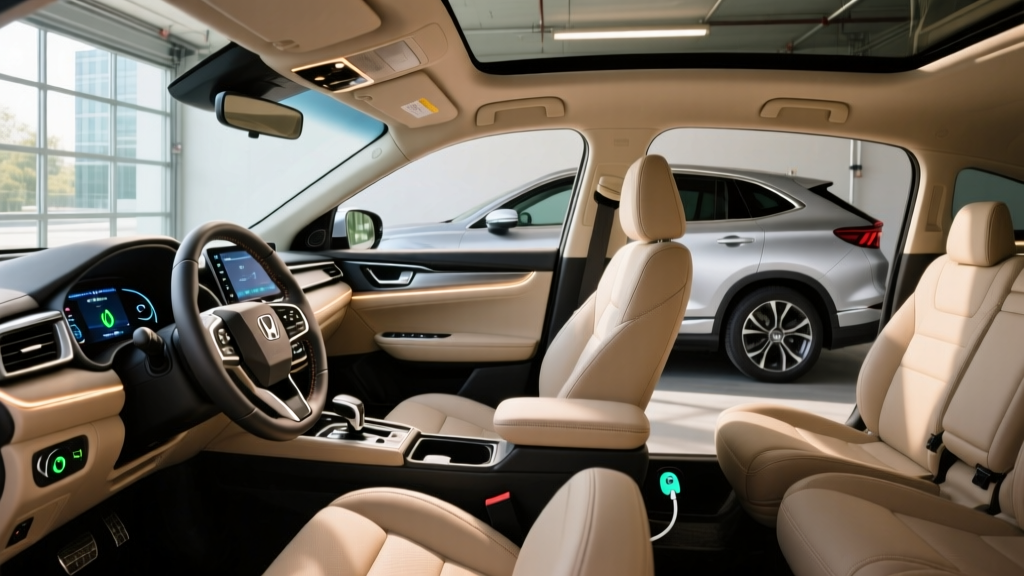
The keyword that brings many shoppers to this page — the 2025 Honda CR-V Hybrid interior — reflects a genuine competitive advantage. Honda redesigned the CR-V for the current generation with noticeably more rear-seat legroom and cargo volume than the outgoing model, and the hybrid variants share the same cabin dimensions as their gas-only siblings. The battery pack is packaged under the cargo floor, so you don't lose any usable space.
| Measurement | Specification |
|---|---|
| Front headroom | 40.0 in |
| Front legroom | 41.3 in |
| Rear headroom | 38.2 in |
| Rear legroom | 41.0 in |
| Cargo volume (behind rear seats) | 36.3 cu ft |
| Cargo volume (rear seats folded) | 76.5 cu ft |
| Seating capacity | 5 passengers |
| Infotainment screen (Sport Touring) | 9.0-inch touchscreen w/ wireless Apple CarPlay & Android Auto |
| Infotainment screen (Sport / Sport-L) | 7.0-inch touchscreen w/ wired Apple CarPlay & Android Auto |
| Wireless phone charging | Standard on Sport Touring; not available on lower trims |
The cabin materials are competitive for the compact SUV segment: soft-touch surfaces on the dashboard and door uppers, cloth upholstery on the Sport trim, and leather-trimmed seats on the Sport-L and Sport Touring. The honeycomb mesh air vent design and metal-look trim accents give the interior a more upscale feel than the previous generation. Rear-seat passengers benefit from available heated outboard seats and USB-C ports on the Sport Touring trim — useful for family road trips.
One practical note for hybrid shoppers: the CR-V Hybrid's cargo floor is slightly elevated compared to the gas model due to the hybrid battery and power electronics beneath it. The difference is minor — roughly an inch — and doesn't meaningfully impact loading groceries or strollers, but it's worth knowing if you frequently haul tall items with the rear seats folded flat.
Fuel Economy: EPA Ratings and Real-World MPG
The 2025 CR-V Hybrid's headline number is 40 MPG combined for front-wheel-drive trims, according to EPA data on fueleconomy.gov. All-wheel-drive (AWD) trims drop slightly to 37 MPG combined. Here's the full breakdown:
| Drivetrain | City MPG | Highway MPG | Combined MPG |
|---|---|---|---|
| FWD (Sport) | 43 | 36 | 40 |
| AWD (Sport, Sport-L, Sport Touring) | 40 | 34 | 37 |
Real-World MPG vs. EPA Sticker
Honda's two-motor hybrid system excels in stop-and-go city driving, where regenerative braking recaptures energy and the electric motor handles low-speed propulsion. This is why the city MPG rating is higher than the highway rating — the opposite of a conventional gas car. In real-world driving, owners who do mostly urban and suburban driving often report exceeding the EPA city estimate, sometimes seeing 42–45 MPG on the trip computer during warm-weather city commutes.
Highway driving is a different story. At sustained speeds above 70 mph, the gasoline engine does most of the work, and aerodynamic drag reduces efficiency. Expect 32–35 MPG on the highway in real-world conditions with AWD, slightly below the EPA rating. Cold weather also reduces efficiency — expect a 5–10% MPG penalty in freezing temperatures because the engine runs more frequently to provide cabin heat and because battery chemistry is less efficient when cold.
For a driver covering 15,000 miles per year in mixed driving (AWD trim), the CR-V Hybrid will consume roughly 405 gallons of fuel annually. At $3.40/gallon, that's about $1,377 per year in fuel. A comparable gas-only CR-V (28 MPG combined AWD) would burn about 536 gallons, or roughly $1,822 per year — a savings of around $445 annually with the hybrid.
Powertrain: Honda's Fourth-Generation Two-Motor Hybrid System
The 2025 CR-V Hybrid uses Honda's latest two-motor hybrid architecture, which is a series-parallel system. At low speeds and during gentle acceleration, the gasoline engine acts as a generator, producing electricity that powers the drive motor — essentially operating as a series hybrid. At higher cruising speeds, a lock-up clutch connects the engine directly to the wheels for greater efficiency, operating as a parallel hybrid.
| Specification | Value |
|---|---|
| Engine | 2.0L Atkinson-cycle DOHC 4-cylinder |
| Engine horsepower | 147 hp @ 6,100 rpm |
| Engine torque | 135 lb-ft @ 4,500 rpm |
| Drive motor output | 184 hp / 247 lb-ft |
| Combined system horsepower | 204 hp |
| Combined system torque | 247 lb-ft |
| Transmission | Electronic continuously variable (e-CVT) |
| Drivetrain options | FWD (Sport only) or AWD (Sport, Sport-L, Sport Touring) |
| 0–60 mph (est.) | ~7.6 seconds |
| Towing capacity | 1,000 lbs |
The 204 combined horsepower is adequate for daily driving and highway merging, though it won't feel quick compared to turbocharged competitors or electric SUVs with instant torque. The e-CVT delivers smooth, linear acceleration without the gear-hunting of a traditional automatic. Honda's AWD system uses a mechanical connection to the rear axle (not a separate rear motor), which keeps weight and complexity down but means the rear wheels don't receive electric-only propulsion.
HEV vs. PHEV vs. BEV: Which Powertrain Fits Your Life?
The CR-V Hybrid is a conventional hybrid (HEV). It has a small lithium-ion battery (approximately 1.1 kWh) that charges solely through regenerative braking and the gasoline engine. You never plug it in. This is fundamentally different from a plug-in hybrid (PHEV) or a battery electric vehicle (BEV).
| Feature | HEV (CR-V Hybrid) | PHEV (e.g., Toyota RAV4 Prime) | BEV (e.g., Tesla Model Y) |
|---|---|---|---|
| Plug in to charge? | No | Yes | Yes |
| Battery size | ~1.1 kWh | ~18.1 kWh | 60–82 kWh |
| Electric-only range | None (EV assist only) | 35–42 miles | 260–330 miles |
| Home charging needed? | No | Recommended (Level 2) | Essential |
| Federal tax credit (§30D) | Not eligible | Up to $7,500 (if eligible) | Up to $7,500 (if eligible) |
| Annual fuel cost (15k mi) | ~$1,377 | ~$600–$900* | ~$500–$700 (electricity) |
| Best for | No home charging access; want simplicity | Home charging + short commutes | Home charging + low running costs |
*PHEV fuel cost assumes regular home charging and a commute within electric-only range.
Choose the CR-V Hybrid (HEV) if: You don't have access to home or workplace charging, you want a no-compromise SUV with excellent fuel economy, and you prefer the lowest upfront cost. The CR-V Hybrid starts around $35,700 (Sport FWD) and requires zero behavioral change from a gas car.
Consider a PHEV if: You can install a Level 2 home charger, your daily commute is under 40 miles round-trip, and you want to drive mostly on electricity while keeping a gas engine for road trips. The tradeoff: PHEVs cost $5,000–$8,000 more upfront, though the federal tax credit can offset some of that.
Consider a full BEV if: You have reliable home charging, want the lowest per-mile energy cost, and your driving range needs are within 250–300 miles between charges (or you're comfortable with DC fast charging on road trips).
Pricing, Trims, and Tax Credit Eligibility
The 2025 Honda CR-V Hybrid is offered in three trims. Pricing below includes the destination charge:
- Sport (FWD): ~$35,700 MSRP
- Sport (AWD): ~$37,200 MSRP
- Sport-L (AWD): ~$39,500 MSRP
- Sport Touring (AWD): ~$42,200 MSRP
Does the CR-V Hybrid Qualify for a Federal Tax Credit?
No. The CR-V Hybrid is a conventional HEV, and the IRS §30D New Clean Vehicle Credit applies only to plug-in electric vehicles (BEVs and PHEVs) with sufficient battery capacity. Conventional hybrids do not qualify for the federal purchase credit. Some states may offer minor incentives for hybrids, but these vary by jurisdiction — check your state's energy office or department of environmental quality for current programs.
The fuel savings alone — roughly $445 per year compared to the gas CR-V AWD — mean the hybrid premium (approximately $1,300–$1,500 over a comparably equipped gas EX AWD) pays for itself in about three years of average driving.
Battery Warranty, Reliability, and Replacement Cost
Honda Hybrid Battery Warranty
- Hybrid battery warranty: 8 years / 100,000 miles (10 years / 150,000 miles in CARB states including CA, CO, CT, ME, MA, NJ, NY, OR, RI, VT, WA)
- Powertrain warranty: 5 years / 60,000 miles
- Hybrid system warranty: 8 years / 100,000 miles (covers inverter, electric motor, control unit)
- Limited vehicle warranty: 3 years / 36,000 miles
Is the CR-V Hybrid Reliable?
Honda's two-motor hybrid system has been in production since 2014 (Accord Hybrid) and is now in its fourth generation. The system is well-proven with a strong reliability track record. Unlike early hybrid systems from two decades ago, modern lithium-ion hybrid batteries are designed with robust thermal management and conservative state-of-charge windows (the system never fully charges or fully depletes the small battery), which significantly extends cell life.
Based on historical data from Honda's hybrid lineup, the CR-V Hybrid's battery pack should last well beyond the warranty period — typically 150,000+ miles before significant degradation. The battery is small (~1.1 kWh), so even if it degrades 20% over a decade, the impact on fuel economy is minimal (perhaps 1–2 MPG) because the gasoline engine compensates.
Battery Replacement Cost
If the hybrid battery does need replacement out of warranty, expect a cost in the range of $2,000–$4,000 including parts and labor at a Honda dealership. This is considerably less than a full EV battery replacement ($10,000–$20,000+) because the CR-V Hybrid's battery is small. Third-party hybrid battery specialists often offer refurbished replacements for $1,200–$2,000. In practice, hybrid battery failures before 150,000 miles are uncommon.
Pros, Cons, and the Bottom Line
Pros
- 40 MPG combined (FWD) — best-in-class for a non-plug-in compact SUV
- Spacious interior with 41.0 inches of rear legroom and 36.3 cu ft cargo
- No plug-in charging required — zero lifestyle change from a gas car
- Strong hybrid battery warranty (8 yr/100k mi; 10 yr/150k mi in CARB states)
- Smooth, quiet e-CVT powertrain with 204 combined hp
- Lower annual fuel cost (~$445/yr savings vs. gas CR-V AWD)
Cons
- No electric-only driving capability — always uses gasoline
- No federal tax credit eligibility (HEV, not PHEV or BEV)
- AWD highway MPG drops to 34 — less impressive on road trips
- Sport trim gets the smaller 7-inch infotainment screen
- Towing limited to 1,000 lbs (gas CR-V: 1,500 lbs)
- No DC fast charging or plug-in option available
The 2025 Honda CR-V Hybrid is the right choice for buyers who want a fuel-efficient compact SUV without the complexity, cost, or infrastructure requirements of a plug-in vehicle. The interior is roomy, the powertrain is proven, and the real-world fuel savings are meaningful. If you have home charging access and a short commute, a PHEV or BEV will save you more on energy — but if simplicity and a lower purchase price are priorities, the CR-V Hybrid is one of the strongest options in its segment.
Frequently Asked Questions
How many MPG does the 2025 Honda CR-V Hybrid get?
The EPA rates the FWD CR-V Hybrid at 43 city / 36 highway / 40 combined MPG. The AWD version is rated at 40 city / 34 highway / 37 combined. Real-world city driving often exceeds EPA estimates by 2–5 MPG, while sustained highway driving at 75+ mph may fall 2–3 MPG below the sticker.
Does the CR-V Hybrid need to be plugged in?
No. The 2025 CR-V Hybrid is a conventional hybrid (HEV). Its small lithium-ion battery charges through regenerative braking and the gasoline engine. You refuel it exactly like a regular gas car at any gas station.
How far can the CR-V Hybrid drive on electric power alone?
The CR-V Hybrid cannot drive on electric power alone for any meaningful distance. The electric motor assists the gasoline engine during acceleration and can propel the car at very low speeds (under ~15 mph) for brief moments, but the gasoline engine is always running or ready to engage. If you want electric-only driving, you need a PHEV like the Toyota RAV4 Prime (42 miles electric-only) or a full BEV.
Does the 2025 CR-V Hybrid qualify for any tax credit?
The CR-V Hybrid does not qualify for the federal §30D New Clean Vehicle Credit because it is not a plug-in vehicle. That credit (up to $7,500) is reserved for BEVs and PHEVs that meet battery sourcing, MSRP cap, and buyer income requirements per IRS guidelines. Some states may offer small rebates for hybrids — check your state energy office.
Is the Honda CR-V Hybrid reliable, and what does a battery replacement cost?
Honda's hybrid system has a strong reliability record spanning over a decade of production. The hybrid battery is covered by an 8-year/100,000-mile warranty (10 years/150,000 miles in CARB states). Out-of-warranty replacement costs typically range from $2,000–$4,000 at a dealership, or $1,200–$2,000 through third-party specialists. Battery failures before 150,000 miles are rare.
Should I buy the CR-V Hybrid or wait for a plug-in version?
Honda has not announced a CR-V PHEV for the U.S. market as of early 2026. If you need plug-in capability now, the Toyota RAV4 Prime (PHEV, 42 miles electric, up to $7,500 tax credit if eligible) is the closest competitor. If you're satisfied with 37–40 MPG and don't want to install a home charger, there's no reason to wait — the CR-V Hybrid is available now with proven efficiency.
What's the difference between the Sport, Sport-L, and Sport Touring trims?
The Sport is the base hybrid trim with cloth seats and a 7-inch screen. The Sport-L adds leather-trimmed seats, a power tailgate, and heated front seats. The Sport Touring is the top trim with a 9-inch touchscreen, wireless Apple CarPlay/Android Auto, wireless phone charging, heated rear seats, a Bose premium audio system, and Honda's full Honda Sensing suite with low-speed braking control. All three share the identical 204-hp hybrid powertrain.