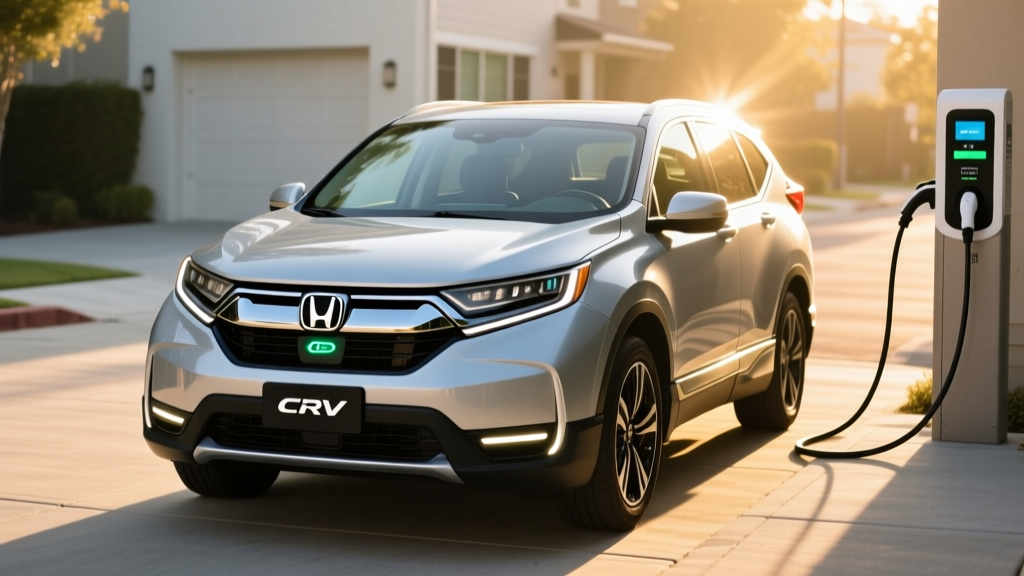
The compact SUV segment is flooded with electrified options, but the 2025 Honda CR-V Hybrid AWD remains one of the most pragmatic choices for buyers who want better fuel economy without changing their daily habits. No plugs, no range anxiety, no charging apps — just a two-motor hybrid system that delivers 204 combined horsepower and an EPA-estimated 40 MPG combined with all-wheel drive.
But does the real-world fuel economy match the sticker? How does Honda's hybrid battery hold up over a decade? And with plug-in hybrids and full EVs proliferating, is a conventional hybrid still the smart buy in 2025? This guide breaks down every spec that matters.
2025 Honda CR-V Hybrid AWD: Key Specs at a Glance
| Specification | 2025 CR-V Hybrid AWD |
|---|---|
| Powertrain | 2.0L 4-cyl Atkinson-cycle + 2-motor hybrid system |
| Combined Horsepower | 204 hp |
| Combined Torque | 247 lb-ft (electric motor) |
| Drivetrain | Real Time AWD™ (mechanical rear axle coupling) |
| EPA MPG (City / Hwy / Combined) | 40 / 34 / 37 |
| Fuel Tank Capacity | 14.0 gallons |
| Estimated Total Range | ~518 miles |
| 0–60 mph | ~7.6 seconds |
| Cargo Volume (behind rear seats) | 36.3 cu ft |
| Cargo Volume (rear seats folded) | 76.5 cu ft |
| Towing Capacity | 1,000 lbs |
| Hybrid Battery Warranty | 8 years / 100,000 miles |
| Starting MSRP (Sport trim) | $36,395 (incl. $1,395 destination) |
Source: Honda CR-V Hybrid official specs and EPA fueleconomy.gov
Fuel Economy: EPA Numbers vs. Real-World MPG
The 2025 CR-V Hybrid AWD carries an EPA rating of 40 city / 34 highway / 37 combined MPG. That city-dominant split is the hallmark of Honda's two-motor hybrid system, which uses the electric motor as the primary drive force at low and moderate speeds, engaging the gasoline engine mostly for highway cruising and hard acceleration.
| Driving Scenario | EPA Estimate | Real-World Expectation |
|---|---|---|
| City / Stop-and-Go | 40 MPG | 38–43 MPG (regenerative braking excels here) |
| Highway (70–80 mph) | 34 MPG | 30–33 MPG (aero drag, engine-direct drive) |
| Combined Mixed Driving | 37 MPG | 34–38 MPG |
| Cold Weather (below 30°F) | Not rated | 30–34 MPG (engine runs more for cabin heat) |
In practice, hybrid owners who do a lot of city and suburban driving frequently report beating the EPA combined figure. The regenerative braking system recovers energy at every stoplight, and the engine shuts off entirely during low-speed coasting. Highway-heavy commuters, however, will see numbers closer to 31–33 MPG, especially at speeds above 75 mph or in mountainous terrain.
Cold weather is the main MPG killer for conventional hybrids. Below freezing, the 2.0L engine must run more frequently to provide cabin heat (the CR-V Hybrid lacks a heat pump, which is a feature found in full EVs, not hybrids). Expect a 10–15% fuel economy drop in sustained winter conditions.
How the Hybrid Powertrain Actually Works
Honda's fourth-generation two-motor hybrid system in the CR-V is fundamentally different from the planetary-gear setups used by Toyota. Here's how it operates:
- EV Drive: At low speeds and light loads, the electric traction motor (181 hp, 247 lb-ft) powers the front wheels alone. The gas engine is off. The battery pack is small (~1.06 kWh usable) — this is not a plug-in system, so EV-only operation lasts roughly 1–2 miles at low speed.
- Hybrid Drive: Under moderate acceleration, the gas engine spins a generator motor that produces electricity to feed the traction motor. The engine is not mechanically connected to the wheels.
- Engine Direct Drive: Only at steady highway speeds (roughly 45–80 mph) does a lock-up clutch mechanically connect the 2.0L engine to the front wheels, because a gasoline engine is more efficient than an electric motor at sustained high-rpm cruising.
The AWD system is worth clarifying: Honda's Real Time AWD™ uses a mechanical coupling to send torque to the rear axle when front-wheel slip is detected. The rear wheels are not driven by a separate electric motor (unlike some Toyota hybrid AWD systems). This means the AWD system adds traction in rain and light snow but doesn't contribute to the hybrid efficiency equation.
Hybrid (HEV) vs. Plug-In Hybrid (PHEV) vs. Full EV: Which Is Right for You?
The 2025 CR-V is offered only as a conventional hybrid (HEV). Honda does not currently sell a CR-V plug-in hybrid in the United States. Here's how the three electrified powertrain types compare for a compact SUV buyer:
| Factor | HEV (CR-V Hybrid) | PHEV (e.g., Toyota RAV4 Prime) | Full EV (e.g., Hyundai Ioniq 5) |
|---|---|---|---|
| Plug-in Required? | No | Yes (for max benefit) | Yes |
| Electric-Only Range | ~1–2 miles | 35–42 miles | 250–320+ miles |
| Combined MPG / MPGe | 37 MPG | 38 MPG (gas) / 94 MPGe (elec) | 114–132 MPGe |
| Total Range | ~518 miles | ~600+ miles | 250–320 miles |
| Home Charging Needed? | No | Recommended (Level 2) | Required (Level 2) |
| Federal Tax Credit (§30D) | Not eligible | Up to $7,500 (if eligible) | Up to $7,500 (if eligible) |
| Starting Price Range | ~$36,000 | ~$44,000 | ~$42,000 |
| Best For | No home charger; want simplicity | Short commute + home charger | Home charger; low running cost |
- You don't have access to home or workplace Level 2 charging
- You want a lower purchase price and zero behavior change from a gas car
- You take frequent road trips exceeding 300 miles and don't want to plan charging stops
- You live in an apartment or street-park and can't install a charger
- You have a garage or driveway where you can install a 240V Level 2 charger
- Your daily commute is under 40 miles round-trip (a PHEV covers this on electricity alone)
- You want to minimize gasoline use and qualify for the federal §30D tax credit
Pricing, Trims, and Tax Credit Eligibility
The 2025 Honda CR-V Hybrid is available in three trims, all with standard AWD:
- Sport: $36,395 (incl. destination) — 7-inch touchscreen, wireless Apple CarPlay/Android Auto, heated front seats, Honda Sensing suite
- Sport-L: $38,395 — leather-trimmed seats, power liftgate, wireless phone charger, 9-inch touchscreen
- Sport Touring: $41,395 — Bose 12-speaker audio, navigation, heated steering wheel, hands-free power liftgate, front and rear parking sensors
While the lack of a federal tax credit is a disadvantage compared to PHEVs and EVs, the CR-V Hybrid's lower base price narrows the gap. A fully loaded Sport Touring at ~$41,400 is still thousands less than a comparable PHEV SUV before any credits are applied.
Battery Longevity, Warranty, and Replacement Costs
Hybrid battery anxiety is the number-one concern we hear from prospective buyers. Here's what the data shows for the CR-V Hybrid:
- Battery Chemistry: Lithium-ion (small capacity, ~1.06 kWh usable)
- Warranty: 8 years / 100,000 miles (10 years / 150,000 miles in CARB states including CA, NY, MA, and others that follow California emissions standards)
- Warranty Threshold: Honda covers the battery if it falls below a specified capacity threshold (typically around 60–70% of original capacity, though Honda does not publish an exact percentage)
The CR-V Hybrid's battery pack is small and operates within a narrow state-of-charge window — Honda's battery management system rarely allows it to fully charge or fully discharge, which dramatically reduces degradation stress. This is fundamentally different from a full EV battery that cycles through a much wider range daily.
Based on long-term data from Honda's earlier hybrid systems (Insight, Accord Hybrid), hybrid battery packs commonly last 150,000–200,000+ miles before significant capacity loss. Failure before 100,000 miles is rare.
Replacement cost if out of warranty: A new Honda hybrid battery pack typically runs between $2,000 and $4,000 installed, depending on the dealer and whether a refurbished unit is available. Independent hybrid battery shops often offer refurbished packs for $1,500–$2,500 with a 1–3 year warranty. For context, this is a fraction of a full EV battery replacement, which can exceed $10,000–$15,000.
Reliability and Safety Ratings
Honda's hybrid powertrain has a strong reliability track record. The two-motor system has fewer moving parts than a traditional automatic transmission — there is no conventional gearbox, no torque converter, and no multi-speed shifting mechanism. The e-CVT operation is electronically managed, which reduces mechanical wear points.
The 2025 CR-V (including Hybrid) earned the IIHS Top Safety Pick award when equipped with specific headlights. The NHTSA awarded the CR-V a 5-Star Overall Safety Rating. Honda Sensing — the standard ADAS suite — includes adaptive cruise control, lane-keeping assist, collision mitigation braking, and traffic sign recognition. This is an SAE Level 1 system, meaning it assists with steering or speed but not both simultaneously in a sustained manner. The driver must remain fully engaged at all times.
Pros, Cons, and the Verdict
- 37 MPG combined AWD is excellent for the class; city MPG often exceeds EPA
- No plug-in required — zero lifestyle change from a gas car
- Smooth, linear electric-motor torque in city driving
- Spacious cargo area (36.3 cu ft) — no battery-pack intrusion
- Strong safety ratings (IIHS Top Safety Pick, NHTSA 5-Star)
- Proven hybrid system with low long-term maintenance costs
- Lower starting price than PHEV and EV competitors
- No federal tax credit eligibility (HEV, not PHEV)
- Highway MPG drops to ~30–33 in real-world 75+ mph driving
- Engine drone under hard acceleration (e-CVT character)
- AWD is mechanical, not electric rear-motor — less responsive than some competitors
- Towing limited to 1,000 lbs (PHEV and gas rivals often tow 1,500–3,500 lbs)
- No wireless charging pad on base Sport trim
- Cold-weather MPG penalty of 10–15% without a heat pump
The 2025 Honda CR-V Hybrid AWD is the rational choice for SUV buyers who want meaningful fuel savings without the complexity, cost, or infrastructure requirements of a plug-in vehicle. It's not the most exciting electrified SUV on the market, but it may be the most livable one for the majority of drivers.
Frequently Asked Questions
How many MPG does the 2025 Honda CR-V Hybrid AWD get?
The EPA rates it at 40 city / 34 highway / 37 combined MPG. In real-world mixed driving, most owners see 34–38 MPG combined, with city-heavy drivers often exceeding the EPA city number and highway-heavy drivers falling a few MPG below the highway estimate.
Does the CR-V Hybrid need to be plugged in?
No. The CR-V Hybrid is a conventional hybrid (HEV), not a plug-in hybrid. It charges its small battery pack through regenerative braking and the gasoline engine. You fuel it like any regular gas car.
Does the 2025 CR-V Hybrid qualify for a federal tax credit?
No. The IRS §30D Clean Vehicle Credit applies only to plug-in electric vehicles and plug-in hybrids with a battery capacity of at least 7 kWh. The CR-V Hybrid's ~1 kWh battery does not qualify. Check your state's energy office for any local hybrid incentives.
How long will the CR-V Hybrid battery last?
Honda covers the hybrid battery for 8 years / 100,000 miles (10 years / 150,000 miles in CARB states). Based on historical data from Honda hybrid models, the battery commonly lasts 150,000–200,000+ miles. Out-of-warranty replacement costs roughly $2,000–$4,000.
Is the CR-V Hybrid better than a full EV for road trips?
For road trips exceeding 300 miles, the CR-V Hybrid's 518-mile total range and 5-minute gas fill-ups are a clear advantage over EVs, which require 20–40 minute DC fast-charging stops. However, for daily commuting under 40 miles, a full EV or PHEV will cost less per mile to operate.
How does the CR-V Hybrid AWD system work in snow?
Honda's Real Time AWD sends torque to the rear wheels when front slip is detected, providing added traction in rain, snow, and light off-road conditions. It is not a full-time AWD system and is not designed for severe off-roading. Combined with the hybrid's low-end electric torque, it performs competently in moderate winter conditions.
What's the difference between the CR-V Hybrid and the CR-V gas model?
The gas-only CR-V AWD uses a 1.5L turbocharged engine rated at 190 hp and 30 MPG combined. The Hybrid is 7 MPG more efficient (37 combined), produces 204 hp with smoother low-speed response, and starts about $3,000–$4,000 higher depending on trim. The hybrid also has a quieter, more refined powertrain in city driving but a less engaging character under hard acceleration.