Quick Verdict: The 2020 Honda CR-V Hybrid in 2026
If you are shopping the used compact-SUV market in 2026, the 2020 Honda CR-V Hybrid remains one of the smartest electrified crossovers you can buy. It delivers an EPA-rated 40 MPG combined without ever needing a plug, offers standard all-wheel drive, and carries Honda's reputation for long-haul reliability. With used examples now depreciating well below their original MSRP, this conventional hybrid (HEV) is a compelling bridge for buyers who want EV-like efficiency without range anxiety or charging logistics.
This guide covers the exact specs, real-world MPG data, battery longevity, and ownership economics you need to make an informed decision — no marketing fluff, just numbers.
HEV vs PHEV vs EV: Where Does the CR-V Hybrid Fit?
Before diving into specs, it is critical to understand what the 2020 CR-V Hybrid is — and what it is not. This is a conventional hybrid (HEV), not a plug-in hybrid (PHEV) or a battery electric vehicle (BEV).
| Feature | HEV (CR-V Hybrid) | PHEV (e.g., Toyota RAV4 Prime) | BEV (e.g., Tesla Model Y) |
|---|---|---|---|
| Plugs in to charge? | No — self-charging via regen & engine | Yes — Level 1/2 AC charging | Yes — Level 1/2/DC fast charging |
| Electric-only range | ~1 mile at low speed | 25–42 miles typical | 250–330+ miles (full battery) |
| Fuel / energy source | Gasoline only | Gasoline + grid electricity | Grid electricity only |
| Federal tax credit (§30D) | Not eligible | Up to $7,500 (if eligible) | Up to $7,500 (if eligible) |
| Used EV tax credit (§25E) | Not eligible | Not eligible | Up to $4,000 (if eligible) |
| Home charger needed? | No | Recommended | Essential |
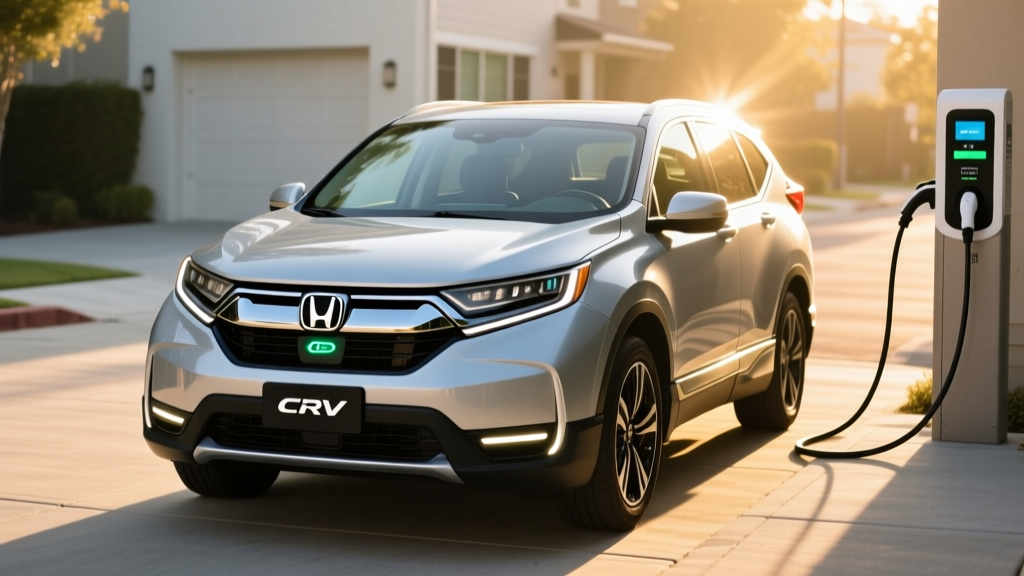
The CR-V Hybrid captures energy through regenerative braking and its gasoline engine to charge a small lithium-ion battery. You never plug it in. If you want electric-only commuting, you would need to look at a PHEV like the Toyota RAV4 Prime or a full BEV.
Fuel Economy: EPA Ratings and Real-World MPG
The headline number for the 2020 Honda CR-V Hybrid is its EPA-estimated fuel economy. Here is the official breakdown from fueleconomy.gov:
| Driving Cycle | EPA Rating |
|---|---|
| City | 40 MPG |
| Highway | 35 MPG |
| Combined | 40 MPG (some trims listed at 38) |
Real-World MPG: What Owners Actually See
Hybrids like the CR-V often exceed their EPA city rating in stop-and-go traffic because regenerative braking recovers energy that a gas car wastes as heat. On the highway, where regen opportunities are fewer and aerodynamic drag dominates, real-world numbers tend to drop closer to or slightly below the EPA highway estimate.
Real-world expectation: In mixed suburban driving, owners commonly report 37–42 MPG. In dense city traffic, 42–45 MPG is achievable. On sustained highway trips at 70+ mph, expect 33–36 MPG. In cold weather (below 30°F), MPG can dip 10–15% as the engine runs more frequently for cabin heat and battery conditioning.
Compared to the gas-only 2020 CR-V AWD (EPA 27 city / 32 highway / 29 combined), the hybrid saves roughly 3–4 gallons per 1,000 miles driven. At $3.50/gallon, that is approximately $1,225 in annual fuel savings for a driver covering 15,000 miles per year.
Powertrain Specs: Engine, Motors, and Performance
The 2020 CR-V Hybrid uses Honda's two-motor hybrid system paired with a 2.0-liter Atkinson-cycle four-cylinder engine. Here are the exact figures:
| Specification | Value |
|---|---|
| Engine | 2.0L Atkinson-cycle inline-4 |
| Engine horsepower | 145 hp @ 6,200 rpm |
| Engine torque | 129 lb-ft @ 3,500 rpm |
| Drive motor output | 181 hp / 232 lb-ft |
| Combined system output | 212 hp |
| Transmission | Direct-drive (no traditional CVT gears) |
| Drivetrain | Standard Real-Time AWD (all trims) |
| 0–60 mph | ~7.8 seconds (independent testing) |
| Hybrid battery | ~1.4 kWh lithium-ion (nominal) |
| Towing capacity | Not rated for towing |
The two-motor system is notable: one motor primarily generates electricity from the engine, while the other directly drives the wheels. At highway speeds, a lock-up clutch connects the engine directly to the wheels for efficiency. This design avoids the rubber-band feel of conventional CVTs and provides responsive, torque-rich acceleration from a stop.
Hybrid Battery: Longevity, Warranty, and Replacement Cost
Battery lifespan is the single most common concern for used-hybrid buyers. Here is what you need to know about the 2020 CR-V Hybrid's battery.
Battery Warranty Coverage (Original)
- Federal emissions warranty: 8 years / 80,000 miles (mandatory in all 50 states)
- CARB-state extended warranty: 10 years / 150,000 miles (California, New York, Massachusetts, and other states that adopted California emissions standards)
- Capacity threshold: Honda covers the battery if it fails or drops below a functional threshold that impairs hybrid system operation
Real-World Battery Longevity
The CR-V Hybrid's ~1.4 kWh battery is small and operates in a narrow state-of-charge window (roughly 40–80%), managed by Honda's battery management system. This shallow cycling dramatically reduces degradation compared to a full BEV battery that regularly cycles from 10–100%. Based on Honda's track record with the Accord Hybrid and Insight, these batteries routinely last 150,000–200,000+ miles before any significant capacity loss.
Battery Replacement Cost
If the hybrid battery does fail outside warranty, expect the following:
- OEM replacement battery: $2,000–$4,000 (parts only)
- Labor: $500–$1,000
- Total installed cost: $2,500–$5,000 at a Honda dealer
- Aftermarket/refurbished options: $1,500–$2,500 installed (growing availability as the hybrid fleet ages)
For context, a 2020 model with 80,000 miles in 2026 likely still has 2+ years of federal warranty coverage remaining. A CARB-state vehicle would have warranty coverage through 2030 or 150,000 miles.
Pricing: Used Market Value and Tax Credit Eligibility
The 2020 CR-V Hybrid was originally sold in three trims. Here were the MSRPs at launch and approximate used-market values as of early 2026:
| Trim | Original MSRP | 2026 Used Range (60K–90K mi) |
|---|---|---|
| EX | $30,560 | $19,000–$23,000 |
| EX-L | $33,150 | $21,000–$25,000 |
| Touring | $36,350 | $23,000–$27,500 |
Federal Tax Credit Status
The 2020 CR-V Hybrid is a conventional hybrid (HEV) and does not qualify for the federal §30D new clean vehicle credit (up to $7,500) or the §25E used clean vehicle credit (up to $4,000). These credits under current IRS rules apply only to plug-in vehicles (PHEVs and BEVs) that meet battery-sourcing, MSRP, and buyer income requirements.
Some states may offer minor incentives for hybrids, but these are uncommon and vary by jurisdiction. Check your state's energy office or department of environmental quality for current programs.
Who Should Buy the 2020 CR-V Hybrid — And Who Should Look Elsewhere
Choose the 2020 CR-V Hybrid If:
- You want 38–42 MPG without changing your fueling habits (no plugs, no apps, no charging networks)
- You live in an apartment or lack access to home/workplace charging
- You want AWD standard for snow and rain without the fuel penalty of a gas AWD SUV
- You plan to own the vehicle for 5+ years and value Honda's reliability track record
- Your budget is $19,000–$27,000 for a well-equipped used compact SUV
Look at a PHEV or BEV Instead If:
- You have home charging access and want to commute on electricity (consider a used RAV4 Prime or a new PHEV)
- You want to qualify for federal tax credits (§30D for new PHEVs/BEVs, §25E for used BEVs)
- You want to eliminate tailpipe emissions entirely (BEV) or reduce them substantially (PHEV)
- You drive fewer than 30 miles daily and could cover most trips on electric-only range
Pros and Cons at a Glance
Pros
- 40 MPG combined EPA — among the best in the compact SUV segment
- Standard AWD on every trim (gas CR-V AWD was optional/cost extra)
- 212 hp combined — noticeably quicker than the 190 hp gas model
- No plug-in required; zero behavior change from a gas car
- Honda Sensing safety suite standard (adaptive cruise, lane keeping, auto emergency braking)
- Spacious cabin: 33.2 cu ft cargo behind rear seats, 68.7 cu ft with seats folded
- Proven hybrid system shared with Accord Hybrid — strong parts availability
Cons
- No federal or most state tax credits (HEV, not PHEV/BEV)
- Highway MPG drops to ~33–35 real-world at sustained 70+ mph
- Not rated for towing (gas CR-V AWD can tow 1,500 lbs)
- Small 1.4 kWh battery means almost no electric-only driving
- Infotainment system (2020-era) feels dated compared to 2024+ models — no wireless Apple CarPlay on EX/EX-L
- Road noise at highway speeds is noticeable (a common CR-V critique across generations)
Frequently Asked Questions
How many MPG does the 2020 Honda CR-V Hybrid get?
The EPA rates it at 40 MPG city, 35 MPG highway, and 40 MPG combined. Real-world results typically range from 33 MPG (highway-heavy, cold weather) to 45 MPG (city-heavy, warm weather). Over 15,000 miles annually at $3.50/gallon, expect roughly $1,310 in fuel costs — compared to about $1,970 for the gas AWD CR-V.
Can I plug in the 2020 CR-V Hybrid to charge?
No. The 2020 CR-V Hybrid is a conventional hybrid (HEV). It charges its small lithium-ion battery through regenerative braking and the gasoline engine. There is no charging port. If you want a Honda with a plug, the Clarity Plug-In Hybrid was Honda's PHEV offering, but it was discontinued after 2022. Honda does not currently sell a CR-V PHEV in the U.S. market as of 2026.
Is the 2020 CR-V Hybrid reliable?
Honda's two-motor hybrid system has been in production since 2014 (Accord Hybrid) and is well-proven. The system has fewer wear items than a traditional automatic transmission — there is no torque converter, no planetary gearset, and no multi-speed gearbox. IIHS gave the 2020 CR-V its Top Safety Pick designation when equipped with specific headlights. Common complaints across the generation include occasional infotainment glitches and road noise, but the powertrain itself has a strong reliability record.
What is the hybrid battery replacement cost?
An OEM Honda hybrid battery replacement runs $2,500–$5,000 installed at a dealership. Aftermarket and refurbished options are increasingly available for $1,500–$2,500. However, based on data from Honda's earlier hybrid models, most batteries last 150,000–200,000+ miles. A 2020 model with under 100,000 miles in 2026 is very unlikely to need a battery replacement within the next several years.
Does the 2020 CR-V Hybrid qualify for any tax credit?
No. As a conventional hybrid, it does not qualify for the federal §30D new vehicle credit or the §25E used vehicle credit. These credits require a plug-in vehicle (PHEV or BEV) that meets battery component sourcing, critical minerals, MSRP caps, and buyer income thresholds per current IRS guidelines. Some states or local utilities may offer small rebates for hybrids, but these are rare and vary by location.
How does the CR-V Hybrid compare to the Toyota RAV4 Hybrid?
The 2020 Toyota RAV4 Hybrid is the CR-V Hybrid's closest rival. The RAV4 Hybrid is rated at 41 MPG city / 38 highway / 40 combined — nearly identical. The RAV4 offers slightly more cargo space and is rated to tow 1,750 lbs. The CR-V Hybrid has a more refined ride quality and slightly quicker acceleration (212 hp vs 219 hp, but the CR-V feels more responsive at lower speeds due to its direct-drive motor setup). Both are excellent choices; the decision often comes down to brand preference, dealer availability, and which used example is in better condition at your price point.
Is the 2020 CR-V Hybrid good in snow?
Yes. All-wheel drive is standard on every 2020 CR-V Hybrid trim. Honda's Real-Time AWD system sends torque to the rear wheels when front-wheel slip is detected. Combined with the instant torque from the electric drive motor, the CR-V Hybrid performs well in moderate snow and ice. For severe winter conditions, dedicated winter tires are recommended regardless of drivetrain.