Quick Verdict: The Efficiency King of Compact Hybrids
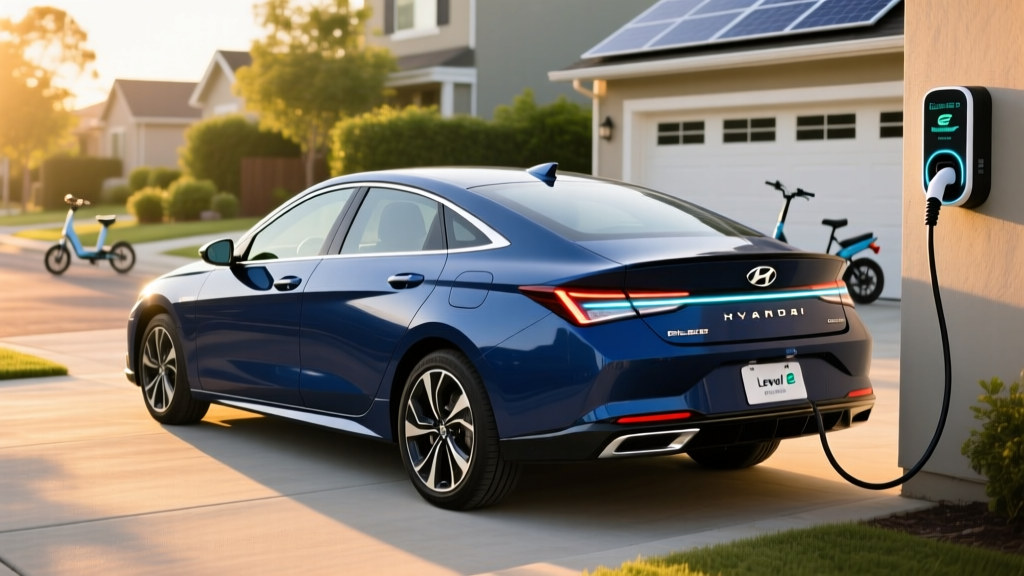
The 2025 Hyundai Elantra Hybrid remains one of the most fuel-efficient sedans you can buy without plugging in. With an EPA-estimated 54 MPG combined, a starting MSRP under $27,000, and Hyundai's industry-leading hybrid battery warranty, it occupies a specific and valuable niche: buyers who want EV-like efficiency without changing how they refuel. No plug, no range anxiety, no charging-curve math — just fill up and go.
This guide breaks down the exact specs, real-world MPG expectations, powertrain details, and ownership economics of the 2025 Elantra Hybrid. We'll also clarify where this conventional hybrid (HEV) fits relative to plug-in hybrids (PHEVs) and full battery-electric vehicles (BEVs), so you can make the right powertrain choice for your driving pattern.
| Spec | Value |
|---|---|
| Powertrain | 1.6L GDI 4-cyl + electric motor (HEV) |
| Combined Horsepower | 139 HP |
| Combined Torque | 195 lb-ft |
| Transmission | 6-speed dual-clutch automatic (DCT) |
| EPA MPG (City / Hwy / Combined) | 51 / 58 / 54 (Blue trim) |
| Fuel Tank Capacity | 11.1 gallons |
| Total Driving Range (EPA est.) | ~599 miles |
| 0–60 MPH | ~8.5 seconds (est.) |
| Drivetrain | Front-wheel drive |
| Hybrid Battery | 1.32 kWh lithium-ion polymer |
| Base MSRP (Blue trim) | $26,250 |
| Limited Trim MSRP | $29,600 |
| Hybrid Battery Warranty | 10 years / 100,000 miles |
| Federal Tax Credit (§30D) | Not eligible (HEV) |
HEV vs PHEV: The 2025 Elantra Hybrid Is a Conventional Hybrid
A critical distinction before we go further: the 2025 Elantra Hybrid is a conventional hybrid electric vehicle (HEV), not a plug-in hybrid (PHEV). This means:
| Feature | HEV (Elantra Hybrid) | PHEV (e.g., Tucson PHEV) |
|---|---|---|
| Plugs in to charge? | No — charges via regenerative braking and engine | Yes — has a charge port for Level 1/2 |
| Electric-only range | ~1 mile at low speed | 25–40 miles typical |
| Battery size | 1.32 kWh | 13–18 kWh typical |
| DC fast charging | No | Rarely (most PHEVs are Level 2 only) |
| Federal tax credit (§30D) | Not eligible | May qualify (subject to sourcing/income rules) |
| Best for | No home charging access; want max simplicity | Short commutes + home charging; want some EV driving |
Hyundai does not currently offer an Elantra PHEV in the US market for the 2025 model year. If you need plug-in capability in Hyundai's lineup, you'd look to the Tucson PHEV or Ioniq PHEV (discontinued after 2022 in the US). The Elantra Hybrid is purely an HEV — it recovers energy during braking and deceleration, stores it in its small 1.32 kWh battery, and uses the electric motor to assist the gasoline engine and enable brief electric-only movement at low speeds.
Fuel Economy: EPA Ratings and Real-World MPG
The headline number is what draws most buyers to this car. Here's the EPA breakdown by trim, sourced from fueleconomy.gov:
| Trim | City MPG | Highway MPG | Combined MPG | Est. Annual Fuel Cost* |
|---|---|---|---|---|
| Blue | 51 | 58 | 54 | ~$1,050 |
| Limited | 49 | 55 | 51 | ~$1,100 |
*Based on 15,000 miles/year, 55% city / 45% highway, $3.50/gal regular unleaded. Your costs will vary with local fuel prices.
Why the Blue trim gets better MPG: The Blue trim uses lower-rolling-resistance tires, slightly different gear ratios, and forgoes some of the Limited's heavier features (leather seats, larger wheels, sunroof). The trade-off is roughly 3 MPG combined for a more premium interior.
Real-World MPG: What to Actually Expect
Hybrids often exceed their EPA ratings in city driving, where regenerative braking recovers the most energy. Based on owner-reported data and third-party testing:
- City driving (stop-and-go): 52–58 MPG is common. The Elantra Hybrid's regenerative braking system is highly effective in traffic, and many owners report beating the EPA city estimate.
- Highway cruising (70–80 MPH): Expect 46–52 MPG. Hybrids lose their city advantage at sustained highway speeds, where the gasoline engine does most of the work. Aerodynamic drag and the 6-speed DCT's gearing limit efficiency here.
- Cold weather (below 30°F): Expect a 10–15% drop, putting combined MPG around 45–48. The engine runs more frequently to heat the cabin and maintain battery temperature.
- Combined real-world average: Most drivers will land between 48–54 MPG depending on driving mix, climate, and habits.
The Elantra Hybrid's 11.1-gallon fuel tank means a real-world range of approximately 530–600 miles between fill-ups — enough for most drivers to visit a gas station once every two weeks.
Powertrain and Performance
The 2025 Elantra Hybrid pairs a 1.6-liter gasoline direct-injection (GDI) 4-cylinder engine with a 32 kW (43 HP) permanent-magnet synchronous electric motor. Combined system output is 139 horsepower and 195 lb-ft of torque.
Unlike Toyota's planetary-gear hybrid system (used in the Corolla Hybrid and Prius), Hyundai uses a 6-speed dual-clutch transmission (DCT). This gives the Elantra Hybrid a more traditional, direct driving feel — shifts are perceptible and there's no "rubber-band" effect common to CVT-based hybrids. The trade-off is slightly less seamless low-speed transitions, though Hyundai has refined this significantly in recent model years.
Performance reality check: At 139 HP, the Elantra Hybrid is adequate for commuting and highway merging but not quick. The 0–60 MPH time of approximately 8.5 seconds puts it behind the Toyota Prius (7.2 seconds, 194 HP) and well behind any BEV. If performance matters, this isn't your car. If efficiency matters, it absolutely is.
Pricing, Trims, and Tax Credit Eligibility
The 2025 Elantra Hybrid is offered in two trims:
- Blue: $26,250 MSRP (destination included) — the efficiency-focused base model
- Limited: $29,600 MSRP — adds leather, sunroof, Bose audio, larger touchscreen, wireless charging pad, Highway Driving Assist
Federal Tax Credit: Not Eligible
The 2025 Elantra Hybrid does not qualify for the federal §30D Clean Vehicle Credit. Under current IRS rules, only plug-in electric vehicles (BEVs and PHEVs with sufficient battery capacity) are eligible. Conventional hybrids like the Elantra Hybrid are excluded regardless of price or buyer income.
Some states offer their own incentives for hybrids, but these vary significantly by jurisdiction. Check your state's energy or environmental agency website for current programs. A tax professional can advise on any applicable local credits.
Battery Warranty, Reliability, and Replacement Cost
Hybrid battery longevity is consistently the top concern for first-time hybrid buyers. Here's what you need to know about the 2025 Elantra Hybrid specifically:
Hyundai Hybrid Battery Warranty
- Coverage: 10 years or 100,000 miles (whichever comes first)
- What's covered: Hybrid battery pack, hybrid control unit, electric motor, inverter
- Transferability: Warranty transfers to subsequent owners at 10yr/100k; original owner retains full coverage
- Capacity threshold: Hyundai replaces or repairs if the battery fails to hold sufficient charge to operate the hybrid system (specific SoH threshold is defined in warranty documentation)
Real-world reliability data: Hyundai's hybrid powertrain has proven durable. The 1.6L GDI + DCT hybrid system has been in production since the 2017 Ioniq Hybrid, and large-scale failure reports are rare. The lithium-ion polymer battery is relatively small (1.32 kWh), meaning it experiences shallow charge/discharge cycles — the least stressful pattern for battery chemistry. Most hybrid batteries in similar systems (Toyota, Honda, Hyundai) last well beyond 150,000 miles with gradual capacity loss rather than sudden failure.
Out-of-warranty replacement cost: If the hybrid battery does require replacement after the warranty period, expect $2,000–$3,500 for parts and labor at a dealership. Independent hybrid specialists may offer refurbished units for $1,200–$2,000. For context, this is significantly less than a BEV traction battery replacement ($8,000–$20,000+) because the hybrid battery is much smaller.
Who Should Choose the Elantra Hybrid vs a PHEV or Full EV?
The right powertrain depends on your charging access, driving pattern, and willingness to adapt. Here's a practical decision framework:
Choose the 2025 Elantra Hybrid (HEV) if:
- You don't have access to home or workplace charging (apartment, street parking)
- You want maximum MPG with zero behavior change — no plugging in, no app management
- Your budget is under $30,000 and you don't qualify for EV tax credits
- You drive a mix of city and highway and want consistent efficiency in both
- You plan to keep the car 8+ years and value the 10-year hybrid warranty
Consider a PHEV or Full EV instead if:
- You have Level 2 home charging and a commute under 30 miles (a PHEV covers this on electric)
- You want to eliminate tailpipe emissions on daily driving (BEV) or most daily driving (PHEV)
- You qualify for the §30D federal credit ($7,500 for eligible BEVs/PHEVs) and it changes the math
- You want stronger acceleration (most BEVs hit 0–60 in under 6 seconds)
- You drive primarily in the city and want the lowest per-mile energy cost (electricity is cheaper than gasoline in most states)
The cost comparison: At 54 MPG combined and $3.50/gallon, the Elantra Hybrid costs roughly $0.065 per mile in fuel. A comparable BEV (like the Hyundai Ioniq 6 or Tesla Model 3) charging at home at $0.14/kWh and averaging 3.5 miles/kWh costs roughly $0.04 per mile in electricity. Over 15,000 miles/year, that's a savings of about $375/year with a BEV — meaningful but not transformative, especially when the BEV carries a higher purchase price and potential insurance premium increase.
How the Elantra Hybrid Compares to Key Rivals
| Spec | Hyundai Elantra Hybrid Blue | Toyota Corolla Hybrid LE | Toyota Prius LE |
|---|---|---|---|
| Combined MPG (EPA) | 54 | 50 | 57 |
| Combined HP | 139 | 138 | 194 |
| 0–60 MPH (est.) | ~8.5 sec | ~9.0 sec | ~7.2 sec |
| Drivetrain | FWD | FWD (AWD available) | FWD (AWD available) |
| Base MSRP | $26,250 | $24,350 | $28,350 |
| Hybrid Battery Warranty | 10 yr / 100k mi | 10 yr / 150k mi | 10 yr / 150k mi |
| Cargo Volume | 14.2 cu ft | 13.1 cu ft | ~20.3 cu ft (hatchback) |
| Tax Credit Eligible | No | No | No |
Key takeaways: The Prius wins on MPG (57 combined) and performance (194 HP) but costs more and is a hatchback, which not everyone wants in a sedan. The Corolla Hybrid is the cheapest entry point and offers AWD, but trails in MPG and interior space. The Elantra Hybrid splits the difference: excellent efficiency, a traditional sedan profile, a generous warranty, and a well-equipped Limited trim. According to IIHS, the Elantra has historically performed well in crash testing, adding to its value proposition.
Frequently Asked Questions
How many MPG does the 2025 Elantra Hybrid get?
The EPA rates the Elantra Hybrid Blue at 51 city / 58 highway / 54 combined MPG. The Limited trim is rated at 49 city / 55 highway / 51 combined. Real-world results typically fall between 48–54 MPG combined, with city driving often exceeding the EPA estimate thanks to regenerative braking.
Does the Elantra Hybrid need to be plugged in?
No. The Elantra Hybrid is a conventional hybrid (HEV). It charges its 1.32 kWh battery entirely through regenerative braking and the gasoline engine. There is no charge port and no plug. You refuel only at gas stations.
Does the 2025 Elantra Hybrid qualify for any tax credit?
It does not qualify for the federal §30D Clean Vehicle Credit, which is limited to plug-in vehicles (BEVs and PHEVs). Some states may offer hybrid-specific incentives, but these vary by jurisdiction. Check your state's energy office or consult a tax professional for details.
How long will the Elantra Hybrid battery last?
Hyundai covers the hybrid battery for 10 years or 100,000 miles. In practice, Toyota and Hyundai hybrid batteries in similar systems routinely last 150,000–200,000+ miles with gradual capacity loss. The small 1.32 kWh battery experiences shallow cycles, which is the least stressful pattern for lithium-ion chemistry.
What does it cost to replace the hybrid battery?
Out-of-warranty replacement runs approximately $2,000–$3,500 at a dealership, or $1,200–$2,000 through an independent hybrid specialist using refurbished units. This is significantly less than a full EV battery replacement.
Is the Elantra Hybrid better than a full EV?
It depends on your situation. If you lack home charging access, drive long distances frequently, or want to stay under $30,000, the Elantra Hybrid offers outstanding efficiency with no infrastructure requirements. If you have home charging, a short commute, and want the lowest per-mile cost and zero tailpipe emissions, a BEV may be a better fit. The Elantra Hybrid eliminates range anxiety entirely — you can drive 600 miles and refuel in 5 minutes at any gas station.
Does the Elantra Hybrid have all-wheel drive?
No. The 2025 Elantra Hybrid is front-wheel drive only. If AWD is a priority in a compact hybrid, the Toyota Corolla Hybrid and Toyota Prius both offer AWD variants.
What is the Elantra Hybrid's annual fuel cost?
At 15,000 miles per year and $3.50/gallon, the Elantra Hybrid Blue costs approximately $1,050 per year in fuel — roughly $650–$800 less than a comparable non-hybrid compact sedan getting 30 MPG combined.