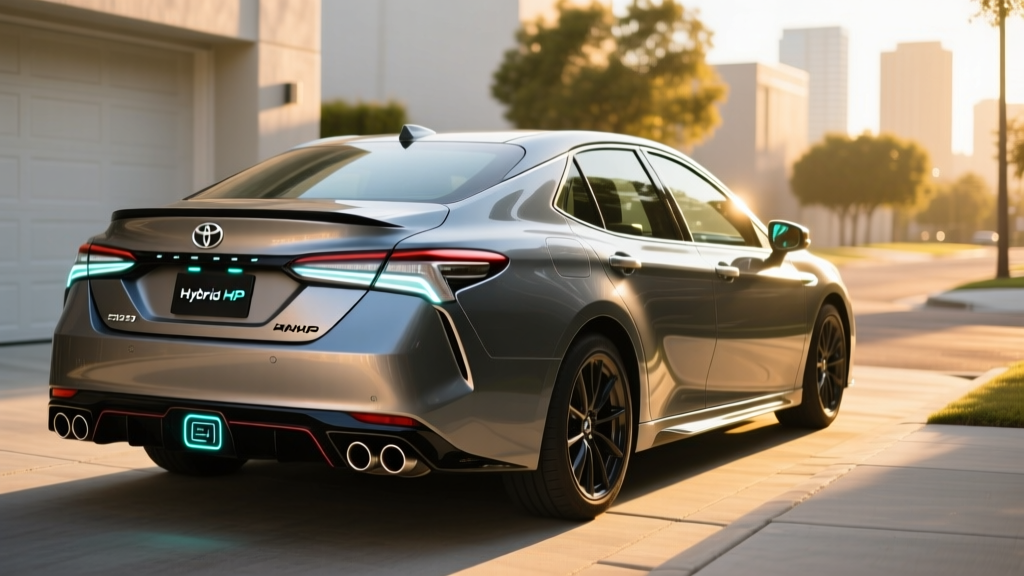
The ninth-generation Toyota Camry arrived for the 2025 model year with a significant powertrain shift: every Camry is now a hybrid. Toyota dropped the standalone four-cylinder and V6 gasoline options, betting that its fifth-generation hybrid system delivers the performance and efficiency buyers actually want. For shoppers searching for 2025 Camry Hybrid hp figures and real-world fuel economy, the answer is 225 horsepower on front-wheel-drive trims and 232 hp on all-wheel-drive models — paired with EPA ratings as high as 51 MPG combined.
This guide breaks down every powertrain spec, real-world efficiency expectation, battery warranty detail, and pricing tier you need to make an informed decision. We'll also clarify where the Camry Hybrid sits against plug-in hybrids and full battery-electric vehicles, so you can pick the right electrified drivetrain for your routine.
2025 Camry Hybrid Horsepower and Powertrain Breakdown
The 2025 Camry uses Toyota's latest fifth-generation hybrid architecture, which pairs a 2.5-liter four-cylinder engine running the Atkinson cycle with electric motor-generators and a lithium-ion hybrid battery pack. This is a conventional hybrid (HEV), meaning it charges its own battery through regenerative braking and the gasoline engine — you never plug it in.
| Specification | FWD Trims | AWD Trims |
|---|---|---|
| Combined System Horsepower | 225 hp | 232 hp |
| Gas Engine | 2.5L 4-cyl Atkinson (184 hp) | 2.5L 4-cyl Atkinson (184 hp) |
| Front Electric Motor | 100 kW (134 hp) | 100 kW (134 hp) |
| Rear Electric Motor (AWD) | N/A | 30 kW (40 hp) |
| Transmission | eCVT | eCVT |
| Hybrid Battery | Lithium-ion (~1.0 kWh) | Lithium-ion (~1.0 kWh) |
| 0–60 mph (est.) | ~7.1 seconds | ~6.9 seconds |
The combined horsepower figure (225 or 232) represents the maximum net output the engine and electric motors can deliver simultaneously — not a simple addition of individual peak ratings. Electric motors deliver peak torque from zero RPM, which gives the Camry Hybrid responsive off-the-line acceleration that feels stronger than the numbers suggest. The AWD model's rear motor provides electronic on-demand traction without a mechanical driveshaft, adding 7 net system horsepower and improving launch grip.
Fuel Economy: EPA Ratings and Real-World MPG
Toyota publishes distinct EPA ratings depending on trim and wheel size. The efficiency gap between the lightest LE trim and the sportier XSE is meaningful — about 7 MPG combined.
| Trim / Drivetrain | City MPG | Highway MPG | Combined MPG |
|---|---|---|---|
| LE FWD | 53 | 50 | 51 |
| LE AWD | 51 | 49 | 50 |
| SE / XLE / XSE FWD | 48 | 47 | 47 |
| SE / XLE / XSE AWD | 46 | 46 | 46 |
Source: fueleconomy.gov
Hybrids routinely match or exceed their EPA city ratings in stop-and-go driving because regenerative braking recaptures energy that gas cars waste as heat. On the LE FWD, expect 50–55 MPG in urban commutes. Highway-only driving at 75+ mph typically drops to 42–46 MPG on the LE, since the electric motor assists less at sustained speed. In cold weather (below 30°F), expect a 5–10% efficiency penalty as the engine runs more frequently for cabin heat and battery conditioning. Drivers who predominantly do city driving will see the biggest advantage over conventional gas cars.
HEV vs PHEV vs EV: Which Powertrain Fits You?
The 2025 Camry is offered exclusively as a conventional hybrid (HEV). Toyota does not currently offer a Camry plug-in hybrid (PHEV) in the US market. Here's how the three electrified powertrain types differ and who each one serves:
| Factor | HEV (Camry Hybrid) | PHEV (e.g., RAV4 Prime) | BEV (e.g., Tesla Model 3) |
|---|---|---|---|
| Plug In to Charge? | No — self-charging | Yes — optional plug-in | Yes — required |
| Electric-Only Range | ~1 mi at low speed | 25–42 mi typical | 250–360 mi typical |
| Total Range | ~600+ mi | ~400–500 mi combined | 250–360 mi |
| Home Charging Needed? | No | Recommended (120V OK) | Yes (240V ideal) |
| Federal Tax Credit (§30D) | Not eligible | Up to $7,500 (if eligible) | Up to $7,500 (if eligible) |
| Best For | No charging access, long trips | Short commutes + long trips | Home charging + daily driving |
Choose the Camry Hybrid (HEV) if you lack reliable access to a charging outlet, drive more than 40 miles daily, take frequent road trips, or want maximum simplicity with no plug-in routine. The HEV powertrain eliminates range anxiety entirely — you refuel at any gas station and the system manages energy optimization automatically.
Consider a PHEV instead if you have a garage or driveway where you can install a 120V or 240V outlet, your daily commute is under 30–40 miles, and you want to drive mostly on electricity during the week while retaining gas-engine range for weekend trips.
Consider a full BEV if you can install a Level 2 home charger, your daily driving stays under 250 miles, you want to eliminate gasoline costs entirely, and you're eligible for the full federal tax credit to offset the higher purchase price.
Pricing, Trims, and Tax Credit Eligibility
The 2025 Camry Hybrid starts at approximately $28,700 MSRP for the LE FWD trim and climbs to around $35,000 for the range-topping XSE AWD with available packages. Here's the approximate trim pricing ladder:
- LE FWD: ~$28,700
- LE AWD: ~$30,100
- SE FWD: ~$30,900
- SE AWD: ~$32,300
- XLE FWD: ~$33,400
- XLE AWD: ~$34,800
- XSE FWD: ~$33,900
- XSE AWD: ~$35,300
The 2025 Camry Hybrid is a conventional HEV, not a plug-in vehicle. Under IRS §30D rules, only battery-electric vehicles (BEVs) and plug-in hybrids (PHEVs) with sufficient battery capacity qualify for the federal clean vehicle credit. The Camry Hybrid does not qualify for the $7,500 federal tax credit or the point-of-sale transfer option. Some states may offer minor rebates for high-efficiency hybrids — check your state energy office for current programs.
While the lack of a federal tax credit is a disadvantage versus PHEV and BEV competitors, the Camry Hybrid's lower base price partially offsets this. A comparably equipped PHEV sedan typically starts $8,000–$12,000 higher, and even after a $7,500 credit, the total out-of-pocket cost often favors the Camry Hybrid for buyers who don't need electric-only range.
Battery Warranty, Reliability, and Replacement Cost
Toyota covers the 2025 Camry Hybrid battery with a 10-year / 150,000-mile warranty (whichever comes first) in all 50 states. This applies to the hybrid traction battery and related components. The broader hybrid system (inverter, control module, motor-generators) carries the same 10-year/150,000-mile coverage. Toyota's basic new-vehicle warranty is 3 years/36,000 miles, and the powertrain warranty is 5 years/60,000 miles.
Toyota's hybrid reliability track record is among the strongest in the industry. The Prius, Camry Hybrid, and RAV4 Hybrid have accumulated billions of real-world miles with low hybrid-battery failure rates. The lithium-ion pack in the 2025 Camry is smaller (~1.0 kWh) and less stressed than a PHEV or BEV battery, which contributes to longevity. The battery operates within a narrow state-of-charge window managed by the hybrid controller — it never fully charges or fully depletes — which significantly reduces degradation.
If the hybrid battery does require replacement outside warranty, expect a cost between $2,000 and $4,000 for a new OEM unit installed at a Toyota dealer. Refurbished or reconditioned battery packs are available from third-party suppliers for $1,000–$2,500 installed. For context, most Toyota hybrid batteries last well beyond 150,000 miles under normal use, and many exceed 200,000 miles without replacement.
Driving Impressions and Performance Notes
The 225-hp FWD and 232-hp AWD outputs place the 2025 Camry Hybrid firmly in the "adequate and confident" category rather than sporty. The eCVT (which is actually a planetary gearset, not a belt-driven CVT) provides seamless power delivery without the rubber-band rev feel that older CVTs produced. Off-the-line acceleration benefits from instant electric motor torque — the Camry Hybrid pulls away from stoplights with authority that belies its four-cylinder displacement.
The AWD system engages the rear electric motor automatically during acceleration from a stop, on slippery surfaces, or when the front wheels lose traction. It operates up to approximately 43 mph as a driven axle, then disengages to preserve efficiency. This is a traction aid, not a performance AWD system — don't expect torque-vectoring corner carving. It does, however, provide genuine confidence in rain and light snow without the fuel-economy penalty of mechanical AWD.
Highway passing power is where the 225/232 hp figures matter most. The Camry Hybrid merges and overtakes competently at interstate speeds, though it won't match the urgency of the now-discontinued V6 Camry (301 hp). Buyers who prioritize acceleration over efficiency may want to test-drive and compare, but for the vast majority of daily driving scenarios, the hybrid powertrain is more than sufficient.
5-Year Ownership Cost Snapshot
| Category | Estimated Cost |
|---|---|
| Purchase Price (MSRP) | $28,700 |
| Fuel (51 MPG combined, $3.40/gal avg) | ~$5,000 |
| Insurance (national avg) | ~$7,500 |
| Maintenance (oil, filters, brakes) | ~$2,200 |
| Estimated Depreciation | ~$11,000 |
| Total Estimated 5-Yr Cost | ~$54,400 |
The Camry Hybrid's fuel cost advantage is substantial. A comparable gas-only midsize sedan averaging 30 MPG combined would spend approximately $8,500 on fuel over the same period — a $3,500 gap. Maintenance costs also trend lower because regenerative braking extends brake pad life (often 60,000+ miles on original pads) and the hybrid system eliminates the traditional starter motor and alternator as failure points.
Pros and Cons at a Glance
- 51 MPG combined (LE FWD) — best-in-class midsize sedan efficiency
- 225–232 hp provides confident acceleration
- No plug-in required — zero lifestyle change from gas cars
- 10-year/150,000-mile hybrid battery warranty
- ~$28,700 starting price undercuts PHEV and BEV rivals
- Electronic AWD available across all trims
- Proven Toyota hybrid reliability track record
- No federal tax credit eligibility (HEV, not PHEV/BEV)
- No electric-only driving range beyond very low-speed creeping
- Higher trims (XSE AWD) drop to 46 MPG combined
- eCVT drone under hard acceleration (less refined than geared automatic)
- No DC fast charging capability (not applicable — HEV)
- Still burns gasoline — tailpipe emissions remain
Frequently Asked Questions
How many MPG does the 2025 Camry Hybrid get?
The EPA rates the Camry Hybrid LE FWD at 53 city / 50 highway / 51 combined MPG. Sportier trims (SE, XLE, XSE) with larger wheels drop to 47–48 combined. AWD models lose 1–2 MPG across the board. In real-world city driving, many owners report matching or slightly exceeding the EPA city number thanks to aggressive regenerative braking.
How much horsepower does the 2025 Camry Hybrid have?
The 2025 Camry Hybrid produces 225 net system horsepower with front-wheel drive and 232 hp with electronic all-wheel drive. This comes from a 2.5-liter four-cylinder engine paired with one or two electric motor-generators through Toyota's fifth-generation hybrid system.
Does the Camry Hybrid need to be plugged in?
No. The Camry Hybrid is a conventional hybrid (HEV). Its small lithium-ion battery charges through regenerative braking and the gasoline engine. You simply fill up at a gas station as you would with any conventional car. There is no plug, no charging cable, and no electric-only driving mode for meaningful distances.
Is the 2025 Camry Hybrid eligible for a federal tax credit?
No. Under current IRS §30D rules, only plug-in electric vehicles (BEVs and PHEVs) with battery packs of at least 7 kWh qualify for the federal clean vehicle credit. The Camry Hybrid's ~1.0 kWh battery does not meet this threshold. Check your state's energy office for any local hybrid incentives, though these are uncommon.
How long will the Camry Hybrid battery last and what does replacement cost?
Toyota warranties the hybrid battery for 10 years or 150,000 miles. Real-world data from Toyota's hybrid fleet suggests most batteries last well beyond 150,000 miles, with many reaching 200,000+ miles. If replacement is needed out of warranty, expect $2,000–$4,000 for a new OEM battery installed at a dealer, or $1,000–$2,500 for a refurbished unit from an independent shop.
Should I buy the Camry Hybrid or a plug-in hybrid like the RAV4 Prime?
If you can charge at home and your daily commute is under 35 miles, a PHEV like the RAV4 Prime (42 miles electric-only range) lets you drive most days without burning gas. However, the RAV4 Prime starts around $43,000 and requires plug-in access. The Camry Hybrid costs less upfront, needs no charging infrastructure, and still delivers outstanding fuel economy. Choose the Camry Hybrid for simplicity and lower cost; choose a PHEV if you want electric-only commuting with gas-engine backup.
Sources: fueleconomy.gov, Toyota Motor Corporation, IRS.gov §30D