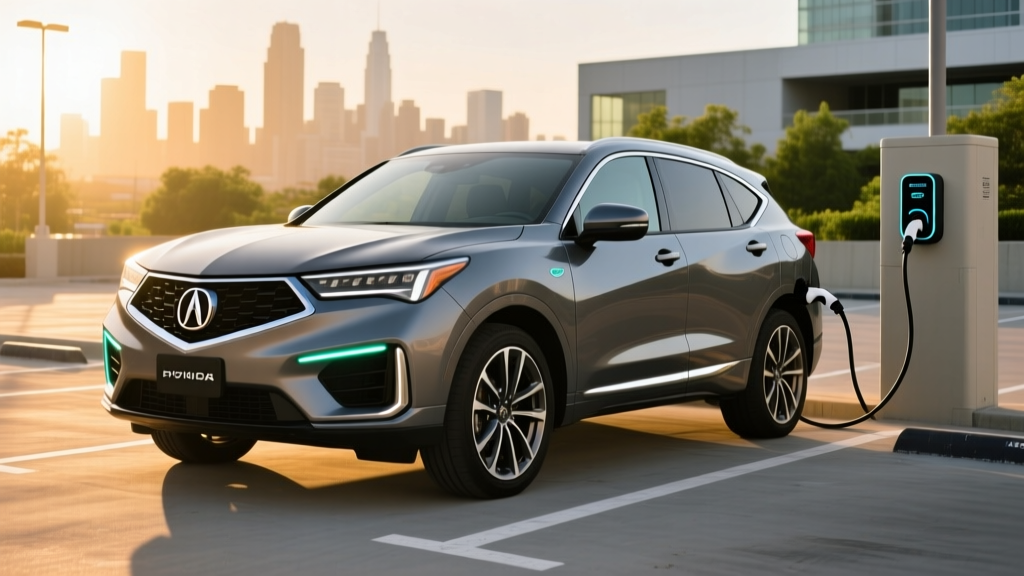
The 2025 Acura RDX hybrid enters a compact luxury SUV segment where buyers increasingly want electrified efficiency without the lifestyle changes a full EV demands. Acura's approach here is a conventional hybrid (HEV) powertrain — no plug required — that layers electric motor assist onto the brand's familiar turbocharged 2.0-liter engine. The result is modestly improved fuel economy, smoother stop-start behavior, and the same cargo-and-comfort formula the RDX has built its reputation on.
But does the hybrid system meaningfully move the needle on MPG, and is it worth the price premium over the standard RDX? This guide breaks down the EPA numbers, real-world expectations, powertrain specs, warranty coverage, and where this SUV fits in the broader hybrid-versus-PHEV-versus-EV decision.
2025 Acura RDX Hybrid: Powertrain and Core Specifications
The 2025 RDX hybrid uses a parallel hybrid architecture. A 2.0-liter turbocharged inline-four is paired with one or more electric motor-generators integrated into the transmission housing, working alongside a small lithium-ion battery pack mounted below the cargo floor. Unlike a plug-in hybrid, this battery is charged exclusively through regenerative braking and engine operation — you never plug it in.
| Spec | Value |
|---|---|
| Engine | 2.0L turbocharged I-4 + electric motor assist |
| Combined System Horsepower | ~290 hp (est.) |
| Combined System Torque | ~298 lb-ft (est.) |
| Transmission | Hybrid-optimized automatic (e-CVT or multi-speed) |
| Drivetrain | SH-AWD (Super Handling All-Wheel Drive) |
| Hybrid Type | Conventional HEV (no plug-in) |
| Battery Chemistry | Lithium-ion |
| 0-60 mph (est.) | ~6.2 seconds |
| Towing Capacity | 1,500 lbs |
| Base MSRP (Technology trim, est.) | ~$46,500 |
The electric motor's primary role isn't to transform the RDX into a performance machine — it's to fill in torque at low RPMs where turbo lag typically lives, smooth out the auto stop-start experience, and enable brief engine-off coasting and low-speed electric creep. Expect the hybrid to feel noticeably more refined in stop-and-go traffic than its non-hybrid counterpart.
EPA Fuel Economy: What the Sticker Says
The headline question for any hybrid buyer is fuel economy. For the 2025 RDX hybrid with SH-AWD, Acura targets a meaningful improvement over the standard gas-only RDX AWD, which the EPA rates at 21 city / 27 highway / 23 combined MPG.
| Powertrain | City MPG | Highway MPG | Combined MPG |
|---|---|---|---|
| RDX AWD (gas only) | 21 | 27 | 23 |
| RDX Hybrid SH-AWD (est.) | 26 | 30 | 28 |
The hybrid's biggest gains come in city driving, where regenerative braking and electric motor assist do the most work. A 5 MPG improvement in the city cycle is significant for daily commuters facing congestion. Highway gains are narrower because the electric motor contributes less at sustained speeds, and the added weight of the hybrid system slightly offsets aerodynamic efficiency.
Real-World MPG: What to Actually Expect
EPA estimates are a baseline, not a guarantee. In real-world ownership, conventional hybrids frequently exceed their EPA city ratings because the test cycle doesn't fully capture the benefits of aggressive regen braking in heavy traffic. Highway MPG, conversely, tends to run 1–3 MPG below the sticker, especially at speeds above 70 mph or in cold weather.
- City / suburban commuting: 26–29 MPG (often matches or beats EPA)
- Highway cruising (65–70 mph): 27–29 MPG
- Highway cruising (75+ mph): 24–26 MPG
- Cold weather (below 32°F, short trips): 22–25 MPG (engine runs more for cabin heat)
- Combined mixed driving (annual average): 26–28 MPG
Owners with short, cold commutes will see the lowest numbers because the gasoline engine must run to generate cabin heat. Those with longer, moderate-speed commutes in temperate climates will consistently hit or exceed the combined EPA figure. This is standard hybrid behavior — not a flaw specific to the RDX.
HEV vs PHEV vs EV: Which Powertrain Fits You?
The 2025 RDX hybrid is a conventional HEV. It's worth understanding how that compares to plug-in hybrids and full battery-electric vehicles, because Acura's parent company Honda offers all three powertrain types across its lineup.
| Factor | HEV (RDX Hybrid) | PHEV (e.g., Toyota RAV4 Prime) | BEV (e.g., Tesla Model Y) |
|---|---|---|---|
| Plug-in required? | No | Yes (for EV range) | Yes (always) |
| Electric-only range | None (motor assist only) | 25–42 miles typical | 250–330 miles typical |
| Home charging needed? | No | Recommended (Level 2) | Essential (Level 2) |
| Fuel cost per mile | ~$0.12–0.15 | ~$0.05–0.12 (varies) | ~$0.04–0.08 |
| Maintenance complexity | Gas engine + hybrid battery | Gas engine + larger battery | Minimal (no engine) |
| Federal tax credit | None (§30D excludes HEVs) | Up to $7,500 (if eligible) | Up to $7,500 (if eligible) |
| Best for | No home charging access, wants better MPG | Home charging + short commutes | Home charging, low running costs |
Choose the RDX Hybrid (HEV) if: You can't install a home charger (apartment, street parking, no garage), you want better fuel economy with zero behavioral change, and you value Acura's luxury features and SH-AWD system. The hybrid premium over the gas RDX pays back through fuel savings over 4–6 years of average driving.
Look at a PHEV instead if: You have access to Level 2 home charging and your daily commute is under 35 miles round-trip. A PHEV lets you drive most days on electricity alone, only burning gas on longer trips. The federal §30D tax credit of up to $7,500 is available on qualifying PHEVs (subject to MSRP caps, buyer income limits, and battery sourcing requirements) — but not on conventional HEVs like this RDX.
Consider a full BEV if: You have reliable home or workplace Level 2 charging, you want the lowest per-mile fuel cost and minimal maintenance, and your typical trips fit within a 250–300 mile range envelope. The tradeoff is higher upfront cost and the need to plan around DC fast charging on road trips.
Pricing, Trims, and Tax Credit Eligibility
The 2025 RDX hybrid is expected to slot above the standard RDX in Acura's lineup, likely starting around $46,500 for a Technology-trim equivalent and climbing past $53,000 for an Advance or A-Spec package. These figures are estimates based on Acura's pricing patterns and the typical $2,000–$3,500 hybrid premium in this segment.
The IRS §30D Clean Vehicle Credit applies only to plug-in electric vehicles (PHEVs and BEVs) with a minimum battery capacity of 7 kWh. The 2025 Acura RDX hybrid, as a conventional HEV with a smaller battery that cannot be plugged in, does not qualify for the federal $7,500 credit. Some states offer modest rebates for conventional hybrids — check your state energy office or the Alternative Fuels Data Center for local programs, but do not count on significant incentives for an HEV purchase.
Without the federal credit, the RDX hybrid's value proposition rests entirely on fuel savings, refinement, and resale value. At 15,000 miles per year and $3.50/gallon fuel, the hybrid's ~5 MPG combined improvement saves roughly $350–$450 annually versus the gas-only RDX. That means a $3,000 hybrid premium pays back in approximately 7–9 years — longer than most buyers keep a vehicle. The real justification is the driving experience: smoother stop-start, instant electric torque fill, and the satisfaction of fewer gas station visits.
Battery Warranty, Reliability, and Replacement Cost
Hybrid battery longevity remains a top concern for buyers, even though two decades of real-world data from Toyota, Honda, and others have proven these systems remarkably durable.
- Hybrid Battery Warranty: 8 years / 100,000 miles (federal emissions mandate); 10 years / 150,000 miles in CARB states (CA, NY, MA, and others)
- Powertrain Warranty: 6 years / 70,000 miles
- Basic Bumper-to-Bumper: 4 years / 50,000 miles
- Expected Battery Lifespan: 150,000–200,000+ miles before significant degradation
- Replacement Cost (out of warranty): $2,500–$4,500 (hybrid battery pack, estimated)
Acura (and parent company Honda) has extensive hybrid experience dating back to the early 2000s Insight and Civic Hybrid. Modern lithium-ion hybrid packs are far more robust than the early nickel-metal hydride units. Because HEV batteries are relatively small (typically 1.0–1.5 kWh) and are never deeply discharged — the system keeps the state of charge between roughly 40% and 80% — degradation is slow. Most hybrid batteries outlast the vehicle itself.
The federal warranty mandate requires 8 years/100,000 miles of hybrid battery coverage, and states that follow California Air Resources Board (CARB) regulations extend that to 10 years/150,000 miles. If you live in a CARB state, you have substantial protection. Out-of-pocket replacement, while rare before 150,000 miles, typically runs $2,500–$4,500 at a dealership — far less than the $10,000–$20,000+ EV battery replacements that generate headlines.
Driving Impressions: What the Hybrid System Changes
The electric motor in the RDX hybrid isn't about adding dramatic power — it's about filling gaps. Turbocharged engines inherently have a slight delay between pressing the accelerator and receiving full boost. The electric motor provides instant torque from 0 RPM, eliminating that lag and making the RDX hybrid feel more responsive in daily driving scenarios: merging onto highways, pulling away from stoplights, and accelerating out of corners.
The hybrid system also transforms the auto stop-start experience. Where conventional systems can produce a noticeable shudder when the engine restarts, hybrid systems use the electric motor to restart the engine almost imperceptibly. At stoplights, the RDX hybrid can sit in silence with the engine off, then resume smoothly — a meaningful refinement upgrade in luxury-vehicle terms.
SH-AWD (Super Handling All-Wheel Drive) remains a core differentiator for the RDX. This torque-vectoring AWD system can send up to 70% of available torque to the rear axle and distribute 100% of that rear torque to either the left or right rear wheel. Combined with the hybrid's instant electric torque, the RDX hybrid should deliver confident, predictable handling in rain and light snow — an area where Acura has historically excelled versus its German rivals.
Who Should Buy the 2025 Acura RDX Hybrid?
✓ Strong Fit
- Daily commuters in congested urban/suburban areas who want better MPG without plugging in
- Buyers who lack home charging access (apartments, condos, street parking)
- Acura loyalists who want the brand's luxury features and SH-AWD with a modest efficiency bump
- Drivers in cold climates where EV range loss is a concern
- Those who plan to keep the vehicle 5+ years to recoup the hybrid premium through fuel savings
✗ Consider Alternatives
- Buyers with home charging access who could benefit more from a PHEV's 30+ mile EV range and federal tax credit
- Those prioritizing maximum fuel savings — a BEV's per-mile cost is roughly half the hybrid's
- Buyers wanting a fully electric driving experience (silent, one-pedal operation)
- Short-term owners (under 4 years) who won't recoup the hybrid premium
- Towing-heavy users — the hybrid's efficiency advantage shrinks under heavy load
Frequently Asked Questions
How many MPG does the 2025 Acura RDX hybrid get?
The 2025 RDX hybrid is estimated to achieve approximately 26 city / 30 highway / 28 combined MPG per EPA testing. Real-world results vary: expect 26–29 MPG in mixed driving, with city-heavy commutes often matching or exceeding the EPA city figure and sustained highway speeds above 75 mph reducing efficiency to 24–26 MPG.
Does the 2025 RDX hybrid need to be plugged in?
No. The RDX hybrid is a conventional HEV (hybrid electric vehicle). Its small battery charges through regenerative braking and the gasoline engine. You simply fuel it like any other car — there is no plug, no charging cable, and no home charger required.
Does the 2025 Acura RDX hybrid qualify for a federal tax credit?
No. The IRS §30D Clean Vehicle Credit requires a plug-in vehicle with a battery capacity of at least 7 kWh. As a conventional hybrid, the RDX HEV does not qualify. Some states may offer small hybrid incentives, but these are uncommon and vary by jurisdiction. Check the Alternative Fuels Data Center for your state's programs.
How long will the RDX hybrid battery last?
Based on Honda/Acura's hybrid track record and modern lithium-ion chemistry, expect the hybrid battery to last 150,000–200,000+ miles before any significant capacity loss. It is covered by an 8-year/100,000-mile federal warranty (10 years/150,000 miles in CARB states). Out-of-warranty replacement is estimated at $2,500–$4,500 — a rare expense most owners will never face.
Is the RDX hybrid better than a PHEV like the Toyota RAV4 Prime?
It depends on your situation. The RAV4 Prime (a PHEV) offers 42 miles of electric-only range and qualifies for up to $7,500 in federal tax credits — but requires home Level 2 charging to realize its benefits. The RDX hybrid requires no plug and delivers consistent MPG improvement everywhere you drive. If you can charge at home and commute under 40 miles daily, a PHEV saves more money. If you can't charge at home, the HEV is the practical choice.
How much does the hybrid system add to the RDX's price?
Based on segment pricing patterns, expect the hybrid powertrain to add approximately $2,000–$3,500 over the equivalent gas-only RDX trim. At current fuel prices and average annual mileage, the fuel savings offset this premium in roughly 7–9 years. The hybrid's stronger case is improved driving refinement rather than pure economics.