Quick Verdict: A Luxury PHEV That Bridges the Gap
The 2024 Mazda CX-90 PHEV Preferred occupies a narrow but compelling lane in the three-row SUV market: a plug-in hybrid that delivers genuine electric-only commuting range without sacrificing the driving dynamics Mazda has cultivated over the past decade. With 327 combined horsepower, a 17.8 kWh battery enabling 26 miles of electric-only driving, and a starting MSRP of $49,945, the Preferred trim represents the value entry point into the CX-90 PHEV lineup.
But does it deliver in real-world conditions? After examining EPA data, owner reports, and Mazda's powertrain engineering, the answer is nuanced — this is a PHEV that rewards owners who can charge at home and whose commutes fall within its electric envelope, while penalizing those who treat it like a conventional hybrid.
| Spec | Value |
|---|---|
| Base MSRP | $49,945 (destination included) |
| Powertrain | 2.5L I4 + electric motor, 8-speed auto, AWD |
| Combined Horsepower | 327 hp / 369 lb-ft torque |
| Battery (usable) | 17.8 kWh, lithium-ion |
| EPA Electric Range | 26 miles |
| EPA Combined Range (EV + Gas) | 490 miles |
| MPGe (electric mode) | 56 MPGe |
| EPA MPG (gas-only, combined) | 25 MPG (24 city / 28 hwy) |
| 0–60 mph | ~5.9 seconds |
| Charging: Level 2 (240V) | ~4 hours (0–100%) |
| DC Fast Charging | Not supported |
| Seating | 7 passengers (2-3-2) or 6 (2-2-2, Captain's Chairs pkg) |
| Towing Capacity | 3,500 lbs |
| Cargo (behind 3rd row) | 14.9 cu ft |
HEV vs. PHEV: Understanding What the CX-90 Actually Is
Before diving deeper, it is critical to distinguish between conventional hybrids (HEVs) and plug-in hybrids (PHEVs), because the CX-90 PHEV is definitively the latter — and that distinction shapes the entire ownership experience.
| Feature | Conventional Hybrid (HEV) | Plug-In Hybrid (PHEV) |
|---|---|---|
| Plug-in Charging | No — battery charges via regen and engine | Yes — plug in for full electric range |
| Electric-Only Range | 0–2 miles at low speeds | 20–40+ miles typical |
| Battery Size | 1–2 kWh | 10–25+ kWh |
| Fuel Economy Benefit | Constant MPG improvement | Maximized only with regular charging |
| Federal Tax Credit (§30D) | Not eligible | Potentially eligible (subject to sourcing/income rules) |
| Home Charger Needed | No | Strongly recommended for value |
The CX-90 PHEV uses a 17.8 kWh battery paired with a 2.5-liter inline-four engine and an electric motor integrated into the transmission. When the battery is charged, you drive on electricity alone for up to 26 EPA-rated miles. When the battery depletes, the vehicle seamlessly transitions to hybrid mode, operating like a conventional HEV with the engine and motor working in tandem.
The key insight: If you never plug in the CX-90 PHEV, you are paying a premium (roughly $5,000–$7,000 over a gas-only CX-90) to haul around a heavy battery you are not using. The math only works if you charge regularly.
Fuel Economy: EPA Numbers vs. Real-World Results
The EPA rates the 2024 Mazda CX-90 PHEV at 56 MPGe when operating in electric mode and 25 MPG combined (24 city / 28 highway) once the battery is depleted and the gasoline engine takes over. According to fueleconomy.gov, these figures place the CX-90 PHEV mid-pack among three-row PHEV SUVs.
| Mode | City | Highway | Combined |
|---|---|---|---|
| Electric (MPGe) | — | — | 56 MPGe |
| Gas-Only Hybrid (MPG) | 24 | 28 | 25 |
Real-World MPG: What Owners Actually See
Real-world fuel economy for the CX-90 PHEV varies dramatically based on charging habits:
- With daily home charging (commute under 26 miles): Many owners report using little to no gasoline during the workweek, achieving effective economy well above 100 MPGe for local driving. Weekend road trips revert to gas-only operation at 24–27 MPG.
- Without regular charging: Expect the EPA-rated 24–25 MPG combined. Some drivers report slightly lower figures (22–23 MPG) in heavy stop-and-go traffic or when carrying full passenger/cargo loads, as the 4,800-lb curb weight works against efficiency.
- Cold-weather impact: Below freezing, the electric-only range drops by roughly 15–25% due to battery chemistry limitations and cabin heating demands. Expect 19–22 miles of electric range in winter conditions before the engine engages.
- Highway driving at 75+ mph: The electric range diminishes rapidly at sustained highway speeds. On a long road trip without charging, expect 26–28 MPG on flat terrain — the 8-speed automatic and engine tuning favor highway efficiency over city slogging.
The 25 MPG gas-only figure is respectable for a 4,800-lb three-row AWD SUV, but it does not dramatically outperform the non-hybrid CX-90 turbo (23 MPG combined). The PHEV's efficiency advantage is almost entirely dependent on utilizing its electric range.
Electric Range, Battery, and Charging: The Daily Reality
The 2024 CX-90 PHEV carries a 17.8 kWh lithium-ion battery (gross capacity), yielding an EPA-rated 26 miles of electric-only range. Total combined range with a full tank of gas and a full battery is approximately 490 miles.
Charging Speeds and Connectors
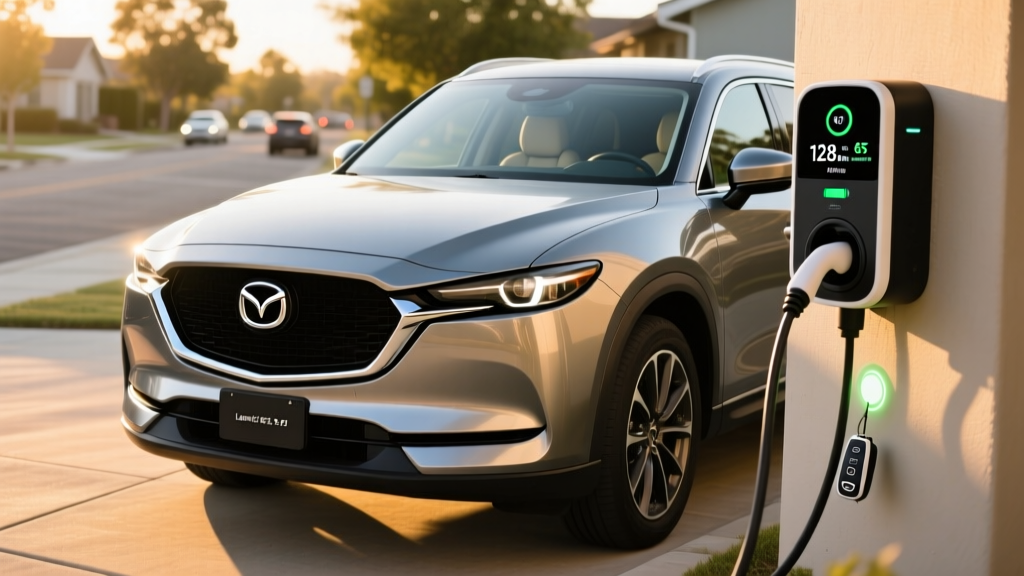
Mazda equips the CX-90 PHEV with a J1772 AC charging port. Here is what to expect at each charging level:
| Level | Voltage / Power | Time (0–100%) | Notes |
|---|---|---|---|
| Level 1 | 120V / ~1.4 kW | ~12–14 hours | Standard household outlet; adequate for overnight top-ups |
| Level 2 | 240V / ~7.2 kW | ~4 hours | Recommended for daily use; home or workplace charger |
| DC Fast Charge | N/A | N/A | Not supported — no DC fast charging capability |
Critical limitation: The CX-90 PHEV does not support DC fast charging. This is common among PHEVs (the Toyota RAV4 Prime and Hyundai Tucson PHEV also lack DCFC), but it means you cannot quickly top up at a public fast-charging station. All charging is AC-based, which is fine for overnight home use but impractical for road-trip battery replenishment.
For most PHEV owners, a Level 2 home charger (240V, 32–48 amp circuit) is the optimal setup. A full charge in roughly 4 hours means you can easily replenish the battery overnight or during a workday if your workplace offers Level 2 charging. Installation of a Level 2 home circuit typically runs $500–$1,500 depending on your electrical panel capacity and run length — consult a licensed electrician for your specific situation.
Preconditioning and Cold-Weather Strategy
The CX-90 PHEV supports scheduled charging and climate preconditioning via the Mazda Connect app. Preconditioning warms or cools the cabin while the vehicle is still plugged in, preserving battery range for actual driving rather than climate control. In sub-freezing climates, this feature is essential to maximizing your usable electric range.
Powertrain Performance: 327 Horsepower, Smoothly Delivered
The CX-90 PHEV pairs a naturally aspirated 2.5-liter inline-four engine with an electric motor integrated into the 8-speed automatic transmission. Combined output is 327 horsepower and 369 lb-ft of torque — a substantial figure that makes this the most powerful CX-90 variant Mazda offers.
The powertrain sends power to all four wheels via Mazda's i-Activ AWD system. The 0–60 mph sprint takes approximately 5.9 seconds, which is genuinely quick for a three-row family SUV. The electric motor provides immediate low-end torque, making around-town acceleration feel effortless and eliminating the turbo lag present in the gas-only turbo-six CX-90 variants.
Driving dynamics are a Mazda hallmark, and the CX-90 PHEV maintains the brand's emphasis on steering feel and chassis balance. The additional weight of the battery (roughly 400 lbs over the gas model) is noticeable in aggressive cornering, but the low-mounted battery pack helps keep the center of gravity in check. Ride quality on the Preferred trim's 19-inch wheels strikes a reasonable balance between comfort and firmness.
Pricing, Trims, and Federal Tax Credit Eligibility
The 2024 Mazda CX-90 PHEV is offered in four trims:
- Preferred: $49,945
- Premium: $54,145
- Premium Plus: $57,145
- S Premium Plus (range-topping): $61,395
All prices include Mazda's $1,495 destination charge. The Preferred trim is well-equipped with leatherette upholstery, heated front seats, a 10.25-inch infotainment display, wireless Apple CarPlay/Android Auto, and Mazda's full i-Activsense safety suite (adaptive cruise, lane-keeping, blind-spot monitoring, automatic emergency braking).
Federal §30D Tax Credit: Current Status
Under the IRS §30D Clean Vehicle Credit, the CX-90 PHEV may qualify for up to $3,750 — not the full $7,500. This is because the vehicle meets some but not all of the critical-minerals and battery-component sourcing requirements established under the Inflation Reduction Act. Per IRS guidance, the credit amount depends on whether the vehicle satisfies:
- Critical minerals requirement ($3,750): A percentage of battery minerals must be sourced from the U.S. or free-trade-agreement partners.
- Battery component requirement ($3,750): Battery components must be manufactured or assembled in North America.
- MSRP cap: SUVs must have an MSRP at or below $80,000 — all CX-90 PHEV trims qualify.
- Buyer income cap: Adjusted gross income must not exceed $150,000 (single) / $225,000 (head of household) / $300,000 (joint).
- Final assembly in North America: The CX-90 is built in Hofu, Japan — this may disqualify it depending on current-year IRS interpretation of assembly requirements.
Important caveat: Tax credit eligibility for imported vehicles has been subject to regulatory changes. Always verify current eligibility on the IRS Clean Vehicle Credit page and consult a tax professional before making a purchase decision based on credit assumptions. As of the latest IRS guidance, the Japan-assembled CX-90 PHEV's credit eligibility is limited and subject to change.
Beginning in 2024, buyers can also transfer the credit to the dealer at the point of sale, reducing the purchase price upfront rather than waiting for a tax refund. This point-of-sale transfer is available for eligible vehicles.
Battery Warranty, Reliability, and Long-Term Costs
Mazda PHEV Battery & Powertrain Warranty
- Hybrid/EV Battery Warranty: 8 years / 100,000 miles (whichever comes first)
- Powertrain Warranty: 5 years / 60,000 miles
- Bumper-to-Bumper: 3 years / 36,000 miles
- Capacity Retention Threshold: Mazda covers battery replacement if capacity drops below approximately 70% during the warranty period
Is the CX-90 PHEV Reliable?
Mazda's 2.5-liter inline-four is one of the most proven engines in the brand's lineup, with years of service across the Mazda3, CX-5, and CX-50. The electric motor and 8-speed automatic are also carryover components from the CX-60 PHEV sold internationally. The primary reliability question centers on the high-voltage battery system, which is new to Mazda's U.S. lineup.
Historically, Mazda has scored well in reliability surveys from Consumer Reports and J.D. Power, typically ranking in the top third of brands. The PHEV system adds complexity compared to a pure gas vehicle, but it is less complex than a full battery-electric vehicle (no massive battery pack, no DC fast-charge thermal management system).
Battery Replacement Cost
Should the high-voltage battery require replacement outside of warranty, expect a cost in the range of $8,000–$12,000 for the battery pack, plus labor. This figure is based on comparable PHEV battery replacements in the industry (Toyota RAV4 Prime, Hyundai Tucson PHEV). However, PHEV batteries experience less stress than full EV batteries because they operate in a narrower state-of-charge window (the system maintains a buffer to prevent full depletion), which typically extends their usable life well beyond the warranty period.
Most PHEV batteries from major manufacturers last 10–15 years with gradual degradation rather than sudden failure. Capacity loss of 10–20% over 100,000 miles is typical, meaning your 26-mile electric range might become 21–23 miles after a decade of use.
Pros
- 327 hp makes it the quickest CX-90 variant
- 26 miles of electric range covers many commutes
- Premium interior quality at a mainstream price
- Standard AWD with 3,500-lb towing
- Smooth engine/motor transitions
- 8-year/100,000-mile battery warranty
Cons
- No DC fast charging
- Gas-only MPG (25) only marginally better than non-hybrid CX-90
- Japan assembly may limit federal tax credit
- Third row is tight for adults
- Requires home charging to realize value
- 14.9 cu ft cargo space behind 3rd row is modest
Who Should Buy the CX-90 PHEV Preferred — And Who Should Look Elsewhere
Choose the CX-90 PHEV Preferred if:
- Your daily commute is 25 miles or less round-trip and you can charge at home
- You want three rows and AWD but are not ready for a full EV
- You value driving dynamics and interior quality over maximum cargo space
- You take occasional road trips where charging infrastructure is uncertain
- You want to reduce weekday fuel consumption without range anxiety
Consider a full EV (e.g., Kia EV9, Tesla Model X) if:
- You have reliable home charging and your trips rarely exceed 250 miles
- You want zero tailpipe emissions and lower per-mile energy costs
- You want DC fast charging for road trips
- You want to maximize federal and state EV incentives
Consider a conventional HEV (e.g., Toyota Grand Highlander Hybrid) if:
- You cannot charge at home (apartment, street parking)
- You want consistent fuel savings without plugging in
- You prioritize maximum cargo and passenger space
- You want a simpler powertrain with no plug-in complexity
Stick with the gas-only CX-90 Turbo if:
- Your budget is tighter (turbo models start ~$5,000 less)
- You drive mostly highway miles where PHEV advantage is minimal
- You do not want to install a home charger
How the CX-90 PHEV Compares to Rivals
| Spec | 2024 Mazda CX-90 PHEV | 2024 Toyota Grand Highlander Hybrid | 2024 Kia Sorento PHEV |
|---|---|---|---|
| Type | PHEV | HEV (not plug-in) | PHEV |
| EPA Electric Range | 26 mi | N/A | 32 mi |
| Combined MPG (gas) | 25 | 36 | 34 (hybrid mode) |
| Horsepower | 327 | 245 (Hybrid Max: 362) | 261 |
| Starting MSRP | $49,945 | $44,405 | $50,290 |
| 3rd Row Usability | Tight | Genuine adult space | Very tight |
| DC Fast Charging | No | No (HEV) | No |
The Grand Highlander Hybrid dominates on fuel economy and space but is not a plug-in. The Sorento PHEV offers slightly more electric range and better gas-mode MPG but is smaller inside and less powerful. The CX-90 PHEV wins on performance, interior materials, and driving refinement — it is the driver's choice in this segment, not the efficiency champion.
Frequently Asked Questions
How many MPG does the 2024 Mazda CX-90 PHEV get?
The EPA rates the CX-90 PHEV at 25 MPG combined (24 city / 28 highway) when running on gasoline after the battery is depleted. When operating in electric mode, it achieves 56 MPGe. Real-world gas-only results cluster around 24–27 MPG depending on driving style, terrain, and temperature.
How far can the CX-90 PHEV go on electric only?
The EPA rates it at 26 miles of electric-only range. In real-world conditions, expect 22–26 miles in moderate temperatures and 19–22 miles in freezing weather. Highway speeds above 65 mph will reduce range further. The total combined range (electric + gasoline) is approximately 490 miles.
Does the CX-90 PHEV qualify for the federal tax credit?
Potentially, but likely only up to $3,750 rather than the full $7,500, due to battery sourcing requirements and the vehicle's Japan assembly. Eligibility also depends on your income (must be under $150K single / $300K joint) and the MSRP (all trims fall under the $80K SUV cap). Always check the latest IRS Clean Vehicle Credit page and consult a tax professional before purchasing.
Is the CX-90 PHEV reliable, and what does battery replacement cost?
Mazda's 2.5L engine is well-proven, and the brand consistently ranks above average in reliability surveys. The PHEV system is covered by an 8-year/100,000-mile battery warranty. Out-of-warranty battery replacement is estimated at $8,000–$12,000, though most PHEV batteries last 10–15 years with gradual rather than catastrophic degradation.
Can the CX-90 PHEV use DC fast chargers?
No. The CX-90 PHEV supports only AC charging (Level 1 at 120V and Level 2 at 240V). DC fast charging is not available, which is typical for plug-in hybrids. A full Level 2 charge takes approximately 4 hours.
Hybrid vs. PHEV vs. EV — which is right for me?
If you can charge at home and your daily driving is under 30 miles, a PHEV like the CX-90 lets you commute on electricity while keeping a gas engine for longer trips — eliminating range anxiety entirely. A conventional hybrid (HEV) is better if you cannot plug in but still want improved fuel economy. A full EV (BEV) is ideal if you want the lowest operating costs, have charging access, and your trips fit within 250–300 miles of range.
Do I need to install a home charger for the CX-90 PHEV?
You do not strictly need one — a standard 120V outlet (Level 1) will charge the battery overnight in about 12–14 hours. However, a 240V Level 2 home charger reduces that to roughly 4 hours and is strongly recommended to make daily electric driving practical. Installation costs range from $500–$1,500 depending on your home's electrical panel and the distance from the panel to your parking spot.
Sources: U.S. EPA / fueleconomy.gov, IRS Clean Vehicle Credit, Mazda USA, IIHS.