Ram Hybrid Cars: What's Actually Available for 2026?
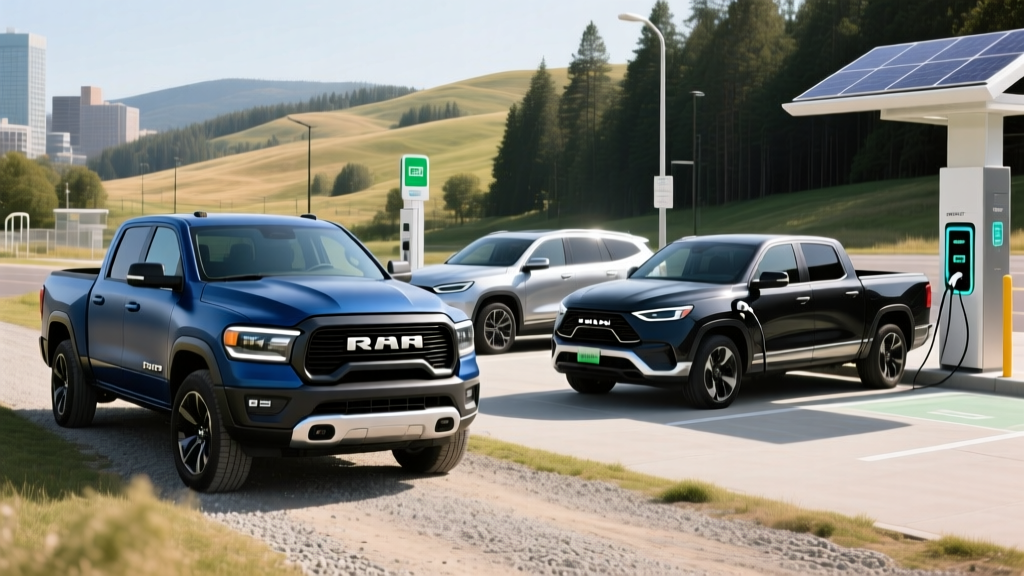
Ram's hybrid strategy in 2026 spans three distinct technologies: the mild-hybrid eTorque system on the outgoing 1500 Classic, the all-new Ramcharger extended-range electric vehicle (EREV) — a plug-in series hybrid that pairs a battery-electric drivetrain with an onboard gasoline generator — and the anticipated Ram 1500 REV battery-electric pickup. For buyers searching "ram hybrid cars," the landscape requires careful parsing because these powertrains serve fundamentally different use cases and carry different tax-credit implications.
Unlike Toyota or Hyundai, Ram does not currently sell a conventional full hybrid (HEV) in the vein of a RAV4 Hybrid or Tucson Hybrid. Instead, Stellantis has pursued a two-track approach: a 48-volt mild-hybrid assist on legacy V6/V8 engines, and the headline-grabbing Ramcharger EREV that functions as a plug-in hybrid with substantial electric-only range.
HEV vs PHEV vs EREV: Understanding Ram's Hybrid Lineup
Before evaluating specific models, it is critical to understand how these powertrain types differ in daily operation:
| Powertrain Type | How It Works | Plug In? | Electric-Only Range |
|---|---|---|---|
| Mild Hybrid (eTorque) | 48V motor-assist on gas engine; cannot drive on electric alone | No | 0 miles |
| Full Hybrid (HEV) | Gas engine + electric motor; battery recharges via regen & engine | No | 1-2 miles at low speed |
| Plug-In Hybrid (PHEV) | Larger battery; gas engine + motor can both drive wheels | Yes | 20-50 miles typical |
| EREV (Ramcharger) | Electric motors drive wheels always; gas engine is a generator only | Yes | ~145 miles (target) |
The Ramcharger is technically classified as an extended-range electric vehicle, a subset of plug-in hybrids. The key distinction: the 3.6-liter Pentastar V6 under the hood never drives the wheels mechanically. It exists solely to generate electricity for the battery and motors when the pack depletes. This means driving feel is always electric — instant torque, one-pedal regenerative braking — but you carry the safety net of a gasoline generator for long hauls.
2026 Ram 1500 Ramcharger: The Headline Plug-In Hybrid
The Ramcharger is Ram's most ambitious electrified product and the model most buyers associate with "ram hybrid cars." After production delays from its initial 2024 announcement, Stellantis confirmed the Ramcharger is targeted for late-2026 availability with preliminary specifications that position it as a serious contender in the electrified truck segment.
Spec Table: 2026 Ram 1500 Ramcharger (Preliminary)
| Specification | Value |
|---|---|
| Powertrain | Dual electric motors (front + rear) + 3.6L V6 generator |
| Combined Horsepower | 663 hp (target) |
| Combined Torque | 615 lb-ft (target) |
| Battery Capacity | 92 kWh (usable, NMC chemistry) |
| Electric-Only Range | ~145 miles (target, final EPA pending) |
| Total Combined Range | ~690 miles (electric + generator, target) |
| DC Fast Charge Peak | ~145 kW (estimated) |
| 10-80% DC Charge Time | ~40 minutes (estimated) |
| Level 2 Charge Rate | ~11.5 kW onboard charger |
| 0-60 mph | 4.4 seconds (target) |
| Towing Capacity | ~14,000 lbs (target) |
| Payload Capacity | ~2,625 lbs (target) |
| Starting MSRP | Estimated $60,000-$65,000 (base) |
Ramcharger Powertrain Deep Dive
The Ramcharger uses a 92 kWh usable battery pack (NMC lithium-ion chemistry) paired with front and rear electric motors producing a combined 663 horsepower. The 3.6-liter Pentastar V6 generator activates automatically when the battery's state of charge drops to a predetermined threshold. Drivers can also manually select "eSave" mode to preserve battery charge for later electric driving — useful if you commute through an urban zero-emission zone after a highway stretch.
Charging is handled via a CCS1 connector for DC fast charging and a J1772/NACS adapter for Level 2 home charging. At a 150 kW DC fast charger, expect peak rates around 145 kW tapering to approximately 50 kW above 80% state of charge — typical charge-curve behavior for large NMC packs. A full Level 2 home charge from empty takes roughly 8-9 hours on a 48-amp (11.5 kW) circuit.
Federal Tax Credit Eligibility for the Ramcharger
As a plug-in hybrid with a battery exceeding 16 kWh, the Ramcharger is expected to qualify for partial or full federal tax credits under IRS §30D Clean Vehicle Credit rules. However, eligibility depends on several factors current for 2026:
- MSRP Cap: Vans, SUVs, and pickups must have an MSRP at or below $80,000 to qualify
- Buyer Income Cap: AGI must not exceed $150,000 (single), $225,000 (head of household), or $300,000 (joint)
- Battery Sourcing: Critical minerals and battery components must meet escalating domestic-content thresholds; the Ramcharger's North American assembly (Sterling Heights, MI) is favorable, but battery cell sourcing determines the final credit amount ($3,750 or $7,500)
- Point-of-Sale Transfer: Eligible buyers can transfer the credit to the dealer at purchase, reducing the out-of-pocket price immediately
Note: Tax credit rules are subject to legislative change. Consult a tax professional and verify current IRS guidance before purchasing.
Ram 1500 Classic eTorque: The Mild-Hybrid Option
The previous-generation Ram 1500 Classic (still sold alongside the current DT platform in limited trims for 2026) offered the eTorque mild-hybrid system on both the 3.6L Pentastar V6 and 5.7L HEMI V8. This is not a full hybrid — the 48-volt belt-driven motor-generator cannot propel the truck on electric power alone. Instead, it provides:
- Smooth stop-start engine shutoff at idle
- Torque-fill during acceleration (up to ~130 lb-ft of electric assist on the V8)
- Regenerative braking that recaptures energy to the small 0.43 kWh lithium-ion pack
- Marginally improved fuel economy, particularly in city driving
Fuel Economy: Ram 1500 Classic eTorque
| Engine | City MPG | Highway MPG | Combined MPG |
|---|---|---|---|
| 3.6L V6 eTorque (4WD) | 19 | 24 | 21 |
| 5.7L V8 eTorque (4WD) | 15 | 22 | 17 |
Source: fueleconomy.gov EPA estimates. Real-world city MPG with eTorque often runs 1-2 MPG above EPA thanks to aggressive idle stop-start. Highway figures tend to match or slightly underperform EPA in real-world testing at 70+ mph.
The eTorque system adds roughly $1,000-$1,500 to the vehicle price over a non-hybrid equivalent. It does not qualify for any federal EV or plug-in hybrid tax credit because it cannot be plugged in and the battery is far below the §30D minimum capacity threshold.
Ramcharger vs Conventional Gas Ram 1500: Ownership Cost Comparison
For buyers cross-shopping the Ramcharger against a conventional 2026 Ram 1500 with the 3.0L Hurricane inline-six turbo, the economics depend heavily on your driving patterns and home charging access.
| Cost Factor (5 Years / 75,000 Miles) | Ramcharger EREV (Est.) | Gas Ram 1500 Hurricane I6 (Est.) |
|---|---|---|
| Purchase Price (after credit) | $55,000-$60,000 | $52,000-$58,000 |
| Fuel / Electricity Cost | $4,500-$6,500 | $10,500-$13,000 |
| Maintenance | $2,800-$3,500 | $4,000-$5,200 |
| Insurance (avg) | $9,500-$11,000 | $8,000-$10,000 |
| Estimated Depreciation | $22,000-$28,000 | $18,000-$24,000 |
| Total 5-Year Cost | $93,800-$109,000 | $92,500-$110,200 |
The Ramcharger's advantage lies in fuel savings — if you can charge at home and keep most daily driving within the ~110-130 mile real-world electric range, your gasoline consumption drops dramatically. However, higher insurance premiums (common for electrified vehicles) and steeper projected depreciation partially offset those savings. Buyers who tow frequently or drive predominantly highway miles will see less electric benefit, narrowing the gap with the conventional gas model.
Battery Warranty, Reliability, and Replacement Costs
Ramcharger (PHEV/EREV): Federal law mandates a minimum 8-year/100,000-mile warranty on the high-voltage battery pack for plug-in hybrids and EVs. In CARB states (California, Colorado, and others adopting California emissions standards), this extends to 10 years/150,000 miles. The warranty covers battery capacity falling below a specified threshold (typically 70% state of health).
eTorque Mild-Hybrid: The 48V battery and motor-generator are covered under the standard powertrain warranty of 5 years/60,000 miles, with some dealers reporting extended coverage to 8 years/80,000 miles on hybrid-specific components.
Is the Ramcharger Reliable?
As a new powertrain for the 2026 model year, the Ramcharger lacks long-term reliability data. However, its core components are proven: the Pentastar 3.6L V6 is one of Stellantis's most widely produced engines with over 10 million units built, and the electric drive modules share architecture with other Stellantis BEV platforms. The primary reliability question mark is the integration complexity — managing thermal loads between a large battery pack, dual electric motors, and an onboard generator under heavy towing conditions.
For the eTorque mild-hybrid system, reliability has been strong since its 2019 introduction. The small 0.43 kWh pack and belt-driven motor-generator are low-stress components. Reported issues have centered on software glitches in the stop-start system rather than hardware failures.
Battery Replacement Cost
If the Ramcharger's 92 kWh battery pack requires out-of-warranty replacement, expect a cost between $12,000 and $18,000 including parts and labor — in line with large NMC packs from other manufacturers. The eTorque 48V battery is far less expensive, estimated at $800-$1,500 for replacement. Battery degradation data for the Ramcharger is not yet available given its newness, but NMC chemistry in similar applications typically shows 8-12% capacity loss over 100,000 miles with normal use.
Who Should Choose a Ram Hybrid vs a Full EV or Gas Truck?
Choose the Ramcharger EREV If:
- Your daily commute is under 120 miles round-trip and you have home Level 2 charging
- You need serious towing capacity (up to 14,000 lbs) without range anxiety on long hauls
- You want electric driving feel but regularly drive routes with sparse DC fast-charging infrastructure
- You qualify for the §30D federal tax credit, reducing effective purchase price
Choose the Gas Ram 1500 (Hurricane I6) If:
- You primarily tow heavy loads over long distances where the generator's MPG penalty matters
- You lack reliable home charging access (apartment, street parking)
- Your budget prioritizes lower upfront cost over long-term fuel savings
- You prefer proven powertrain simplicity without high-voltage system maintenance concerns
Choose a Full EV Pickup (Ford F-150 Lightning, Silverado EV) If:
- You want zero tailpipe emissions and the lowest per-mile energy cost
- Your daily driving stays under 250 miles and you have DC fast-charging access for road trips
- You value frunk storage and vehicle-to-home (V2H) backup power capability
Pros and Cons: Ram Hybrid Cars at a Glance
✓ Pros
- Ramcharger offers ~145 miles electric-only — best in the plug-in truck segment
- 663 hp with instant electric torque for responsive driving
- No range anxiety: gasoline generator extends total range to ~690 miles
- Home charging covers most daily driving on electricity alone
- Qualifies for federal §30D tax credit (up to $7,500) if sourcing requirements are met
- eTorque provides smooth stop-start and modest city MPG improvement at low cost
✗ Cons
- Ramcharger pricing starts ~$60K+ before options — premium over gas 1500
- New platform means unproven long-term reliability for the EREV system
- DC fast charging at ~145 kW is slower than dedicated BEVs like the Silverado EV (350 kW)
- Fuel economy on generator-only power (est. 18-22 MPG) offers no advantage over gas Ram
- No conventional full hybrid (HEV) option — eTorque is mild-hybrid only
- Insurance premiums typically 10-20% higher than gas equivalents
Frequently Asked Questions
How many MPG does the Ram hybrid get?
The Ram 1500 Classic with eTorque V6 achieves an EPA-estimated 21 MPG combined (19 city/24 highway) in 4WD configuration. The V8 eTorque delivers 17 MPG combined. The Ramcharger EREV, when operating on its gasoline generator after battery depletion, is estimated to achieve 18-22 MPG combined — though most daily driving will use electricity, dramatically reducing gasoline consumption for owners who charge regularly.
How far can the Ramcharger go on electric only?
Ram targets approximately 145 miles of electric-only range from the 92 kWh battery pack. Real-world expectations should be closer to 110-130 miles in mixed driving, and 80-100 miles at sustained highway speeds or in cold weather. Once depleted, the V6 generator activates and extends total range to approximately 690 miles.
Does the Ramcharger qualify for a federal tax credit?
The Ramcharger is expected to qualify for the IRS §30D Clean Vehicle Credit (up to $7,500) as a plug-in hybrid, subject to 2026 rules including the $80,000 MSRP cap for trucks, buyer income limits ($300K joint / $150K single), and battery critical-mineral/component sourcing requirements. The credit can be transferred to the dealer at point of sale. The eTorque mild-hybrid does not qualify for any federal plug-in credit. Always verify current eligibility at IRS.gov.
Is the Ram hybrid system reliable?
The eTorque mild-hybrid system has proven reliable since its 2019 introduction, with the 48V components experiencing few reported hardware failures. The Ramcharger EREV is a new platform for 2026 and lacks long-term data, though its Pentastar V6 generator and Stellantis electric drive components are individually proven. The high-voltage battery carries a federally mandated 8-year/100,000-mile warranty (10 years/150,000 miles in CARB states).
What does a Ram hybrid battery replacement cost?
The Ramcharger's 92 kWh NMC battery pack would cost an estimated $12,000-$18,000 to replace out of warranty. The eTorque 48V battery is far less expensive at approximately $800-$1,500. Most buyers should never face this cost — battery warranties cover capacity degradation below the manufacturer's threshold for the coverage period, and modern NMC packs typically retain 85-90% capacity at 100,000 miles.
Hybrid vs PHEV vs EV — which Ram is right for me?
If you can charge at home and want maximum electric daily driving with a gas backup for road trips, the Ramcharger EREV is the clear choice. If you want simplicity, lower upfront cost, and don't mind higher fuel bills, the conventional gas Ram 1500 (optionally with eTorque) remains practical. If you want zero gasoline use, have reliable charging access, and your trips stay under ~300 miles, a full EV pickup like the Ford F-150 Lightning may be a better fit — though Ram's own 1500 REV BEV is also anticipated for 2026-2027.