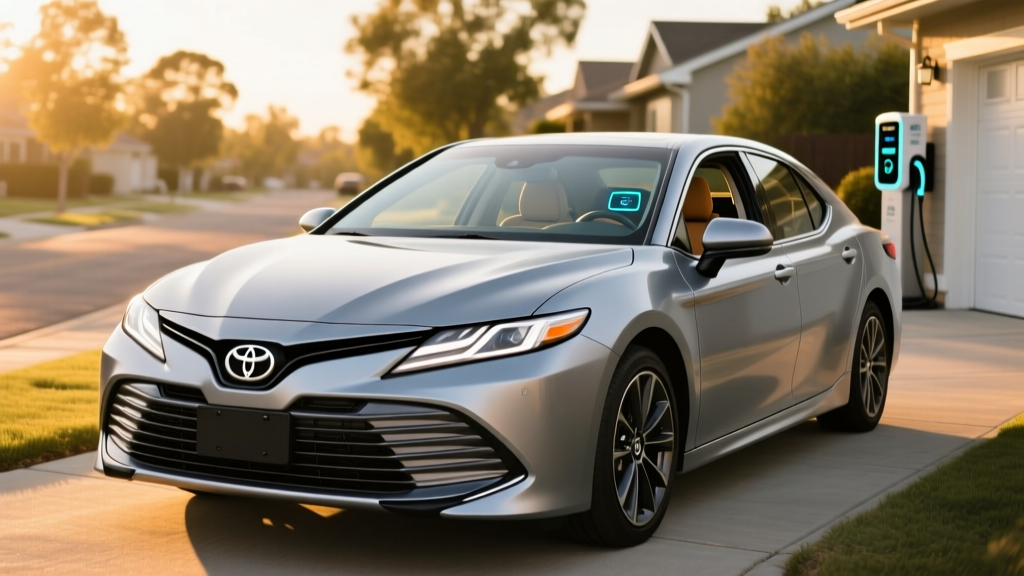
The 2023 Toyota Camry Hybrid occupies a specific niche: it's a conventional hybrid electric vehicle (HEV) that requires no plug, no behavioral change, and no charging infrastructure — yet delivers fuel economy that embarrasses most compact cars. With an EPA-estimated 52 MPG combined on the LE trim, it remains one of the most efficient midsize sedans sold in the United States. But with plug-in hybrids and battery-electric vehicles proliferating, does a non-plug-in hybrid still make sense in 2026? This review covers the exact numbers, real-world expectations, and ownership economics you need to decide.
2023 Camry Hybrid Key Specifications
| Specification | LE Trim | SE / XLE / XSE Trims |
|---|---|---|
| Powertrain | 2.5L 4-cyl + electric motor (HEV) | 2.5L 4-cyl + electric motor (HEV) |
| Combined Horsepower | 208 hp | 208 hp |
| EPA City MPG | 51 | 44 |
| EPA Highway MPG | 53 | 47 |
| EPA Combined MPG | 52 | 46 |
| Fuel Tank Capacity | 13.2 gal | 13.2 gal |
| Estimated Total Range | ~686 miles | ~607 miles |
| Drivetrain | FWD | FWD (AWD available on SE/XLE) |
| 0–60 mph | ~7.5 sec (est.) | ~7.2 sec (est.) |
| Hybrid Battery | 1.6 kWh NiMH (sealed) | 1.6 kWh NiMH (sealed) |
| Plug-In Required? | No | No |
| Base MSRP (2023) | $28,455 | $30,195 – $33,745 |
| Hybrid Battery Warranty | 10 yr / 150,000 mi | 10 yr / 150,000 mi |
Source: EPA fueleconomy.gov, Toyota Motor Corporation.
HEV vs PHEV vs EV: Where Does the Camry Hybrid Fit?
Before evaluating the Camry Hybrid on its own merits, it's worth clarifying what it is — and what it isn't.
Conventional Hybrid (HEV) — This Is the Camry Hybrid
A conventional hybrid like the Camry pairs a gasoline engine with a small electric motor and a compact battery pack (1.6 kWh in this case). The battery charges exclusively through regenerative braking and engine-driven generation. You never plug it in. The electric motor assists during acceleration, enables low-speed electric-only creeping, and allows the engine to shut off at stops. The result is dramatically improved fuel economy with zero change to your refueling habits — you still visit gas stations.
Plug-In Hybrid (PHEV) — Not the Camry
A PHEV (like the Toyota RAV4 Prime or Hyundai Tucson PHEV) carries a much larger battery (typically 13–20 kWh), can be plugged into a wall outlet or Level 2 charger, and offers 25–45 miles of electric-only driving before the gasoline engine engages. Toyota does not offer a Camry PHEV variant in the US market. If you want plug-in capability in a Toyota sedan, you'd look at the Prius Prime.
Battery Electric Vehicle (BEV) — No Gasoline At All
A BEV (Tesla Model 3, Hyundai Ioniq 6, etc.) has no gasoline engine, relies entirely on a large battery pack (50–100+ kWh), and must be charged from the grid. It produces zero tailpipe emissions but requires access to home or public charging infrastructure.
The Camry Hybrid is an HEV. It cannot drive on electric power alone for meaningful distances (perhaps 0.5–1 mile at very low speeds). It cannot be plugged in. It does not qualify for the federal §30D new EV tax credit, which is reserved for plug-in vehicles meeting battery-sourcing and critical-mineral requirements under current IRS rules.
Fuel Economy: EPA Numbers and Real-World MPG
| Trim | City | Highway | Combined |
|---|---|---|---|
| LE (FWD) | 51 MPG | 53 MPG | 52 MPG |
| SE (FWD) | 44 MPG | 47 MPG | 46 MPG |
| XLE (FWD) | 44 MPG | 47 MPG | 46 MPG |
| XSE (FWD) | 44 MPG | 47 MPG | 46 MPG |
| SE / XLE (AWD-e) | 44 MPG | 46 MPG | 45 MPG |
Data: fueleconomy.gov
Why Does the LE Get 6 MPG More Than the SE/XLE?
The LE trim uses low-rolling-resistance tires, a lighter wheel package, and slightly different aerodynamic tuning. The SE, XLE, and XSE trims add wider tires, sport-tuned suspensions, and additional equipment weight. The 6 MPG gap is real and measurable — if maximum efficiency is your priority, the LE is the clear pick.
Real-World MPG: What Owners Actually Report
Toyota's hybrid system excels in stop-and-go city driving, where regenerative braking recaptures energy and the engine shuts off frequently. Many owners report exceeding the EPA city estimate in warm-weather urban commutes — 53–56 MPG is common in the LE during summer months. Highway driving at sustained 70–80 mph speeds yields closer to the EPA figure or slightly below, typically 48–51 MPG for the LE.
In cold weather (below 35°F), expect a 5–10% reduction in fuel economy as the engine runs longer to generate cabin heat and the battery operates less efficiently. A realistic winter combined figure for the LE is approximately 46–49 MPG. These are still exceptional numbers for a midsize sedan.
Powertrain Deep Dive: 208 Horsepower, Toyota's Fourth-Gen Hybrid System
The 2023 Camry Hybrid uses Toyota's fourth-generation hybrid synergy drive. The 2.5-liter Dynamic Force four-cylinder engine produces 176 hp and 163 lb-ft of torque on its own. Combined with the electric motor-generator (which contributes up to 88 kW / 118 hp), the system's net output is 208 horsepower.
Power is routed through an electronically controlled continuously variable transmission (eCVT) — not a belt-driven CVT like those in some competitors, but a planetary gearset that blends engine and motor power seamlessly. This design has proven extremely durable; Toyota's eCVT lacks the belts or chains that fail in conventional CVTs.
The AWD-e system, available on SE and XLE trims, adds a rear-mounted 40 kW electric motor that engages automatically when front-wheel slip is detected or during hard acceleration from a stop. It operates up to approximately 43 mph and does not meaningfully impact fuel economy (only a 1 MPG combined penalty vs. FWD on the SE/XLE).
Battery Warranty, Lifespan, and Replacement Cost
Hybrid Battery Warranty
10 years / 150,000 miles (whichever comes first) — applicable in all 50 states. This covers the hybrid battery pack against defects and excessive capacity loss. Toyota's warranty is among the strongest in the hybrid segment.
Note: Prior to 2020, Toyota's hybrid battery warranty was 8 years / 100,000 miles. The 2023 model benefits from the extended coverage.
How Long Do Camry Hybrid Batteries Actually Last?
The Camry Hybrid uses a 1.6 kWh nickel-metal hydride (NiMH) battery pack. Unlike the larger lithium-ion packs in BEVs, this small battery undergoes shallow charge-discharge cycles — the hybrid system keeps it between roughly 40% and 80% state of charge to maximize longevity. Real-world data from Toyota taxi fleets and high-mileage owners suggests these packs routinely last 150,000–200,000+ miles before significant degradation.
Individual cell failures can sometimes be repaired by replacing specific modules rather than the entire pack, at a cost of $500–$1,500 at an independent hybrid specialist. A full new OEM battery pack replacement at a Toyota dealer typically costs $2,500–$4,000 including labor. Remanufactured packs are available for $1,500–$2,500. Given the 10-year/150,000-mile warranty and the pack's proven durability, battery replacement is rarely an ownership concern for first or second owners.
Pricing, Tax Credits, and Total Cost of Ownership
2023 MSRP by Trim
- LE: $28,455 (includes destination)
- SE: $30,195
- XLE: $32,545
- XSE: $33,745
- SE AWD-e: $31,595
- XLE AWD-e: $33,945
Does the 2023 Camry Hybrid Qualify for a Federal Tax Credit?
No. The federal §30D Clean Vehicle Credit applies only to plug-in electric vehicles (PHEVs and BEVs) with qualifying battery sourcing and critical-mineral content. As a conventional hybrid that cannot be plugged in, the Camry Hybrid is ineligible for the federal EV tax credit. Some states may offer minor incentives for high-efficiency vehicles, but these vary by jurisdiction — check your state's energy office or department of revenue for current programs.
Five-Year Fuel Cost Comparison
Here's where the Camry Hybrid justifies its premium over a gas-only midsize sedan. Using EPA estimates, 15,000 miles/year, and $3.50/gallon regular unleaded:
| Vehicle | Combined MPG | Annual Fuel Cost | 5-Year Fuel Cost |
|---|---|---|---|
| 2023 Camry Hybrid LE | 52 | $1,010 | $5,048 |
| 2023 Camry Gas (4-cyl) | 32 | $1,641 | $8,203 |
| 2023 Honda Accord (1.5T) | 33 | $1,591 | $7,955 |
| BEV (e.g., Tesla Model 3 RWD) | 132 MPGe | ~$650* | ~$3,250* |
*BEV cost assumes $0.14/kWh national average electricity rate. Actual costs vary significantly by local utility rates and home charging setup.
The Camry Hybrid LE saves approximately $3,155 in fuel over five years compared to the gas Camry — enough to offset most of the hybrid's price premium and then some. A BEV saves even more on energy, but requires charging infrastructure access and carries a higher upfront purchase price.
Who Should Buy the 2023 Camry Hybrid — And Who Shouldn't
Choose the Camry Hybrid If:
- You want 50+ MPG without changing your refueling habits
- You lack access to home or workplace EV charging
- You drive a mix of city and highway miles with frequent stop-and-go
- You want a proven, low-risk powertrain with a 10-year battery warranty
- You need a comfortable midsize sedan with strong resale value
- You want AWD availability without a massive fuel-economy penalty
Look Elsewhere If:
- You want electric-only driving or plug-in capability (consider the Prius Prime or a PHEV SUV)
- You want to eliminate gasoline purchases entirely (choose a BEV)
- You prioritize sporty handling over efficiency (the eCVT drones under hard acceleration)
- You need more than 15.1 cu ft of trunk space (the hybrid battery slightly reduces cargo vs. some competitors)
- You want the latest infotainment tech — the 2023 system is functional but not class-leading
Camry Hybrid vs. Full EV vs. Gas Car: A Decision Framework
Choose the Camry Hybrid (HEV) if: You want maximum MPG with zero lifestyle change, you can't charge at home, or you take frequent long road trips where charging infrastructure is uncertain.
Choose a PHEV (e.g., Prius Prime, RAV4 Prime) if: You can charge at home, your daily commute is under 40 miles (so you rarely use gas), but you still want gasoline backup for road trips.
Choose a BEV (e.g., Tesla Model 3, Ioniq 6) if: You have reliable home charging, want the lowest per-mile energy cost, want to eliminate tailpipe emissions, and your typical daily driving is under 250 miles.
Choose a gas car if: Your budget is extremely tight upfront, you drive very few annual miles (under 5,000), or you live in an area with extremely cheap gasoline and no efficiency incentives.
Frequently Asked Questions
How many MPG does the 2023 Camry Hybrid get?
The LE trim achieves an EPA-estimated 51 city / 53 highway / 52 combined MPG. The SE, XLE, and XSE trims are rated at 44 city / 47 highway / 46 combined. Real-world results often exceed EPA city estimates in warm-weather urban driving, with many LE owners reporting 53–56 MPG in stop-and-go conditions.
Can I plug in the Camry Hybrid to charge it?
No. The 2023 Camry Hybrid is a conventional hybrid (HEV), not a plug-in hybrid (PHEV). Its 1.6 kWh battery charges exclusively through regenerative braking and the gasoline engine. There is no charge port and no electric-only driving range beyond very low-speed creeping.
How far can the Camry Hybrid go on a tank of gas?
With a 13.2-gallon fuel tank and 52 MPG combined (LE trim), the Camry Hybrid can travel approximately 686 miles between fill-ups. In real-world mixed driving, expect 600–660 miles. The SE/XLE/XSE trims deliver approximately 607 miles of EPA-rated range per tank.
Is the Camry Hybrid reliable, and what does a battery replacement cost?
Toyota's hybrid system has an exceptional reliability record spanning two decades and millions of vehicles. The hybrid battery is warranted for 10 years / 150,000 miles. Real-world data suggests these packs routinely last 150,000–200,000+ miles. If replacement is eventually needed, expect $2,500–$4,000 for a new OEM pack at a dealer, or $1,500–$2,500 for a remanufactured unit. Individual module repairs can cost as little as $500–$1,500.
Does the 2023 Camry Hybrid qualify for any tax credit?
No. The federal §30D Clean Vehicle Credit requires a plug-in vehicle with a battery capacity of at least 7 kWh and qualifying critical-mineral/battery-component sourcing. The Camry Hybrid's 1.6 kWh NiMH pack and non-plug-in design make it ineligible. Check your state's energy office for any local high-efficiency vehicle incentives, which vary by jurisdiction.
How does the Camry Hybrid compare to the 2023 Honda Accord Hybrid?
The Accord Hybrid is rated at 48 city / 47 highway / 48 combined MPG (Sport/L EX-L trims), which is 4 MPG combined below the Camry Hybrid LE. The Accord Hybrid's two-motor system delivers smoother power delivery and a more engaging driving experience, but the Camry Hybrid LE's 52 MPG combined and available AWD-e give it the edge for pure efficiency and all-weather capability. Both carry 10-year/150,000-mile hybrid battery warranties.
Does the AWD-e system hurt fuel economy significantly?
The electronic AWD system on the SE and XLE trims costs only 1 MPG combined compared to their FWD counterparts (45 vs. 46 combined). The rear motor only engages when needed and disconnects during steady-state cruising, making the efficiency penalty negligible. If you live in a snowy climate, the AWD-e is a worthwhile addition.
Sources: EPA fueleconomy.gov, IRS §30D Clean Vehicle Credit, Toyota Motor Corporation press materials. Pricing and specifications reflect the 2023 model year as originally published. Verify current availability and pricing with your local Toyota dealer.